 |
Pyrador |
|
He is not recognized by the F.C.I. |
Origin |
France <> Canada -> U.S.A. | |
Translation |
Francis Vandersteen |
A brief presentation of the Pyrador |
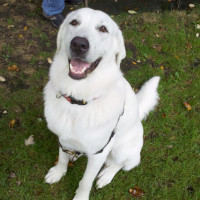
| The Pyrador is an intentional cross between the most popular dog in the United States, the Labrador Retriever, and the Pyrenean Mountain Dog, a faithful guardian and protector of sheep in the mountains bordering France and Spain. These are very large dogs that are generally more cooperative and trainable than the Pyrenean Mountain Dog, but more discriminating and naturally protective than the Labrador Retriever. Although this crossbreed of dogs integrates well into many different domestic and environmental situations, they are generally too large and active for most apartment buildings and are more likely to thrive in a larger home with a yard to run around in. |
History of the Pyrador |
| The Pyrador is a designer dog, the specific cross between an exceptional sheep guardian, the Pyrenean Mountain Dog and the Labrador Retriever, a good-natured hunting dog and the most popular dog breed in the U.S.A. for 26 years. |
A little of the Pyrenean Mountain Dog |
||
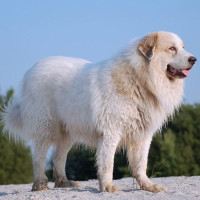
| The Pyrenean Mountain Dog is a much older breed than the Labrador Retriever, these dogs have been guarding sheep for thousands of years against the bears, wolves and lynx that populated the Pyrenean mountains between France and Spain, and are thought to be descendants of large white dogs that existed as herdsmen in Asia Minor somewhere around ten to eleven thousand years ago. Although Pyrenean Mountain Dogs still exist guarding sheep in the cold, remote mountains of the Pyrenees, as the region's large predator populations dwindled, these dogs diversified and were frequently employed as guard dogs for people and property and as gaol dogs. These dogs became so popular in this capacity that in the 1600s, they were labeled Chien Royal de France by the Dauphin Louis XIV. | ||
 |
||
| Standard of the Pyrenean Mountain Dog |
A little of the Labrador Retriever |
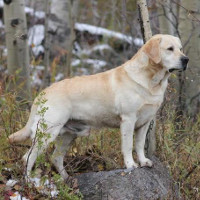
| The Labrador Retriever has a long history as a sporting dog, with an ancestry we can only guess at. While we know that the Labrador Retriever is one of many retrieving dogs descended from the St. John's dog, a tireless worker who retrieved nets, ropes and even fish from the oceans for local fishermen, we don't know how the St. John's dog itself came to be. We do know that in the 1800s, two St. John's dog breeders, James Harris and Walter Scott, both launched dog breeding programs to develop the St. John's into a capable hunting dog. To this end, James Harris gave two of his male Retrievers to Walter Scott, who, when mated with Mr. Scott's kennel dogs, gave birth to the Labrador Retriever. |
 |
| Standard of the Labrador Retriever |
Appearance of the Pyrador |
| This is a large breed of hybrid dog, occasionally venturing into the giant category, with an imposing, athletic build. The body of this crossbreed is generally slightly longer than it is tall, and their skulls are usually a little broad and slightly wedge-shaped, with a proportioned muzzle wide and deep enough to safely carry game birds in water without damaging them. Their medium-sized, almond-shaped eyes can be any shade of brown as well as hazel, and while some may have the short, triangular ears of Pyrenean Mountain Dogs, most have the slightly longer ears of Labrador Retrievers that usually hang just below the cheekbones to frame the face. They generally sport a double-layered coat with a thick, coarse layer of protective fur covering a short, dense undercoat, although those favoring Pyrenean Mountain Dogs will have a longer, more copious coat, while those favoring the Labrador Retriever coat will have a greater ability to repel water. |
Temperament of the Pyrador |
| The Pyrador is generally a friendly dog, although it can tend to be a little more aloof and wary of strangers than the parent Labrador Retriever breed, so positive socialization is of particular importance for the outgoing nature of this mix. This hybrid dog breed is generally positive towards children, although they are quite large and can sometimes inherit the enthusiasm of the Labrador Retriever breed, so any interactions with small children should be closely supervised, especially when the dog is in its awkward adolescent phase. They should get on quite well with family members, human and otherwise, but Pyrenean Mountain Dogs can influence some dogs to adopt territorial behavior towards strangers. Although these dogs are generally quite intelligent, the trainability of this crossbreed can be variable; those who prefer the Labrador Retriever are very eager to please and quick to learn, however, some may inherit the more independent nature and strong will of Pyrenean Mountain Dogs, and will be more difficult to train. |
Needs and activities of the Pyrador |
| While the Labrador Retriever is an extremely athletic and active dog, the more moderate pace of Pyrenean Mountain Dogs helps to somewhat reduce the daily exercise requirement for this hybrid dog breed. Pyradors are generally content with around an hour of vigorous activity a day, although this is most effective when broken down into smaller chunks throughout the day. This hybrid dog breed is also likely to enjoy swimming and water sports, which can help strengthen the dog's cardiovascular system and muscles without causing the stress to bones and joints that most activities do, and may reduce the risk of developing hip and elbow dysplasia in the long term. |
Maintenance of the Pyrador |
| Grooming requirements for this dog are relatively simple and not time-consuming. Although these dogs need bathing several times a year, and when they get into something dirty or smelly, they should not be bathed too often to avoid loss of natural coat oils and skin irritation. Brushing sessions should take place at least once a week, although a few times a week is preferable to ensure that all dead hairs are removed and the coat remains shiny and healthy. It's also important to ensure that the Pyrador's ears are clean and dry, and that they are regularly checked for infection or irritation. |



 English (United Kingdom)

Comments