
 |
Pughasa |
|
He is not recognized by the F.C.I. |
Origin |
China <> Tibet -> U.S.A. | |
Translation |
Francis Vandersteen |
A brief presentation of the Pughasa |
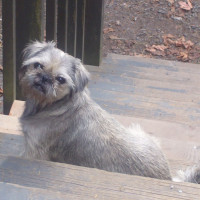
| The Pughasa is a cross between a Pug and a Lhassa Apso. They are active, friendly dogs that make excellent pets. They are good with children if socialized early. Pughasa are playful and although they have an independent streak, they like nothing better than to be close to their human family, of whom they are very protective. This breed is considered a good watchdog despite the fact that they are quite small, weighing on average between 5.5 and 8 kilos, with a height of up to 28 centimeters. They will need a firm hand in training so they can learn early on that they are not in charge. Common colors include fawn, black and white, and their coats are fine, hard and rough, which can be long or short. |
History of the Pughasa |
| The Pughasa is a hybrid breed developed by crossing a Pug and a Lhassa Apso. |
A little of the Pug |
||
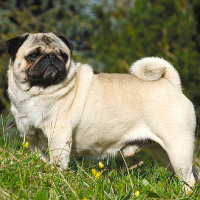
| Rather than being guard dogs, like the Lhassa Apso, Pugs were themselves guarded by soldiers. These little dogs originated in China, where they were prized by emperors. Some say they are related to the Tibetan Mastiff. They were brought from China to Europe in the 16th century, probably by Dutch traders, who named the breed Mopshond. The Pug became the official dog of the House of Orange after William, Prince of Orange, was warned that Spanish assassins were heading his way. The breed also appeared in works of art in the 1700s by William Hogarth and Goya. Queen Victoria was a fan of the breed and had many in her kennel. Pugs were recognized by the American Kennel Club in 1885. | ||
 |
||
| Standard of the Pug |
A little of the Lhassa Apso |
| The Lhassa Apso originated in the sacred Tibetan city of Lhassa and was bred as a companion for nobility and monks. Although small, they were known as brave watchdogs and their Tibetan name means “Bark Lion Sentinal Dog”. Lhassa Apsos guarded indoor dwellings, while Tibetan Mastiffs were responsible for outdoor ones. The breed's history dates back to 80 BC, making it one of the oldest dog breeds. Tibetans believed that the souls of deceased monks entered the bodies of Lhassa Apsos. Only the Dalai Lama could offer the dogs as gifts outside Tibet, which is how they ended up in the UK and the USA. The 13th Dalai Lama gave a pair to world traveler and naturalist Suydam Cutting, who brought the dogs to the USA in 1933. The American Kennel Club recognized the Lhassa Apso in 1935. |
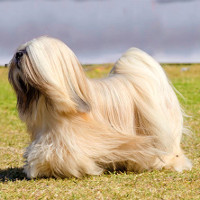 |
| Standard of the Lhassa Apso |
Appearance of the Pughasa |
| The Pughasa is a cross between a Pug and a Lhassa Apso. Common colors include fawn, black and white, and their coats are fine, hard and rough. Hair can be short or long, depending on which parent breed they follow most closely. They are small dogs weighing between 5.5 and 8 kilos and measuring up to 28 centimeters. A Pughasa has dark brown eyes that may protrude slightly from the Pug's side. Their tails curl over the back and this breed may have a slight underbite from the parent Lhassa Apso breed. The muzzle will be slightly longer than that of a Pug. |
Temperament of the Pughasa |
| The Pughasa is a playful, affectionate dog who loves to be pampered and doesn't hesitate to take matters into his own hands if given half the chance. They are friendly, lively dogs that thrive on human companionship but can be very stubborn. They can be eager to please, but only if they want to. They are good with children but wary of strangers. With very young children, they will need to be supervised as they do not tolerate rough handling and can pinch. They'll be happy to be picked up and cuddled, or to spend time on your lap. They make excellent watchdogs and are very protective and loyal dogs. The Pughasa is an intelligent dog that will respond to a firm handler with consistent training. Early training and socialization will be important for this breed. They will do best with lots of praise and positive reinforcement. They are energetic little dogs but won't need much exercise. |
Needs and activities of the Pughasa |
| The Pughasa is an energetic little dog, but won't need much exercise to be happy. They're social little dogs, so they'll love going for walks, but will also enjoy indoor activities. They'll be happy to play with all the children in the house and other pets, provided they've been socialized early on. They can easily adapt to apartment life as long as they are taken out every day. They are very playful and will love to chase a ball. Pughasa don't tolerate heat very well, so don't exercise them in the heat of the day, especially in summer. |
Maintenance of the Pughasa |
| This will depend on the parent breed your Pughasa takes most after the grooming it needs. If it has a short, smooth coat like a Pug, it will be easier, but if it has the longer coat of a Lhassa Apso, it can be more difficult. Your pet will probably need daily brushing and combing, and some prefer to trim the longer hairs, especially in summer. Your dog will need a bath about once a month with a good pet shampoo. Make sure they are thoroughly dried afterwards. Check his ears regularly for dirt, and brush his teeth daily if you can. Nails can be trimmed if necessary. |



 English (United Kingdom)

Comments