
 |
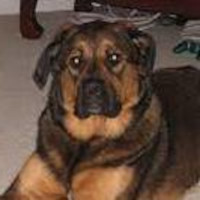
Mountain Mastiff |
|
He is not recognized by the F.C.I. |
Origin |
Switzerland <> Great Britain -> U.S.A. | |
Translation |
Francis Vandersteen |
A brief presentation of the Mountain Mastiff |
| The Mountain Mastiff is a specific cross between a Bernese Mountain Dog and a Mastiff. A very large dog, the average Mountain Mastiff weighs between 68 and 91 kilos. Despite its large size, the Mountain Mastiff is affectionate, gentle and loyal to its humans. Hybrid dogs make excellent guardians; in addition to their size, they are wary of strangers and will assume the role of protector when necessary. Mountain Mastiffs are also good at tracking and pulling weights. Hybrid dogs are brilliant, but because of their sensitive nature, training must be done gently. Happiest with their families, these affectionate dogs make excellent pets. |
History of the Mountain Mastiff |
| The hybrid known as the Mountain Mastiff is a new breed of dog with no detailed history. The two breeds that are bred to create the hybrid have a long history: the Bernese Mountain Dog and the Mastiff. |
A little of the Bernese Mountain Dog |
||
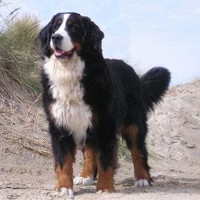
| The Bernese Mountain Dog is thought to be descended from the Molosse, a Mastiff-type dog. Dogs of this breed have been used for farm work in the Swiss Alps for over 2,000 years. Bernese Mountain Dogs were bred for jobs such as pulling carts, guarding property and protecting livestock. In addition to his work, he functioned as a companion. With the onset of industrialization, the need for a dog to work on a farm diminished. Fortunately, the Swiss took steps to preserve the breed. | ||
 |
||
| Standard of the Bernese Mountain Dog | ||
A little of the Mastiff |
||
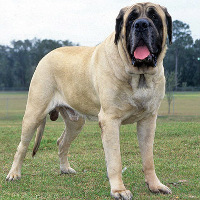
| Like the Bernese Mountain Dog, the Mastiff is descended from the Molosser. Appreciated for their strength and courage, Mastiff-type dogs have held many jobs, from war and hunting dogs to guard dogs. It is thought that these dogs were first introduced to the British Isles by Phoenician trading ships between 2000 and 1500 BC. During the Roman invasion in 55 BC, Mastiffs were put to work as war dogs in the resistance against Rome. Julius Caesar was impressed by the Mastiff's size and bravery, and brought a pack to Rome to fight lions and gladiators. The breed was later used to bait bulls and bears, and for pit fighting. Today's Mastiffs are the descendants of these fighting dogs, although due to a selective breeding program, the breed is now proving to be docile giants. The American Kennel Club recognized the breed in 1885. | ||
 |
||
| Standard of the Mastiff |
Appearance of the Mountain Mastiff |
| Weighing from 68 to 91 kilos, the Mountain Mastiff is a very large dog. It will have a strong, powerful body, a flat head and almond-shaped eyes. A hybrid dog will inherit traits from both parents. The Mastiff's head is large and its eyes are dark and set wide apart. Its ears will be small in proportion and it will display distinctive wrinkles. The muzzle is short and dark, with a broad, dark nose. His lips are loose and hang down his jaw. Bernese Mountain Dogs generally have a tricolored coat and large brown eyes. Because of its Mastiff ancestry, your hybrid's head will be large. His body will be large and muscular. The Mountain Mastiff coat can be short like that of the Mastiff, or of medium length like that of the Bernese Mountain Dog. |
Temperament of the Mountain Mastiff |
| Although the Mountain Mastiff is big and strong, it is affectionate, gentle and sensitive. Like the Mastiff, it is gentle and its even temperament means it gets on well with children and other animals. Hybrid dogs will be loyal to their humans and courageous, offering protection when they deem it necessary. The Mountain Mastiff will have a natural distrust of strangers, although eager to please its humans. Because of his sensitive nature, training must be done in an informed and positive way so that he doesn't feel bad or become fearful, shy and ultimately aggressive. His sensitivity will also lead him to get upset if his humans argue in his presence. |
Needs and activities of the Mountain Mastiff |
| The Mountain Mastiff is a relatively active dog. Because of its size, it will need a few daily walks as well as time to play with its humans. Trips to the dog park will also be fun for the Mountain Mastiff. Hybrid dogs don't have a lot of energy and will generally have a low level of stamina, which means it's important that you don't expect your Mountain Mastiff to take part in vigorous or prolonged activity. Because of the Mountain Mastiff's large size, access to a large yard will be important, and the hybrid won't do well in a small apartment. |
Maintenance of the Mountain Mastiff |
| The Mountain Mastiff will require a moderate amount of grooming. Whatever coat it inherits, it will be easy to brush. Since the hybrid will shed a lot, daily brushing will be a necessity. The Mountain Mastiff will only need bathing when it's very dirty, which is a good thing, because due to its size, bathing it yourself can be a challenge. As with all dogs, his nails should be trimmed as needed and his teeth brushed several times a week. In addition, you'll want to check his ears once a week, wiping them if necessary. If your Mountain Mastiff is a drooler like his Mastiff parent, check his skin regularly for irritation, and gently clean and dry the skin if necessary. |



 English (United Kingdom)

Comments