
 |
Labernard |
|
He is not recognized by the F.C.I. |
Origin |
Canada <> Switzerland -> U.S.A. | |
Translation |
Francis Vandersteen |
A brief presentation of the Labernard |
| The Labernard is a patient, friendly and affectionate dog, just like the parent breeds that create it: the Labrador Retriever and the gentle giant St. Bernard, both bred as working dogs. These are large to giant dogs that need a firm hand as they can be quite strong-willed, so it's best to start training young. Common colors are white, yellow, brown, beige, black and red, while their coat is short and dense, with a thick double coat that can make them fight in the heat. They shed moderately, so will need regular brushing to keep their coats healthy. Labernards need a lot of exercise, so they're best suited to active families who like to take them on outings. |
History of the Labernard |
| The Labernard is a combination of a pure-bred St. Bernard, bred for alpine rescue, and a Labrador Retriever, bred as a working dog by Newfoundland fishermen. |
A little of the Labrador Retriever |
||
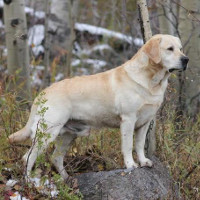
| The Labrador Retriever originated on the island of Newfoundland, off Canada's northeast Atlantic coast, where it worked with local fishermen hauling nets and catching fish as early as the 1700s. They were originally called St. John's dogs and are thought to have been crossed with the Newfoundland dog and other small local water dogs. They arrived in England around 1830, where they were used as hunting dogs. It was the third Earl of Malmesbury who first referred to the dogs as Labradors. They died out in Newfoundland due to government restrictions and heavy taxes, but flourished in the United States where they are considered the most popular breed. | ||
 |
||
| Standard of the Labrador Retriever | ||
A little of the St. Bernard |
||
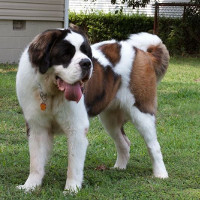
| St. Bernard Dogs, also known as Alpine Mountain Dogs or Alpine Cattle Dogs, are recognized as one of the Molossoid breeds. The monks of the St. Bernard hospice, high in the Swiss Alps, used the dogs to rescue lost travelers. A St. Bernard dog named Barry was credited with saving between 40 and 100 lives on the Grand St. Bernard pass. Young dogs are said to have acquired the rescue skills of older dogs and received no special training. Many have been killed in avalanches while searching for people lost in the snow. They are often depicted as having a barrel of brandy around their necks to revive stranded travelers, but this is not true. This is simply because painter Edward Lanseer painted a barrel around the dog's neck in one of his paintings, but it got stuck. St. Bernards are thought to have been developed when Alpine dogs were bred with Mastiff-type dogs that came with the Roman army in the time of Emperor Augustus. The Swiss Kennel Club recognized the breed in 1880, and in 1888 the Saint Bernard Club of America was founded. The English called Saint Bernards Sacred Dogs, and many joined with the aim of reinvigorating the Mastiff breed. Today, St. Bernards excel in dog sports such as drawing, weight pulling and obedience trials. | ||
 |
||
| Standard of the St. Bernard |
Appearance of the Labernard |
| Labernards are large to giant dogs whose parent breeds are Labrador Retrievers and St. Bernards. They have thick double coats that are short and dense, and common colors are yellow, brown, beige, black and red with white markings. They are powerfully built, muscular dogs with large heads and often have wrinkles on their foreheads. They have a friendly, intelligent expression. They have dark brown eyes and the ears are set fairly high on the head but hang over the face. They are likely to have a long, thick and perhaps bushy tail and a black nose. |
Temperament of the Labernard |
| The Labernard is a gentle, friendly, family-loving dog that is very tolerant and patient with children. Because of their size, young children need to be supervised around them to avoid accidental injury. They are good with strangers because of their gentle personalities, but bark to alert the family of intruders. These dogs don't do well left to their own devices and will thrive with large, active families where there's someone at home most of the time. Labernards will need a firm, confident hand in training, as they have a mind of their own. But being intelligent, they will respond to positive reinforcement and once trained, are obedient dogs eager to please. The Labernard will always be up for an outing, whether it's a long walk or a hike in the mountains. But with their thick coats, they're not good at hot weather and can suffer from heat exhaustion. Try to exercise them in cooler weather, and make sure they have plenty of water. |
Needs and activities of the Labernard |
| A Labernard is an energetic, active dog that will need daily exercise. This will depend on which parent breed your dog follows the most, as Labrador Retrievers need much more intensive exercise compared to a St. Bernard, which does well with walks but not with high-impact sports like running. St. Bernards don't do well in the heat, so be careful in summer when exercising your pet. A Labernard will do better in a house with a fenced-in yard than in an apartment. Ball games will keep him happy and mentally stimulated, and prevent any bad behavior from developing. Your puppy will love playing outdoors, but he's not an outdoor dog and will need to live indoors with the family. |
Maintenance of the Labernard |
| Your Labernard will need regular brushing with a pin brush to get rid of any loose hair and to avoid tangles. Grooming requirements are not excessive, but brushing every other day will keep your pet in good health. If the hair is a little longer, daily brushing is a good idea. These dogs are not hypoallergenic and drool a little, which is something for owners to bear in mind. A shedding blade can be used during periods of heavy shedding. Fortunately, these big dogs don't need to be bathed very often, and only if they get very dirty. Because they are prone to ear infections, ears should be checked frequently for any signs of irritation. Nails should also be checked to see if they need trimming. Teeth should be brushed to prevent tartar build-up and help keep bad breath at bay. |



 English (United Kingdom)

Comments