 |
Great Keeshees |
|
He is not recognized by the F.C.I. |
Origin |
France <> Germany -> U.S.A. | |
Translation |
Francis Vandersteen |
A brief presentation of the Great Keeshees |
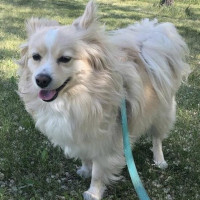
| The Great Keeshees is a larger hybrid, a cross between a large white dog that has served as a sheep herder for thousands of years, the Pyrenean Mountain Dog and the German Spitz / Keeshond breed, a friendly, intelligent spitz-type dog from Germany. Their long double coat is relatively easy to maintain, and although it requires intensive brushing a few times a week, the need to bathe is rare. They are generally too large and active to live comfortably in an apartment-type environment, however, these dogs make excellent companions for children and are generally tolerant of other animals. |
History of the Great Keeshees |
| The Great Keeshees is a specific cross between the friendly, energetic Spitz-type dog known as the German Spitz/Keeshond and the Pyrenean Mountain Dog, a large, protective shepherd breed. |
A little of the Pyrenean Mountain Dog |
||
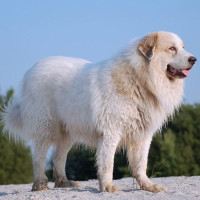
| The Pyrenean Mountain Dog is known by this name in the UK and Europe because they have been raising sheep in the Pyrenees for around three thousand years. Where they came from before settling in the mountains is not well documented, although they are thought to have appeared ten to eleven thousand years ago. Pyrenean Mountain Dogs were used to guard property and as jailer's dogs. In the 1600s, the dauphin Louis XIV dubbed this breed the royal dog of France, and they were instrumental in the development of the modern Newfoundland and Landseer breeds. | ||
 |
||
| Standard of the Pyrenean Mountain Dog | ||
A little of the German Spitz / Keeshond |
||
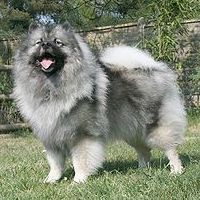
| The German Spitz / Keeshond has also been around for some time, but not as long as the Pyrenean Mountain Dog. As early as the 1400s and 1500s, they were appreciated on farms for their gentle, entertaining way with children and their watchdog instincts. By the 1600s and 1700s, their role in society had expanded, and although many farms still kept them, they were also employed as barge and river dogs, where they killed vermin, helped guide cargo and sometimes even jumped into the water to guide the boats themselves. | ||
 |
||
| Standard of the German Spitz / Keeshond |
Appearance of the Great Keeshees |
| Great Keeshees are generally large dogs with a fairly square outline, although they are generally a little smaller than the Pyrenean Mountain Dog. There can be a lot of variation from there, as the two dogs are quite different in structure, the Pyrenean Mountain Dog's head is a little large and square, as is the muzzle, but not usually to the point of being heavy and medium sporting long ears that fold forward, the German Spitz/Keeshond however tends to have a smaller head, with a more delicate, fox-like structure and small triangular ears that stand straight up. The tails of both breeds end in a shepherd's crook and can curl up completely when excited, and while this dog certainly has an abundant double coat, there can be big differences in the look and feel of the coat as well as the coloring. If Great Keeshees take their inspiration from the Pyrenean side of their ancestry, their long, thick outer coat will lie flat against their body, however, those resembling the German Spitz / Keeshond will have a harsh, rough coat that stands out from the body, although both breeds tend to sport a more abundant mane around the neck. |
Temperament of the Great Keeshees |
| The Great Keeshees can adopt personality traits from either parent breed, so there can be variations in the Great Keeshees dog's temperament. The German Spitz / Keeshond is very people-oriented and needs attention while the Pyrenean Mountain Dog tend to be more independent and aloof, although both need early socialization to avoid shy, aloof or sometimes aggressive behavior, and neither responds well to hard training techniques. Both dogs are fairly intelligent, although the Pyrenean Mountain Dog can be quite strong-willed, reacting stubbornly if treated harshly, and the German Spitz/Keeshond tends to be a little mischievous. Harsh training methods tend to result in manipulative and destructive behavior. Properly socialized, Great Keeshees should be extremely tolerant of children and small family pets, and most will also be tolerant of others, although Pyrenean guardian heritage can sometimes lead to overprotective behavior. In most cases, Great Keeshees will be friendlier and more outgoing than Pyrenean Mountain Dogs, less shy and more protective than German Spitz/Keeshond, and endowed with an intelligence that can be both cooperative and independent. |
Needs and activities of the Great Keeshees |
| Although the German Spitz / Keeshond is quite energetic, none of the parent breeds are particularly active, and Great Keeshees will generally be content with 40 to 60 minutes of activity a day. While this dog will certainly enjoy brisk or leisurely walks with you, it will also benefit from the inclusion of alternative activities, especially those that engage the mind. Great Keeshees can enjoy and excel in activities such as cart pulling, agility training and acrobatic dog dancing. Although they don't need much exercise, mental stimulation and family inclusion are essential for a well-balanced, confident and stable animal, and too much time bored or alone can lead to relentlessly vocal or destructive behaviors. |
Maintenance of the Great Keeshees |
| Although the Great Keeshees' long, thick coat may seem like a lot of work, it's actually quite simple to maintain. Both dogs have somewhat dirt- and water-resistant coats, and neither should be bathed too often, as this can deplete the body oils needed to keep the skin and coat supple and shiny. Although daily brushing can cause hair tips to break off, it is necessary at least three or four times a week to avoid knots and matting. It's particularly important to ensure that the entire depth of the undercoat is brushed, as heavy matting in this area can damage the underlying skin. |



 English (United Kingdom)

Comments