German Wolfsspitz / Keeshond

FCI standard Nº 97_1

Origin
Germany
Translation
C. Seidler / Gabriele Dulling
Original version: (DE)
Group
Group 5 Spitz and primitive types
Section
Section 4 European Spitz
Working
Without working trial
Acceptance on a definitive basis by the FCI
Tuesday 01 January 1957
Publication of the official valid standard
Wednesday 04 September 2019
Last update
Tuesday 12 November 2019
En français, cette race se dit
Spitz allemand / Keeshond
Diese Norm ist in deutscher Sprache sichtbar
Deutscher Spitz / Keeshond
En español, esta raza se dice
Spitz alemán / Keeshond
In het Nederlands, wordt dit ras gezegd
Duitse Spitz / Keeshond

Standard valid for German Giant Spitz, German Medium Size Spitz, German Miniature Spitz

Usage

Watch and Companion Dog.

Brief historical summary

German Spitz dogs are descendants of the stoneage «Peat Dogs» (Torfhunde) «Canis familiaris palustris Rütimeyer» and the later Lake Dwelling Spitz(Pfahlbauspitz); it is the oldest breed of dog in Central Europe. Numerous other breeds have been developed from them. In non-German speaking countries Wolfsspitz dogs are known as Keeshonds.

General appearance

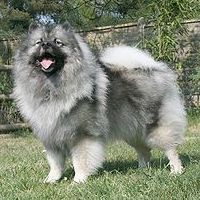
Spitz breeds are captivating on account of their beautiful coats, made to stand off by plentiful undercoat. Particularly impressive are the strong, mane-like collar round the neck (ruff) and the bushy tail carried boldly over the back. The foxy head with alert eyes and the small pointed, closely set ears give the Spitz its unique characteristic, cheeky appearance.

Important proportions

The ratio of height at withers to body length is 1 : 1.
The ratio length of the muzzle to length of the skull is approximately 2 : 3.

Behaviour / temperament

The German Wolfsspitz/Keeshond is always attentive, lively and extraordinarily attached to its owner. It is very teachable and easy to train. It snatural distrust of strangers and lack of hunting instinct make it the ideal companion and family dog and watch dog for home and farm. It is neither timid nor aggressive. Indifference to weather, robustness and longevity are its most outstanding attributes.

Head

Cranial region

Skull
The Spitz’s medium-sized head, seen from above, appears broadest at the back and tapers wedge-shaped to the tip of the nose. 
Stop
Moderate to marked, never abrupt.

Facial region

Nose
The nose is round, small and pure black.
Muzzle
The muzzle is not overlong and stands in pleasing proportion to the skull (approximately 2:3).
Lips
The lips are not exaggerated, close fitting to the jaws and do not form any folds to the corner of the mouth. They are completely black.
Jaws and teeth
The jaws are normally developed and show a complete scissor bite with 42 teeth, corresponding to the dental formula of the dog, i. e. the upper incisors closely overlapping the lower onesand set square to the jaws. Strong canines fitting exactly into each other. Pincer bite is permissible.
Cheeks
The cheeks are gently rounded, not protruding.
Eyes
The eyes are of medium size, almond-shaped,slightly slanting and dark. The eyelids are black.
Ears
The small ears are set high and relatively close to each other, triangular pointed; they are always carried upright, stiff at the tips.

Neck

The medium length neck is set broadly on the shoulders, slightly arched without dewlap and covered by a thick, profuse coat, forming a large ruff.

Body

Topline
Merges in a gentle curve with the short, straight back. The bushy, sweeping tail, which partially covers the back, rounds off the silhouette.
Withers
The high withers drops imperceptibly.
Back
As short as possible, straight, firm.
Loin
Short, broad and strong.
Croup
The croup is broad and short, not falling away.
Chest
The deep chest is well sprung, the forechest well developed.
Underline and belly
The chestreaches back as far as possible; the belly has only a slight tuck up.

Tail

The tail is set on high and of medium length. It reaches upwards and rolls forward over the back, straight from the root. It lies firmly over the back and is covered with very bushy hair. A double curl at tip of tail is tolerated.

Limbs

Forequarters

Generality
Straight, rather broad front with well-developed bone strength.
Shoulders
The shoulder is well muscled and firmly connected to the chest. The shoulder blade is long and well laid back.
Upper arm
The upper arm, which is approximately the same length as the shoulder blade, forms an angle of 90 degrees to the shoulder blade.
Elbows
The elbow joint is strong, close fitting to the chestand turns neither in nor out.
Forearm
The forearm is of medium length in relation to the body, sturdy and completely straight. The back of the forearm is well feathered.
Pastern
The strong, medium length front pastern stands at an angle of 20 degrees from the vertical.
Forefeet
The forefeet are as small as possible, round and closed, with well arched and tight nails, so called cat feet. The colour of nails and pads is as dark as possible.

Hindquarters

Generality
The hindquarters are very muscular and abundantly feathered to the hocks. The hind legs stand straight and parallel.
Upper thigh
Thigh and lower leg are of about equal length.
Stifle
The stifle joint is strong with only moderate angulation and is turned neither in nor out in movement.
Hock
The hock is of medium length, very strong and vertical to the ground.
Hind feet
The hindfeet are as small as possible, round and closed,with well arched and tightnails, so called cat feet. The pads are coarse. The colour of nails and pads is as dark as possible.

Gait and movement

The German Wolfsspitz/Keeshond moves straight ahead with good drive, fluidly and springy.

Skin

The skin covers the body tightly without any wrinkles.

Coat

Hair
German Wolfsspitz/Keeshond has a double coat : Long, straight and firmstanding off top coat and short, thick, cotton-wool-like undercoat.
Head, ears, front side of front and hind legs and the paws are covered by short, thick (velvety) hair. The rest of the body has a long, rich, hairy coat. Not wavy, curly or shaggy, not parted along the back. Neck and shoulders are covered by a thick mane. The backside of the front legs is well feathered, the hind legs have ample feathering from croup to hocks.
The tail is bushy. Hair must not look like being modelled.
Colour
Wolfsspitz/Keeshond : Grey-shaded.

Grey-shaded is a silver-grey with black hair-tips. Muzzle and ears aredark in colour, round the eyes well defined shown as a delicately pencilled black line slanting from outer corner of eye to lower corner of ear, coupled with distinct markings and shading forming short but expressiveeyebrows; mane and ring on shoulder lighter; fore- and hind legs silver-grey without any black markings under the elbows or stifles, except slight pencilling on the toes; black tip of tail; underside of tail and trousers pale silver-grey.

Size and weight

Height at withers
Wolfsspitz/Keeshond : 49 ± 6 cm.
Weight
The Wolfsspitz / Keeshond should have a weight corresponding to its size.

Faults

• Any departure from the foregoing points should be considered a fault and the seriousness with which the fault should be regarded should be in exact proportion to its degree and its effect upon the health and welfare of the dog and its ability to perform its traditional work.
• Faults listed should be in degree of seriousness.

Serious faults

 Faults in construction.
 Head too flat.
 Distinct apple head.
 Flesh-coloured nose, eyelids and lips.
 Dentition faults, missing teeth.
 Too large and too bright eyes.
 Prodtruding eyes.
 Missing of distinct markings of the face.
 Faults in movement.

Disqualifying faults

 Aggressive or overly shy dogs.
 Gap in fontanel.
 Overbite, underbite, crossbite.
 Ectropion or entropion.
 Ears not fully erected.
 Definite white markings or spots.

NB :

• Any dog clearly showing physical or behavioural abnormalities shall be disqualified.
• The above mentioned faults when occurring to a highly marked degree or frequently are disqualifying.
• Male animals should have two apparently normal testicles fully descended into the scrotum.
• Only functionally and clinically healthy dogs, with breed typical conformation should be used for breeding.

Bibliography

https://www.fci.be/


Detailed history

Formerly known as the Loulous in France, the Spitz have lost this name. At the same time, they are a bit unnoticed, which is not suitable for these dogs cut for celebrity. Because at home, everything calls for success and admiration. Their appearance first: with their fox's head and their sumptuous fur, they are not likely to go unnoticed. Their character then lively, malignant, sometimes impetuous, always affectionate, such a temperament can only seduce dog lovers well in their hair. After abandoning a name laden with tradition, the Loulou seem to have fallen into the hollow of the wave. But, as we know them, they should not stay long.

Not content with being among the most popular and colorful dogs at one time, the Spitz are without a doubt the oldest domestic dogs. Indeed, direct descendants of the famous Peat bog (Canis Familiaris palustris) of the Neolithic, they were the first to populate, alongside men, the lacustrine villages of prehistoric Europe.

Switzerland, the Jura, Great Britain, Denmark all have their national remains of this canine type. Better! Ten thousand years old, the Spitz ancestors also gave birth to all current lupoid-type dogs, that is, more or less resembling the wolf. Sharp muzzle, erect ears, bushy tail often coiled on the back, these are the main characteristics of these dogs, now grouped in the fifth group of the dog nomenclature: that of Spitz-type dogs and primitive type. Called to keep, hunt, pull sleds, keep company with the nomads who stayed at the camp, the Spitz and their "cousins" proved that they knew how to do everything. But where are these primitive dogs born? It is difficult to say, traces found in the East, in Africa, in the Great Siberian North, on the shores of the Baltic. They have unfortunately disappeared from all these regions, replaced by their own more specialized descendants.

The Spitz have spread in Europe, especially in the Netherlands, Germany, Belgium and France (especially in Alsace). Varieties of different colors and sizes have developed according to the regions and also according to the evolution due to crosses and selections. Thus, the white Spitz were particularly present in Pomerania, between Prussia, Poland and Baltic, while the blacks were raised in the Wurtemberg, county rich of an important past cynophile. There, they are used for the guard or for the trait, here they become crew dogs. Like the Pinschers and Schnauzers, they follow the horses, and very few are diligences that do not have their Spitz.

In this connection, it is worth mentioning J. Dhers: "He is the Loulou diligences, the adjutant of the coach, the imperial runner, barking, wriggling, cumbersome, loved by all! I remember that at that time all the diligences, all the truckers had one of those little devils white, black or gray which most of the time, of a back and forth fast, incessant, and always by barking, made a quick shuttle from seat to harness, skirting the spine, often sitting on the rump."

The largest Spits have been known for centuries in northern Germany and the Netherlands, where they were the boatmen's specialty. Proudly camped in the bow of the Dutch barges, they became, it is said, the symbol of the patriots opposed to the House of Orange, towards the end of the eighteenth century, and they would have been called Keeshonds (or Keeshonden) according to the name of the leader of these patriots, William Kees van Gyselaar. Arrived in Britain in the early twentieth century (thanks to Mrs. Mrs. Digby), the Keeshonds prospered there. The first club was founded there in 1925. The British asserted a strong preference for gray subjects, which they selected at the expense of whites, blacks and big cats, colors still admitted in Holland at the time.

Meanwhile, the Spitz, especially small ones, have another story, to say the least, in a role of company. One of them was the companion of the great Wolfgang Amadeus himself, who was not the only artist to appreciate it, since Michelangelo had possessed one too. In France, the popularity of the Spitz soared under the Empire, because he was one of Josephine's favorite dogs. Napoleon III, meanwhile, had many setbacks with the Spitz Eugenie, who used to escape or hiding in a particularly clever way. The police had to bring this little devil to the palace many times. The Spitz has also made the companion of ordinary citizens, not least anyway since it is Courteline and Emile Zola. The dwarf subjects then enjoyed immense success under the name of Loulous of Pomerania.

But it was the British who would give the small format Spitz its hour of glory. Already, in the 18th century, King George III had, by his example, generated a certain craze for these dogs, but it was Queen Victoria who was at the origin of the irresistible movement that led to the fame and miniaturization of the race. On a trip to Florence in 1888, she returned with Gona, a white Volpino (Little Italian Spitz). The queen became so enamored with this dog that she even founded a kennel where she would breed those of her race, fixing on her an average weight of 5.5 to 7 kilos, and she frequently presented exhibitions. Now, the English knew the Spitz only in a larger format, and it was a real challenge to reduce the dogs to the size recommended by the queen. However, given that, before the end of the century, the British breeders had managed to produce 3 kilo subjects with exceptional fur. But it would be bad to know the English to think that they were going to stop there. They sought to further improve their tiny dogs by affixing them in the most diverse colors, from blue to isabelle, through all possible pastel colors. Unlike their previous experiences, this test proved a bitter failure. The dogs were fading or fading with time, which was not very aesthetic. Yet, the twenties can boast one of the most beautiful mini-dogs ever created by cynophilia, in the "person" of Sable Mite. A wealthy American offered 500 pounds (an impressive sum at the time), but his proposal was rejected, so much did the English stick to their Spitz.

In the first half of the 20th century, the situation was therefore somewhat complicated. The English attributed themselves to the privilege of the miniature Spitz (the Pomeranians), and, if they agreed with the Dutch to give the older ones the name of Keeshonds, their standard was the only one to require the gray color for this variety . In France, we knew the Loulous (whose Club was founded in 1955), the Great Loulous, which became the Great Spitz; Keeshonds and Wolfspitz (Spitz-Wolves), which came from Germany, were distinguished. Indeed, the Germans claimed the paternity of all these dogs. By 1899, they had decreed the Spitz national race and created a club to safeguard this canine heritage. A solution was needed. In 1960, the International Cynological Federation, seized, decided in favor of Germany and recognized all Spitz German nationality.

Today, in a single group, with a single standard for five varieties, a single official origin, and "only" two breed clubs in France, the Spitz have found their consistency. And, most importantly, an easily recognizable identity, even for the most novice doggie. No longer having to go for the Medium, Small and Dwarf Spitz in the group of pet dogs, and the Big and the Spitz-Wolf in the utility dogs, the public will finally be able to rediscover these endearing dogs. For whatever it is, a Spitz is always a wonderful companion. Sizes and colors differ, but the temperament remains the same: that of the dog that accompanies man since the dawn of time. A real guarantee of quality.

Some morphologies are revealing. That of Spitz is certainly part of it. Just look at his little fox head, his eyes sparkling with mischief, his ears proudly erected to guess the keen temperament of this dog. Similarly, the name Spitz, which means sharp in German, perfectly reflects the curious and mischievous character of those who were called the Loulous. The body, compact and solid, trimmed with sumptuous fur, exudes confidence and dignity.

But who is really the Spitz? One imagines it willingly small, surly, screaming. It is not so. On the one hand, there are five varieties of Spitz, the largest being able to reach a height of 60 centimeters, and, on the other hand, this dog knows how to be a marvel of tenderness and calm at his hours. Okay, he willingly gives voice, but it is more the expression of his joyous nature than the manifestation of some aggressiveness. The Spitz is far too sure of him for that. It is true that he is often distant from strangers, but in these days, when dog thieves and laboratory purveyors abound, who would like to complain? The great Spitz who makes his voice heard behind the gate of a pavilion is generally listened to, and his frank and determined look overcomes many bad intentions. Because, watchdogs, the first Spitz, those who accompanied our ancestors ten thousand years ago, were. And hunting dogs. And draft dogs, by interposed descendants. In fact, the Spitz are able to fulfill all the tasks that one wants to entrust to them.

Why are they today pet dogs? Because they are remarkable in this role, quite simply. What about the Spitz at home? He is very present, always on the alert, running immediately to the slightest sound. Tired, the Spitz? Maybe a little, if you are used to dogs much quieter. With him, we certainly have no time to be bored. Does he like to play? It is said of this dog that he reaches full maturity, physical and psychic, quite late: to say that he is an inveterate player, always ready for a good game of ball or race. Because the Spitz are also athletes. We must see them, even the Dwarves, use their sturdy legs to gallop in the woods and fields. Of course, the little ones are a little less rustic than the big ones, but that does not stop them from venting occasionally. Long walks in the forest are suitable for older people, who have more endurance. The little ones will enjoy shorter, but equally intense walks. Woe to rodents encountered on the way. Some Spitz do not despise the unfortunate mouse that would fall to their noses.

Do they like children? No. They love them! Provided, of course, that they are respectful of animals, which should always be the case. The Spitz and Means are very suitable for families with children. Games can be animated without the dog suffering. On the other hand, the Little and Dwarves are better advised to single people, who will know better to pamper them. Although more delicate, they are not fragile. Having a good health, they have a remarkable longevity: from fourteen to eighteen years old. Unlike many Nordic dogs, the Spitz are not runaway. They are much too attached to their home to move away. And their strong sense of duty drives them to keep the house empty rather than abandon it for the sake of wild racing around.

Another sore point they share with most dogs in their group, intraspecific relationships, namely with other dogs. Here again, the Spitz are exceptional. Sure of them without aggressiveness, they do not let themselves be "dismounted" by beefy men trying to impress them. Even the dwarves show unusual courage. It may happen that a Spitz is allowed to be dragged into battle by too much provocation, but which race can boast of the opposite? As for other pets, cats for example, they should be used to young people if you want them to live together.

Does the Spitz like transport? In any case, he actively keeps what he comes very quickly to consider as "his" car. Public transport is possible, since, apart from the Big and the Wolf, all Spitz have the legal size and can if necessary slip a few minutes in a basket according to the regulations of the railway or the metro. Due to their small size, they may even be able to access aircraft cabins at the discretion of the captain. As for the boat, the Spitz-Wolf has borrowed enough while still called Keeshond to be comfortable. In short, taking the Spitz on vacation is not a problem.

In front of all these qualities, one is tempted to imagine a hidden defect. Is the Spitz very receptive to education, for example? At the risk of seeming to have lost all impartiality, we must answer yes. Indeed, the Spitz are particularly good at learning what their teacher wants to teach them. Have not they long been, beside the Poodle, excellent circus dogs? Showing to the Spitz all kinds of tricks can only delight him. Endowed with a very developed intelligence, he does not support intellectual inactivity and goes so far as to invent the most extraordinary jokes if his masters do not give him the necessary mental stimulation. Moreover, the Spitz is docile. Certainly, he seems willingly agitated, rough, but it is only an appearance. Subject to a well-conducted apprenticeship, he is a most attentive pupil. By educating him, his Spitz is a small, sociable and pleasant animal to have in his company. Initiated to essential orders; sitting, lying, not moving, at the foot; he will be able to follow his master everywhere without ever becoming an embarrassment. As for its propensity to bark, it can be quickly corrected by proper education.

As for maintenance, the Spitz is not a complicated dog either. Rustic, he is infrequently ill and makes a pretty bad client for the vet. More gourmet than gourmand, it does not require expensive food, especially since it must be avoided obesity, which would disfigure. His fur makes the fortune of groomers? False! It claims all in all little maintenance. Of course, you have to take care of it regularly, but a good brushing two or three times a week can suffice. As for the bath, it is disadvised because it destroys for several weeks the natural ooze of the skin and weakens it. Dry shampoos are appropriate because they help keep a dog clean without having to wet it.

So, is the Spitz the ideal dog? Why not? If it is not very popular today, it was very popular in the past, and it may well be again in the years to come, because whoever appreciates the beauty, the spirit and the kindness can only to love him, that Loulou there.

Comments

Latest page updates

  • Samusky

    Samusky He is not recognized by the F.C.I. Origin Northern Russia and Siberia <> Siberia -> North America Translation Francis Vandersteen En français, cette race se dit Samusky Diese Norm ist in deutscher Sprache sichtbar Samusky En español, esta raza se dice Samusky In het Nederlands, wordt dit ras gezegd Samusky This breed is also known as SamhuskySamsky     A...
  • Agouti Husky

    Agouti Husky FCI standard Nº 270 Origin Siberian Translation Francis Vandersteen En français, cette race se dit Husky Agouti Diese Norm ist in deutscher Sprache sichtbar Agouti-Husky En español, esta raza se dice Husky Agouti In het Nederlands, wordt dit ras gezegd Agouti Husky   The "Agouti" Husky is not a distinct breed but a rare color variant...
  • White Husky

    White Husky   FCI standard Nº 270       Origin Siberia Translation Francis Vandersteen En français, cette race se dit Husky blanc Diese Norm ist in deutscher Sprache sichtbar Weißer Husky En español, esta raza se dice Husky blanco In het Nederlands, wordt dit ras gezegd Witte Husky   The white Husky is not a distinct breed, but rather a rare and striking...
  • Taimyr Wolf

    Taimyr Wolf He is not recognized by the F.C.I. Origin Siberia Translation Francis Vandersteen En français, cette race se dit Loup de Taïmyr Diese Norm ist in deutscher Sprache sichtbar Taimyr-Wolf En español, esta raza se dice Lobo de Taimyr In het Nederlands, wordt dit ras gezegd Taimyr-wolf   The Taimyr Wolf is no longer an extant breed, but it...
  • Manchurian Spitz

    Manchurian Spitz He is not recognized by the F.C.I. Origin Manchuria and Siberia region Translation Francis Vandersteen En français, cette race se dit Spitz de Mandchourie Diese Norm ist in deutscher Sprache sichtbar Mandschurischer Spitz En español, esta raza se dice Spitz de Manchuria In het Nederlands, wordt dit ras gezegd Mantsjoerije-spits   The...
  • White Swedish Elkhound

    White Swedish Elkhound He is not recognized by the F.C.I. Origin Sweden Translation Francis Vandersteen En français, cette race se dit Chien d'élan suédois blanc Diese Norm ist in deutscher Sprache sichtbar Schwedischer weißer Elchhund En español, esta raza se dice Perro de alce sueco blanco In het Nederlands, wordt dit ras gezegd Witte Zweedse...
  • Turkish Spitz

    Turkish Spitz He is not recognized by the F.C.I. Origin Turkey Translation Francis Vandersteen En français, cette race se dit Spitz turc Diese Norm ist in deutscher Sprache sichtbar Türkischer Spitz En español, esta raza se dice Spitz turco In het Nederlands, wordt dit ras gezegd Turkse spits This breed is also known as Tonya FinosuFino TonyaKobi   The Tonya...
  • Hunters Creek Feist

    Hunters Creek Feist He is not recognized by the F.C.I. Origin U.S.A. Translation Francis Vandersteen En français, cette race se dit Hunters Creek Feist Diese Norm ist in deutscher Sprache sichtbar Hunters Creek Feist En español, esta raza se dice Hunters Creek Feist In het Nederlands, wordt dit ras gezegd Hunters Creek Feist   The Hunters Creek Feist is...
  • Gray’s Mountain Feist

    Gray’s Mountain Feist He is not recognized by the F.C.I. Origin U.S.A. Translation Francis Vandersteen En français, cette race se dit Gray’s Mountain Feist Diese Norm ist in deutscher Sprache sichtbar Gray’s Mountain Feist En español, esta raza se dice Gray’s Mountain Feist In het Nederlands, wordt dit ras gezegd Gray’s Mountain Feist   The Gray’s...
  • Thornburg Feist

    Thornburg Feist He is not recognized by the F.C.I. Origin U.S.A. Translation Francis Vandersteen En français, cette race se dit Thornburg Feist Diese Norm ist in deutscher Sprache sichtbar Thornburg Feist En español, esta raza se dice Thornburg Feist In het Nederlands, wordt dit ras gezegd Thornburg Feist   The Thornburg Feist is a specialized line of...
  • Mullins Feist

    Mullins Feist He is not recognized by the F.C.I. Origin U.S.A. Translation Francis Vandersteen En français, cette race se dit Mullins Feist Diese Norm ist in deutscher Sprache sichtbar Mullins Feist En español, esta raza se dice Mullins Feist In het Nederlands, wordt dit ras gezegd Mullins Feist   The Mullins Feist is an American hunting dog breed...
  • Kemmer Stock Hybrid Squirrel Dog

    Kemmer Stock Hybrid Squirrel Dog He is not recognized by the F.C.I. Origin U.S.A. Translation Francis Vandersteen En français, cette race se dit Kemmer Stock Hybrid Squirrel Dog Diese Norm ist in deutscher Sprache sichtbar Kemmer Stock Hybrid Squirrel Dog En español, esta raza se dice Kemmer Stock Hybrid Squirrel Dog In het Nederlands, wordt dit...
  • Buckley Mountain Feist

    Buckley Mountain Feist He is not recognized by the F.C.I. Origin U.S.A. Translation Francis Vandersteen En français, cette race se dit Buckley Mountain Feist Diese Norm ist in deutscher Sprache sichtbar Buckley Mountain Feist En español, esta raza se dice Buckley Mountain Feist In het Nederlands, wordt dit ras gezegd Buckley Mountain Feist   The...
  • Charlie Feist

    Charlie Feist He is not recognized by the F.C.I. Origin United Kingdom, U.S.A. Translation Francis Vandersteen En français, cette race se dit Charlie Feist Diese Norm ist in deutscher Sprache sichtbar Charlie Feist En español, esta raza se dice Charlie Feist In het Nederlands, wordt dit ras gezegd Charlie Feist   The charming Charlie Feist is one of...
  • Barger Stock Feist

    Barger Stock Feist He is not recognized by the F.C.I. Origin U.S.A. Translation Francis Vandersteen En français, cette race se dit Barger Stock Feist Diese Norm ist in deutscher Sprache sichtbar Barger Stock Feist En español, esta raza se dice Barger Stock Feist In het Nederlands, wordt dit ras gezegd Barger Stock Feist   The Barger Stock Feist is a...
  • Toy Manchester Terrier

    Toy Manchester Terrier He is not recognized by the F.C.I. Origin U.S.A. Translation Francis Vandersteen En français, cette race se dit Manchester Terrier miniature Diese Norm ist in deutscher Sprache sichtbar Miniatur-Manchester-Terrier En español, esta raza se dice Manchester Terrier miniatura In het Nederlands, wordt dit ras gezegd Miniatuur-Manchesterterriër   The Toy...
  • Donggyeongi

    Donggyeongi He is not recognized by the F.C.I. Origin South Korea Translation Francis Vandersteen En français, cette race se dit Donggyeongi Diese Norm ist in deutscher Sprache sichtbar Donggyeongi En español, esta raza se dice Donggyeongi In het Nederlands, wordt dit ras gezegd Donggyeongi This breed is also known as Daeng GyeonDonggyeong Gae   The...
  • Mackenzie River Husky

    Mackenzie River Husky He is not recognized by the F.C.I. Origin Canada, U.S.A. Translation Francis Vandersteen En français, cette race se dit Husky du fleuve Mackenzie Diese Norm ist in deutscher Sprache sichtbar Mackenzie-River-Husky En español, esta raza se dice Husky del río Mackenzie In het Nederlands, wordt dit ras gezegd Mackenzie-rivier...
  • Danish Spitz

    Danish Spitz He is not recognized by the F.C.I. Origin Denmark Translation Francis VandersteenAuthoritative language (DK) Working No working trial required En français, cette race se dit Spitz danois Diese Norm ist in deutscher Sprache sichtbar Dänischer Spitz En español, esta raza se dice Spitz danés In het Nederlands, wordt dit ras gezegd Deense...
  • Hällefors Elkhound

    Hällefors Elkhound He is not recognized by the F.C.I. Origin Sweden Translation Francis Vandersteen En français, cette race se dit Chien d'élan de Hällefors Diese Norm ist in deutscher Sprache sichtbar Hällefors Elchhund En español, esta raza se dice Elkhound de Hällefors In het Nederlands, wordt dit ras gezegd Hällefors Elkhound   The Hällefors...
  • Great Fauve of Brittany

    Great Fauve of Brittany He is not recognized by the F.C.I. Origin France Translation Francis Vandersteen En français, cette race se dit Grand Fauve de Bretagne Diese Norm ist in deutscher Sprache sichtbar Großer Fauve der Bretagne En español, esta raza se dice Gran Fauve de Bretaña In het Nederlands, wordt dit ras gezegd Grote Fauvist van...
  • Timmon’s Biter Herding Dog

    Timmon’s Biter Herding Dog He is not recognized by the F.C.I. Origin Australia Translation Francis Vandersteen En français, cette race se dit Chien de berger Timmon’s Biter Diese Norm ist in deutscher Sprache sichtbar Timmon’s-Biter-Schäferhund En español, esta raza se dice Perro pastor Timmon’s Biter In het Nederlands, wordt dit ras gezegd Timmon’s...
  • Montemboeuf Dog

    Montemboeuf Dog He is not recognized by the F.C.I. Origin France Translation Francis Vandersteen En français, cette race se dit Chien Montemboeuf Diese Norm ist in deutscher Sprache sichtbar Montemboeuf-Hund En español, esta raza se dice Perro Montemboeuf In het Nederlands, wordt dit ras gezegd Montemboeuf-hond   The Montemboeuf is an extinct dog breed, developed...
  • Leauvenaar Dog

    Leauvenaar Dog He is not recognized by the F.C.I. Origin Belgium Translation Francis Vandersteen En français, cette race se dit Chien Leauvenaar Diese Norm ist in deutscher Sprache sichtbar Leauvenaar-Hund En español, esta raza se dice Perro Leauvenaar In het Nederlands, wordt dit ras gezegd Leauvenaar Hond   The Leauvenaar is an extinct dog breed that...
  • Larye Dog

    Larye Dog He is not recognized by the F.C.I. Origin France Translation Francis Vandersteen En français, cette race se dit Chien de Larye Diese Norm ist in deutscher Sprache sichtbar Larye-Hund En español, esta raza se dice Perro de Larye In het Nederlands, wordt dit ras gezegd Larye-hond This breed is also known as Layrre   The Larye is a...
  • Happa Dog

    Happa Dog He is not recognized by the F.C.I. Origin China Translation Francis Vandersteen En français, cette race se dit Chien Happa Diese Norm ist in deutscher Sprache sichtbar Happa-Hund En español, esta raza se dice Perro Happa In het Nederlands, wordt dit ras gezegd Happa-hond   The Happa Dog was a dog breed originating in China. Closely...
  • Han Epoch Dog

    Han Epoch Dog He is not recognized by the F.C.I. Origin China Translation Francis Vandersteen En français, cette race se dit Chien de l'époque Han Diese Norm ist in deutscher Sprache sichtbar Hund der Han-Zeit En español, esta raza se dice Perro de la época Han In het Nederlands, wordt dit ras gezegd Hond uit de Han-periode This breed is also known...
  • Stable Griffon

    Stable Griffon He is not recognized by the F.C.I. Origin Belgium Translation Francis Vandersteen En français, cette race se dit Griffon d’écurie Diese Norm ist in deutscher Sprache sichtbar Stallgriffon En español, esta raza se dice Grifón de establo In het Nederlands, wordt dit ras gezegd Stalgriffon   The Stable Griffon was developed to hunt rats...
  • Red Decoy Dog

    Red Decoy Dog He is not recognized by the F.C.I. Origin England Translation Francis Vandersteen En français, cette race se dit Chien d'appel rouge Diese Norm ist in deutscher Sprache sichtbar Roter Lockhund En español, esta raza se dice Perro de reclamo rojo In het Nederlands, wordt dit ras gezegd Lokjachthond This breed is also known as Decoy...
  • Coton from Réunion

    Coton from Réunion He is not recognized by the F.C.I. Origin Réunion Island En français, cette race se dit Coton de Réunion Diese Norm ist in deutscher Sprache sichtbar Coton von Réunion En español, esta raza se dice Cotón de Reunión In het Nederlands, wordt dit ras gezegd Coton van Réunion This breed is also known as Réunion Dog   The Coton from...
  • Céris Dog

    Céris Dog He is not recognized by the F.C.I. Origin France Translation Francis Vandersteen En français, cette race se dit Chien Céris Diese Norm ist in deutscher Sprache sichtbar Céris Hund En español, esta raza se dice Perro Céris In het Nederlands, wordt dit ras gezegd Céris Hond   The Céris is an extinct dog breed, created in France by Monsieur de...
  • Roulers Cattle Dog

    Roulers Cattle Dog He is not recognized by the F.C.I. Origin Belgium Translation Francis Vandersteen En français, cette race se dit Bouvier des Roulers Diese Norm ist in deutscher Sprache sichtbar Roulers Treibhund En español, esta raza se dice Boyero de Roulers In het Nederlands, wordt dit ras gezegd Roulers Koehond   The Roulers Cattle Dog was...
  • Paret Cattle Dog

    Paret Cattle Dog He is not recognized by the F.C.I. Origin Belgium Translation Francis Vandersteen En français, cette race se dit Bouvier des Paret Diese Norm ist in deutscher Sprache sichtbar Paret Treibhund En español, esta raza se dice Boyero de Paret In het Nederlands, wordt dit ras gezegd Paret Koehond   The Paret Cattle Dog was one of five...
  • Moerman Cattle Dog

    Moerman Cattle Dog He is not recognized by the F.C.I. Origin Belgium Translation Francis Vandersteen En français, cette race se dit Bouvier des Moerman Diese Norm ist in deutscher Sprache sichtbar Moerman Treibhund En español, esta raza se dice Boyero de Moerman In het Nederlands, wordt dit ras gezegd Moerman Koehond   The Moerman Cattle Dog was...
  • Blanquito de la Habana

    Blanquito de la Habana He is not recognized by the F.C.I. Origin Cuba Translation Francis Vandersteen En français, cette race se dit Blanquito de la Habana Diese Norm ist in deutscher Sprache sichtbar Blanquito de la Habana En español, esta raza se dice Blanquito de La Habana In het Nederlands, wordt dit ras gezegd Blanquito de la Habana   The...
  • Black and Tan Terrier

    Black and Tan Terrier He is not recognized by the F.C.I. Origin United Kingdom Translation Francis Vandersteen En français, cette race se dit Terrier noir et feu Diese Norm ist in deutscher Sprache sichtbar Schwarzer und feuriger Terrier En español, esta raza se dice Terrier Negro y Fuego In het Nederlands, wordt dit ras gezegd Zwart-bruine...
  • Saintonge Hound

    Saintonge Hound He is not recognized by the F.C.I. Origin France Translation Francis Vandersteen En français, cette race se dit Chien de Saintonge Diese Norm ist in deutscher Sprache sichtbar Saintonge-Laufhund En español, esta raza se dice Perro de Saintonge In het Nederlands, wordt dit ras gezegd Saintonge-hond   The Saintonge Hound is an extinct breed that...
  • Basset Saintongeois

    Basset Saintongeois He is not recognized by the F.C.I. Origin France Translation Francis Vandersteen En français, cette race se dit Basset saintongeois Diese Norm ist in deutscher Sprache sichtbar Basset Saintongeois En español, esta raza se dice Basset saintongeois In het Nederlands, wordt dit ras gezegd Basset Saintongeois   The Basset...
  • Basset Normand

    Basset Normand He is not recognized by the F.C.I. Origin France Translation Francis Vandersteen En français, cette race se dit Basset normand Diese Norm ist in deutscher Sprache sichtbar Basset Normand En español, esta raza se dice Basset normando In het Nederlands, wordt dit ras gezegd Basset Normand   The Basset Normand was a Basset-type hound...
  • Basset d'Artois

    Basset d'Artois He is not recognized by the F.C.I. Origin France Translation Francis Vandersteen En français, cette race se dit Basset d'Artois Diese Norm ist in deutscher Sprache sichtbar Basset d’Artois En español, esta raza se dice Basset de Artois In het Nederlands, wordt dit ras gezegd Basset d'Artois   The Basset d’Artois was a basset-type hound...
  • Tenerife Dog

    Tenerife Dog He is not recognized by the F.C.I. Origin Island of Tenerife (Canary Islands) Translation Francis Vandersteen En français, cette race se dit Chien de Tenerife Diese Norm ist in deutscher Sprache sichtbar Teneriffa-Hund En español, esta raza se dice Perro de Tenerife In het Nederlands, wordt dit ras gezegd Tenerife-hond This breed is also known...
  • Welsh Hillman

    Welsh Hillman He is not recognized by the F.C.I. Origin Wales Translation Francis Vandersteen En français, cette race se dit Welsh Hillman Diese Norm ist in deutscher Sprache sichtbar Welsh Hillman En español, esta raza se dice Welsh Hillman In het Nederlands, wordt dit ras gezegd Welsh Hillman   The Welsh Hillman was an old local breed or type of...
  • Turnspit Dog

    Turnspit Dog He is not recognized by the F.C.I. Origin United Kingdom Translation Francis Vandersteen En français, cette race se dit Chien de tournebroche Diese Norm ist in deutscher Sprache sichtbar Rotisserie-Hund En español, esta raza se dice Perro asador In het Nederlands, wordt dit ras gezegd Turnspit-hond   The Turnspit dog was a...
  • Toy Trawler Spaniel

    Toy Trawler Spaniel He is not recognized by the F.C.I. Origin United Kingdom Translation Francis Vandersteen En français, cette race se dit Epagneul Miniature Trawler Diese Norm ist in deutscher Sprache sichtbar Miniatur-Trawler-Spaniel En español, esta raza se dice Spaniel de Trawler en miniatura In het Nederlands, wordt dit ras gezegd Miniatuur...
  • Cão de Fila da Terceira

    Cão de Fila da Terceira He is not recognized by the F.C.I. Origin Terceira Island in the Azores Translation Francis Vandersteen The Terceira Mastiff (Portuguese : Cão de Fila da Terceira) is a local Portuguese dog breed, also known as the Rabo Torto (rabo = tail, torto = twisted). Neither the Fédération Cynologique Internationale nor the Local...
  • Talbot Hound

    Talbot Hound He is not recognized by the F.C.I. Origin France Translation Francis Vandersteen En français, cette race se dit Chien de Talbot Diese Norm ist in deutscher Sprache sichtbar Talbot-Hund En español, esta raza se dice Sabueso Talbot In het Nederlands, wordt dit ras gezegd Talbot-hond This breed is also known as Talbot BloodhoundFrench...
  • English Staghound

    English Staghound He is not recognized by the F.C.I. Origin England Translation Francis Vandersteen En français, cette race se dit Staghound anglais Diese Norm ist in deutscher Sprache sichtbar Englischer Staghound En español, esta raza se dice Staghound inglés In het Nederlands, wordt dit ras gezegd Engelse Staghound   The Staghound is an extinct...
  • Southern Hound

    Southern Hound He is not recognized by the F.C.I. Origin Great Britain Translation Francis Vandersteen En français, cette race se dit Chien du Sud Diese Norm ist in deutscher Sprache sichtbar Südlicher Laufhund En español, esta raza se dice Sabueso del sur In het Nederlands, wordt dit ras gezegd Zuidelijke Hond   The Southern Hound was a large...
  • St. John's Water Dog

    St. John's Water Dog He is not recognized by the F.C.I. Origin Canada Translation Francis Vandersteen En français, cette race se dit Chien d’eau de St. John's Diese Norm ist in deutscher Sprache sichtbar St. John's Wasserhund En español, esta raza se dice Perro de aguas de San Juan In het Nederlands, wordt dit ras gezegd St. John's Water Dog The St...
  • Rache Hound

    Rache Hound He is not recognized by the F.C.I. Origin Middle Ages Translation Francis Vandersteen En français, cette race se dit Chien courant Rache Diese Norm ist in deutscher Sprache sichtbar Rache-Laufhund En español, esta raza se dice Sabueso Rache In het Nederlands, wordt dit ras gezegd Rache-hond This breed is also known as RacchRachRatch   The term...
  • Welsh Grey Sheepdog

    Welsh Grey Sheepdog He is not recognized by the F.C.I. Origin Wales Translation Francis Vandersteen En français, cette race se dit Chien de berger gallois gris Diese Norm ist in deutscher Sprache sichtbar Waliser Grauer Schäferhund En español, esta raza se dice Pastor Gris Galés In het Nederlands, wordt dit ras gezegd Welsh Grey Herdershond This breed is...
  • Old Croatian Sighthound

    Old Croatian Sighthound He is not recognized by the F.C.I. Origin Croatia Translation Francis Vandersteen En français, cette race se dit Lévrier croate ancien Diese Norm ist in deutscher Sprache sichtbar Alter kroatischer Windhund En español, esta raza se dice Viejo lebrel croata In het Nederlands, wordt dit ras gezegd Oude Kroatische Windhond This...
  • Norman Hound

    Norman Hound He is not recognized by the F.C.I. Origin France Translation Francis Vandersteen En français, cette race se dit Chien normand Diese Norm ist in deutscher Sprache sichtbar Normannischer Laufhund En español, esta raza se dice Sabueso Normando In het Nederlands, wordt dit ras gezegd Normandische Brak   Little is known about the origins of...
  • Moscow Water Dog

    Moscow Water Dog He is not recognized by the F.C.I. Origin Russia Translation Francis Vandersteen En français, cette race se dit Chien d'eau de Moscou Diese Norm ist in deutscher Sprache sichtbar Moskauer Wasserhund En español, esta raza se dice Perro de agua de Moscú In het Nederlands, wordt dit ras gezegd Moskou-waterhond This breed is also...
  • Tracking Hound

    Tracking Hound He is not recognized by the F.C.I. Origin Middle Ages Translation Francis Vandersteen En français, cette race se dit Chien pisteur Diese Norm ist in deutscher Sprache sichtbar Spürhund En español, esta raza se dice Sabueso de rastro In het Nederlands, wordt dit ras gezegd Speurhond This breed is also known as LimerLymerLyam...
  • Laconian

    Laconian He is not recognized by the F.C.I. Origin Ancient Laconia, Greece Translation Francis Vandersteen En français, cette race se dit Laconien Diese Norm ist in deutscher Sprache sichtbar Lakonier En español, esta raza se dice Laconio In het Nederlands, wordt dit ras gezegd Laconisch This breed is also known as SpartanCastorian   The Laconian is an...
  • Halls Heeler

    Halls Heeler He is not recognized by the F.C.I. Origin Australia Translation Francis Vandersteen En français, cette race se dit Halls Heeler Diese Norm ist in deutscher Sprache sichtbar Halls Heeler En español, esta raza se dice Halls Heeler In het Nederlands, wordt dit ras gezegd Halls Heeler   The Halls Heeler is the presumed ancestor of two...
  • Dogo Cubano

    Dogo Cubano He is not recognized by the F.C.I. Origin Cuba Translation Francis Vandersteen The Dogo Cubano, also known as the Cuban Dogue, Cuban Bloodhound and Cuban Mastiff, is an extinct breed of dog from Cuba. It was of the Bullmastiff type and was used for bull and dog fighting. The breed was introduced to Cuba to capture runaway slaves...
  • Dalbo Dog

    Dalbo Dog He is not recognized by the F.C.I. Origin Sweden Translation Francis Vandersteen En français, cette race se dit Chien de Dalbo Diese Norm ist in deutscher Sprache sichtbar Dalbo-Hund En español, esta raza se dice Perro Dalbo In het Nederlands, wordt dit ras gezegd Dalbo-hond This breed is also known as DalbohundDalsland Mastiff   Icelandic...
  • Cordoba Fighting Dog

    Cordoba Fighting Dog He is not recognized by the F.C.I. Origin Argentina Translation Francis Vandersteen En français, cette race se dit Chien de combat de Cordoue Diese Norm ist in deutscher Sprache sichtbar Córdoba-Kampfhund En español, esta raza se dice Perro de pelea de Córdoba In het Nederlands, wordt dit ras gezegd Cordoba-vechthond This breed is...
  • Celtic Greyhound

    Celtic Greyhound He is not recognized by the F.C.I. Origin Celtic Mythology Translation Francis Vandersteen En français, cette race se dit Lévrier celte Diese Norm ist in deutscher Sprache sichtbar Keltische Windhund En español, esta raza se dice Lebrel celta In het Nederlands, wordt dit ras gezegd Keltische windhond   The Celtic Greyhound is an...
  • Belgian Mastiff

    Belgian Mastiff He is not recognized by the F.C.I. Origin Belgium Translation Francis VandersteenOrigin SRSH-KMSH - Belgian Royal Canine SocietyAuthentic language FR Group Group 2 : Pinscher and Schnauzer - Molossoid and Swiss Mountain and Cattle Dogs Section Section 2.1 : Molossoids, mastiff type Working Without working trial En français, cette...
  • Argentine polar dog

    Argentine polar dog He is not recognized by the F.C.I. Origin Argentina Translation Francis Vandersteen The Argentine polar dog (perro polar argentino) was a breed of Argentine dog that is now extinct. Argentine polar dogs were developed by the Argentine army to provide sled dogs for their Antarctic bases. The breed was the result of a cross...
  • Alaunt

    Alaunt He is not recognized by the F.C.I. Origin Central Asia Translation Francis Vandersteen This breed is also known as Kavkaz AlauntCaucasian AlauntAlan DoggePersian AlauntContinental AlauntEnglish AlauntFrench AlauntSpanish AlauntAlan DogArnaut Dogge The legendary Alaunt is one of the most important Molosse breeds in history, but also one of...
  • Small Dutch Hound

    Small Dutch Hound He is not recognized by the F.C.I. Origin The Netherlands Translation Francis Vandersteen En français, cette race se dit Petit Chien courant néerlandais Diese Norm ist in deutscher Sprache sichtbar Kleiner niederländischer Brackenhund En español, esta raza se dice Sabueso holandés pequeño In het Nederlands, wordt dit ras gezegd Kleine...
  • Sri Lankan Hound

    Sri Lankan Hound He is not recognized by the F.C.I. Origin Sri Lankan Translation Francis Vandersteen En français, cette race se dit Chien courant du Sri Lanka Diese Norm ist in deutscher Sprache sichtbar Sri-Lanka-Hund En español, esta raza se dice Sabueso de Sri Lanka In het Nederlands, wordt dit ras gezegd Sri Lankaanse Brak This breed is also...
  • Bulgarian Tricolour Hound

    Bulgarian Tricolour Hound He is not recognized by the F.C.I. Origin Bulgaria Translation Francis Vandersteen En français, cette race se dit Chien courant tricolore bulgare Diese Norm ist in deutscher Sprache sichtbar Bulgarischer Dreifarbiger Laufhund En español, esta raza se dice Sabueso tricolor búlgaro In het Nederlands, wordt dit ras gezegd Bulgaarse...
  • Međimurje Small Dog

    Međimurje Small Dog He is not recognized by the F.C.I. Origin Northwestern Croatia Translation Francis Vandersteen En français, cette race se dit Petit chien du Međimurje Diese Norm ist in deutscher Sprache sichtbar Međimurje-Kleinhund En español, esta raza se dice Perro pequeño de Međimurje In het Nederlands, wordt dit ras gezegd Međimurje-hondje This...
  • Serbian Yellow Hound

    Serbian Yellow Hound He is not recognized by the F.C.I. Origin Serbia (Balkans, Southeast Europe) Translation Francis Vandersteen En français, cette race se dit Chien jaune serbe Diese Norm ist in deutscher Sprache sichtbar Serbischer Gelber Laufhund En español, esta raza se dice Sabueso Amarillo Serbio In het Nederlands, wordt dit ras gezegd Servische...
  • Gotland Hound

    Gotland Hound He is not recognized by the F.C.I. Origin Sweden Translation Francis Vandersteen En français, cette race se dit Chien de chasse de Gotland Diese Norm ist in deutscher Sprache sichtbar Gotlandhund En español, esta raza se dice Sabueso de Gotland In het Nederlands, wordt dit ras gezegd Gotlandhond This breed is also known as Gotland...
  • Westerwald Mountain Dog

    Westerwald Mountain Dog He is not recognized by the F.C.I. Origin Germany Translation Francis Vandersteen En français, cette race se dit Bouvier du Westerwald Diese Norm ist in deutscher Sprache sichtbar Westerwalder Sennenhund En español, esta raza se dice Perro de Montaña de Westerwald In het Nederlands, wordt dit ras gezegd Westerwaldse...
  • Carnia Hound

    Carnia Hound He is not recognized by the F.C.I. Origin Italy Translation Francis Vandersteen En français, cette race se dit Chien courant de Carnia Diese Norm ist in deutscher Sprache sichtbar Carnia-Hund En español, esta raza se dice Sabueso de Carnia In het Nederlands, wordt dit ras gezegd Carnia-hond This breed is also known as Segugio Carnico   The...
  • Kemmer Feist

    Kemmer Feist He is not recognized by the F.C.I. Origin Southern United States Translation Francis Vandersteen En français, cette race se dit Kemmer Feist Diese Norm ist in deutscher Sprache sichtbar Kemmer Feist En español, esta raza se dice Kemmer Feist In het Nederlands, wordt dit ras gezegd Kemmer Feist   The Kemmer Feist originates from the...
  • Alpine Spaniel

    Alpine Spaniel He is not recognized by the F.C.I. Origin Switzerland Translation Francis Vandersteen En français, cette race se dit Epagneul Alpin Diese Norm ist in deutscher Sprache sichtbar Alpenspaniel En español, esta raza se dice Spaniel Alpino In het Nederlands, wordt dit ras gezegd Alpenspaniël   Alpine Spaniels were bred by canons in Alpine...
  • Alpine Mastiff

    Alpine Mastiff He is not recognized by the F.C.I. Origin Switzerland Translation Francis Vandersteen En français, cette race se dit Mâtin alpin Diese Norm ist in deutscher Sprache sichtbar Alpenmastiff En español, esta raza se dice Mastín Alpino In het Nederlands, wordt dit ras gezegd Alpenmastiff   The Alpine Mastiff was an ancient, giant working...
  • Hairless Chihuahua

    Hairless Chihuahua He is not recognized by the F.C.I. Origin Mexico Translation Francis Vandersteen En français, cette race se dit Chihuahua nu Diese Norm ist in deutscher Sprache sichtbar Nackter Chihuahua En español, esta raza se dice Chihuahua sin pelo In het Nederlands, wordt dit ras gezegd Haarloze Chihuahua   The Chihuahua is a small, lively,...
  • Argentine Pila

    Argentine Pila He is not recognized by the F.C.I. Origin Argentina Translation Francis Vandersteen En français, cette race se dit Pila Argentin Diese Norm ist in deutscher Sprache sichtbar Argentinischer Pila En español, esta raza se dice Pila Argentino In het Nederlands, wordt dit ras gezegd Argentijnse Pila This breed is also known as Perro...
  • Ecuadorian Hairless Dog

    Ecuadorian Hairless Dog He is not recognized by the F.C.I. Origin Ecuador Translation Francis Vandersteen En français, cette race se dit Chien nu équatorien Diese Norm ist in deutscher Sprache sichtbar Ecuadorianischer Nackthund En español, esta raza se dice Perro sin pelo ecuatoriano In het Nederlands, wordt dit ras gezegd Ecuadoriaanse...
  • Tesem

    Tesem He is not recognized by the F.C.I. Origin Egypt Translation Francis Vandersteen En français, cette race se dit Tesem Diese Norm ist in deutscher Sprache sichtbar Tesem En español, esta raza se dice Tesem In het Nederlands, wordt dit ras gezegd Tesem   The Tesem was a hunting dog from ancient Egypt. Now extinct, its ancestry is believed to...
  • Salish Woolly Dog

    Salish Woolly Dog He is not recognized by the F.C.I. Origin British Columbia, Canada Translation Francis Vandersteen En français, cette race se dit Chien laineux Salish Diese Norm ist in deutscher Sprache sichtbar Salish-Wollhund En español, esta raza se dice Perro Lanudo Salish In het Nederlands, wordt dit ras gezegd Salish wollige hond This...
  • Tierra del Fuego Dog

    Tierra del Fuego Dog He is not recognized by the F.C.I. Origin South America Translation Francis Vandersteen En français, cette race se dit Chien de Terre de Feu Diese Norm ist in deutscher Sprache sichtbar Feuerlandhund En español, esta raza se dice Perro de Tierra del Fuego In het Nederlands, wordt dit ras gezegd Tierra del Fuego-hond This...
  • Techichi

    Techichi He is not recognized by the F.C.I. Origin Mexico Translation Francis Vandersteen En français, cette race se dit Techichi Diese Norm ist in deutscher Sprache sichtbar Techichi En español, esta raza se dice Techichi In het Nederlands, wordt dit ras gezegd Techichi   The Techichi was an indigenous dog of Mesoamerica, specifically associated...
  • Hare Indian Dog

    Hare Indian Dog He is not recognized by the F.C.I. Origin Canada Translation Francis Vandersteen The Hare Indian Dog is an extinct domesticated dog; possibly a breed of domestic dog, hybrid coyote/dog or domestic coyote; previously found and originally bred in northern Canada by the Hare Indians for hunting. It had the speed and certain...
  • Tahitian Dog

    Tahitian Dog He is not recognized by the F.C.I. Origin Tahiti Translation Francis Vandersteen En français, cette race se dit Chien de Tahiti Diese Norm ist in deutscher Sprache sichtbar Tahiti-Hund En español, esta raza se dice Perro Tahitiano In het Nederlands, wordt dit ras gezegd Tahitiaanse hond   The Tahitian Dog is an extinct Polynesian breed,...
  • Polynesian Dog

    Polynesian Dog He is not recognized by the F.C.I. Origin Polynesia Translation Francis Vandersteen En français, cette race se dit Chien polynésien Diese Norm ist in deutscher Sprache sichtbar Polynesischer Hund En español, esta raza se dice Perro polinesio In het Nederlands, wordt dit ras gezegd Polynesische hond   The term "Polynesian dog" does...
  • Marquesan Dog

    Marquesan Dog He is not recognized by the F.C.I. Origin Marquesas Islands Translation Francis Vandersteen En français, cette race se dit Chien des Marquises Diese Norm ist in deutscher Sprache sichtbar Marquesas-Hund En español, esta raza se dice Perro Marquesano In het Nederlands, wordt dit ras gezegd De Marquesaanse hond This breed is also...
  • Kuri

    Kuri He is not recognized by the F.C.I. Origin New Zealand, between "Waikava" & Mataura plains, Catlins Translation Francis Vandersteen This breed is also known as Maori dog Kurī, or Pacific dog, were a unique breed, brought to Aotearoa New Zealand by ancestors of Māori. These animals were prized – not necessarily as friends, but as valuable...
  • Chiribaya Dog

    Chiribaya Dog He is not recognized by the F.C.I. Origin Peru Translation Francis Vandersteen The Chiribaya Dog (perro Chiribaya) or Peruvian Shepherd Dog (perro pastor Peruano) was a pre-Columbian breed of dog from southwestern Peru, identified by the 42 mummies discovered by anthropologist Sonia Guillén Oneglio in the Ilo district, Moquegua...
  • Philippine Forest Dog

    Philippine Forest Dog He is not recognized by the F.C.I. Origin Philippines Translation Francis Vandersteen En français, cette race se dit Chien des forêts des Philippines Diese Norm ist in deutscher Sprache sichtbar Philippinischer Waldhund En español, esta raza se dice Perro del Bosque Filipino In het Nederlands, wordt dit ras gezegd Filipijnse...
  • Lai Dog

    Lai Dog He is not recognized by the F.C.I. Origin Vietnam Translation Francis Vandersteen En français, cette race se dit Chien de Lai Diese Norm ist in deutscher Sprache sichtbar Lai-Hund En español, esta raza se dice Perro Lai In het Nederlands, wordt dit ras gezegd Lai-hond   With its unique appearance and hunting dog origins, the Lai Dog is...
  • Pampas Hound

    Pampas Hound He is not recognized by the F.C.I. Origin Brazil, Argentina, and Uruguay Translation Francis Vandersteen En français, cette race se dit Chien de chasse des Pampas Diese Norm ist in deutscher Sprache sichtbar Pampashund En español, esta raza se dice Sabueso de las Pampas In het Nederlands, wordt dit ras gezegd Pampashond   The Pampas Hound...
  • Zerdava

    Zerdava He is not recognized by the F.C.I. Origin Turkey and Georgia Translation Francis Vandersteen En français, cette race se dit Zerdava Diese Norm ist in deutscher Sprache sichtbar Zerdava En español, esta raza se dice Zerdava In het Nederlands, wordt dit ras gezegd Zerdava This breed is also known as Eastern Black Sea SpitzKapi Kopegi   The...
  • I-Twina

    I-Twina He is not recognized by the F.C.I. Origin Southern/Eastern Africa Translation Francis Vandersteen En français, cette race se dit I-Twina Diese Norm ist in deutscher Sprache sichtbar I-Twina En español, esta raza se dice I-Twina In het Nederlands, wordt dit ras gezegd I-Twina   The I-Twina is a specific variety of Africanis, an ancient dog breed...
  • Greek Greyhound

    Greek Greyhound He is not recognized by the F.C.I. Origin Greece Translation Francis Vandersteen En français, cette race se dit Lévrier grec Diese Norm ist in deutscher Sprache sichtbar Griechischer Windhund En español, esta raza se dice Galgo Griego In het Nederlands, wordt dit ras gezegd Griekse Windhond   The Greek Greyhound is medium-sized, and its...
  • Khoikhoi Hottentot Dog

      Khoikhoi Hottentot Dog He is not recognized by the F.C.I. Origin South Africa Translation Francis Vandersteen En français, cette race se dit Chien Khoïkhoï Hottentot Diese Norm ist in deutscher Sprache sichtbar Khoikhoi-Hottentottenhund En español, esta raza se dice Perro Hotentote Khoikhoi In het Nederlands, wordt dit ras gezegd Khoikhoi...
  • Santal Hound

    Santal Hound He is not recognized by the F.C.I. Origin India Translation Francis Vandersteen En français, cette race se dit Chien de chasse Santal Diese Norm ist in deutscher Sprache sichtbar Santal-Hund En español, esta raza se dice Sabueso Santal In het Nederlands, wordt dit ras gezegd Santal jachthond   The Santal Hound is an indigenous Indian...
  • Middle Eastern Village Dog

    Middle Eastern Village Dog He is not recognized by the F.C.I. Origin Middle East Translation Francis Vandersteen En français, cette race se dit Chien de village du Moyen-Orient Diese Norm ist in deutscher Sprache sichtbar Dorfhund aus dem Nahen Osten En español, esta raza se dice Perro de aldea de Oriente Medio In het Nederlands, wordt dit ras...
  • Avuvi

    Avuvi He is not recognized by the F.C.I. Origin Ghana and Togo Translation Francis Vandersteen En français, cette race se dit Avuvi Diese Norm ist in deutscher Sprache sichtbar Avuvi En español, esta raza se dice Avuvi In het Nederlands, wordt dit ras gezegd Avuvi This breed is also known as Ghana Stray Dog   Ghana stray dogs are free-roaming dogs that...
  • Old Spanish Pointer

    Old Spanish Pointer He is not recognized by the F.C.I. Origin Spain Translation Francis Vandersteen En français, cette race se dit Braque espagnol ancien Diese Norm ist in deutscher Sprache sichtbar Altspanischer Vorstehhund En español, esta raza se dice Pointer Español Antiguo In het Nederlands, wordt dit ras gezegd Oude Spaanse Pointer This breed...
  • Paisley Terrier

    Paisley Terrier He is not recognized by the F.C.I. Origin Scotland Translation Francis Vandersteen The Paisley Terrier is a descendant of its ancestor, the Skye Terrier, with a similar temperament and appearance.Records from 1440 use the word terrier, telling us that the Skye Terrier was not the first of this group, although we have little...
  • Blue Bay Shepherd

    Blue Bay Shepherd He is not recognized by the F.C.I. Origin U.S.A. Translation Francis Vandersteen En français, cette race se dit Berger de la Baie Bleue Diese Norm ist in deutscher Sprache sichtbar Blue Bay Schäferhund En español, esta raza se dice Pastor Azul de la Bahía In het Nederlands, wordt dit ras gezegd Blauwe Baai Herdershond   The Blue...
  • Tweed Water Spaniel

    Tweed Water Spaniel He is not recognized by the F.C.I. Origin Great Britain Translation Francis Vandersteen En français, cette race se dit Epagneul d'eau du Tweed Diese Norm ist in deutscher Sprache sichtbar Tweed Wasserspaniel En español, esta raza se dice Spaniel de Agua del Tweed In het Nederlands, wordt dit ras gezegd Tweed Waterspaniël   The...
  • Old English Terrier

    Old English Terrier He is not recognized by the F.C.I. Origin Great Britain Translation Francis Vandersteen En français, cette race se dit Terrier anglais ancien Diese Norm ist in deutscher Sprache sichtbar Alte Englische Terrier En español, esta raza se dice Terrier Inglés Antiguo In het Nederlands, wordt dit ras gezegd Oude Engelse Terriër   Also...
  • Old English Bulldog

    Old English Bulldog He is not recognized by the F.C.I. Origin Great Britain Translation Francis Vandersteen En français, cette race se dit Bouledogue anglais ancien Diese Norm ist in deutscher Sprache sichtbar Altenglische Bulldogge En español, esta raza se dice Bulldog Inglés Antiguo In het Nederlands, wordt dit ras gezegd Oude Engelse Bulldog   When...
  • North Country Beagle

    North Country Beagle He is not recognized by the F.C.I. Origin Great Britain Translation Francis Vandersteen Few records remain describing the appearance of the North Country Beagle, except that it resembled the Southern Hound, the English Foxhound and the modern Harrier. It has been said that the North Country Beagle was shorter than the...
  • Norfolk Spaniel

    Norfolk Spaniel He is not recognized by the F.C.I. Origin Great Britain Translation Francis Vandersteen The Norfolk Spaniel or Shropshire Spaniel is a dog breed that has been extinct since the early 20th century. It was originally thought to have originated from the work of one of the Dukes of Norfolk, but this theory was disproved after being...
  • English White Terrier

    English White Terrier He is not recognized by the F.C.I. Origin Great Britain Translation Francis Vandersteen This breed is also known as White TerrierOlde English White TerrierEnglish WhiteOld White Manchester TerrierBirmingham White Terrier A brief presentation of the English White Terrier The English White Terrier was one of the first, if not...
  • English Water Spaniel

    English Water Spaniel He is not recognized by the F.C.I. Origin Great Britain Translation Francis Vandersteen En français, cette race se dit Epagneul d'eau anglais Diese Norm ist in deutscher Sprache sichtbar Englischer Wasserspaniel En español, esta raza se dice Spaniel de Agua Inglés In het Nederlands, wordt dit ras gezegd Engelse Waterspaniël   The...
  • Cur Dog

    Cur Dog He is not recognized by the F.C.I. Origin U.S.A. Translation Francis Vandersteen En français, cette race se dit Chien Cur Diese Norm ist in deutscher Sprache sichtbar Cur-Hunde En español, esta raza se dice Perros Cur In het Nederlands, wordt dit ras gezegd Curhond   Cur dogs are a diverse group of intelligent, energetic, and loyal working breeds...
  • Cumberland Sheepdog

    Cumberland Sheepdog He is not recognized by the F.C.I. Origin Great Britain Translation Francis Vandersteen En français, cette race se dit Berger de Cumberland Diese Norm ist in deutscher Sprache sichtbar Cumberland Shepherd En español, esta raza se dice Pastor de Cumberland In het Nederlands, wordt dit ras gezegd Cumberland Shepherd   The...
  • Buckhound

    Buckhound He is not recognized by the F.C.I. Origin Great Britain Translation Francis Vandersteen En français, cette race se dit Buckhound Diese Norm ist in deutscher Sprache sichtbar Buckhound En español, esta raza se dice Buckhound In het Nederlands, wordt dit ras gezegd Buckhound   The Buckhound is an extinct breed of English hound, formerly...
  • Miniature Bulldog

    Miniature Bulldog He is not recognized by the F.C.I. Origin Great Britain Translation Francis Vandersteen En français, cette race se dit Bouledogue Miniature Diese Norm ist in deutscher Sprache sichtbar Zwergbulldogge En español, esta raza se dice Bulldog Miniatura In het Nederlands, wordt dit ras gezegd Miniatuur Bulldog   The Toy Bulldog was a...
  • Bullenbeisser

    Bullenbeisser He is not recognized by the F.C.I. Origin Germany and the Netherlands Translation Francis Vandersteen The Bullenbeisser was a Molosser-type dog native to Germany and the Netherlands. Bred for a variety of purposes, the Bullenbeisser specialized in bull-baiting and wild boar hunting. Also known as the Barenbeiszer, Bullenbijter,...
  • Panda German Shepherd

    Panda German Shepherd He is not recognized by the F.C.I. Origin Germany Translation Francis Vandersteen En français, cette race se dit Berger Allemand Panda Diese Norm ist in deutscher Sprache sichtbar Panda-Schäferhund En español, esta raza se dice Pastor Alemán Panda In het Nederlands, wordt dit ras gezegd Panda Duitse Herder   Panda German...

© 2026 Groupe Milouchouchou ASBL. Tous droits réservés. En savoir plus

Protected by Copyright01

