
 |
Frenchie Bichon |
|
He is not recognized by the F.C.I. |
Origin |
France <> France / Belgium -> U.S.A. | |
Translation |
Francis Vandersteen |
A brief presentation of the Frenchie Bichon |
| Frenchie Bichons are intelligent, confident family dogs. They are relatively independent, but don't shy away from affection either. Their average lifespan for small breeds is 9 to 15 years, and they generally weigh between 6 and 10 kilos. At their smallest, they measure 25.5 centimeters, and at their largest, 30.5 centimeters. Frenchie Bichons have a dense, medium-length coat that comes in apricot, buff, cream, white and/or fawn color combinations with a possible brindle pattern and ticked markings. This mix is likely to have been bred since the late 1900s, and its personality and appearance are relatively stable. Those who have a Frenchie Bichon in the family say they are easy to care for dogs with a lot of courage. |
History of the Frenchie Bichon |
| The name Frenchie Bichon is a combination of the two names of its breed parents: the French Bulldog and the Bichon à poil frisé. |
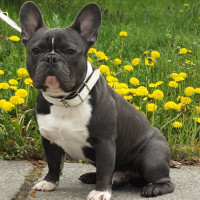
A little of the French Bulldog |
||
| The English Industrial Revolution replaced many workers with machines. By the 1850s and 1860s, lacemakers were out of work. English lacemakers began moving to France to find work. They brought their dogs, which were small, miniature Bulldogs. Eventually bred with the native French Bulldog, today's French Bulldog was born. In 1885, a breeding program for American French Bulldogs was launched. Once in America, the breed became popular with society women. The breed was shown at the Westminster Kennel Club dog show in 1896. The only winners in the French Bulldog group were those with "pink ears", not breed members with "erect bat ears". The ladies of the society disagreed with the judge's decision. They formed the French Bulldog Club of America, which went on to create the breed standard. The "erect bat ear" was the correct type. In the early 20th century, the breed was owned by the Rockefeller family and the J.P. Morgan family. The American Kennel Club recognized the breed in 1898. By 1906, the French Bulldog was the 5th most popular dog breed in America. | ||
 |
||
| Standard of the French Bulldog | ||
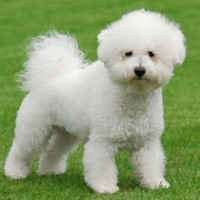
A little of the Bichon frise |
||
| The Bichon frise is a Mediterranean dog, like its cousins the Coton de Tuléar, the Bolognese, the Maltese and the Havanese. They are all related to the Barbet. Once in Europe, they were favored by the nobility, and when the trend changed, they became street and circus performers. Today, they perform, and very well, in the competition ring. Wonderful companions, they were registered by the American Kennel Club in 1972. The Frenchie Bichon was probably bred in the mid-1900s, but has only recently been recognized as a specific cross-breed hybrid. It quickly gained in popularity and is known for its gentle, playful character. | ||
 |
||
| Standard of the Bichon frise |
Appearance of the Frenchie Bichon |
| Frenchie Bichons have well-balanced Bichon à poil frisé bodies, as well as many French Bulldog characteristics. They are small dogs, averaging between 6 and 10 kilos and measuring 25.5 to 30.5 centimeters. The Frenchie Bichon doesn't have the full coat of its curly-haired Bichon relative, however, its coat is of medium length and relatively soft with a slight wave. Frenchie Bichons vary considerably in color and can be any combination of apricot, buff, cream, white or fawn with a possible brindle pattern and ticked markings. They have "bat" or slightly erect ears, well-coated medium-length tails and a solid French Bulldog stance. Frenchie Bichons have gentle, tender expressions, with round, dark eyes and short muzzles that end in a black nose. |
Temperament of the Frenchie Bichon |
| These happy dogs are naturally affectionate and cheerful. Frenchie Bichons can be territorial towards their owners and toys, but not aggressively so. They tend to stay by their owners' side outside the house, but play enthusiastically with other humans and furry friends when indoors. Frenchie Bichons are also intelligent and attention-seeking, making them excellent at learning commands and tricks to perform for their admiring audience. However, their intelligence sometimes makes them stubborn. As such, early and consistent training, as well as patience, is essential to raising a well-bred Frenchie Bichon. Nevertheless, this breed makes an excellent pet for apartment or city living due to its small size, manageable exercise requirements and relatively easy maintenance. Frenchie Bichons also like to snuggle and receive attention from their owners, but are not known for being needy. On the whole, Frenchie Bichons are happiest in the company of others, but they are also content to sit in a dog bed and chew on a toy. |
Needs and activities of the Frenchie Bichon |
| The Frenchie Bichon is a well-balanced breed that loves to play and relax in equal measure. As such, they only require an average of 30 minutes of daily exercise. They enjoy short walks and occasional outings to the dog park. They also like to romp indoors with other puppies and members of their human family. Otherwise, you'll find this breed curled up on the sofa or spread out in a sunspot. When feeling affectionate, Frenchie Bichons will happily sit and doze on their owners' laps. This breed is well suited to all climates, as it is primarily an indoor pet. Note, however, that Frenchie Bichons should not be exercised in extremely hot or extremely cold conditions. |
Maintenance of the Frenchie Bichon |
| Frenchie Bichons are minimal excretors and don't require much grooming. Depending on the coat, a pair of scissors may sometimes be needed to keep the coat in shape. They are not hypoallergenic, but produce fewer allergens than your typical dog due to their curly-haired Bichon heritage. These puppies are particularly prone to plaque build-up, so it's extremely important for owners to brush their dogs' teeth every day to avoid gum disease and tooth loss. Owners should not bathe their Frenchie Bichons more than once a month, otherwise they risk drying out their dog's coat. Finally, owners should trim their Frenchie Bichons' nails once or twice a month and check their ears regularly. |



 English (United Kingdom)

Comments