Dameranian

He is not recognized by the F.C.I.

Origin
Germany -> U.S.A.
Translation
Francis Vandersteen
This breed is also known as
Pomaweenie 
Pom-Dach 
Pom Weenie

A brief presentation of the Dameranian

The Dameranian is a mix of Dachshund and Spitz Toy / Pomeranian. It's a small to medium-sized dog, depending on the size of its direct parents. It's a very affectionate dog and usually bonds with its family, especially one member. They are often described as friendly. He tends to lose weight and will need a moderate amount of grooming. He may suffer from separation anxiety if left for long periods. He can be a bit of a barker thanks to the Pom parentage, he should be able to mix well with other dogs and animals. He's happy in any kind of home.

History of the Dameranian

There isn't much information on the Dameranian breed itself, but we can learn more about the parent breeds to understand what to expect from the hybrid breed.
        

A little of the Dachshund

        
The little Dachshund originated in Germany as a badger dog. Drawings of the Dachshund date back to the 15th century. It was also used to hunt foxes and den animals. In the eighteenth and nineteenth centuries, breeders began to work on a dog with long, strong legs and the ability to follow a badger into its den. This is how today's Dachshund was born. Over time, they began to be introduced in a companion-type role. Royalty throughout Europe, including Queen Victoria, loved the breed. By the 1950s, the Dachshund had become a popular pet, and this popularity as a companion dog remains today.
Standard of the Dachshund

A little of the German Toy Spitz / Pomeranian

The Spitz Toy / Pomeranian is distantly related to the Northern Spitz family of dogs. Pomeranians have always been popular, and it's said that Martin Luther (the church reformer), Michelangelo, Isaac Newton and Mozart all owned Spitz Toy / Pomeranians. The Spitz Toy / Pomeranian was also popular in royal circles. Even Queen Victoria owned a Spitz Toy / Pomeranian, and many believe that Queen Victoria, who was quite the dog breeder, is influential in breeding the smaller Spitz Toy / Pomeranian. The Spitz Toy / Pomeranian is recognized by the American Kennel Club, and was added to the stud book in 1888. It has always been a very popular breed, especially since its introduction to America.
Standard of the German Toy Spitz / Pomeranian

Appearance of the Dameranian

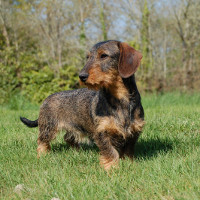
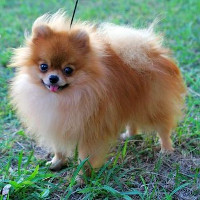
The Dameranian is a combination of the two parent breeds, the Dachshund and the Spitz Toy / Pomeranian. The Dachshund can have a smooth or wire-haired coat. The Smooth coat is short and glossy. Colors vary, some being solid, usually red or cream, with a few black hairs. There are two-tone Dachshunds, usually black, chocolate, boar (graying), gray or fawn with tan or cream markings. There are also spotted Dachshunds, which may have a merle pattern in their coat. Wirehaired Dachshunds have short, thick, hard hair as a topcoat with a soft undercoat. The same colors apply to Wirehaired and Smooth Dachshunds. There are also long-haired Dachshunds. Their coat is long and slightly wavy. The Spitz Toy / Pomeranian is considered a toy-sized dog. The Pom is available in many colors, including black, black and tan, blue and tan, chocolate and tan, cream, cream sable, orange, red, sable, brindle and white. At its heaviest, the Spitz Toy / Pomeranian normally weighs just 3 kilos. The Spitz Toy / Pomeranian has a long coat and short undercoat. Most often seen with a smooth coat, Dameranians can have floppy or erect ears. The eyes are usually Dachshund-shaped and colored.

Temperament of the Dameranian

A look at the parent breeds can give us an idea of the type of behavior to expect from the hybrid breed. The Dachshund is a lively, playful little dog. He's brave and bold, but can also be a little stubborn. They love to cuddle with their family, and remember that they may choose one member over another to form a special bond with. Sometimes, if they're too lonely, they'll display anxious behaviors. Wirehaired Dachshunds tend to be mischievous. Long-haired Dachshunds tend to be calm, and Smooth Dachshunds are a mixture of both. With good socialization, the Dachshund is a happy, affectionate little addition to your family. The Spitz Toy / Pomeranian is considered an extrovert dog who loves others and animals. However, he thinks he's much bigger than he really is and can sometimes challenge other dogs. He is alert and curious. He can be prone to barking, so training to stop barking on command should start at an early age. Most correctly socialized Spitz Toy / Pomeranian do not show the aggression mentioned above. This also helps with small children, as some Poms are not good with children if they are not properly socialized. Your Dameranian is likely to be a little bundle of fire, ready for action and bossing everyone around. Use positive reinforcement when training and you should be able to teach him how to behave.

Needs and activities of the Dameranian

The Dameranian is a fairly active dog. It's recommended that he gets enough exercise to ensure he doesn't put on weight. He may or may not be inclined to roam, depending on his parentage, but it would be wise to keep him on a leash unless you're in a fenced-in area. He'll enjoy short, brisk walks with you, as well as a visit to the dog park. He's usually able to get along with other dogs and pets if he's had the opportunity to rub shoulders with them on a regular basis. He can also enjoy playtime with the children in your family.

Maintenance of the Dameranian

The Dameranian will most likely have a fairly easy grooming routine, but it must be carried out consistently. Regardless of whether your hybrid ends up with a smooth or fluffy coat, long or short, you should brush it at least once a week. A matted coat can occur if the coat is long and silky. Loss is always visible, whatever the length of the coat. A pin brush will work in any coat texture and is an excellent brush for removing tangles. If your Dameranian has long ears, check them often for dirt and moisture build-up. Small dogs are notorious for teething problems and periodontal disease, so don't neglect the teeth. Brush them daily if possible. Nail care is essential, and twice-weekly clipping should suffice.

Comments

Latest page updates

  • Telomian

    Telomian He is not recognized by the F.C.I. Origin Malaysia Translation Francis Vandersteen A brief presentation of the Telomian The Telomian is a very rare breed of dog, and the only one native to Malaysia to have been bred outside the country. They were originally bred by the indigenous people of Malaysia to combat parasites such as snakes, rats,...
  • King Wheaten -- Cavalier King Charles Spaniel X Irish Soft Coated Wheaten Terrier

    King Wheaten He is not recognized by the F.C.I. Origin Great Britain <> Ireland -> U.S.A. Translation Francis Vandersteen A brief presentation of the King Wheaten The King Wheaten is a small dog with a heart this big and a playful disposition. Borrowing the energy and soft-coated waves of the Irish Soft Coated Wheaten Terrier and the size and...
  • Spanierd -- English Springer Spaniel X German Shepherd

    Spanierd He is not recognized by the F.C.I. Origin Great Britain <> Germany -> U.S.A. Translation Francis Vandersteen A brief presentation of the Spanierd The Spanierd is a hybrid dog. Its parent breeds are the English Springer Spaniel and the German Shepherd. They have an affable personality. He's known for entertaining family and friends with his...
  • Alaskan Goldenmute -- Alaskan Malamute X Golden Retriever

    Alaskan Goldenmute He is not recognized by the F.C.I. Origin U.S.A. <> Great Britain -> U.S.A. Translation Francis Vandersteen This breed is also known as Alaskan GoldenGoldenmuteAlaskan Gold Retriever     A brief presentation of the Alaskan Goldenmute The Alaskan Goldenmute is a descendant of two great dog breeds: the Alaskan Malamute and the Golden...
  • French pointing dog Pyrenean type

    French pointing dog Pyrenean type FCI standard Nº 134 Origin France Translation Mrs. Peggy Davis Group Group 7 Pointing Dogs Section Section 1.1 Continental Pointing Dogs « Braque » Type Working With working trial Acceptance on a definitive basis by the FCI Tuesday 18 January 1955 Publication of the official valid standard Tuesday 01 August 2023 Last...
  • French pointing dog Gascogne type

    French pointing dog Gascogne type FCI standard Nº 133 Origin France Translation Mrs. Peggy Davis Group Group 7 Pointing Dogs Section Section 1.1 Continental Pointing Dogs « Braque » Type Working With working trial Acceptance on a definitive basis by the FCI Monday 17 January 1955 Publication of the official valid standard Tuesday 01 August 2023 Last...
  • Vucciriscu

    Vucciriscu He is not recognized by the F.C.I. Origin Sicily Translation Francis Vandersteen En français, cette race se dit Vucciriscu Diese Norm ist in deutscher Sprache sichtbar Vucciriscu En español, esta raza se dice Vucciriscu In het Nederlands, wordt dit ras gezegd Vucciriscu This breed is also known as Sicilian Vucciriscu Sicilian Butcher...

© 2026 Groupe Milouchouchou ASBL. Tous droits réservés. En savoir plus

Protected by Copyright01
We use cookies

We use cookies on our website. Some of them are essential for the operation of the site, while others help us to improve this site and the user experience (tracking cookies). You can decide for yourself whether you want to allow cookies or not. Please note that if you reject them, you may not be able to use all the functionalities of the site.

Ok