Dachsweiler

He is not recognized by the F.C.I.

Origin
Germany -> U.S.A.
Translation
Francis Vandersteen

A brief presentation of the Dachsweiler

The Dachsweiler is a rare hybrid dog that is the result of crossing a Dachshund with a Rottweiler. It's too early to get any useful data on this new breed, only that the resulting Dachsweiler puppies can vary considerably in appearance, size and characteristics due to their unusual parentage. It has been said that the Dachsweiler resembles a Rottweiler with short legs. By studying the parent breeds, we can determine to some extent what their nature is. They are intelligent dogs, even tempered with a touch of mischief, yet loyal and protective towards their family. Their coloring tends towards the two-tone combination of black and chocolate or black and tan, but may include other colors. Their body is generally long like the Dachshund, but solid like the Rottweiler. Affectionate, reliable and full of energy, they make good pets if socialized early in life.

History of the Dachsweiler

Little is known about the early history of the Dachsweiler, as it is a very modern breed. However, both the Dachshund and the Rottweiler have a long history that we can draw on to determine how this has shaped the new Dachsweiler.
        

A little of the Dachshund

        
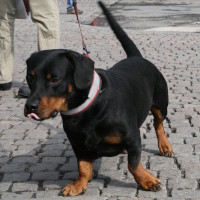
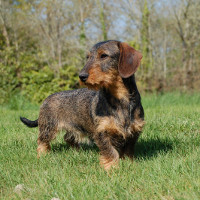
The Dachshund originated in Germany in the 15th century and was used to catch badgers and other den animals such as foxes and rabbits. These early dogs varied considerably in size, and this continues today. They can be miniature or standard in size. The breed's popularity declined during the First World War, but dogs were then imported from Germany to the United States of America, and once again, the Dachshund gained in popularity. They have many Terrier characteristics and are versatile, courageous dogs. The Dachshund was recognized by the American Kennel Club (AKC) in 1885.
Standard of the Dachshund

A little of the Rottweiler

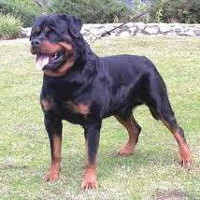
The Rottweiler is perhaps a descendant of the Italian Mastiff, which often accompanied the herds the Romans brought with them when they invaded Europe. In the Middle Ages, it was used to herd and guide cattle, became a messenger dog, a draft dog and was used in police work. The Rottweiler originated in the German town of the same name, in Württemberg. It almost became extinct in the 1800s, but enthusiastic breeders made a comeback with the breed thanks to careful breeding and selection. Finally, in 1931, the breed was recognized for the first time by the AKC. Rottweilers have many talents, including tracking, guarding, search and rescue, guide dogs for the blind, police work and much more. They also make devoted companions and are loyal and affectionate with their families, and are known for their calm, even temperament.
Standard of the Rottweiler

Appearance of the Dachsweiler

The Dachsweiler can vary in appearance even within a single litter. Some puppies have grown to resemble the Rottweiler with a muscular, powerful body, but still have the shorter legs of the Dachshund. Other puppies may resemble the Dachshund with its long body, short legs and dormant body, but may have a head like a Rottweiler. The Dachsweiler is a hybrid dog whose exact description is difficult to determine. Their defined head with long, well-developed muzzle, short but powerful legs, long sturdy tails that extend directly from the spine, deep chest and great lung capacity highlight a dog built for action. Some dogs will have paddle-like legs thanks to their Dachshund parent, while others will have firm, rounded paws like their Rottweiler parent. Their ears are likely to be long and floppy, while their eyes are dark and almond-shaped, with a curious glint. The long body and back is the Dachshund's true trademark and part of its broad appeal.

Temperament of the Dachsweiler

The Dachsweiler line comes from dogs with a strong instinct to hunt, stalk and, in the case of the Dachshund, kill their prey. These instincts will be passed on in part to your Dachsweiler, with a personality that's even tempered, courageous, confident and with a touch of stubbornness. They are not for the inexperienced owner, for if he is not taught to respect his owner and accept him as pack leader, the dog can become a calamity. This problem can then see the Dachsweiler become destructive, disobedient and a dog that will defy all your commands. But if you're a solid owner, then once this dog is socialized and trained, it will be one of the most reliable, gentle and affectionate dogs around. They can be good as family dogs, protectors of family members. They will even accept cats and other pets, if they have been well socialized and the owner has authority over them. They are deep thinkers, gauging situations before reacting. They can also become barkers unless trained. With the right training, socialization and a solid owner, these are loving, funny, active and adorable dogs.

Needs and activities of the Dachsweiler

The Dachsweiler's family history includes both parent breeds as active dogs, so the hybrid Dachsweiler will be similar to them. They need a daily walk or stimulating games at home to help them burn off some of their energy. Their longer bodies can be prone to back injuries, even when jumping out of bed. When holding your dog, be sure to support the back and rear. Obedience training and socialization should start when your dog is young. Keep your dog on a leash until he is well trained and socialized, as he may show aggression towards other dogs of the same sex. Dachsweilers can learn anything if they receive proper training and lavish praise and rewards for their efforts. They do best in a home with a secure yard and adapt easily to most climates.

Maintenance of the Dachsweiler

The Dachsweiler is a low-maintenance dog, unless it has the longer coat or stiff coat of some Dachshund breeds. For the short, smooth coat, weekly brushing, rubbing with a damp cloth and general maintenance tasks such as nail trimming and tooth brushing are all that's needed. For longer or stiffer coats, more brushing is needed to remove fallen hairs and avoid matting. They don't need to bathe all the time, just when necessary. This practice will keep the coat in good condition. Because they have floppy ears, take care to clean the inside of the ear to avoid debris build-up and look for any infection, which is often inflamed and smelly. If you get your Dachsweiler used to the grooming routine, it will be easier for the vet to handle him if you need to visit. Grooming is valuable bonding time with your dog and a chance to check for cuts, sores or parasites such as ticks or fleas.

Comments

Latest page updates

  • Telomian

    Telomian He is not recognized by the F.C.I. Origin Malaysia Translation Francis Vandersteen A brief presentation of the Telomian The Telomian is a very rare breed of dog, and the only one native to Malaysia to have been bred outside the country. They were originally bred by the indigenous people of Malaysia to combat parasites such as snakes, rats,...
  • King Wheaten -- Cavalier King Charles Spaniel X Irish Soft Coated Wheaten Terrier

    King Wheaten He is not recognized by the F.C.I. Origin Great Britain <> Ireland -> U.S.A. Translation Francis Vandersteen A brief presentation of the King Wheaten The King Wheaten is a small dog with a heart this big and a playful disposition. Borrowing the energy and soft-coated waves of the Irish Soft Coated Wheaten Terrier and the size and...
  • Spanierd -- English Springer Spaniel X German Shepherd

    Spanierd He is not recognized by the F.C.I. Origin Great Britain <> Germany -> U.S.A. Translation Francis Vandersteen A brief presentation of the Spanierd The Spanierd is a hybrid dog. Its parent breeds are the English Springer Spaniel and the German Shepherd. They have an affable personality. He's known for entertaining family and friends with his...
  • Alaskan Goldenmute -- Alaskan Malamute X Golden Retriever

    Alaskan Goldenmute He is not recognized by the F.C.I. Origin U.S.A. <> Great Britain -> U.S.A. Translation Francis Vandersteen This breed is also known as Alaskan GoldenGoldenmuteAlaskan Gold Retriever     A brief presentation of the Alaskan Goldenmute The Alaskan Goldenmute is a descendant of two great dog breeds: the Alaskan Malamute and the Golden...
  • French pointing dog Pyrenean type

    French pointing dog Pyrenean type FCI standard Nº 134 Origin France Translation Mrs. Peggy Davis Group Group 7 Pointing Dogs Section Section 1.1 Continental Pointing Dogs « Braque » Type Working With working trial Acceptance on a definitive basis by the FCI Tuesday 18 January 1955 Publication of the official valid standard Tuesday 01 August 2023 Last...
  • French pointing dog Gascogne type

    French pointing dog Gascogne type FCI standard Nº 133 Origin France Translation Mrs. Peggy Davis Group Group 7 Pointing Dogs Section Section 1.1 Continental Pointing Dogs « Braque » Type Working With working trial Acceptance on a definitive basis by the FCI Monday 17 January 1955 Publication of the official valid standard Tuesday 01 August 2023 Last...
  • Vucciriscu

    Vucciriscu He is not recognized by the F.C.I. Origin Sicily Translation Francis Vandersteen En français, cette race se dit Vucciriscu Diese Norm ist in deutscher Sprache sichtbar Vucciriscu En español, esta raza se dice Vucciriscu In het Nederlands, wordt dit ras gezegd Vucciriscu This breed is also known as Sicilian Vucciriscu Sicilian Butcher...

© 2026 Groupe Milouchouchou ASBL. Tous droits réservés. En savoir plus

Protected by Copyright01
We use cookies

We use cookies on our website. Some of them are essential for the operation of the site, while others help us to improve this site and the user experience (tracking cookies). You can decide for yourself whether you want to allow cookies or not. Please note that if you reject them, you may not be able to use all the functionalities of the site.

Ok