Cane Corxer

He is not recognized by the F.C.I.

Origin
Italy <> Germany -> U.S.A.
Translation
Francis Vandersteen

A brief presentation of the Cane Corxer

The Cane Corxer is a hybrid of the Cane Corso and Boxer and, being a fairly recent hybrid, little information is available on the hybrid itself. However, some information is available on related breeds. The Boxer originates from Germany and the Cane Corso from Italy. Both the Boxer and the Cane Corso were originally bred for work, hunting and guarding in their respective countries, and they continue to be used in these areas in these countries of origin as well as in the USA. They are known to be useful in many military and police operations. Both parent breeds are large and have coats that require low-maintenance grooming due to the minimal to moderate natural shedding that occurs. When properly socialized as puppies, both parent breeds have similar temperament characteristics: energetic, affectionate, cheerful, courageous, friendly, intelligent, loyal, social and playful.

History of the Cane Corxer

The Cane Corxer is a mix of two purebreds, the Cane Corso and the Boxer, and is a new hybrid. There is little history available on the hybrid itself, but there is some history available on the parent breeds. The Cane Corxer is recognized by the American Canine Hybrid Club and the Designer Breed Registry and is considered a hybrid because it is the result of crossing two purebred dog breeds.
        

A little of the Italian Corso dog

        
The Cane Corso is a breed that originated in the remote villages of Italy, where they were used as hunting dogs, guard dogs and companion dogs. The breed was feared extinct until, in the 1980s, some breed enthusiasts regenerated the breed in southern Italy, where it continues to thrive. The breed's reputation and popularity spread throughout Europe and eventually to the United States, where it continues to be used not only for hunting, observation and guarding, but has also gained popularity in conformation and other competitive canine activities.
Standard of the Italian Corso dog

A little of the Boxer

The Boxer breed originated in Germany, where they were used to hunt, catch and hold ferocious wild game that included bear, wild boar and bison. These activities continued until 1815, when the great German hunting estates began to be dismantled and the breed's hunting duties were no longer needed. The Germans worked to keep the breed stabilized, and eventually the dogs were used in both world wars as messengers and carriers of ammunition and supplies. They continue to thrive today as guardians, watchdogs and family companions.
Standard of the Boxer

Appearance of the Cane Corxer

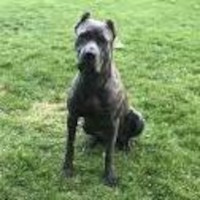
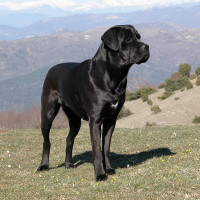
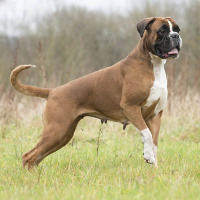
The Cane Corxer hybrid can take on the appearance traits of one or both of its parent breeds. The coat may be short, elegant and easy to care for, or double-coated, with the outer coat short, glossy and coarse, and the undercoat soft and light. The hybrid's body will be muscular and strong, with proportionate size and weight. Size will be determined by the dominant parent breed in the gene pool. Facial expression will be watchful with combined eye shape and size, eye positioning and forehead crease, which is similar in both parent breeds. The eyes will be dark and may be round or almond-shaped with dark rims. The ears of both parent breeds are usually cropped, but if not cultivated, they hang close to the cheeks. The muzzles of both breed parents are of equal proportion, with an underbite being larger in the Boxer parent than in the Corso parent. The paws are likely to be round and compact, with well arched toes. The tail can be of various lengths. The coat may be smooth and dense or double-coated, depending on the dominant breed parent, and may be black, gray, fawn, red, brindle, blue and brown with white markings.

Temperament of the Cane Corxer

The Cane Corxer can take on the temperament traits of one or both of the breed's parents. These include alertness, cheerfulness, courage, intelligence, energy, kindness, loyalty, sociability, outgoing, playful and calm. The Corso parent can be quite dominant and will add a great deal of independence to the gene pool, making it imperative that the responsible entity be established from the outset for a successful relationship. The Corso parent also contributes to gentleness and stability if the dog is properly socialized and trained early enough. The breed will bond with family members and be very protective of family and possessions, but wary of strangers, seeming to have heightened feelings when something goes wrong. Both parent breeds are highly intelligent and, although sometimes stubborn, can be easily trained if appropriate positive training and discipline methods are used. They may not get along with other animals, given their hunting heritage. Because of the Corso's organic influence, the Cane Corxer may do best in a home where it is the only dog.

Needs and activities of the Cane Corxer

The mature Cane Corxer will probably require 1 to 2 hours of daily exercise, which may take the form of daily walks, agility games, retrieving, Frisbee and obedience. The Cane Corxer is a relatively active hybrid, but will do well in an apartment or house with a well-secured fenced yard where he can run, romp and play. Apartment dwellers will need to walk and exercise him appropriately to avoid the destructive behaviors that can develop. Both parent breeds will bond with family members, so they do best when not left alone for long periods. They can live in urban or rural environments, but can do best when not exposed to extreme temperatures.

Maintenance of the Cane Corxer

Both parent breeds provide coats that are moderate excretors but are relatively smooth and dense, requiring little maintenance, which essentially amounts to weekly brushing to keep the coat clean and free of debris. Shampooing or bathing the Cane Corxer hybrid, like its parent breeds, should only be done if necessary to maintain the oils in the coat. As with almost all canine breeds, regular dental cleaning and examinations will help prevent periodontal disease and the resulting tooth loss. Eye examinations will probably be necessary periodically, as there are a number of eye conditions known to afflict related breeds and will need to be assessed and monitored as your pet ages. Ears should be checked and cleaned weekly or as needed to prevent infection.

Comments

Latest page updates

  • Telomian

    Telomian He is not recognized by the F.C.I. Origin Malaysia Translation Francis Vandersteen A brief presentation of the Telomian The Telomian is a very rare breed of dog, and the only one native to Malaysia to have been bred outside the country. They were originally bred by the indigenous people of Malaysia to combat parasites such as snakes, rats,...
  • King Wheaten -- Cavalier King Charles Spaniel X Irish Soft Coated Wheaten Terrier

    King Wheaten He is not recognized by the F.C.I. Origin Great Britain <> Ireland -> U.S.A. Translation Francis Vandersteen A brief presentation of the King Wheaten The King Wheaten is a small dog with a heart this big and a playful disposition. Borrowing the energy and soft-coated waves of the Irish Soft Coated Wheaten Terrier and the size and...
  • Spanierd -- English Springer Spaniel X German Shepherd

    Spanierd He is not recognized by the F.C.I. Origin Great Britain <> Germany -> U.S.A. Translation Francis Vandersteen A brief presentation of the Spanierd The Spanierd is a hybrid dog. Its parent breeds are the English Springer Spaniel and the German Shepherd. They have an affable personality. He's known for entertaining family and friends with his...
  • Alaskan Goldenmute -- Alaskan Malamute X Golden Retriever

    Alaskan Goldenmute He is not recognized by the F.C.I. Origin U.S.A. <> Great Britain -> U.S.A. Translation Francis Vandersteen This breed is also known as Alaskan GoldenGoldenmuteAlaskan Gold Retriever     A brief presentation of the Alaskan Goldenmute The Alaskan Goldenmute is a descendant of two great dog breeds: the Alaskan Malamute and the Golden...
  • French pointing dog Pyrenean type

    French pointing dog Pyrenean type FCI standard Nº 134 Origin France Translation Mrs. Peggy Davis Group Group 7 Pointing Dogs Section Section 1.1 Continental Pointing Dogs « Braque » Type Working With working trial Acceptance on a definitive basis by the FCI Tuesday 18 January 1955 Publication of the official valid standard Tuesday 01 August 2023 Last...
  • French pointing dog Gascogne type

    French pointing dog Gascogne type FCI standard Nº 133 Origin France Translation Mrs. Peggy Davis Group Group 7 Pointing Dogs Section Section 1.1 Continental Pointing Dogs « Braque » Type Working With working trial Acceptance on a definitive basis by the FCI Monday 17 January 1955 Publication of the official valid standard Tuesday 01 August 2023 Last...
  • Vucciriscu

    Vucciriscu He is not recognized by the F.C.I. Origin Sicily Translation Francis Vandersteen En français, cette race se dit Vucciriscu Diese Norm ist in deutscher Sprache sichtbar Vucciriscu En español, esta raza se dice Vucciriscu In het Nederlands, wordt dit ras gezegd Vucciriscu This breed is also known as Sicilian Vucciriscu Sicilian Butcher...

© 2026 Groupe Milouchouchou ASBL. Tous droits réservés. En savoir plus

Protected by Copyright01
We use cookies

We use cookies on our website. Some of them are essential for the operation of the site, while others help us to improve this site and the user experience (tracking cookies). You can decide for yourself whether you want to allow cookies or not. Please note that if you reject them, you may not be able to use all the functionalities of the site.

Ok