 |
Italian Corso dog |
|
FCI standard Nº 343 |
||
Origin |
Italy | |
Translation |
Revised by Mrs R. Sporre-Willes Official language : (EN) Latest amendments : Ente Nazionale della Cinofilia Italiana |
|
Group |
Group 2 Pinscher and Schnauzer, Molossian and Swiss Mountain- and Cattledogs | |
Section |
Section 2.1 Molosside breeds, Mastiff type | |
Working |
Without working trial | |
Acceptance on a definitive basis by the FCI |
Monday 21 May 2007 | |
Acceptance on a provisional basis by the FCI |
Tuesday 12 November 1996 | |
Publication of the official valid standard |
Monday 25 September 2023 | |
Last update |
Friday 13 October 2023 | |
En français, cette race se dit |
 |
Cane Corso |
Diese Norm ist in deutscher Sprache sichtbar |
 |
Italianischer Corso Hund |
En español, esta raza se dice |
 |
Perro Corso Italiano |
In het Nederlands, wordt dit ras gezegd |
 |
Cane Corso Italiano |
Usage |
| Guard-, protection-, police-and tracking dog. |
Brief historical summary |
| Its direct ancestor is the old Roman Molossian. Formerly scattered all over Italy, in the recent past, the breed was only prevalent in the Province Apulia and in the adjacent regions of Southern Italy. His name derives from the Latin « cohors », which means « protector, guardian of the farmyard ». |
General appearance |
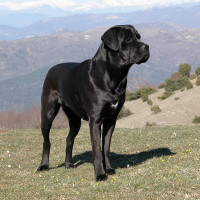
| Medium to large-sized. Robust and sturdy, nevertheless elegant. Lean, powerful muscles. |
Important proportions |
| The length of the head reaches 36 % of the height at withers. The dog is somewhat longer than high. |
Behaviour / temperament |
| Guardian of property, family and livestock; extremely agile and responsive. In the past, it has been used for herding cattle and hunting big game. |
Head |
||
Cranial region |
||
Head |
Large and typically molossoid. The upper longitudinal axes of the skull and the muzzle converge slightly. | |
Skull |
Wide; at the zygomatic arches its witdh is equal to or greater than its length. Convex in front, it becomes fairly flat behind the forehead as far as the occiput. The medio-frontal furrow is visible. | |
Stop |
Marked. | |
Facial region |
||
Nose |
Black and large with ample, open nostrils, on the same line as the nasal bridge. | |
Muzzle |
Noticeably shorter than the skull (ratio muzzle : skull approximately 1 : 2). Strong, square; the front part of the muzzle is flat; the lateral surfaces are parallel; the muzzle is as wide as long. The profile of the nasal bridge is straight. | |
Lips |
The upper lips hang moderately and cover the mandible, so that the lower profile of the muzzle is determined by the lips. | |
Jaws and teeth |
Jaws very large, thick and curved. Slightly undershot. Level bite acceptable, but not sought after. | |
Eyes |
Medium-sized, ovoid, looking directly forward, slightly protruding. Eyelids close fitting. Colour of iris as dark as possible, depending from the colour of the coat. Expression keen and attentive. | |
Ears |
Triangular, drooping, with a wide set on high above the zygomatic arches. Often cropped in the shape of an equilateral triangle. | |
Neck |
| Strong, muscular, as long as the head. |
Body |
||
Body |
The body is somewhat longer than the height at the withers. Sturdily built, but not squat. | |
Withers |
Pronounced, rising above the level of the croup. | |
Back |
Rectilinear, very muscular and firm. | |
Loin |
Short and strong. | |
Croup |
Long, wide, slightly inclined. | |
Chest |
Well developed in three dimensions, reaches to the elbow. | |
Tail |
| Set on fairly high; very thick at the root. The tail is docked at the fourth vertebra. In action carried high, but never curled nor erect. |
Limbs |
Forequarters |
||
Shoulders |
Long, oblique, very muscular. | |
Upper arm |
Strong. | |
Forearm |
Straight, very strong. | |
Pastern |
Elastic. | |
Forefeet |
Cat feet. | |
Hindquarters |
||
Upper thigh |
Long, wide, back line of thigh convex. | |
Lower thigh |
Strong, not fleshy. | |
Metatarsus |
Thick and sinewy. | |
Hock |
Moderately angulated. | |
Hind feet |
Slightly less compact than the forefeet. | |
Gait and movement |
| Long stride, extended trot. The preferred gait is the trot. |
Skin |
| Fairly thick, rather close fitting. |
Coat |
||
Hair |
Short, shiny, very dense with a light undercoat. | |
Colour |
Black, lead-grey (blue), slate-grey (blue), light grey (blue), light fawn; dark fawn and stag red; dark wheat colour; black brindle, grey (blue) brindle, in brindle dogs fawn stripes can be of different shades; in fawn and brindle dogs the black or grey (blue) mask on the muzzle should not go beyond the line of the eyes. A small white patch on the chest, on the tip of the toes and on the bridge of the nose is acceptable. | |
Size and weight |
||
Height at withers |
Males from 64 to 68 cm, females from 60 to 64 cm. Tolerance of 2 cm more or less. | |
Weight |
Males from 45 to 50 kg, females from 40 to 45 kg. | |
Faults |
| • Any departure from the foregoing points should be considered a fault and the seriousness with which the fault should be regarded should be in exact proportion to its degree and its effect upon the health and welfare of the dog and its ability to perform its traditional work. • Faults listed should be in degree of seriousness. |
Serious faults |
 Axes of muzzle and skull parallel or too converging; lateral surfaces of the muzzle converging. Partial depigmentation of the nose. Scissor bite; pronounced undershot mouth. Ring-tail, tail in vertical position. Permanent amble when trotting. Over-or undersize. Axes of muzzle and skull parallel or too converging; lateral surfaces of the muzzle converging. Partial depigmentation of the nose. Scissor bite; pronounced undershot mouth. Ring-tail, tail in vertical position. Permanent amble when trotting. Over-or undersize. |
Disqualifying faults |
| Aggressive or overly shy. Axes of muzzle and skull diverging. Total depigmentation of the nose. Bridge of nose very hollow, rams’s nose. Overshot mouth. Partial or complete palpebral depigmentation. Wall eye; strabism. Tailless, short tail (docked or not). Semi-long, smooth or fringed hair. All colours not indicated in the standard; large white patches. |
NB : |
| • Any dog clearly showing physical or behavioural abnormalities shall be disqualified. • The above mentioned faults when occurring to a highly marked degree or frequently are disqualifying. • Male animals should have two apparently normal testicles fully descended into the scrotum. • Only functionally and clinically healthy dogs, with breed typical conformation should be used for breeding. |
Bibliography |
| https://www.fci.be/ |



 English (United Kingdom)

Comments