 |
Bull Daniff |
|
He is not recognized by the F.C.I. |
Origin |
Great Britain <> Germany -> U.S.A. | |
Translation |
Francis Vandersteen | |
This breed is also known as |
Daniff
|
A brief presentation of the Bull Daniff |
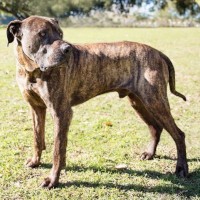
| The Bull Daniff is a specific crossbreed of two pure breeds, the Bullmastiff and the Great Dane. The Bull Daniff will be a large to giant dog. His coat will be short and his shedding moderate. Brushing can be done weekly to remove dead hairs and keep his coat shiny. He will have moderate energy levels, but due to his size and stature, he will need to go out and about more than once a day. The Bull Daniff is a loving, loyal companion best suited to a large home with secure outdoor space for him to stretch his legs. Hybrid owners say he's gentle, but needs a firm, consistent handler to keep him at his best. |
History of the Bull Daniff |
| The Bull Daniff is a new breed with very little detailed history. This designer breed is thought to have originated in the USA and was recognized by the International Designer Canine Registry in 2009. Bullmastiffs and Great Danes date back to ancient times. |
A little of the Bullmastiff |
||
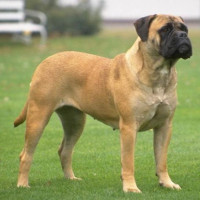
| The Bullmastiff is a working breed, originating in Great Britain in the 1800s. Gamekeepers bred the Mastiff and Bulldog to help them ward off poachers. A gamekeeper's job was to look after the wild animals and birds that lived on the estate, which were kept for hunting. The Bullmastiff is known as the "gamekeeper's night dog". The Bullmastiff was fast, big and strong and would rush down and detain a poacher until the gamekeeper arrived. Bullmastiffs were imported to the USA in the 1920s by oil magnate John D. Rockefeller. The dogs were used to guard his estate. Sylvester Stallone used his beloved Bullmastiff, Butkus, in the film Rocky. The Bullmastiff has a genetic heritage of around 60% Mastiff and 40% Bulldog. The American Kennel Club recognized the Bullmastiff in 1934. | ||
 |
||
| Standard of the Bullmastiff | ||
A little of the Great Dane |
||
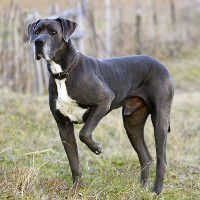
| Egyptian artifacts showing drawings of large dogs resembling the Great Dane date back to 3000 BC. There are also Chinese writings describing the Great Dane in 1121 BC. It is thought that the Assyrians traded the breed to the Greeks and Romans. These dogs were then probably bred with the English Mastiff and Irish Wolfhound. In the 16th century, the Great Dane was bred in Germany to hunt wild boar and was called "Boar Hounds". They were also owned by German nobles as guard dogs and companions. The Great Dane became Germany's national dog in 1876. Great Danes arrived in the United States in the mid-1800s. The American Kennel Club recognized the Great Dane in 1887. During the Second World War, a bomb was dropped through the roof of a British house. Inside was a Great Dane named Juliana. Juliana continued to urinate on the bomb, which extinguished it. She was awarded a Blue Cross medal for her "courageous" actions. Juliana received her second medal for alerting her owners that there was a fire in their shoe store. | ||
 |
||
| Standard of the Great Dane |
Appearance of the Bull Daniff |
| The Bull Daniff will have a mixture of Bullmastiff and Great Dane physical traits. Some Bull Daniffs may inherit more Bullmastiff traits, while others will take on more Great Dane characteristics. Many Bull Daniff hybrids will resemble a rounder, heavier Great Dane. They have a muscular, solid build. As a general rule, Bull Daniffs have large heads with floppy ears. Their facial expression is noble and loving. The breed has large, deep jowls and can drool. Some of the most common Bull Daniff colors are black and white, light brown, gray, gold and tan. They can also have brindle, merle or spotted coats. |
Temperament of the Bull Daniff |
| The Bull Daniff will have the behavior and personality traits of both parents. Even among the same littermates, you may notice different temperaments. In general, however, this hybrid is highly intelligent, confident and loyal. It's important that your Bull Daniff puppy is socialized at a young age. The Bull Daniff can be wary of strangers, but rarely aggressive. Bullmastiff and Great Dane traits make him a protector and an excellent watchdog. Although they are very large, they are gentle, easy-going and loving dogs. Bull Daniffs love children. Because of their size, they need to be supervised when playing with young children. If exposed to animals at a young age, the Bull Daniff will be loving and protective of other pets in the home. Because of its willingness to please its owner, training is not difficult. He may suffer from separation anxiety if left for long periods. |
Needs and activities of the Bull Daniff |
| Your Bull Daniff will enjoy long daily walks, which are essential for a dog of his size. He'll also enjoy playing fetch and running in a fenced-in yard. In addition, your Bull Daniff may enjoy visiting a dog park, and it's a good idea to get him used to meeting new faces. Positive experiences with others will help him grow in confidence. Play should be limited to high temperatures. His energy levels will be higher when he's a puppy, but as he's a large breed and growing fast, it's important for him not to overdo activities that can put stress on bones and joints. |
Maintenance of the Bull Daniff |
| Bull Daniffs have short coats that require little maintenance. Weekly brushing can help remove dead hairs. Folds in the skin should be cleaned and kept dry to prevent the development of bacterial or yeast infections. After walking in the rain or taking a bath, he should be carefully and gently dried. His ears should be checked once a week and cleaned with an earwash if dirt and debris are present. To prevent tartar and gingivitis, his teeth should be brushed with canine toothpaste several times a week. His nails may need to be trimmed every month. It's recommended that his nails be trimmed often as a puppy, to get him used to the practice. His sheer size can make the grooming routine a chore rather than a bonding moment, so consistency with grooming needs is essential. |



 English (United Kingdom)

Comments