 |
Bernese Cattle Dog |
|
He is not recognized by the F.C.I. |
Origin |
Switzerland <> Australia -> U.S.A. | |
Translation |
Francis Vandersteen |
A brief presentation of the Bernese Cattle Dog |
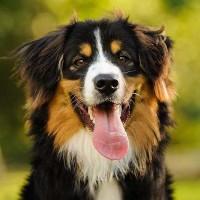
| The Bernese Cattle Dog is a hybrid breed created by crossing the Bernese Mountain Dog and the Australian Mountain Dog. Not much is known about this specific crossbreed, and the best way to guess what this dog will be like is to consider the characteristics of its parents. Both parent breeds are excellent with children and are highly intelligent, making them easy to train. This breed will most likely require an experienced owner willing to spend time exercising his dog. All dogs, including the Bernese Cattle Dog, will need good socialization as a puppy to become a well-bred, confident companion. |
History of the Bernese Cattle Dog |
| The Bernese Cattle Dog is a modern hybrid breed with little documented history. Consequently, we don't know when or where they were first created. However, we do know the history of its two parent breeds. |
A little of the Bernese Mountain Dog |
||
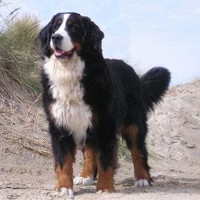
| The Bernese Mountain Dog originated in the Swiss mountains, with evidence of similar-looking dogs dating back to the 18th century. They got their name from the canton of Bern in Switzerland. These dogs were used as working dogs and were particularly good at draught work, such as pulling carts. They were also used on farms as pets for farmers, or to drive dairy cattle and keep an eye on the farm. Their numbers were reduced in the 19th century when more working dogs were imported into Switzerland and began to replace them on farms. It took the efforts of several people, including Professor Albert Heim and Franz Schertenleib, to keep the breed alive. They began collecting the breed's remaining dogs and stabilizing their population by breeding. | ||
 |
||
| Standard of the Bernese Mountain Dog | ||
A little of the Australian Cattle Dog |
||
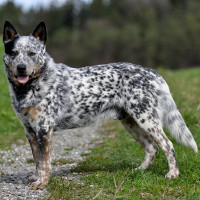
| Despite their name, the Australian Cattle Dog originated in Europe. They were first developed in the 18th century by pioneer settlers. These dogs were excellent workers and were very good at herding cattle on ranches, as they were appreciated for their impressive stamina as well as their guarding and hunting instincts. These dogs are still very adept at many activities today, including breeding. | ||
 |
||
| Standard of the Australian Cattle Dog |
Appearance of the Bernese Cattle Dog |
| It can be difficult to determine exactly what the Bernese Cattle Dog will look like, as it may resemble one parent more than the other. The Bernese Cattle Dog is large and strong, with a body that is not as tall as it is long. The head is broad and flat, with a straight muzzle and moderate stop. They will have teeth that connect in a scissor bite and medium-sized ears that are high and triangular in shape but rounded at the tip. These dogs have bushy tails that will be carried by low, strong legs that are straight and end in round paws with arched toes. They have thick coats with long fur. Australian Cattle Dogs are agile and muscular. Their bodies are slightly longer than they are tall, and their tails hang moderately low with a slight curve. They have strong, straight legs with round feet and short toes. Their broad skulls curve slightly between the ears and have a defined stop that is not too sharp. Their medium-sized ears prick when the dog becomes alert and are broad. Their eyes will be dark brown, oval-shaped and medium-sized. They will have black noses and teeth that meet in a scissor bite. |
Temperament of the Bernese Cattle Dog |
| Australian Cattle Dogs are intelligent and responsive, making them easy to train. They're also alert and aggressive, so they'll make great watchdogs, especially as they're loyal and protective of their families. They are also playful, energetic pets who love to play and accompany their owners on walks. Bernese Mountain Dogs, on the other hand, are more gentle and affectionate. They are also intelligent, easy to train and loyal to their families. Both breeds are sensitive and don't respond well to bad behavior. The Bernese and Australian Cattle Dogs are known to be good with children as well as with other pets. Since the Bernese Cattle Dog is a cross between these two breeds, we can assume that they will have similar characteristics. They will be intelligent and should be obedient and loving but protective around their family. Like all dogs, they need to be properly socialized as puppies and undergo basic obedience training. With all dogs, you need to be gentle but firm, and show them that you're the pack leader, not the other way around. |
Needs and activities of the Bernese Cattle Dog |
| The Bernese Cattle Dog will have exercise needs that fall somewhere between those of its parents. The Bernese Cattle Dog will need at least 30 minutes of exercise a day, and the Australian Cattle Dog should take two 45-minute long walks a day. Consequently, their offspring will have similar requirements. The exact amount of activity required will depend on the individual dog, but you should bear in mind that both parent breeds are prone to obesity, so good exercise is important. Don't forget to work your dog not only physically, but mentally too. |
Maintenance of the Bernese Cattle Dog |
| Depending on the type of coat the Bernese Cattle Dog takes, coat care will differ. The Bernese Cattle Dog is a breed that sheds regularly and seasonally. They should be brushed at least once a week and daily during shedding seasons. They should be bathed if necessary. Australian Cattle Dogs have lower maintenance requirements. Their short coats should be easy to maintain with a comb and firm bristle brush. They too only need baths when necessary. In addition to regular brushing, Bernese Cattle Dogs, like all other breeds, need dental care, nail trimming and ear cleaning. Teeth should be brushed every day if possible, and at least two or three times a week. Their nails should be trimmed as needed, which will be once or twice a month, or perhaps less if they wear down naturally. They should have their ears checked and cleaned every week. This will help reduce the risk of infection. |



 English (United Kingdom)

Comments