
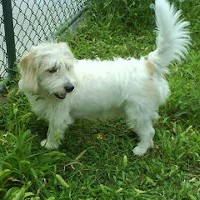
 |
Beaglolo |
|
He is not recognized by the F.C.I. |
Origin |
Great Britain <> Italy -> U.S.A. | |
Translation |
Francis Vandersteen |
A brief presentation of the Beaglolo |
| The Beaglolo is a specific cross between the Beagle and the Bolognese. It is a small to medium-sized dog. The Bolognese doesn't shed, but the Beagle sheds moderately, which means there will be some maintenance required with the acquisition of this hybrid. The Beaglolo's coat can be wavy and of medium to long length. Daily brushing and combing will keep the coat looking its best. Beaglolo dogs are energetic, loving, playful and happy. They love spending time with their families. Wherever its owners are, that's where the Beaglolo wants to be. |
History of the Beaglolo |
| The Beaglolo is a new breed with little recorded history. However, we can discuss the parental past to get an idea of the history behind the hybrid. |
A little of the Beagle |
||
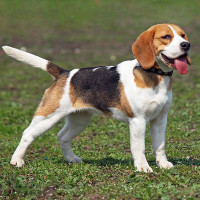
| The original Beagle was bred in England for tracking and hunting. Originally, they were called Pocket Beagles because they were so small they could easily fit into the hunter's pockets. The term Beagle is said to derive from the old French word becquele, meaning noisy person or open throat. The term was probably used because of the breed's loud call. The call was an easy way for the hunter to know where the hunt was headed. The term Beagle was not used until 1475. The Beagle is a scent hound and uses its keen sense of smell to track prey. In the 18th century, hunting with larger dogs became more popular. The Pocket Beagle was no longer used for hunting and the breed almost disappeared. Fortunately, Beagle lovers were determined to preserve the breed. By the 1840s, there were four types of Beagle: Medium Beagle, Lapdog Beagle, Fox Beagle and Rough-Coated or Terrier Beagle. In 1870, General Richard Rowett was one of the first people to import Beagles from England to the USA. General Rowett set standards for his Beagles, and his Beagles served as examples for the first American Beagles. Beagles were recognized by the American Kennel Club in 1884. The U.S. Department of Agriculture's Animal and Plant Health Inspection Service (APHIS) uses trained Beagles to inspect baggage for contraband food and plants. These trained Beagles are called the Beagle Brigade. They are responsible for around 75,000 successful seizures a year. | ||
 |
||
| Standard of the Beagle | ||
A little of the Bolognese Bichon |
||
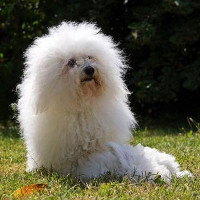
| The first recorded mention of the Bolognese dates back to the Italian Renaissance. They were kept as companion dogs by the wealthy and were often gifted to the nobility. The breed was depicted as a loving pet for royalty and dignitaries in tapestries and works of art. The Bolognese was featured in paintings by Goya, Titian, Gosse and Pierre Bruegel. King Philip 11 of Spain received two Bolognese from Alfonso d'Este, Duke of the House of Este. He was so delighted by the dogs, he wrote a letter of thanks saying, "These two little dogs are the most royal gifts one could give to an emperor." With the decline of the nobility and the start of the Second World War, the Bolognese almost disappeared. Fortunately, there were a few European breeders determined to preserve the breed. | ||
 |
||
| Standard of the Bolognese Bichon |
Appearance of the Beaglolo |
| Because the Beagle and the Bolognese are so different in appearance, it's hard to say what their offspring will look like. Variations in color, size and temperament often occur within the same litter. The Beaglolo will be a small to medium-sized dog. The coat is usually white or cream, although black has been seen, and is medium to long and wavy or curly. Most often, the Beaglolo will have floppy ears and expressive dark eyes. The Beaglolo may have a medium-sized muzzle with a black button nose. Whichever parent breed the Beaglolo takes, he'll be an adorable puppy with a happy smile, bright eyes and an eager disposition. |
Temperament of the Beaglolo |
| The Beaglolo will have a combination of Beagle and Bolognese temperaments. The Bolognese is a happy, gentle and friendly companion. It loves to play and go for daily walks, but is not a high-energy dog. If well socialized, the Bolognese enjoys making new friends with people and other dogs. The breed is not a big barker and has no juicy bark. Beagles are intelligent, affectionate, curious and friendly. Beagles are high-energy and best suited to an active family who enjoy hiking, jogging and other outdoor adventures. They can suffer from separation anxiety resulting in excessive barking or howling. The Bichon Bolonais and Beagle breeds love children. However, children should never be left unsupervised with a dog. Overall, if you're looking for a gentle but feisty companion with tons of love to give, the Beaglolo may be just the addition you're looking for. |
Needs and activities of the Beaglolo |
| Your Beaglolo can be a medium- to high-energy dog. They enjoy daily walks, interactive play with the family and activities that are beyond boring such as hiking short distances and trips to the beach or park. Because of the Beagle's hunting instinct, you shouldn't leave your Beaglolo off-leash. They may catch a scent and decide that following the scent is more interesting than practicing their recall skills. This hybrid can tolerate all temperatures but doesn't have them in extremes, either hot or cold, for long periods. If your Beaglolo likes to talk, an urban or rural home will be better than an apartment. |
Maintenance of the Beaglolo |
| The Beaglolo's coat can be medium to long and wavy. His coat should be brushed and combed daily to avoid matting and tangles. If your Beaglolo is white or cream, wipe carefully around the eyes if tear-staining seems to be a problem. Your Beaglolo's teeth should be brushed several times a week to prevent tartar build-up. Drooping ears will need to be checked and monitored, as dogs with lowered ears can experience a build-up of moisture leading to the growth of yeast or bacteria. Some Beaglolo owners prefer their dogs to be groomed, nails clipped, ears inspected and cleaned, and hair trimmed by a professional groomer every month or 6 weeks. |



 English (United Kingdom)

Comments