
 |
Bolognese Bichon |
|
FCI standard Nº 196 |
||
Origin |
Italy | |
Translation |
Mrs. Peggy Davis | |
Group |
Group 9 Companion and Toy Dogs | |
Section |
Section 1 Bichons and related breeds | |
Working |
Without working trial | |
Acceptance on a definitive basis by the FCI |
Monday 05 March 1956 | |
Publication of the official valid standard |
Friday 13 November 2015 | |
Last update |
Thursday 17 December 2015 | |
En français, cette race se dit |
 |
Bichon bolonais |
Diese Norm ist in deutscher Sprache sichtbar |
 |
Bologneser Bichon |
En español, esta raza se dice |
 |
Bichón Boloñés |
In het Nederlands, wordt dit ras gezegd |
 |
Bichon Bolognese |
Usage |
| Companion dog. |
Brief historical summary |
| Its origins are confused with those of the Maltese, because its distant ancestors are the same little dogs mentioned in Latin by Aristotle (384-322 BC) under the denomination of "canes melitenses". Already known in the Roman era, the Bolognese appears most especially among the very appreciated gifts which were made during a whole era by the powerful of that world. Cosimo de Medici (1389-1464) brought no less than eight to Brussels as gifts to as many Belgian noblemen. Philipe II, king of Spain from 1556 to 1598, after having received two as a gift from the Duke d’Este, thanks the donor in writing saying "that these two little dogs are the most royal gifts one can make to an emperor". Bolognese are represented in paintings of Titian, of Pierre Breughel called le Vieux and Goya. |
General appearance |
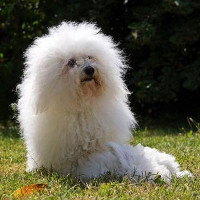
| Small size, stocky and compact, covered with a pure white coat, long and fluffy. |
Important proportions |
| Square built, the length of the body being equal to the height at the withers. |
Behaviour / temperament |
| Very serious, generally not very active. Enterprising, docile, very much attached to his master and his entourage. |
Head |
||
Cranial region |
||
Head |
Of medium length reaching 1/3 of the height at the withers. Its width, measured at the level of the zygomatic arches is the same as its length. | |
Skull |
Of slightly ovoid (egg-shaped) shape in the sagittal direction and rather flat in its upper part, has rather convex sides; the protuberances of the frontal bones are well developed - The longitudinal axes of the skull and muzzle are parallel; the frontal furrow is only slightly accentuated and the occipital protuberance only slightly marked. The length of the skull is slightly more than that of the muzzle. | |
Stop |
Rather accentuated. | |
Facial region |
||
Nose |
On the same line as the topline of the muzzle; seen in profile, its front side is on the vertical. Is large and must be black. | |
Muzzle |
Its length is equal to 2/5 of the length of the head; the topline of the muzzle is straight and the sides of the muzzle are paralell, so that the forepart of the muzzle is almost square. The lower orbital region is well chiselled. | |
Lips |
Upper lips being hardly developed in depth, they do not cover the bottom lips, and the lower profile of the muzzle is determined by the lower jaw. | |
Jaws and teeth |
Jaws normally developed, with top and bottom arches perfectly adapted. Teeth white, evenly aligned, with strong and complete dentition. Articulation of incisors as scissor bite; pincer bite tolerated. | |
Eyes |
Set on an almost frontal plan; well opened, of superior to normal in size. Eyelid opening is round; the eyeball must not be prominent; the white of the eye is not visible. The rims of the eyelids must be black, and the iris of a dark ochre colour. | |
Ears |
High set, they are long and hanging, but rather rigid at their base, so that the upper part of the external ear is detached from the skull, giving thus the impression of the head being larger than it really is. | |
Neck |
| Without dewlap; its length is equal to the length of the head. |
Body |
||
Body |
The dog being of a square construction, the length of the body, measured from the point of the shoulder to the point of the buttock bone is equal to that of the height at the withers. | |
Topline |
The straight profile of the back, and that of the loin, slightly convex, merge harmoniously in the line of the croup. | |
Withers |
Only slightly prominent from the top line. | |
Croup |
Very slightly sloping; is very wide. | |
Chest |
Point of the sternum (manubrium) only slightly prominent. Ample, let down to level of elbows, with well sprung ribs, the height reaching almost half of the height at the withers. | |
Underline and belly |
Following the profile of the sternum, then rises slightly towards the belly. | |
Tail |
| Set in the line of the croup, carried curved over the back. |
Limbs |
Forequarters |
||
Generality |
Considered on the whole, they are perfectly straight and parallel in relation to the median plane of the body. | |
Shoulders |
The length of the shoulder blades is equal to 1/4 of the height of the withers; in relation to the horizontal, they are slanting and are near the vertical in relation to the median plane of the body. They are well free in their movements. | |
Upper arm |
Well joined to the body, of an almost equal length to that of the shoulder, but less slanting. | |
Elbows |
They are on a parallel plane to the median plane of the body. | |
Forearm |
Its length is equal to that of the upper arm; follows a perfect vertical direction. | |
Carpal |
See from the front, they continue the vertical line of the forearm. | |
Pastern |
Seen in profile, the pastern is a little bit slanting. | |
Forefeet |
Oval shaped, with well cushioned dark pads and very hard black nails. | |
Hindquarters |
||
Generality |
Considered on the whole and viewed from the back, they must follow from the point of the buttock bone to the ground a perfectly vertical line - they are parallel to each other. | |
Upper thigh |
Their length is equal to 1/3 of the height of the withers. They are slanting from top to bottom and back to front and perfectly parallel to the median plane of the body. | |
Lower thigh |
Is longer than the upper thigh. | |
Metatarsus |
The distance from the point of the hock to the ground is slightly less than a third of the height at the withers. | |
Hock |
The tibia-tarsal angle is not very closed. | |
Hind feet |
Same characteristics as the front feet, but less oval. | |
Gait and movement |
| Free, energetic, with a noble and distinguished head carriage. |
Skin |
| Well taut and welded to the body all over, the visible mucuous membranes and the third eyelids strictly pigmented black. |
Coat |
||
Hair |
Long all over the body, from head to tail, from the top line to the feet. It is shorter on the muzzle. Rather fluffy, thus not lying flat, but in flocks; never forms fringes. | |
Colour |
Pure white, without any patches nor any shades of white. | |
Size and weight |
||
Height at withers |
Males 27 to 30 cm, females 25 to 28 cm. | |
Weight |
From 2,5 to 4 kg. | |
Faults |
| • Any departure from the foregoing points should be considered a fault and the seriousness with which the fault should be regarded should be in exact proportion to its degree and its effect upon the health and welfare of the dog and its ability to perform its traditional work. • Faults listed should be in degree of seriousness. |
General faults |
 Strabismus (Squinting). Strabismus (Squinting). |
Serious faults |
| Accentuated convergence or divergence of the upper longitudinal axes. Convex muzzle (Roman nose). Prognathism, if it alters the outer look of the muzzle. Size under 25 cm and more than 33 cm in the males and under 22 cm or more than 32 cm in females. |
Disqualifying faults |
| Aggresive or overly shy. Depigmentation of the nose. Nose of any other colour than black. Undershot mouth. Bilateral depigmentation of the eyelids. Wall-eyed. Tail less. Shortened tail whether natural or artificial. Any other colour than white. Patches and flecks. |
NB : |
| • Any dog clearly showing physical or behavioural abnormalities shall be disqualified. • The above mentioned faults when occurring to a highly marked degree or frequently are disqualifying. • Male animals should have two apparently normal testicles fully descended into the scrotum. • Only functionally and clinically healthy dogs, with breed typical conformation should be used for breeding. |
Bibliography |
| https://www.fci.be/ |



 English (United Kingdom)

Comments