
 |
Beagle Chin |
|
He is not recognized by the F.C.I. |
Origin |
Great Britain <> China -> U.S.A. | |
Translation |
Francis Vandersteen |
A brief presentation of the Beagle Chin |
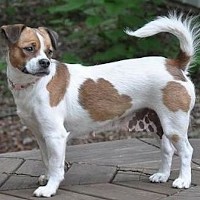
| The Beagle Chin is a small companion dog that was developed by crossing the Beagle, a rabbit-tracking dog, with one of the royal guard dogs of China and Japan, the Japanese Spaniel. The result was an intelligent little dog with soft fur, big brown eyes and a cheerful, affectionate temperament. These dogs make excellent companions for adults and older children, and are equally friendly to other pets. It's a rather small dog, however, and the Beagle Chin can be too delicate for young children to cope with properly, and prone to show increased aggression in the face of fear or injury. |
History of the Beagle Chin |
| The specific Beagle Chin cross, a hybrid between a Beagle, a tracking dog used to follow rabbits and hares, and a Japanese Spaniel, a small companion dog, has recently been developed. The Beagle Chin is quieter than the average Beagle, making it more suited to apartment living, and is generally a more robust animal than the pure-bred Japanese Spaniel, with fewer respiratory dysfunctions. |
A little of the Beagle |
||
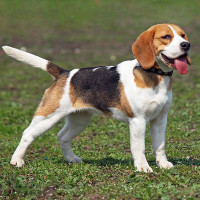
| The Beagle is a tracking dog that has been a popular breed both as a hunting companion and family dog for many centuries, and was noted by name frequently in writings as early as the 15th century. The Beagle breed has changed a little here and there since their first evolution, including a period when a small version of the Beagle known as the Beagle Pocket was bred. Breed standards for the Beagle were established in the late 1800s, around the time the Beagle Club of England and the National Beagle Club in the USA were being formed, and it was first officially recognized as a Hound by the American Kennel Club in 1885. Although the Pocket Beagle has not retained its popularity, the Beagle itself is still ranked as the fifth most popular by the American Kennel Club. | ||
 |
||
| Standard of the Beagle | ||
A little of the Japanese Chin |
||
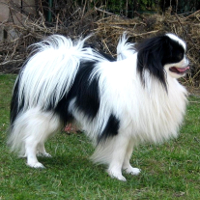
| The Japanese Spaniel is another ancient breed, its origins hidden in myth and legend. The little dogs were prized by Chinese and Japanese royalty, and when they were given as gifts to expeditionary forces in the mid-1850s, they gained popularity in England and the USA. These little dogs were recognized by the American Kennel Club in 1888 as the Japanese Spaniel, and it wasn't until 1977 that the breed name was officially changed to Japanese Spaniel. | ||
 |
||
| Standard of the Japanese Chin |
Appearance of the Beagle Chin |
| The Beagle Chin is usually a small dog with a broad, slightly rounded head. The Beagle has a square muzzle of medium length, where the Japanese Spaniel's muzzle is considerably shorter and wider. Although the Beagle Chin muzzle can resemble either the Beagle or the Spaniel muzzle, it most often ends up somewhere in between, a square muzzle slightly shorter and wider than the Beagle with a somewhat flattened appearance. They have round brown eyes that are slightly on the larger side and give an impression of gentle curiosity, and their ears can range from small triangular ones that are set high on the head and floppy forward to longer ones that are set well to the side of the head and hang down from there. As the Beagle has a short, double-layered, weather-resistant coat and the Japanese Spaniel a long, silky, single-layered coat, the hybrid of the two breeds can sport either a coat or something in between, although the most common result is a rather short, straight, soft coat with or without undercoat. |
Temperament of the Beagle Chin |
| If socialized early, they make excellent companions for adults and older children, but due to their small size and tendency to show increased levels of aggression when frightened or injured, interactions with small children must be closely supervised. They are generally pleasant with other dogs and pets, although their Beagle nature can lead some of them to chase cats and small animals. The Beagle Chin should never be left outside without supervision and protection. Dogs of this size can easily fall prey to wildlife, and although the crossbreed is less likely than the Beagle to follow its nose into trouble, it is not unknown. |
Needs and activities of the Beagle Chin |
| The Beagle Chin tends to be a friendly, gentle and loving companion with a lively, playful nature. Although lively, they are not very active and do well with shorter periods of exercise and activity. They are quite intelligent and can learn a number of commands and tricks, but they can also be easily bored and somewhat stubborn during training sessions. Consistency, creativity and patience are therefore required to bring out this animal's full potential. |
Maintenance of the Beagle Chin |
| Maintaining this hybrid dog is a fairly easy affair. Bathing should only be required every few months, although due to Beagle parentage, a doggy smell may be noticed if maintenance is not maintained. As Beagles and Japanese Spaniels are moderate shedders, it's best to brush the coat every few days to remove loose hair. This will help to spread the natural oils in the coat, keeping it healthy-looking and helping to avoid odors. With all dogs, dental care is essential, and in this case brushing the teeth two or three times a week will prevent tartar build-up. The Beagle Chin will do well with regular ear checks, especially if they fold back, trapping moisture inside. |



 English (United Kingdom)

Comments