
 |
Ausky |
|
He is not recognized by the F.C.I. |
Origin |
Australia <> Siberia -> U.S.A. | |
Translation |
Francis Vandersteen |
A brief presentation of the Ausky |
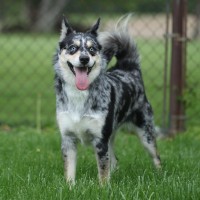
| The Ausky is a cross between an Australian Cattle Dog and a Siberian Husky, two intelligent, active and durable breeds. The resulting cross is an intelligent, active dog that does best with early socialization and lots to do. Fortunately, there are many activities to which they are suited, including running and agility training, as well as the pulling and herding activities enjoyed by the parent breeds. This breed of dog requires a lot of vigorous activity on a daily basis and can become uncooperative and destructive if not kept busy. They can inherit a tendency to be somewhat lively from the Australian Cattle Dog, and they have the strong prey drive of the Siberian Husky, making some Ausky dogs unsuitable companions for small children or fast-moving pets. |
History of the Ausky |
| The Ausky is a recent specific crossbreed and is sometimes referred to as the Australian Husky. Unfortunately, this name is also used to designate a mixture of Siberian Husky and Australian Shepherd, which makes record-keeping even more difficult. The Ausky hybrid is a mix of two very strong, agile dog breeds bred to work closely with people to handle tough, rigorous and sometimes downright dangerous jobs. Although they work closely with people, both parent breeds are known to have an independent nature, and it was this breed's independent and sometimes stubborn nature that inspired Sharon Delarose to write her book Bad Dog to Best Friend about her rescue dog, a hard-to-manage Ausky who had been abandoned by his previous owners. |
A little of the Australian Cattle Dog |
||
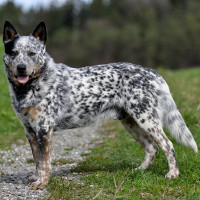
| Australian Cattle Dogs were herded in Australia by nipping at their heels, which meant they also had to be exceptionally fast and agile to avoid being hit by those same hooves. | ||
 |
||
| Standard of the Australian Cattle Dog | ||
A little of the Siberian Husky |
||
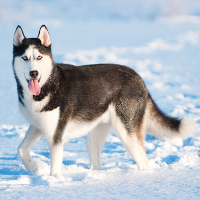
| The Siberian Husky was developed in Russia by an indigenous people known as the Chukchi to transport supplies and sometimes people across the vast expanses of ice and snow in Siberia. Although the Siberian Husky has a wolf-like appearance, it has been bred to live alongside its family, and is traditionally a very friendly breed, the addition of the Australian Cattle Dog gives the Ausky a more protective nature than the Siberian Husky, making it more suitable as a watchdog or guard dog. | ||
 |
||
| Standard of the Siberian Husky |
Appearance of the Ausky |
| These are athletic, medium-sized dogs that are both strong and agile. They tend to be slightly longer than they are tall, and are generally compact and well-muscled. They usually have a broad skull with almond-shaped eyes and a powerfully built muzzle of medium length. Their eyes may be blue or brown, or they may have one of each, and the Ausky should have triangular ears that are held erect and may be heavily furred on the inside. Dogs that are introduced as Auskies that have floppy ears may be a cross between an Australian Shepherd and a Husky rather than an Australian Cattle Dog. Both Ausky parent breeds have a double coat, a dense undercoat covered by a protective layer of stiff hair. If the dog's coat favors the Australian Cattle Dog side of their heritage, then the undercoat will be more frizzy than downy, and the guard hairs will be short, while those who take after their Siberian Husky roots will have the lower undercoat covered by a longer layer of hair. |
Temperament of the Ausky |
| Australian Cattle Dogs and Siberian Huskies have well-defined personality traits, but given that the Ausky breed is still in its infancy, it's hard to say with absolute certainty what traits these specific crossbred dogs will have. However, we can get an idea of the possible temperament of Ausky mixes by examining the traits of both the Australian Cattle Dog and the Siberian Husky. There are no guarantees as to the personality traits an Ausky will inherit from each parent. Their temperament will only become apparent as they begin to mature from puppies to adults. |
Needs and activities of the Ausky |
| Hybrid dogs like the Ausky aren't always a fifty percent cross, and overall personality traits can vary from dog to dog, however, some traits are fairly consistent. The Ausky is a vigorous breed, both in physique and temperament. They are also very independent by nature, and without early socialization and training, these dogs can become stubborn and very difficult to train. They are, however, a very intelligent breed and are quite capable of learning a variety of commands when not busy being wary. They are not animals that like to be confined, and they can inherit the nipping instinct from their Australian Cattle Dog side and a strong prey drive from their Siberian Husky genetics. These traits can make some members of this breed unsuitable to have around small children and smaller or fast-moving pets, depending on the dog's individual personality traits and early training and socialization. |
Maintenance of the Ausky |
| The grooming of this hybrid can vary somewhat from dog to dog. Although both dogs have a double coat of dense undercoat protected by a layer of straight guard hairs, the texture of the undercoat is quite different, and the top coat of a Siberian Husky is considerably longer than that of the Australian Cattle Dog. This means that if your dog takes its Australian parent in coat types, it will only need an occasional bath and regular brushing with a stiff bristle brush or a smoother brush. If your dog has inherited a coat more reminiscent of the Husky range, bathing requirements may still be rare, but brushing is more likely to be a daily requirement. Dogs with a more Husky-type coat will also shed more, and may have periods of heavy shedding in spring and autumn. |



 English (United Kingdom)

Comments