
 |
American Bully Staffy Bull Terrier |
|
He is not recognized by the F.C.I. |
Origin |
U.S.A. <> Great Britain -> U.S.A. | |
Translation |
Francis Vandersteen | |
This breed is also known as |
American Bull Staffy
|
A brief presentation of the American Bully Staffy Bull Terrier |
| Loyal and playful, the American Bully Staffy Bull Terrier is a hybrid breed developed from the American Bulldog and the Staffordshire Bull Terrier. Its history is unknown, but it is thought that the American Bully Staffy Bull Terrier was born when specific crossbreed dogs began to appear fairly recently. The American Bully Staffy Bull Terrier resembles both its parent breeds and maintains a powerful stance. It's a gentle, affectionate breed that's eager for its family's attention. The breed makes an excellent watchdog as well as an adorable companion. Intelligent and friendly, these gallant dogs will protect their families from danger. Exercise and mental stimulation are important for this canine, which likes to engage in agility and obedience. |
History of the American Bully Staffy Bull Terrier |
| The American Bully Staffy Bull Terrier is a cross between two breeds, the American Bulldog and the Staffordshire Bull Terrier. Although the breed was established in the United States, the exact year and location are unknown. There's not much information about the American Bully Staffy Bull Terrier available, so it's not currently known why the breeds were mixed. It can be theorized that the American Bulldog and Staffordshire Bull Terrier were crossed to create a more powerful breed capable of performing its tasks efficiently while being a loving companion to its family. The American Bully Staffy Bull Terrier is said to have great energy and loves to be engaged with others. He thrives on intense play and prefers to be able to move freely as Terriers do. Its original and current purpose is to serve as a guard dog as well as a wonderful companion for families. The American Bulldog is notorious for having been bred to be aggressive decades ago. Fortunately, much of the aggression comes from the parent breed, and the breed is now considered affectionate. Both the American Bulldog and the Staffordshire Bull Terrier are protectors, and like to be able to guard against danger and intruders. The Staffordshire Bull Terrier's original purpose was to hunt and chase small animals, which it did successfully. When the breed was imported to the United States, American breeders wanted to increase its weight and enlarge the size of its head. |
A little of the American Bulldog |
||
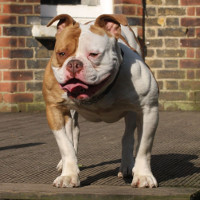
| The American Bulldog was developed as a general-purpose farm dog in the southern United States, with a specialty in catching pigs and cattle. The breed is a direct descendant of the old English Bulldog, now extinct, and is widely regarded as the modern breed in appearance, temperament and use closest to its ancestor. The American Bulldog was almost extinct by the middle of the 20th century, but was revived by the efforts of two breeders, John D. Johnson and Alan Scott, who subsequently developed two distinct lines that were named for them. In recent years, the American Bulldog has experienced a massive increase in popularity and is one of the fastest-growing breeds in the USA. Many have classified this breed as a type of Pit Bull, a member of a group of dogs collectively known as Bully Breeds, but this is totally inaccurate and regarded with great distaste by the vast majority of lovers of both American Bulldog and American Pit Bull Terrier. The two varieties of American Bulldog are sometimes referred to as the Southern White, Old Southern Whites and American Pit Bulldogs. The Scott type is also known as the Standard or Performance type, and the Johnson type is also called the Bully or Classic type. | ||
 |
||
| Presentation of the American Bulldog | ||
A little of the Staffordshire Bull Terrier |
||
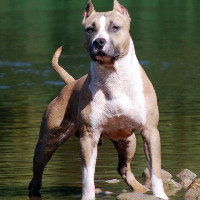
| The Staffordshire Bull Terrier is also a centuries-old English breed. At that time, bull and bear hunting was a common sport in Britain. Once these practices were banned in 1835, dog fighting took their place. To create dogs capable of this sport, Bulldogs were crossed with Black and Tan Terriers, giving rise to the Staffordshire Bull Terrier. Dog fighting was banned in England in the 1930s, although it is still practiced illegally in the underground. The breed first appeared in the United States after the Second World War. | ||
 |
||
| Standard of the Staffordshire Bull Terrier |
Appearance of the American Bully Staffy Bull Terrier |
| The American Bully Staffy Bull Terrier resembles the characteristics of its two breed parents, the American Bulldog and the Staffordshire Bull Terrier. This strong dog is considered a medium to large breed, with an average height of 30.5 to 48 centimeters and a weight ranging from 16 to 25 kilos. Its head is rounded with a strong jaw. While the American Bulldog has round eyes, the Staffordshire Bull Terrier tends to have almond-shaped eyes. The shape of your dog's eyes may vary depending on the dominant breed. The body of this energetic canine breed maintains an athletic, powerful silhouette and can take on the appearance of a leaner or stockier physique depending on the parents. The breed has strong front legs and a short coat that can come in a variety of color combinations such as brown and white and black and white. The proud stance of the American Bully Staffy Bull Terrier is that of an elegant yet agile stance. |
Temperament of the American Bully Staffy Bull Terrier |
| The American Bully Staffy Bull Terrier is described as an intelligent, playful and gentle breed that thrives on the company and attention of its family. Other typical traits include being affectionate, loyal, courageous and social. The American Bully Staffy Bull Terrier is known to have a goofy sense of humor, with a tendency to entertain and have fun. With early training and socialization, this breed is excellent with children and family. This intelligent dog may need patience and time to accept other dogs or animals, but it can be done. As far as training is concerned, the Staffordshire Bull Terrier is easier to train than the American Bulldog because of the Bulldog's stubborn ways. For this reason, your American Bully Staffy Bull Terrier may or may not be difficult to teach. Positive reinforcement will prove effective in training your dog. It's important to note that each dog is unique in the traits it can inherit from its respective breed parents. The American Bully Staffy Bull Terrier is known to have high energy levels and needs to be provided with intense play to keep its mind stimulated. |
Needs and activities of the American Bully Staffy Bull Terrier |
| The American Bully Staffy Bull Terrier is a medium to large breed with high energy levels. It would be beneficial for your dog to exercise daily for around 40 to 60 minutes with a combination of walks, intense play and other fitness activities. It's important to provide both mental and physical stimulation to avoid boredom. The American Bully Staffy Bull Terrier is considered an active breed due to one of its pedigree parents, the Staffordshire Bull Terrier. This eager-to-please dog thrives on excitement and loves to play. The breed can do well in both urban and rural areas, as long as it has plenty of room to run free and roam. An average climate is suitable for the American Bully Staffy Bull Terrier, so it's best to avoid extreme heat when exercising your dog. |
Maintenance of the American Bully Staffy Bull Terrier |
| The American Bully Staffy Bull Terrier is not considered a hypoallergenic breed and sheds moderately, partly due to one of its parent breeds, the Staffordshire Bull Terrier. Daily brushing with a curry rubber brush will help reduce the amount of dead hair on your dog. Bathing can be done every 6 to 8 weeks. Excessive bathing can lead to overproduction of oils in the body. Nails should be trimmed or filed every 2-3 weeks to prevent overgrowth, which can cause discomfort. Teeth should be brushed regularly to prevent tartar build-up. This breed is known to drool and may drool excessively at times, requiring the mouth to be wiped and washed often to prevent bacteria and odors from becoming trapped in the area. Ears should be cleaned weekly to prevent debris build-up. |



 English (United Kingdom)

Comments