
 |
Afghan Bay Retriever |
|
He is not recognized by the F.C.I. |
Origin |
Afghanistan <> U.S.A. -> U.S.A. | |
Translation |
Francis Vandersteen |
A brief presentation of the Afghan Bay Retriever |
| The Afghan Bay Retriever is a designer breed made up of two pure breeds, the Afghan Greyhound and the Chesapeake Bay Retriever. The Afghan Bay Retriever is a medium to large dog with an energetic personality and a willingness to move. The coat of this breed, which is a combination of the parents' characteristics, will need to be brushed and combed several times a week to prevent the hair from matting and the coat from becoming painful. Monthly professional grooming and clipping is recommended. Both parent breeds are independent and have a strong propensity for hunting and chasing small animals; this trait could be passed on to your Afghan Bay Retriever. For this reason, the Afghan Bay Retriever should be introduced to smaller pets at home when it is young. The Afghan Bay Retriever adapts to most environments, but does not tolerate very hot temperatures. |
History of the Afghan Bay Retriever |
| As the Afghan Bay Retriever is a new breed, there isn't much recorded history. Fortunately, there is some very detailed information on the Chesapeake Bay Retriever and the Afghan Greyhound. |
A little of the Afghan Hound |
||
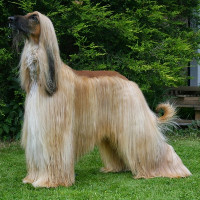
| The Afghan Greyhound is thought to be an ancient breed developed in Afghanistan, India and Pakistan. The Afghan Greyhound is a descendant of the Saluki, which originated in Persia. Originally, their role was to hunt farm animal prey and guard the herds of nomadic tribes. They were later used as coursing dogs. Coursing is a hunting technique that uses Sighthounds to catch prey by running after them. Sighthounds depend on their eyesight, agility, speed and endurance. The breed is no longer used for hunting, but is used in the sport of lure coursing. Lure coursing uses mechanical bait instead of live animals. An Afghan Greyhound won Best in Show at the 1996 World Dog Show in Budapest. An Afghan Greyhound also won Best in Show at the Westminster Kennel Club Dog Show in 1957, and again in 1983. | ||
 |
||
| Standard of the Afghan Hound | ||
A little of the Chesapeake Bay Retriever |
||
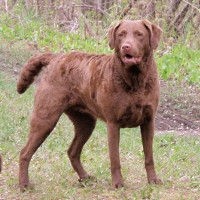
| The origins of the Chesapeake Bay Retriever go back to two dogs rescued in 1807 from a sinking ship in Maryland. They were named Sailor, the male, and Canton, the femalef and are thought to be of the Newfoundland or St. John's Water Dog breed. They were crossed with local dogs, giving rise to the Chesapeake Bay Retriever breed. The Chesapeake Bay Retriever was developed to hunt waterfowl even in poor weather conditions. In 1918, the Chesapeake Bay Retriever was recognized by the American Kennel Club, and breed standards have changed little since. The Chesapeake Bay Retriever is ranked by the American Kennel Club as the third most popular Retriever breed. | ||
 |
||
| Standard of the Chesapeake Bay Retriever |
Appearance of the Afghan Bay Retriever |
| The Afghan Bay Retriever has characteristics of both the Afghan Greyhound and the Chesapeake Bay Retriever. The dense coat of the Chesapeake Bay Retriever is designed to be water-resistant and provide camouflage while hunting. The Afghan Greyhound has a long, fine, flowing coat. The Chesapeake Bay Retriever has a large, square head, while the Afghan Greyhound has a fine face. It's difficult to know the exact appearance of the Afghan Bay Retriever, as variations are common among hybrids. Typically, this hybrid breed is a medium to large dog with an athletic build. |
Temperament of the Afghan Bay Retriever |
| The Chesapeake Bay Retriever has a strong temperament and is more independent than other Retriever breeds. They love to swim, even in icy waters. They are active dogs who enjoy participating in outdoor activities such as hunting, hiking, jogging and camping. This breed can be protective and can also be aggressive towards other dogs, if challenged. It's best to socialize them at an early stage. Afghans can be stubborn, independent and difficult to train. The breed is sometimes described as feline, as it decides when it wants affection or attention. It is not an aggressive breed. It does, however, have a hunting instinct, which can lead it to pursue small animals such as cats, rabbits and squirrels. Your Afghan Bay Retriever can be independent and stubborn. Intelligent and with an innate hunting instinct, this hybrid will always be on the lookout for something exciting to do. The Afghan Bay Retriever is not necessarily a good dog for young children, as it is very energetic and its size can knock a small child off his feet. The Afghan Bay Retriever is not made for apartment living. It needs a home and a large yard where it can run, play and explore. |
Needs and activities of the Afghan Bay Retriever |
| The Afghan Greyhound can be a gentler, easier-going dog when properly trained and socialized, but the Chesapeake Bay Retriever is probably the most stubborn or obstinate of all retriever breeds. He needs constant reminding of his pack leader and needs plenty of exercise. The Afghan Greyhound also needs space to run and play. Consequently, a mix of these two breeds would produce a dog that can sometimes be stubborn and tend to defy authority, but is also capable of mellowing out and living harmoniously in the home, provided it gets enough exercise every day. |
Maintenance of the Afghan Bay Retriever |
| The Afghan Greyhound is a hypoallergenic breed, but the Chesapeake Bay Retriever is a moderate shedder. The Afghan Bay Retriever should be brushed and combed several times a week. Its long, dense coat may need monthly washing with a mild shampoo. If your Afghan Bay Retriever has a very long coat, it may need to be trimmed by a professional groomer. His ears should be cleaned monthly with an ear cleaner. If your Afghan Bay Retriever is a swimmer, its ears should be dried after swimming adventures to avoid bacterial build-up and ear infections. |



 English (United Kingdom)

Comments