 |
Afghan Hound |
|
FCI Standard No. 228 |
Origin |
Afghanistan Patronage Great Britain |
|
Group |
Group 10 Sighthounds | |
Section |
Section 1 Long-haired or fringed sighthounds | |
Working |
Without working trial | |
Date of acceptance on a definitive basis by the FCI |
Tuesday 12 December 1961 | |
Date of publication of the official valid standard |
Tuesday 08 September 2026 | |
Date of the last update |
Tuesday 06 October 2026 | |
En français, cette race se dit |
 |
Lévrier afghan |
Diese Norm ist in deutscher Sprache sichtbar |
 |
Afghanischer Windhund |
En español, esta raza se dice |
 |
Lebrel afgano |
In het Nederlands, wordt dit ras gezegd |
 |
Afghaanse Windhond |
This breed is also known as |
Tazi
|
Usage |
| Sighthound. |
Brief historical summary |
| The first Afghans arrived in Britain in the early 1900s and one, called Zardin, won in spectacular style at the 1907 Crystal Palace show in London. The breed is also known as the Tazi, supporting its resemblance to a Russian breed of that name. One of the typical sighthounds of the world, the Afghan - who, as his name implies, comes from the mountains of Afghanistan - is a hunter and will chase if given opportunity. Nowadays also a glamorous show dog which must combine strength and dignity with a long, silky coat as well as having an Oriental expression. |
General appearance |
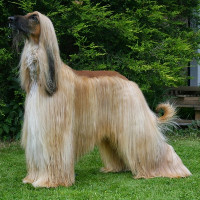
| Gives the impression of strength and dignity, combining speed and power. Head held proudly. |
Behaviour / temperament |
| Eastern or Oriental expression is typical of breed. The Afghan looks at and through one. Dignified and aloof, with a certain keen fierceness. |
Head |
||
Cranial region |
||
Skull |
Long, not too narrow with prominent occiput. Well balanced and mounted by a long “top-knot”. | |
Stop |
Slight. | |
Facial region |
||
Nose |
Preferably black, liver permissible in light-coloured dogs. | |
Muzzle |
Long, with punishing jaws. | |
Jaws and teeth |
Jaws strong, with a perfect, regular and complete scissor bite, i.e. the upper teeth closely overlapping the lower teeth and set square to the jaws. Level bite (pincer bite, edge to edge) tolerated. | |
Eyes |
Preferably dark, but golden colour permissible. Nearly triangular in appearance, slanting slightly upwards from inner corner to outer corner. | |
Ears |
Set low and well back, carried close to head. Covered with long silky hair. | |
Neck |
| Long, strong with proud carriage of head. |
Body |
||
Back |
Level, moderate length, well muscled. | |
Loin |
Straight, broad and rather short. | |
Croup |
Falling slightly away to stern. Hipbones rather prominent and wide apart. | |
Chest |
A fair spring of ribs and good depth. | |
Tail |
| Not too short. Set on low with ring at end. Raised when in action. Sparsely feathered. |
Limbs |
Forequarters |
||
Shoulders |
Long and sloping, set well back, well muscled and strong without being loaded. | |
Upper arm |
Long and sloping. | |
Elbows |
In profile vertically below the withers. Close to rib cage, turning neither in nor out. | |
Forearm |
Forelegs straight and well boned. | |
Pastern |
Long and springy. | |
Forefeet |
Strong and very large both in length and breadth, and covered with long, thick hair; toes arched. Pads well down on ground. | |
Hindquarters |
||
Generality |
Powerful. Great length between hip and hock, with comparatively short distance between hock and foot. | |
Stifle |
Well bent and well turned. | |
Hind feet |
Long, but not quite as broad as forefeet; covered with long thick hair; toes arched. Pads well down on ground. | |
Gait and movement |
| Smooth and springy with a style of high order. |
Coat |
||
Hair |
Long and very fine texture on ribs, fore and hindquarters and flanks. In mature dogs from shoulder backwards and along the saddle, hair short and close. Hair long from forehead backwards, with a distinct silky “top-knot “. On the foreface hair short. Ears and legs well coated. Pasterns can be bare. Coat must develop naturally. Any evidence of clipping or scissoring should be penalized. | |
Colour |
All colours, except merle which is unacceptable. However white markings on the head or collar are highly undesirable. | |
Size and weight |
||
Height at withers |
Ideal height : Males : 68 – 74 cms. Females : 63 – 69 cms. | |
Faults |
| • Any departure from the foregoing points should be considered a fault and the seriousness with which the fault should be regarded should be in exact proportion to its degree and its effect upon the health and welfare of the dog and its ability to perform its traditional work. • Faults listed should be in degree of seriousness. |
Disqualifying faults |
 Aggressive or overly shy dogs. Aggressive or overly shy dogs. |
NB : |
| • Any dog clearly showing physical or behavioural abnormalities shall be disqualified. • The above mentioned faults when occurring to a highly marked degree or frequently are disqualifying. • Male animals should have two apparently normal testicles fully descended into the scrotum. • Only functionally and clinically healthy dogs, with breed typical conformation should be used for breeding. |



 English (United Kingdom)

Comments