
 |
Border-Aussie |
|
He is not recognized by the F.C.I. |
Origin |
Great Britain <> U.S.A. -> U.S.A. | |
Translation |
Francis Vandersteen | |
This breed is also known as |
Aussieollie
|
A brief presentation of the Border-Aussie |
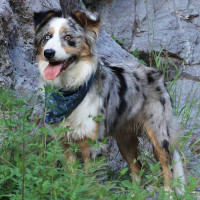
| The Border Collie and Australian Shepherd share many similarities, two extremely intelligent and capable breeds that can be trained to a high degree and are skilful workers. Energetic and a little high-maintenance, crossing these two breeds can be rather a trial. Border-Aussies won't suit every home, as they need a lot of mental and physical stimulation and will quickly acquire behavioral problems if their needs aren't met. With their muscular bodies, bright eyes and long fur, they are beautiful dogs with a striking appearance. |
History of the Border-Aussie |
| The Border-Aussie was created in recent years by crossing two of the most popular and beloved herding breeds: the Border Collie from the Scottish Borders and the Australian Shepherd from America, not Australia as most assume. This hybridization has resulted in the development of a new breed that tends to inherit the best traits of each parent. |
A little of the Border Collie |
||
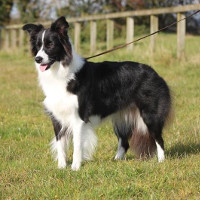
| Border Collies are black and white breeding dogs sometimes called sheepdogs. The word Border refers to the fact that they come from the border region between England and Scotland. Sheepdogs had been around for centuries, and farmers selected the most talented and demanding workers in order to create the best possible farmhands. These dogs were primarily bred to herd livestock and became experts at following their masters' complex commands. It was in the 1800s that the breed we know today as the Border Collie finally began to emerge. Although still used on farms and in sheepdog trials, Border Collies have also diversified, excelling in agility, canine dance, frisbee and flyball. | ||
 |
||
| Standard of the Border Collie | ||
A little of the Australian Shepherd |
||
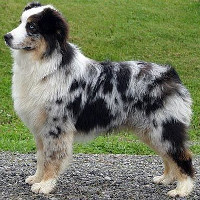
| Australian Shepherds are thought to be direct descendants of Border Collies, originating in the western United States. The very first Australian Shepherds were developed in the mid-19th century, with the emphasis on their ability to thrive in the harsher climate of the local mountains and ranches. As with Border Collies, Australian Shepherds were primarily used for breeding, a task they continue to perform today with immense skill and discipline. Initially, most dogs had blue coats, but merle patterns and tricolors are more common. Australian Shepherds have been around for almost 200 years, but it wasn't until the end of the 20th century that they were officially recognized worldwide by several breeding clubs. The Kennel Club of the United Kingdom has classified them within their pastoral group. | ||
 |
||
| Standard of the Australian Shepherd |
Appearance of the Border-Aussie |
| Border-Aussies are already fairly uniform in appearance, even though they haven't been around very long. This is obviously because their parents are closely related and share many physical characteristics. Australian Shepherds are moderately taller and heavier than Border Collies, so it's not surprising that Border-Aussies generally fall somewhere in between. On average, they measure between 48 and 56 cm and weigh between 25 and 28 kg, making them a good medium-sized breed. Border-Aussies are medium-sized dogs with strong muscles and a well-proportioned structure. They have a medium-sized skull with a good-sized muzzle. Their ears are semi-erect on the side of the head and prick up when the dog is interested in something. Their eyes are bright and sharp, giving us an indication of their intellect. They can have light blue or brown eyes, and there's a current trend towards heterochromia, having one eye of each color. The Border-Aussie's coat is a double layer, and its thickness and length vary from dog to dog. There are many potential color combinations, including the Border Collie's traditional black and white, as well as merle, red, white and the sought-after tricolor blue, among many others. |
Temperament of the Border-Aussie |
| The most prized characteristics of Border-Aussies are their impressive intellectual capacity and the speed with which they can grasp a range of new tricks and tasks. They are extremely docile and always eager to please their humans. They are known to be able to learn a large number of clues. This is a double-edged sword because, while it may make it possible to have a highly trained working dog, it means these guys need almost constant stimulation to stay balanced and content. The Border-Aussie's biggest drawback is that, in the wrong hands, they can turn into very disturbed pets. A lack of exercise and/or mental stimulation can lead to tail chasing, tail biting, incessant barking, digging and other negative vices. Border-Aussies are not the most cuddly dogs, but will have a loving relationship with their own family. When it comes to new people, they are generally aloof. Introducing them to children at an early age should ensure their tolerance, however, they tend to want to control and keep children in groups as soon as they start walking. This is not the breed for those who live in urban areas in small houses. They need lots of outdoor space and freedom. On top of that, they need to be surrounded by people and don't do well when left alone for too long. |
Needs and activities of the Border-Aussie |
| Border Collies and Australian Shepherds are very athletic and energetic animals, and require a lot of exercise. Although the mix isn't as intense as the purebred Border Collie, they're generally happiest and healthiest when they get at least two hours of vigorous physical activity and mental stimulation a day. In addition to brisk walks or jogging, this dog may also be able to expend its considerable energy with alternative activities, such as freestyle dancing, competitive Frisbee, agility training and herding. Although they are fairly quiet, this crossbreed is generally not suitable for apartment living, as it has such high energy levels. |
Maintenance of the Border-Aussie |
| Border-Aussies require regular grooming, but on the whole they're pretty easy to look after. These dogs generally have a relatively low odor, although a bath every month or two keeps them stink-free and can help reduce constant shedding. Their abundant, medium-length fur is prone to matting and matting if left unattended, and brushing is necessary several times a week, although daily is best. It's especially important to keep this breed's ears clean, as the hair growing in them can trap dirt and other contaminants, increasing the risk of your dog developing an ear infection. |



 English (United Kingdom)

Comments