 |
Weimardoodle |
|
He is not recognized by the F.C.I. |
Origin |
Germany <> France -> U.S.A. | |
Translation |
Francis Vandersteen | |
This breed is also known as |
Weimarpoo
|
A brief presentation of the Weimardoodle |
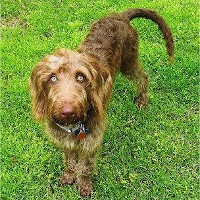
| The Weimardoodle is a hybrid dog developed by crossing a Weimaraner with a Poodle. They are medium to large in size. They weigh between 20.5 and 32 kilos and range in height from 51 to 69 centimeters. Their fur is generally wavy or curly and can be brown, black, white, isabella or fawn. They can be hypoallergenic and shed very little. These dogs are very protective and loyal, and tend to form strong bonds with their masters. They get on very well with children and other pets, but if not properly socialized, they may become wary of strangers in adulthood. |
History of the Weimardoodle |
| The Weimardoodle is a hybrid developed in the USA by crossing a Weimar Pointer with a Poodle. Its date of origin is unknown, but is thought to be within the last two decades. |
A little of the Weimaraner |
||
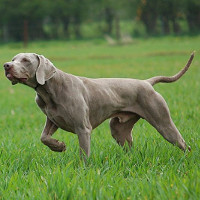
| The origins of the Weimar Pointer date back to the early 19th century. The breed was developed at the court of Weimar in Germany. The breed was developed for hunting; the aim was to create an intelligent, courageous dog with great detection ability, speed and stamina. These dogs were also very loyal and excellent companions. It is thought that the bloodhound, English pointer, blue Great Dane, German shorthaired pointer and German wirehaired pointer were used to develop this breed, first known as the Weimar pointer. In 1897, strict breed standards were established by an exclusive Weimaraner club in Germany. To obtain a Weimaraner, you first had to be accepted into this exclusive club. The Weimaraner was imported to America in 1929 when an American sportsman was allowed to join the German club. The American Kennel Club recognized the Weimaraner in 1942. The breed quickly became popular after World War II, notably after President Dwight D. Eisenhower brought a Weimar Pointer to the White House. | ||
 |
||
| Standard of the Weimaraner | ||
A little of the Poodle |
||
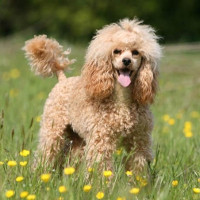
| The Poodle is thought to have originated in Germany and then developed in France. It is thought that water dogs from various European countries were used in its development. Another common belief is that these dogs are related to Asian herding dogs. Whatever the case, it's well known that the Poodle is a very ancient breed. The Egyptians and Romans drew Poodle-like dogs on their artefacts and in their tombs in the early centuries BC. Miniature Poodles and Toy Poodles were later developed by mating small Poodles together, as no other breed was used in their creation. These smaller dogs were developed to appeal to the French bourgeoisie. The Standard Poodle was used for duck hunting, and the Toy Poodle for truffle hunting. Dwarf Poodles were used as companions only by the rich and noble. Eventually, gypsies discovered the Poodles' talent and began training them for circus shows. They dressed the dogs and cut their fur into attractive shapes to make them more appealing. Wealthy individuals then followed the trend, giving their Poodles fancy haircuts and even having them dyed. The American Kennel Club registered the first Poodle in 1886. Poodles became famous in America after the Second World War. | ||
 |
||
| Standard of the Poodle |
Appearance of the Weimardoodle |
| The Weimardoodle can weigh between 20.5 and 32 kilos and measure between 51 and 69 centimeters. They have a shaggy appearance; their coat is dense, short or moderately long, and usually curly or wavy, although they can inherit the straight, coarse coat of the Weimar Poodle. The coat can be black, gray, chocolate, fawn, isabella, white or black and white. They have a thin complexion, with elongated legs. Their faces are rather small and slightly rounded, with a narrower, longer and flatter muzzle. Their eyes are large and almond-shaped, and they have a pensive look. Their eyes can be brown, hazel or green. They have a large, pointed nose that can be black, brown or isabella. They have long, floppy ears and a long furry tail. |
Temperament of the Weimardoodle |
| Weimardoodles are super-loyal dogs who like to form strong bonds with their owners. They are very affectionate and need to be with their family, considered a beloved member. They are not comfortable being left alone, as they suffer from separation anxiety. These gentle dogs are excellent with children and other pets. However, if not properly socialized from infancy, they can be wary of strangers. Your Weimardoodle is highly intelligent, which makes him easy to train, but he may inherit some of the stubbornness of the Weimar Pointer. In this case, you'll need to be very consistent, firm and provide positive reinforcement. Remember, you'll get the best results if you treat him with love and give him lots of praise and treats. These dogs are also very protective and make excellent guardians. They are happy, lively and active, and make excellent companions. |
Needs and activities of the Weimardoodle |
| The Weimardoodle is an active dog that needs plenty of exercise to stay happy and fit. It will need a daily walk of at least 30 to 45 minutes, and time to play and run freely in a yard or park. Being highly intelligent, these dogs also need mental stimulation; agility activities are welcome, as is the chance to play with stimulating toys. They enjoy a good game of fetch and are likely to enjoy swimming too. These dogs live best in cooler climates because of their dense fur. The ideal environment for him is to live in a house with a nice yard to play in. However, he can adapt to apartment living as long as he has plenty of outdoor activity. |
Maintenance of the Weimardoodle |
| Weimardoodles can be hypoallergenic, depending on whether the Poodle coat is dominant, and are low shedders. Because of the density and texture of its fur, you should brush your Weimardoodle at least three times a week to avoid tangles and knots, and remove debris. He's not a smelly dog, so only bathe him when necessary, using a delicate dog shampoo to avoid drying out his skin. A visit to the groomer every 3 months is recommended to groom his coat. Clipping will help keep his coat neat and well-formed, especially if his coat is similar to that of his Poodle parent. You should also clean his ears every week; you can do this using an ear cleaning solution with a cotton ball. Brush his teeth at least three times a week to remove tartar build-up and bacteria. Trim his nails once or twice a month if they're too long, or take him to the groomer for a professional trim. |



 English (United Kingdom)

Comments