
 |
Texas Heeler |
|
He is not recognized by the F.C.I. |
Origin |
Australia <> U.S.A. -> U.S.A. | |
Translation |
Francis Vandersteen |
A brief presentation of the Texas Heeler |
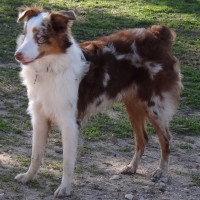
| The Texas Heeler is a hybrid dog. Its parent breeds are the Australian Cattle Dog and the Australian Shepherd Dog. It's a friendly dog, but it's also very protective of its family. More importantly, he's also protective of his territory. They are excellent watchdogs. They are highly intelligent. So he's easy to train. He's also known for his herding skills, so he may not be suitable for families with young children. He's happiest in an active family. He's best suited to a home with a large yard, especially on a farm or in rural areas. |
History of the Texas Heeler |
| The Texas Heeler is a hybrid dog. It's a fairly common hybrid, but there's not much information on its exact origins. We do know, however, that it was probably first developed in Texas in the middle of the 20th century. Lucy Guynes registered the very first Texas Heeler in 1970 with the Dog Registry of America. The Heeler has also been recognized by the American Canine Hybrid Club in recent years. Since there is so little information on the exact origins of the Texas Heeler, we might examine the history of its parent breeds to understand the hybrid breed a little better. |
A little of the Australian Cattle Dog |
||
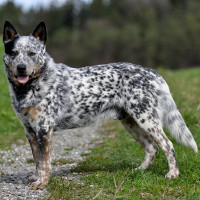
| The Australian Cattle Dog was developed in the 19th century by Australian settlers to herd cattle on ranches. The dogs that had been imported from England had not proved robust enough to cope with the hardships of ranch life in Australia. So breeders began crossing these English dogs with Australian Dingoes. As most of these dogs ended up with a distinctive blue coat, the nickname Blue Heeler stuck. In 1893, Robert Kaleski began breeding Blue Heelers. In 1897, he began showing the breed. Although there is no information on how the Blue Heeler came to America, we do know that the first Australian Cattle Dog was registered with the American Kennel Club in 1980. | ||
 |
||
| Standard of the Australian Cattle Dog | ||
A little of the Australian Shepherd |
||
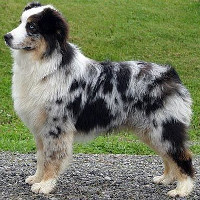
| The Australian Shepherd is not native to Australia; it's an American dog through and through. He was bred to herd cattle on western ranches. No specific breeds have been documented as having been used to develop the Australian Shepherd Dog. Most experts believe that the Australian Shepherd is the result of the importation of many Australian-born Collie and sheepdogs into the United States. The Australian Shepherd was most popular just after World War II, when the Western movie craze was at its height. It was registered with the American Kennel Club in 1993. | ||
 |
||
| Standard of the Australian Shepherd |
Appearance of the Texas Heeler |
| The Texas Heeler is a medium-sized dog. It's worth noting that it often has the curled tail of its parent breed, the Australian Cattle Dog. Texas Heelers come in a variety of colors and coat variations. It generally has a short to medium-length coat, from 2.5 to 7.5 centimeters in length. Its coat is generally smooth and soft. It often resembles the Australian Cattle Dog, but its color can vary. It can be black, blue merle or blue ticked. It may have some white or tan trim, especially on the feet and legs. They usually have the straight ears of their Australian Cattle Dog parent, but may inherit the folded ears of the Australian Shepherd Dog. |
Temperament of the Texas Heeler |
| The Texas Heeler is a highly intelligent dog. That's why they're easy to train. He'll watch you constantly for clues and signals. He also has natural herding instincts, which can sometimes be a challenge for him. He is affectionate with his family and very protective too. He can be aloof with strangers and keep them away from you to protect you. We recommend giving the Texas Heeler a good dose of early socialization to teach him how to behave with his family and with strangers. He's an excellent watchdog, but he may not bark much, except in the presence of a stranger. Although he gets on well with children, he may bite and nag them from time to time. He is not, however, recommended for homes with other dogs or pets. |
Needs and activities of the Texas Heeler |
| The Texas Heeler is a very energetic working dog. He really enjoys having a job to do. He loves learning tricks and commands, and may enjoy participating in agility and flyball activities if he's not assigned to farm or ranch work. Don't forget that he was born to herd cattle, and he won't waver from this instinct. He enjoys any kind of exercise, especially a thirty-minute walk twice a day. However, the best exercise for the Texas Heeler comes from simply running freely outdoors. The Texas Heeler will appreciate outings to the dog park. He'll especially appreciate being taken to an off-leash area where he can play freely. He'll love joining you for hikes on any type of terrain. The Texas Heeler will enjoy any outdoor family activity. |
Maintenance of the Texas Heeler |
| The Texas Heeler is a low-maintenance dog. Its coat is often quite short and smooth. However, as it can have the longer coat of the Australian Shepherd, you may need to brush it weekly to prevent tangling or matting. Only bathe him when necessary. Note: it's important to remember that the Texas Heeler can be sensitive to touch. This means you need to establish a grooming routine with him from an early age so he knows what to expect. Brush his teeth two or three times a week to prevent bad breath and tartar build-up. However, if you want to prevent tooth decay, brush his teeth daily. Trim his nails every two weeks, unless he wears them down naturally. If he has straight ears, you should only clean them when you bathe him. If his ears are folded, you'll need to clean them with a damp cotton pad, perhaps every week. Wipe his ears with the cotton and check for any redness or odours. If you notice any of these symptoms, your dog could be suffering from an ear infection. |



 English (United Kingdom)

Comments