 |
Schnoodle |
|
He is not recognized by the F.C.I. |
Origin |
Germany <> France -> U.S.A. | |
Translation |
Francis Vandersteen |
A brief presentation of the Schnoodle |
| Schnoodles are among the growing number of specific cross-breed dogs that are now commonplace. They are a cross between a Schnauzer and a Poodle and, with a little luck, inherit the best characteristics of both. While the Schnauzer is renowned for its loyalty and fiercely protective nature, the Poodle is a playful and extremely intelligent dog. The best examples of the Schnoodle display these characteristics, without being as stubborn as the Schnauzer or as exciting as the Poodle. However, crossbreeding is always a gamble, and you can never be completely sure of the outcome in terms of appearance and temperament. In the case of the Schnoodle, perhaps more than any other hybrid, appearance can vary enormously, as its two parent breeds come in three distinct flavors: toy, miniature and standard in the case of the Poodle and miniature, standard, and giant for the Schnauzer. What's more, the coats of the two breeds couldn't be more different. When someone tells me they're bringing a Schnoodle, I'm never sure whether I'm about to meet a tiny, barbed-haired creature, or something soft and fluffy that deserves its own zip code. The Schnoodle is a very active dog and needs plenty of exercise. Its high level of intelligence means it needs almost constant contact with its inhabitants and plenty of mental stimulation. Many dogs don't do well when separated from their owners, and will need to be enrolled in a crèche if there's no one at home for long periods during the day. Although cross-breeding can produce healthier offspring than the parents, this is not always the case, as the genetic lottery means that puppies can inherit many health problems affecting family trees. Anyone wishing to buy a specific cross-breed dog needs to be aware of any potential health problems, and be at least as scrupulous when choosing a breeder as when buying a pedigree puppy. That said, the average Schnoodle is healthier than the average dog of its parent breeds, and most have a life expectancy of around 15 years. |
History of the Schnoodle |
| Poodle crosses have always aroused great interest. The breed's high intelligence is widely known, and many believe that its low-film coat is hypoallergenic, although this is disputed by doctors and immunologists. Personally, I think the fact that doodle can be easily associated with many breed names has also played a part. Labradoodles, Dalmadoodles and Mastidoodles are just a few of the hybrids. However, whatever the initial reasoning behind their development, the good nature and sustained temperament of most of these crosses cannot be denied. The Schnoodle made its appearance in the 1980s and has always been one of the most popular specific cross breeds, perhaps because of the variety of shapes and sizes it can fit into. The contrasting and potentially complementary personalities of the two parent breeds also make for a good match. Detractors of the Schnauzer will denounce its stubbornness and sometimes excessively territorial behavior, while those who aren't fans of the Poodle cite its highly tense and excitable character as a flaw. The original Schnoodle breeders hoped that mixing the two breeds would create the ideal pet, and in many cases, it would. Although never designed to be a working dog, most Schnoodles are excellent watchdogs. They demonstrate the naturally territorial behavior of Schnauzers, as well as a tendency to bark, sometimes excessively. |
A little of the Schnauzer |
||
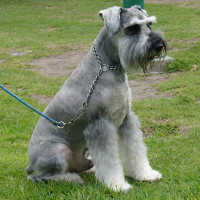
| The Schnauzer is a German breed from Bavaria, distinguished by a facial coat with long eyebrows and a large moustache. A versatile working dog, in addition to hunting vermin, the Schnauzer would have been used on farms to herd animals, guard property and even pull carts. Farmers developed three different breed sizes to ensure that every farm task could be performed by the most appropriate sized dog. To create the smaller variant, local breeds such as Affenpinschers and Poodles were mixed, while breeds such as the Great Dane would have enriched the gene pool of the Giant Schnauzer. | ||
 |
||
| Standard of the Schnauzer | ||
A little of the Poodle |
||
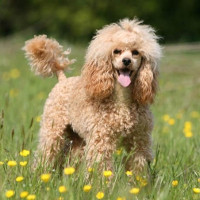
| The Poodle is one of the main players in the new world of hybrid dogs, and is renowned for its versatility. An intelligent dog that excels in many disciplines, the Poodle is not only an excellent pet, but can also compete successfully in events such as agility and flyball. The general public tends to associate the Poodle and its hairstyle with France, but the truth is that it's a German breed. Despite their glamorous appearance, they were originally bred to hunt and retrieve waterfowl and have always been fantastic swimmers. The Poodle is available in three sizes: Toy, Miniature and Standard, although it is the larger Standard Poodle that contributes to the Airedoodle breed. Poodles are recognized by the Kennel Club within their public service group. | ||
 |
||
| Standard of the Poodle |
Appearance of the Schnoodle |
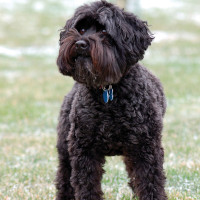
| As mentioned above, the genetic lottery can produce a wide variety of Schnoodle types. Most often, it's the toy or miniature Poodle that's crossed with the miniature Schnauzer, meaning their offspring typically weigh between 6 and 12 kg and measure 25 to 30 cm. However, some are much bulkier, and a cross between a Standard Poodle and a Giant Schnauzer can weigh over 40 kg, making it a very large schnoodle. These are fairly slender dogs, with legs that are long in relation to the body. The head and face are generally less refined than in the Poodle, and the body is lean and strong, a reflection of the Schnoodle's athleticism. The coat is the other extremely variable characteristic, as the Schnauzer has a rough, stiff coat, while the Poodle is famous for its softness and curls. Most Schnoodles have a coat that falls somewhere between these two extremes, although this cannot be guaranteed. The coat can come in many different colors, including: gray, brown, apricot, black, white, sable, black and white, black and beige. |
Temperament of the Schnoodle |
| Schnoodles are very affectionate dogs who like to be the center of attention. They love to have fun, and most have an array of unavoidable tricks to attract attention if they feel ignored. They are also known for their extreme dexterity, using their front paws to manipulate objects in the same way as a cat. Luck permitting, most will spend a lot of time lying on their owners' laps or feet for the comfort and contact this provides. In general, Schnoodles are great with children, again, it must be stressed that some can have the spark of a stubborn Schnauzer and can't tolerate the hissing and prompting that can come from a young child. With their inherited instinct to protect their people and property, they are vigilant and very vocal. Guard dogs and nuisance barking can be a problem, especially for those left alone for long periods. For Schnoodle-owning families who go to work during the day, it's essential to hire a dog walker or book a place at a good dog daycare center. |
Needs and activities of the Schnoodle |
| This hybrid breed is very adaptable and can live well in an apartment. They are moderately active and best suited to owners who share the same love and can commit to a moderate amount of daily exercise. They are talented dogs who enjoy agility, jogging, retrieving play or simply running around the yard, as well as relaxing moments to unwind with loved ones. Since these dogs are so smart, they'll need to exercise both mind and body. Challenge them mentally in a fun and enjoyable way by playing games. This will help you bond with your dog. Given their activity level, this breed should be active for around 30 minutes and up to 60 minutes a day. |
Maintenance of the Schnoodle |
| Schnoodles can have different types of coat, as the two parent breeds are very different. The coat of these brand-name dogs can be curly, straight or stiff, depending on the parent they inherit. In most cases, the coat will be curly or wavy. This breed generally requires professional grooming every 4 to 6 weeks or so. If you choose not to take your dog to a professional groomer, you should brush him every day or at least once a week. They should also be combed and washed regularly. As this breed tends to develop tear stains, their face should be washed every day. Nails should be trimmed once or twice a month, depending on the dog's activity. Ears should also be cleaned daily. This will help prevent ear infections. Finally, your dog should have his teeth brushed two or three times a week, although every day is better if you can manage it. This simple task will prevent unwanted tooth and gum decay. |



 English (United Kingdom)

Comments