
 |
Havapeke |
|
He is not recognized by the F.C.I. |
Origin |
Western Mediterranean basin <> China -> U.S.A. | |
Translation |
Francis Vandersteen |
A brief presentation of the Havapeke |
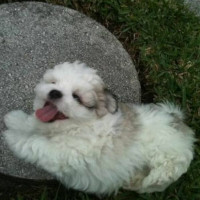
| The Havapeke is a hybrid dog, combining a Havanese parent and a Pekingese, usually of the toy variety. The Havapeke is a small dog with abundant long fur, a compact body and a soft face. Their thick, abundant coat requires considerable dedication and daily combing to keep it tangle-free and in good condition. Like many small dogs, Havapekes know their own minds and tend to take control of them. This can make them difficult to control for the first-time dog owner, while early socialization and good training help to overcome this tricky trait. |
History of the Havapeke |
| A relative newcomer to the scene, it's difficult to trace the history of the Havapeke, so we can really only look at the history of its parent breeds. |
A little of the Havanese Bichon |
||
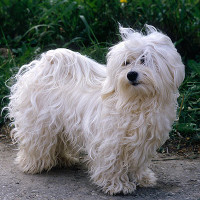
| As its name suggests, the Havana Bichon originated in the Cuban city of Havana and is known as the Little White Dog of Havana. This original breed originated from dogs brought to Havana by the first settlers, but unfortunately no longer exists. From this lineage came many of the most popular dog breeds, such as the Bichon Frise, Bolognese, Maltese and Coton de Tulear. Spanish settlers in Cuba took a liking to these affectionate little dogs and quickly exported them to Europe. The breed became an endangered species in the 1950s, but subsequently became Cuba's national dog and now enjoys healthy popularity both in their native Cuba and abroad. | ||
 |
||
| Standard of the Havanese Bichon | ||
A little of the Pekingese |
||
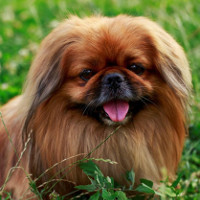
| The Pekingese originated in China and is considered one of the oldest dog breeds still in existence. They have been around for around 2,000 years and are named after the city of Peking, now Beijing. For centuries, the Pekingese dog was closely guarded and was a favorite of the Chinese nobility. Indeed, this special little dog was not allowed to leave the confines of the palace and was certainly not taken abroad. The first Pekingese dogs to enter Western hands did so in 1860, when the British army invaded Peking during the Opium War. These dogs are known as Carlins or Chinese Spaniels, and the breed remained rare outside China for many decades. | ||
 |
||
| Standard of the Pekingese |
Appearance of the Havapeke |
| Think soft play ball and you've summed up the Havapeke. The dogs may be small, but they're friendly. Both parent breeds are blessed with long, luxurious locks, and the resulting production is no different. On a more serious note, the Havapeke is small or toy-sized, their appearance varying according to which parent the puppy takes after most. However, both parents have several traits in common: they are compact, their legs are short and sturdy, and their medium-length feathery tail is carried on their back. A major difference between the parents is the shape of the skull and the length of the nose, the Pekingese having a very flat face. Thus, a Havapeke generally has a stubby muzzle or a muzzle of intermediate length. Both parents also have floppy ears and long coats. As for their coats, the Havapeke can be a range of colors, including black, fawn, white and black or fawn and black. |
Temperament of the Havapeke |
| Sensitive but stubborn, sums up the Havapeke temperament. They are loyal and affectionate dogs, but have certain cat-like characteristics, such as wanting to do things on their own terms. The Havanese has a reputation for being gentle and extremely tolerant, while the Pekingese parent is more demanding and can remain aloof. Indeed, the latter trait may mean they're happiest when they're the sole center of attention in a household with no other pets. Although affectionate, Havapekes don't appreciate a hard life and may not be suitable for people with young children. Another factor to consider is their love of barking. Although their small size allows them to live comfortably in an apartment, neighbors may not be pleased. |
Needs and activities of the Havapeke |
| The Havapeke has moderate energy and requires daily exercise, but its intensity is very low. What's more, exercise can easily be broken down into a few daily 15-minute sessions. The Havapeke's flat face makes breathing difficult, so overly intense exercise is never suggested. The Havanese parent prefers warmer climates, while the Pekingese parent prefers colder climates, which leads Havapekes to prefer temperate climates and indoor living. However, hot climates can stress the Havapeke, which doesn't breathe well. The toy size and low energy of this hybrid make it perfectly suited to apartment living. |
Maintenance of the Havapeke |
| The Havapeke is a hypoallergenic hybrid that sheds moderately due to its Pekinese parentage. The long hair needs daily brushing to avoid matting and tangles, especially around the face and hindquarters. Moisture and dirt can accumulate in the ears. Check and clean them with a vet-approved solution if necessary, taking care not to leave any moisture in the ear, and dry thoroughly after cleaning. As the Havapeke's skin is sensitive, frequent bathing is not recommended, as it may remove the natural oils. The Havapeke's flatter face can affect dentition and, although all dogs should have their teeth brushed regularly, they should be brushed at least twice a week to prevent dental problems. |



 English (United Kingdom)

Comments