
 |
Golden Dox |
|
He is not recognized by the F.C.I. |
Origin |
Great Britain <> Germany -> U.S.A. | |
Translation |
Francis Vandersteen |
A brief presentation of the Golden Dox |
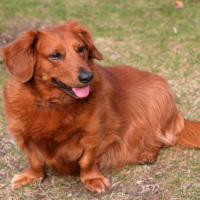
| If you've ever wondered what a shrunken Golden Retriever would look like, the answer is probably a Golden Dox. The chondrodystrophe or Texkel dwarf has been crossed with the large Golden Retriever to create a feisty hybrid with a long body and fleshy limbs. While some inherit the golden, wavy coat of the Retriever, others will have a brown or red coat. Elegant, friendly and dynamic, the Golden Dox is the ultimate companion dog, and an excellent choice for new owners and families with children. However, they require a lot of attention and may become stubborn during training sessions, so they may not be suitable for everyone. |
History of the Golden Dox |
| The canine world is truly an incredible place, where all breeds can be mixed, no matter how unusual. One of the most unexpected creations of the specific crossbreed dog explosion of recent decades has been the Golden Dox, or Golden Doxie. The wiener Dachshund was bred with the gentle Golden Retriever to create the rare and curious Golden Dox. Although records are lacking, it's likely that the first Golden Dox was created in the 1980s to 1990s. Their popularity hasn't increased much since, and they're not a well-recognized breed today. Their parents, on the other hand, have a rich history and are commonly used as pets around the world. |
A little of the Golden Retriever |
||
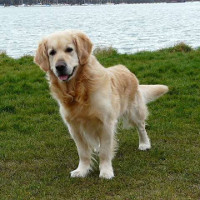
| Golden Retrievers are large, highly trainable dogs with an exceptionally gentle and affectionate character. It was originally developed in Scotland as a breed capable of retrieving game both on land and in water. Today, the Golden Retriever continues to be used as a working dog, but is also a popular choice of family pet due to its good nature. The breed has a medium-length wavy coat, which comes in a variety of light colors. | ||
 |
||
| Standard of the Golden Retriever | ||
A little of the Dachshund |
||
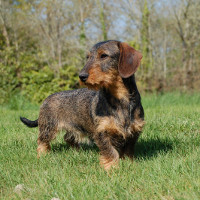
| The Dachshund was developed in Germany to hunt and kill burrowing animals, especially badgers. To do its job effectively, the Dachshund had to be small enough to slip into badger tunnels, brave enough to chase down an angry badger and tough enough to eliminate the badger once it arrived. Although the majority of today's Dachshunds are kept as pets, they still have the same courage and tenacity as their ancestors. The first Dachshund clubs began to form in the late 1800s, and only eleven of these sturdy little dogs were registered with the American Kennel Club in 1885. The breed quickly gained popularity throughout the United States and, by 1914, was one of the ten most popular breeds. | ||
 |
||
| Standard of the Dachshund |
Appearance of the Golden Dox |
| With two remarkably dissimilar parent breeds, the appearance of the Golden Dox varies enormously, and even puppies from the same litter can look completely different. There are, however, certain similarities that we can discuss and that characterize most cases. Many describe this breed as a dog with the head of a Golden Retriever and the body of a Dachshund, but the reality is not so clear-cut. Golden Dox ears sit high on the head, and their fur often extends to the chin. Their eyes are dark brown with an affectionate, confident expression. Their nose can be black or brown and is an important feature of their endearing face, sitting at the end of a long muzzle. An elongated body is frequently seen. It should be well muscled and supported by short, stocky legs. As with the Dachshund, the Golden Dox's coat can be of many lengths and colors. The coat tends to be dense and can be short or long and straight or wavy. There are rough and smooth-coated variants. Despite the name Golden Dox, the coat can be various shades of brown, yellow or red. A fully developed dog can weigh from 13 to 27 kg and measure between 25 and 58 cm. |
Temperament of the Golden Dox |
| The Golden Retriever and Dachshund are both known for their super-star personalities. So it's no surprise that the Golden Dox has inherited a wonderful temperament. A true people lover, this dog is loyal to its family and loves nothing more than to be in their company. Lively and fun-loving, they make excellent playmates for children and are capable of being gentle and sweet in their presence. A happy, social fellow, the Golden Dox is rarely a good watchdog, as it is more likely to welcome an intruder than scare them away. The ease with which this breed can socialize, both with humans and other animals, makes it a good option for first-time owners. One characteristic that may not suit all households is the Golden Dox's very high energy level. They are by no means divided into potatoes and thrive on constant attention, enjoying the opportunity to complete their chores and take part in all sorts of activities on offer. If you associate their intelligence with a playful attitude, you soon realize that this dog has the potential to get bored easily if not sufficiently entertained. In situations where the Golden Dox feels under-stimulated, they may begin to develop nuisance behaviors, such as digging, chewing or barking. |
Needs and activities of the Golden Dox |
| The Golden Dox has a high energy level that will require between 45 and 60 minutes of activity per day. This active breed will benefit from intense activity to meet daily needs and keep them happy. The Golden Dox will thrive on a fun lifestyle of running, fetching and swimming. At least two walks a day is the recommended minimum, with the addition of other activities to stimulate his mind. An ideal environment for your Golden Dox would be a rural home with a fenced yard and a temperate climate. Apartment living is discouraged due to this hybrid's high energy level, which would encourage your dog to engage in property destruction. |
Maintenance of the Golden Dox |
| The Golden Dox is not considered a hypoallergenic breed and maintains low shedding levels throughout the year. Although the length of its hair can vary, it will require some trimming for maintenance. Professional grooming is recommended every 4 to 6 weeks to avoid matting. Daily brushing with a stiff bristle brush for 10 to 15 minutes will help reduce hair damage. We recommend bathing your dog every 6 to 8 weeks. This breed is not known for salivating or being odorous. Ears should be wiped and cleaned weekly, and nails clipped and trimmed every 2-3 weeks. Teeth should be brushed daily to prevent tartar build-up and tooth decay. |



 English (United Kingdom)

Comments