
 |
Frenchie Pug |
|
He is not recognized by the F.C.I. |
Origin |
France <> China -> U.S.A. | |
Translation |
Francis Vandersteen |
A brief presentation of the Frenchie Pug |
| Two popular small breeds, the French Bulldog and the Pug, have been crossed to create the adorable and sought-after Frenchie Pug. This dog is stocky and small, with a curved tail and big, adorable ears. Their short coat comes in a variety of colors and requires little grooming. While the Frenchie Pug is lively, it is not very active, making it suitable for older people or hectic lifestyles. Social butterflies, this breed will never refuse to make new friends, whether four-legged or two-legged. |
History of the Frenchie Pug |
| The Frenchie Pug is often called the Frug by connoisseurs, and this adorable little rascal is, of course, a cross between the French Bulldog and the popular Pug. Although there's a lot of information available on the history of the French Bulldog and the Pug, it's hard to know when the very first Frenchie Pug was created and in which country. In fact, it's quite possible that breed enthusiasts have created this mix independently of each other, all over the world, over the last 50 years. Now that they've been recognized as a specific crossbreed dog in their own right, we've recently started to learn a lot more about the Frenchie Pug. |
A little of the French Bulldog |
||
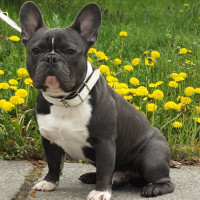
| The English Industrial Revolution replaced many workers with machines. By the 1850s and 1860s, lacemakers were out of work. English lacemakers began moving to France to find work. They brought their dogs, which were small, miniature Bulldogs. Eventually bred with the native French Bulldog, today's French Bulldog was born. In 1885, a breeding program for American French Bulldogs was launched. Once in America, the breed became popular with society women. The breed was shown at the Westminster Kennel Club dog show in 1896. The only winners in the French Bulldog group were those with "pink ears", not breed members with "erect bat ears". The ladies of the society disagreed with the judge's decision. They formed the French Bulldog Club of America, which went on to create the breed standard. The "erect bat ear" was the correct type. In the early 20th century, the breed was owned by the Rockefeller family and the J.P. Morgan family. The American Kennel Club recognized the breed in 1898. By 1906, the French Bulldog was the 5th most popular dog breed in America. | ||
 |
||
| Standard of the French Bulldog | ||
A little of the Pug |
||
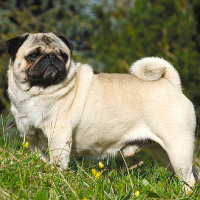
| The Pug originated in China and has probably been around for almost 2,000 years. Their big life personality and funny cute looks have secured their place on the most popular breed 10 lists in several countries, including the UK. Recently, however, they have been the subject of much criticism, with some feeling that their breeders put too much emphasis on their looks and didn't pay enough attention to their overall health. | ||
 |
||
| Standard of the Pug |
Appearance of the Frenchie Pug |
| An undeniably cute crossbreed, the Frenchie Pug resembles a sturdy French Bulldog with straight ears that can point to the sides like bat ears. Their eyes are dark brown and often bear a soulful expression. They are a brachycephalic breed, which means their skull is shortened and broad. Their skin often forms wrinkles around their face. Their bodies are compact and well-muscled, ending in strong legs and clean, compact feet. Most individuals inherit the long Carlin tail that curves around the back. With short, straight fur, the Frenchie Pug's coat is glossy and low-maintenance. The coat can be black, cream, fawn or brindle, and white patches are a common feature. A darker fur mask may be present. Some breeders will sell dogs of certain fur colors for more money, depending on what's in fashion, with trends varying over time and from country to country. Once mature, most dogs of this breed will weigh between 6.5 and 10.5 kilos. At the withers, Frenchie Pugs reach heights of between 25 and 30 centimeters. |
Temperament of the Frenchie Pug |
| Energetic and full of life, the Frenchie Pug is an entertaining animal with a big heart all around. Relaxed and positive, these dogs tackle life head-on, always ready to play with adults and children alike. They are warm and affectionate with those they love, and thrive when shown constant attention. The Frenchie Pug, alert and curious, loves to be part of your life and often follows its owner around. They like to be part of what's going on and can't stand to be left alone for long periods. Sociable guys, this breed loves company, whether animal or human, and gets on well with house guests. Not particularly territorial or defensive, the Frenchie Pug is a poor watchdog. |
Needs and activities of the Frenchie Pug |
| The Frenchie Pug is somewhat active, but only needs 20 to 40 minutes of daily activity. They can take a short walk, stroll indoors or go to the dog park, but prefer to stroll around the house watching their humans. Nevertheless, the Frenchie Pug is an excitable animal who will engage in recreation if asked. This breed also enjoys playing with chew toys and balls, although they are not adept at retrieving them. Note that Frenchie Pugs are extremely sensitive to heat. It's therefore important for owners to monitor their pets' temperature, especially on hot days. As a result, Frenchie Pugs do best in temperate to cool climates. |
Maintenance of the Frenchie Pug |
| Frenchie Pugs are not hypoallergenic and are not suitable for owners with allergies. Because of their short coats, they don't require much grooming. However, these dogs do shed a little. As such, it's important to always have a lint roller on hand. The Frenchie Pug should be washed once a month, taking particular care not to build up too much wax or debris in the ears to avoid infection. Owners should also be conscious of cleaning between the folds of their pet's face and body to prevent irritation and the onset of skin diseases. In addition, owners should brush the Frenchie Pug's teeth daily and trim its nails once a month. |



 English (United Kingdom)

Comments