
 |
Double Doodle |
|
He is not recognized by the F.C.I. |
Origin |
U.S.A. and Canada <> Australia -> U.S.A. | |
Translation |
Francis Vandersteen | |
This breed is also known as |
North America Retriever
|
A brief presentation of the Double Doodle |
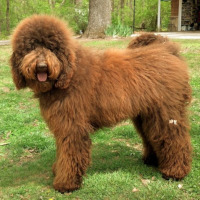
| The Double Doodle is a hybrid of hybrid dogs. This pretty, playful dog is the result of crossing a Goldendoodle (a cross between the mild-mannered Golden Retriever and the quick-witted Poodle) and a Labradoodle (a cross between the family-friendly Labrador Retriever and, once again, the highly trainable Poodle). The two parent dogs share many wonderful traits. The Double Doodle is an intelligent, eager-to-please dog of medium to large size. The Double Doodle has the disposition a potential owner might look for in a family dog. However, they can be boisterous, and their large size means they could accidentally bump into a small child. What's more, although they have a reliable temperament, they are highly food-motivated, which means you'll need intensive training to stop them stealing items off your counter, or from your child's hands. But for the owner willing to put the time and effort into training their dog and giving it plenty of exercise, the Double Doodle has the potential to be the ideal family dog. |
History of the Double Doodle |
| Hybrid dog breeds are phenomena that have taken off in recent decades. As a result, many of these breeds have a relatively short history. However, the Labradoodle is undoubtedly one of the founding father breeds, as they are one of the first hybrids, created to meet a need. It should be noted that no dog is truly hypoallergenic, and no dog is guaranteed to be compatible with a highly allergic person. These so-called hypoallergenic breeds earn this nickname because they produce less dander than breeds with high shedding. Since it's the dander, shed hairs and skin cells, that generally trigger the allergic reaction, a dog with a low shedding rate is therefore less likely, though not guaranteed, to trigger an allergic reaction. |
A little of the Goldendoodle |
||
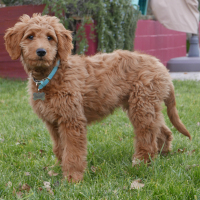
| The origins of the Goldendoodle are linked to those of the Labradoodle. After the success of the latter, breeders had the opportunity to create other hybrids with low shedding rates, making ownership of the dog possible for some people with mild allergies. Equally endowed with an exceptional temperament, the Goldendoodle, the result of crossing the Golden Retriever with the Poodle, quickly became popular as a family dog. | ||
 |
||
| Presentation of the Goldendoodle | ||
A little of the Labradoodle |
||
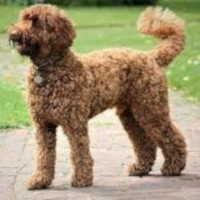
| The Labradoodle was the brainchild of an Australian named Wally Conrad. He saw a need for hypoallergenic assistance dogs, making guide dogs accessible to people with canine allergies. As the Poodle is a low-allergenic, low-rejection breed, Conrad's idea was to breed a Labrador Retriever, the usual guide dog candidate, with a Poodle, resulting in the Labradoodle. Of course, both breeds have their own history, which you can find on the respective breed pages. The Labradoodle's exceptional personality was soon widely recognized and, in the 1990s, the breed took off. The rest, as the saying goes, is history. | ||
 |
||
| Presentation of the Labradoodle |
Appearance of the Double Doodle |
| Labradoodles, Golden Retrievers and Standard Poodles are roughly the same size and average weight. So it's not surprising that the Double Doodle is also a big dog. The coat is generally of medium to long length, tending towards the curly hairs of the Poodle. Coat texture is quite variable, depending on which side of the family they take, but can be wavy or curly, soft or stiff. The most common coat color is gold or yellow, but black, chocolate, white, cream or tan are also possible. The Double Doodle has a well-formed skull with a classic medium to long muzzle. They have expressive floppy ears and a gentle face. Again, they all share a long tail, which is almost guaranteed given their attractive behavior of being constantly on the move. |
Temperament of the Double Doodle |
| All the breeds that contribute to a Double Doodle have a reputation for being friendly, attentive, loyal and intelligent. They particularly enjoy being around people, and nothing makes them happier, with the exception of food, than praise and attention. They generally get on well with other dogs and pets. Double Doodles are intelligent and like to use their minds to solve problems. They thrive on being given tasks and enjoy the individual attention provided by training. Their size also means they are well suited to active hobbies such as agility or canicross. As with all dogs, it's best to supervise a Double Doodle around small children. |
Needs and activities of the Double Doodle |
| The Double Doodle is a high-energy breed. It will need long daily walks, games that allow it to use its intelligence and exercises that sometimes involve work. Activities such as retrieving, agility training, swimming and jogging will keep him happy. This hybrid is not suited to apartment living, as its exuberant personality needs space to move around. The Double Doodle will be happiest in a home with a fenced-in yard in which to explore and practice its work. Double Doodles are most comfortable in moderate temperatures. They don't do well in very cold weather. During the winter months, daily walks should be shorter and they may appreciate a warm coat. |
Maintenance of the Double Doodle |
| The Double Doodle sheds very little and is a low-maintenance dog. It will need weekly brushing. Occasional professional grooming will be necessary to keep his coat neat and clean. Every few weeks, the Double Doodle can be bathed with a mild dog shampoo, as human shampoo is harsh and should not be used on dogs as it dries out their skin. His long, floppy ears should be checked and, if necessary, cleaned weekly, and after bathing and swimming, his ears should be dried to prevent ear infection. Teeth should be brushed once a week to prevent tartar build-up and gum disease. Nails should be trimmed monthly if they don't wear naturally. As with all dogs, an annual wellness check at the vet's will keep your Double Doodle in perfect health. |



 English (United Kingdom)

Comments