
 |
Daniff |
|
He is not recognized by the F.C.I. |
Origin |
Germany <> Great Britain -> U.S.A. | |
Translation |
Francis Vandersteen | |
This breed is also known as |
Mastidane
|
A brief presentation of the Daniff |
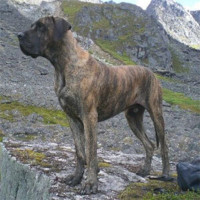
| The Daniff is a hybrid dog, a cross between a Great Dane and a Mastiff parent. They are also known as Mastidane, English Daniff and Great Daniff. But if ever there was a case for not judging a book by its cover, it's the Daniff. Despite being a giant dog, with a size many find intimidating, they are the epitome of the gentle giant. The Daniff takes on much of the laid-back character of the Great Dane side of the family. They have a reputation for being fantastic companions for children and affectionate to boot. But where the Great Dane is often sleepy, the Mastiff is energetic. As a result, Daniffs require a lot of exercise, or risk putting on weight. |
History of the Daniff |
| As a hybrid dog, the Daniff's history is relatively short. The tendency to deliberately cross two different purebred dogs is a relatively new phenomenon, dating back only a few decades. The history of the Daniff is therefore best described by the histories of its two parent breeds. |
A little of the Great Dane |
||
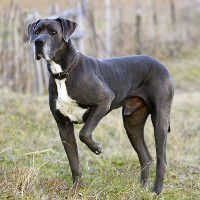
| The Great Dane is a dog that, over time, has undergone a complete turnaround. Dogs matching the description of the Great Dane's massive size can be found in 3000 BC in Egypt and 2000 BC in Babylon. These dogs accompanied Assyrian, Roman and Greek traders to settle throughout Europe. In the Middle Ages, these dogs were known as Sangliers, because they were used to hunt wild boar. Indeed, at that time, their ears were often cropped to prevent the auricles from being gorged by boar tusks. Of course, this task required the dogs to be extremely fierce and bold, and their temperament was a far cry from today's gentle dogs. The change in temperament was deliberately perfected from the 19th century onwards. The Great Dane was thought to be a beautiful but dangerous dog, and deliberate efforts were made to rehabilitate them into a peace-loving companion. Fortunately, these efforts succeeded and are evident in the placid dogs we know today. | ||
 |
||
| Standard of the Great Dane | ||
A little of the Mastiff |
||
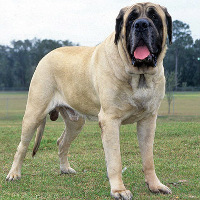
| The Mastiff is another massive dog with working origins. Their ancestors were Molosser dogs, so big and ferocious that they accompanied soldiers into battle. These ancient dogs gave rise to a large number of large dog breeds, such as the Rottweiler, St Bernard and Tibetan Mastiff. Interestingly, they also gave rise to smaller breeds, such as the Pug, which carries a tiny bit of Molosser DNA. Mastiffs became popular in the 16th century, as sporting dogs to help bait bulls. Once these blood sports were banned in the 19th century, Mastiff numbers declined. They fell further during the two world wars, due to the amount of food they consumed. The Mastiff enjoyed a resurgence in the second half of the 20th century thanks to the introduction of Canadian bloodlines. They too enjoyed growing popularity in their gentler reincarnation. | ||
 |
||
| Standard of the Mastiff |
Appearance of the Daniff |
| With two giant breed parents, true to form, the Daniff also has enormous proportions. But where the Great Dane is elegant, the Mastiff is stockier, and this tends to shine through in the Daniff. The Mastiff also leans towards a wrinkled face, which influences the Great Dane's long muzzle and elegant appearance, giving the Daniff a slightly worried or wrinkled forehead. The Daniff is also well equipped with jowls, so drooling is to be expected. Both parent breeds have short, dense coats. Colors can vary widely from the apricot or fawn of the Great Dane, to the brindle, blue, black or harlequin of the Great Dane. What can be said with certainty is that the Daniff has floppy ears and a long, strong tail. |
Temperament of the Daniff |
| Apart from its size, the Daniff's special feature is its reliable character. They are also intelligent, but to learn, they require patience, consistency and a good attitude from their owner. Because of their large size, it's essential that puppies are well socialized to become calm, well-adjusted adults. An overly anxious Daniff could cause real harm if it becomes unbearable. |
Needs and activities of the Daniff |
| The Daniff is a fairly active dog. It is recommended that he gets enough exercise to maintain his weight and health. He may tend to put on weight if not exposed to regular physical activity. He'll do best in a home with a large yard where he can be allowed to run and play. He may also enjoy joining you for a leisurely walk of a few miles. The dog park is an ideal place for the Daniff, as he'll appreciate the ability to get out, run and play with other dogs. He needs regular exercise so he doesn't chew or bark excessively. However, remember that your Daniff will want to be inside with you at night. Never leave him outside all the time. |
Maintenance of the Daniff |
| Daniff's smooth coat can be easily managed with a weekly brushing with a brush. When shedding season arrives, more than weekly will be the rule. If your Daniff puppy inherits Mastiff wrinkles, you'll need to clean them daily to prevent bacterial infections. To clean, use a damp washcloth to wipe the wrinkles. Be careful not to leave the area damp, as this could encourage bacterial growth. The teeth of this massive dog are large, but need to be cleaned with as much care as the tiny, crowded teeth of a small breed. Tartar build-up occurs with any breed of dog, so brushing at least two or three times a week is recommended. Get the Daniff used to all the expectations of grooming when he's a puppy, as this will make the task easier when he's big and heavy. |



 English (United Kingdom)

Comments