 |
Bich-Poo |
|
He is not recognized by the F.C.I. |
Origin |
France / Belgium <> France -> Australia | |
Translation |
Francis Vandersteen | |
This breed is also known as |
Poochon
|
A brief presentation of the Bich-Poo |
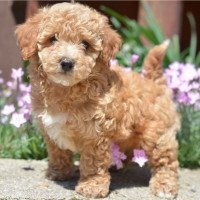
| Also known as the Poochon, the Bich-Poo is a sturdy, playful companion dog bred for its endearing personality and indented coat. As a cross between a Bichon Frise and a toy or miniature Poodle, this little dog is extremely intelligent and equally affectionate. His outgoing nature means he's not a guard dog, and he'll socialize just as well with other animals as with humans, as long as he's been properly socialized in his youth. Poorly socialized Bichons, in particular, can be nervous and can become lively when cornered or frightened. So it's important that their puppies learn to adapt to new situations and new people. This hybrid has little or no hunting instinct, so is generally very reliable with smaller pets. Its mischievousness and tendency to explode without warning into frenzied play mode make it a favorite with younger children, and as long as the Bich-Poo is not an extremely fragile specimen, it should make a good playmate for most children. Bich-Poo's are generally easy to train, as they perfectly combine willingness to please with intelligence, although excessive barking can be a problem. This vocalization can be managed, if not completely eliminated, by providing plenty of stimulation, including lots of house play and walking. Whether the Bich-Poo's coat is more like a Poodle or a Bichon will determine the exact grooming program, but all Bich-Poo's need a dedicated owner willing to brush and detangle at least every other day. They are generally healthy hybrids, although exceptions do occur and parents of cross-bred puppies should be carefully examined for physical or temperamental faults that may possibly be inherited. Although the average life expectancy of a Bich-Poo is 12 to 14 years, some dogs can live several years longer, the oldest in my career being 18. Choose your puppy wisely, he'll probably be by your side for a long time. |
History of the Bich-Poo |
| The Bich-Poo was first created in Australia in the late 1990s and has become extremely popular in its homeland ever since. Chevromist Kennels in Melbourne are reputed to be the original breeders, although this is difficult to verify. Whatever the brains behind the cross, they sought to combine the characteristics that make both breeds excellent companions, including the desirable low-fall coat that both wear. Cross-breeding is also done to mitigate negative characteristics, and Bich-Poo's tend to be less clingy than Bichons and more robust than Miniature and Toy Poodles, which can be somewhat delicate. Although they have a relatively long heritage compared with some designer breeds, very few Bich-Poo are multigenerational mixes, meaning they usually have two pedigree parents. Breeding Bich-Poo to Bich-Poo is rare and results in a high rate of inherited health problems. However, many breeders prefer backcrossing, where a Bich-Poo will be crossed with one or other of the basic breeds to accentuate particular traits. |
A little of the Bichon Frise |
||
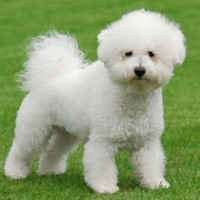
| Bichon Frises are compact, elegant little dogs, always with a distinctive white coat. Originally bred as merry seafaring companions, the Bichon Frise is now a popular choice of dog as a pet. The breed is extremely gentle with children and requires relatively little exercise. The Bichon Frise is intelligent and quick to learn, which means training is not usually a problem. The Bichon Frise's sociable nature means they get on well with other dogs and animals, but can be prone to separation anxiety. Bichon à poil frisé have a medium-length, medium-curly coat that can become spotted and blurred. They require frequent brushing and should ideally be professionally groomed several times a year to keep them in good condition. The breed lives for around 12 to 15 years, but can be affected by certain health problems. It is therefore important to choose a healthy lineage. | ||
 |
||
| Standard of the Bichon Frise | ||
A little of the Poodle |
||
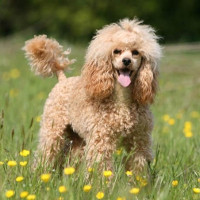
| The Poodle is one of the main players in the new world of hybrid dogs, and is renowned for its versatility. An intelligent dog that excels in many disciplines, the Poodle is not only an excellent pet, but can also compete successfully in events such as agility and flyball. The general public tends to associate the Poodle and its hairstyle with France, but the truth is that it's a German breed. Despite their glamorous appearance, they were originally bred to hunt and retrieve waterfowl and have always been fantastic swimmers. The Poodle is available in three sizes: Toy, Miniature and Standard, although it's the smallest Standard Poodle that contributes to the Bich-Poo breed. Poodles are recognized by the Kennel Club as part of their public service group. | ||
 |
||
| Standard of the Poodle |
Appearance of the Bich-Poo |
| Very high on the friendliness scale, Bich-Poo are small but surprisingly robust dogs with abundant woolly coats. It's impossible to describe a standard appearance, as with all cross-breeds, because each puppy varies in the extent to which it resembles each parent. The fact that one of the parents (the Poodle) may be a toy or a miniature, with a great disparity in size between the two, further complicates the situation. Plush Bich-Poo can weigh from 3 to 4 kg, although the average range is 4 to 6 kg. Miniature Bich-Poo, on the other hand, are much sturdier and can weigh up to 10 kg. The height range is from 20 to 30 cm, with toy-sized dogs obviously tending towards the lower end of the spectrum. The coat is always fluffy and dense, and generally soft, although the thicker hair of the Poodle is appreciable to some extent. The parents' coats differ in other respects too: the Bichon is more fluffy and frizzy, while the Poodle is very curly, so the Bich-Poo will always be a mixture of these two types. The Poodle can also be assigned a wide variety of coat colors in this hybrid, including the following (and possibly including any of the below with white markings): white, bronze, brown, black, apricot, gray, tricolor. |
Temperament of the Bich-Poo |
| Bich-Poo dogs are playful and friendly, extremely affectionate with their families and generally very sociable when meeting new people. They can be sensitive and can become stressed and withdrawn during tense periods at home. This crossbreed is less easy to upset than either of its parent breeds, and likes to live in a home with children. However, they can also revert to typical small dog behavior and be a bit nippy when frightened, but this is not a common problem. He's gentle and considerate towards small pets and is more likely to be bullied by the family cat than to threaten it. When excited or frustrated, the Bich-Poo likes to bark, and sometimes non-stop, and this can become a problem, especially if the dog is left alone for long periods. Anyone wishing to acquire a Bich-Poo must understand that the dog needs constant human companionship, and that it's not a good choice for homes where all the adults go to work during the day. Separation anxiety is not an unusual response to these episodes of abandonment, and manifests itself in destructive, high-strung behavior that is distressing for both dog and owner. |
Needs and activities of the Bich-Poo |
| The Bich-Poo is an active breed of dog, requiring at least 30 minutes of activity a day. However, if they don't have access to a backyard, these dogs may need a little more time for exercise. If you notice your pet is destructive, such as barking, chewing or whining, you may want to increase the time you spend exercising them. Include a visit to the dog park, a play session or a short hike in the woods up to their week for added physical and mental stimulation. |
Maintenance of the Bich-Poo |
| Although this breed is not widespread and can be considered hypoallergenic, its coat of loose, coarse curls will require frequent brushing to avoid any knots or tangles. Bathe and shampoo them if necessary. They will probably need to be professionally groomed once every two to four months. In addition to coat care, this hybrid breed will need dental care and nail clipping, like all other dog breeds. All dogs should have their teeth brushed at least once or twice a week, or preferably every day if possible. Their nails should be trimmed regularly, probably once or twice a month. If they wear naturally, less often will suffice. You'll know when your Bich-Poo needs its nails trimmed if you hear them clicking on the floor as they walk. You should also check and clean their ears once a week. This will help reduce the risk of ear infections. |



 English (United Kingdom)

Comments