 |
Bugg |
|
He is not recognized by the F.C.I. |
Origin |
U.S.A. <> China -> U.S.A. | |
Translation |
Francis Vandersteen |
A brief presentation of the Bugg |
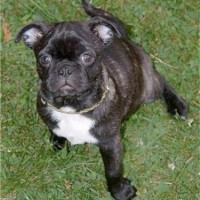
| The Bugg is a hybrid dog breed, created by crossing a Boston Terrier with a Pug. These small to medium-sized dogs are lovers, not fighters, and adore human companionship. Both parent breeds are doggie delights, with the Boston Terrier being known as the American gentleman and the Pug as a clown. Combine these two breeds for an ideal companion dog, suited to apartment living. The Bugg's slight disadvantage is a tendency towards health problems. As both parents have a flat face and large eyes, the puppies may have similar difficulties. For the Bugg, this includes, among other things, breathing difficulties, due to this flat face, and corneal ulcers. Therefore, it's a healthy parent who ensures their Bugg. |
History of the Bugg |
| The deliberate mating of different pedigree breeds is a relatively recent phenomenon. That's why the Bugg's history goes back a few decades. However, parent breeds are well established, with the Boston Terrier originating in the 19th century and the Pug in ancient China. |
A little of the Boston Terrier |
||
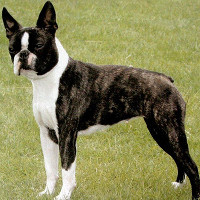
| The history of the Boston Terrier is shorter, with origins in Boston, USA, in the late 19th century. How the breed originated is controversial. On the one hand, it is said to be the result of crossing Bulldogs with a white English Terrier, now extinct. But another story tells of a man named Hooper who bought a dog that closely resembled the modern dog, because it reminded him of another much-loved dog he once owned. This dog, the Judge, became the founding father of the breed. Whatever their origins, their beautiful nature and elegant coat with a white chest, the Tuxedo dog, earned them the nickname The American Gentleman. | ||
 |
||
| Standard of the Boston Terrier | ||
A little of the Pug |
||
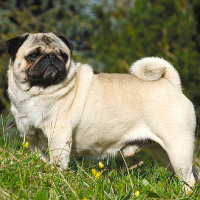
| The older of the two breeds is the Pug. These strong, attractive dogs are thought to be related to the much larger Tibetan Mastiff. Selective crossing of these black Mastiffs with black mastiffs gave rise to two new breeds, including an ancient Pug called the Lo-Sze and the Pekingese. The Pug remained a Chinese treasure, largely unknown to the rest of the world, until the late 16th century. Then, when trade between China and Europe opened up, Dutch traders took Carlins with them. Unsurprisingly, they became popular, not least with the Dutch royal family. The Carlins' star continued to rise, with notable owners including Marie Antoinette, Josephine Bonaparte, Queen Charlotte (wife of George III) and Queen Victoria. | ||
 |
||
| Standard of the Pug |
Appearance of the Bugg |
| There are many similarities between the Boston Terrier and the Pug, including a shortened muzzle and flat face. However, while the Boston has large, erect ears, the Pug has folded the ear flaps into a rosebud shape. While a Bugg puppy may be based on the appearance of either parent, it is more often than not a pretty compromise with large folded ears. The Boston Terrier has a deep chest and narrow waist, while the Pug is altogether sturdier and stockier. Again, the resulting hybrid may have distinct characteristics borrowed from a mother or be a mix of the two. However, as both dogs are small to medium-sized, so is the Bugg. When it comes to color, the Bugg has it all. It can be brindle or black, fawn with a dark mask or black (or seal) with a white coat. The solid coat color is inherited from the Pug, since a pedigree Boston Terrier should always have white markings. The last word goes to the Bugg's tail. A Boston Terrier's tail can be naturally cropped, corkscrewed or even straight, making it difficult to predict a Bugg's tail type. However, the distinctive Carlin style often wins out and is inherited by the Bugg. |
Temperament of the Bugg |
| The Bugg has a reputation for being an affectionate dog, adapted to new owners. Both parent breeds love to be around people, and thrive on being the center of attention. They are not malicious or over-protective dogs and, when treated correctly, will give their owners antics that provide endless amusement. Bear in mind, however, that Pugs and Boston Terriers sometimes have a tendency to be obstinate. If they don't want to do something, they can't be forced to. The best option for the owner is to get the dog out of his psyche with reward-based training. The dog then thinks it was his idea. A well-socialized Bugg will become a mischievous companion who loves to snuggle. Overall, they're a delightful dog, but like all dogs, can bark or be destructive if bored. |
Needs and activities of the Bugg |
| Although neither the Pug nor the Boston Terrier are overly active dogs, and by no means an athletic breed, Buggs will always need a little exercise every day to keep them active and healthy. Simple activities like going for a walk, visiting the park or playing in the yard are active enough to keep Buggs in top shape. They're a very cuddly hybrid breed who'll love to cuddle you all day long and take a few good naps throughout the day. If you're someone who can't do much physical activity, or if you just want a more relaxed pet experience, the Bugg could be the perfect dog for you. Remember, exercise is essential to keep your dog fit and happy, even if it's only for a few minutes a day. The Bugg is an easy dog to keep anywhere, whether in the city or the country, and although he barks often, it shouldn't be loud enough to disturb the neighbors. Warmer climates are a favorite for this little dog. |
Maintenance of the Bugg |
| The Bugg is a very easy dog to care for. Due to the fact that the Pug throws seasonally and the Boston Terrier hardly at all, the Bugg will be a very low excretor, which means that although it is not entirely hypoallergenic, it is an excellent choice of dog for those with a mild allergy who can tolerate a little shedding. Brushing your Bugg at least once a week will be enough to minimize shedding, keep the coat healthy and remove any dirt or soft hair. Because this breed doesn't have a bad dog smell, bathing should only take place once a month, or when your dog is particularly dirty. In addition to basic care and bathing, be sure to trim his nails every two weeks to keep his feet healthy and snag-free. |



 English (United Kingdom)

Comments