Wheagle

He is not recognized by the F.C.I.

Origin
Ireland <> Great Britain -> U.S.A.
Translation
Francis Vandersteen

A brief presentation of the Wheagle

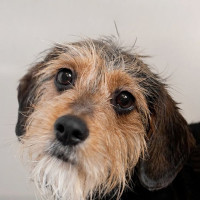
The Wheagle is descended from two breeds, the Irish Soft Coated Wheaten Terrier and the Beagle, both known for their playful attitude, good nature and affection for people. Wheagles are no different. These playful puppies make excellent companions for children and will retain their puppy-like behavior throughout their lives. The only downside to Wheagles is that their intelligence means they can be stubborn when it comes to training. Be sure to start obedience training at an early age and reinforce it continually. Regular exercise will do wonders to keep your Wheagle's boundless energy in check.

History of the Wheagle

The Wheagle is a recent hybrid breed, so little is known about its history. Given the friendly personalities, handy sizes and intelligence of its parent breeds, there's no doubt that it's a winning combination.


A little of the Irish Soft Coated Wheaten Terrier

        
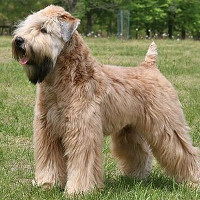
The Irish Soft Coated Wheaten Terrier was bred as a farm dog for the working class in Ireland. This strong, compact dog was used to guard livestock and hunt vermin, especially rats. Irish commoners were not legally allowed to own hunting dogs, so they created this breed to help them. The Irish Soft Coated Wheaten Terrier was not officially admitted to the Irish Kennel Club until 1937. Fittingly, this admission took place on St. Patrick's Day. This jovial breed made its first trip to the USA in 1946, but wasn't admitted to the American Kennel Club until 1973.
Standard of the Irish Soft Coated Wheaten Terrier


A little of the Beagle

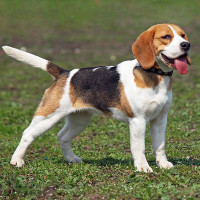
The Beagle is an ancient breed whose ancestors date back as far as Roman times. They are thought to be descended from the extinct Talbot Hound, a hunting dog brought to England by William the Conqueror in 1066. Elizabeth I is said to have had packs of dogs called Pocket Beagles, a tiny version of what we now call a Beagle. These dogs were used for hunting, but were soon replaced by the larger Foxhound, which was much faster thanks to its longer legs. Fortunately, the Beagle breed managed to survive and enjoyed a resurgence in popularity in the 1800s, when it began to be used for rabbit hunting. They quickly won over Americans with their dashing good looks and began to be imported into the United States. They were recognized by the American Kennel Club in 1885, and have remained a popular breed ever since.
Standard of the Beagle

Appearance of the Wheagle

Irish Soft Coated Wheaten Terriers are known and appreciated for their wavy, silky, cream or black coats. They have small to medium-sized ears that flop forward, a square body and long legs. Its eyes are brown and almond-shaped, and its tail is relatively straight, never curling over its back. Beagles also have a compact, square body and straight front legs. Their tails are slightly curved and often erect, especially when happy or hunting. They have compact, round legs and large brown eyes. Their ears are medium to large and hang from the side of their head. Their muzzle is medium-sized, straight and square, and their nose can be brown or black. Beagles have a smooth but relatively dense double coat that lets water through and keeps them warm. They can come in many different colors, including white and tan, tricolor, tick blue, white and brown, or any combination of these. The Wheagle's appearance varies according to the genetic variations of its parent breeds, but it can be said to have any combination of these characteristics. One thing's for sure, though: he'll have big, puppy-brown eyes.

Temperament of the Wheagle

A word commonly used to describe the Wheagle's two parent breeds is friendly. The Wheagle is undoubtedly a wonderful family pet. They are active, playful and young at heart. They love spending time with their owners, especially the younger ones. These dogs make excellent watchdogs, as they'll be sure to sound the alarm when someone comes to the door, but don't expect them to guard anything. They're lovers, not fighters, and they quickly make friends with everyone they meet, including other animals. They are energetic dogs, and plenty of exercise is essential. Otherwise, they risk becoming destructive, chewing things they shouldn't, digging holes or even trying to escape their yard in search of adventure. Beagles are intelligent and relatively easy to train, but they do best with reward-based training; they need to feel they're getting their money's worth, or they'll lose interest. Beagles are known to be very food-oriented, a trait that Wheagles can inherit. As a result, they can be very protective of their food dishes. Make sure you teach them to tolerate people handling their food dish when they're young to avoid any problems of this kind. Overall, these playful dogs are very affectionate and make excellent pets, especially for families with young children. They're so cute, they're almost impossible to resist.

Needs and activities of the Wheagle

Exercise is essential for these intelligent, active dogs. If they don't get enough exercise, they're likely to bark and be destructive. Plan to walk them for at least an hour every day, although longer is ideal for younger dogs. Because of their high intelligence, Wheagles need mental stimulation as well as exercise. This can take the form of training exercises or even tracking games, which Beagles love. This type of activity will keep your dog engaged and help him channel his energy. As a very people-oriented breed, your dog will be happy to snuggle up to you as long as he's getting exercise. Wheagles can adapt to any environment, but they can be noisy, which means they're not necessarily ideal for apartment living. However, plenty of exercise will reduce their tendency to bark. These hardy dogs thrive in all climates, but prefer cold weather.

Maintenance of the Wheagle

Fortunately, whether the Wheagle has inherited the silky, wavy coat of its soft-coated Irish Soft Coated Wheaten Terrier parent, or the smooth double coat of the Beagle side of the family, grooming is low-maintenance. A weekly brushing removes matted or dead hairs. Wheagles tend to have sensitive skin, so should be bathed as needed. If he has inherited large ears from his Beagles parents, be sure to check them several times a month for any signs of irritation; air can get trapped in them and cause infections. Weekly teeth brushing is ideal to prevent tartar build-up, and monthly toenail trimming will keep their nails in good condition.

Comments

Latest page updates

  • Telomian

    Telomian He is not recognized by the F.C.I. Origin Malaysia Translation Francis Vandersteen A brief presentation of the Telomian The Telomian is a very rare breed of dog, and the only one native to Malaysia to have been bred outside the country. They were originally bred by the indigenous people of Malaysia to combat parasites such as snakes, rats,...
  • King Wheaten -- Cavalier King Charles Spaniel X Irish Soft Coated Wheaten Terrier

    King Wheaten He is not recognized by the F.C.I. Origin Great Britain <> Ireland -> U.S.A. Translation Francis Vandersteen A brief presentation of the King Wheaten The King Wheaten is a small dog with a heart this big and a playful disposition. Borrowing the energy and soft-coated waves of the Irish Soft Coated Wheaten Terrier and the size and...
  • Spanierd -- English Springer Spaniel X German Shepherd

    Spanierd He is not recognized by the F.C.I. Origin Great Britain <> Germany -> U.S.A. Translation Francis Vandersteen A brief presentation of the Spanierd The Spanierd is a hybrid dog. Its parent breeds are the English Springer Spaniel and the German Shepherd. They have an affable personality. He's known for entertaining family and friends with his...
  • Alaskan Goldenmute -- Alaskan Malamute X Golden Retriever

    Alaskan Goldenmute He is not recognized by the F.C.I. Origin U.S.A. <> Great Britain -> U.S.A. Translation Francis Vandersteen This breed is also known as Alaskan GoldenGoldenmuteAlaskan Gold Retriever     A brief presentation of the Alaskan Goldenmute The Alaskan Goldenmute is a descendant of two great dog breeds: the Alaskan Malamute and the Golden...
  • French pointing dog Pyrenean type

    French pointing dog Pyrenean type FCI standard Nº 134 Origin France Translation Mrs. Peggy Davis Group Group 7 Pointing Dogs Section Section 1.1 Continental Pointing Dogs « Braque » Type Working With working trial Acceptance on a definitive basis by the FCI Tuesday 18 January 1955 Publication of the official valid standard Tuesday 01 August 2023 Last...
  • French pointing dog Gascogne type

    French pointing dog Gascogne type FCI standard Nº 133 Origin France Translation Mrs. Peggy Davis Group Group 7 Pointing Dogs Section Section 1.1 Continental Pointing Dogs « Braque » Type Working With working trial Acceptance on a definitive basis by the FCI Monday 17 January 1955 Publication of the official valid standard Tuesday 01 August 2023 Last...
  • Vucciriscu

    Vucciriscu He is not recognized by the F.C.I. Origin Sicily Translation Francis Vandersteen En français, cette race se dit Vucciriscu Diese Norm ist in deutscher Sprache sichtbar Vucciriscu En español, esta raza se dice Vucciriscu In het Nederlands, wordt dit ras gezegd Vucciriscu This breed is also known as Sicilian Vucciriscu Sicilian Butcher...

© 2026 Groupe Milouchouchou ASBL. Tous droits réservés. En savoir plus

Protected by Copyright01
We use cookies

We use cookies on our website. Some of them are essential for the operation of the site, while others help us to improve this site and the user experience (tracking cookies). You can decide for yourself whether you want to allow cookies or not. Please note that if you reject them, you may not be able to use all the functionalities of the site.

Ok