
 |
Toy Foxie Doxie |
|
He is not recognized by the F.C.I. |
Origin |
U.S.A. <> Germany -> U.S.A. | |
Translation |
Francis Vandersteen |
A brief presentation of the Toy Foxie Doxie |
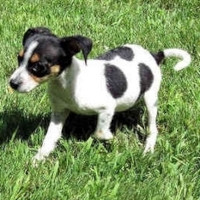
| The Toy Foxie Doxie is a mix of Toy Fox Terrier and Dachshund. These small dogs measure between 20 and 28 centimeters and weigh between 3 and 8 kilos. They have a short, straight coat that can be brown, black, white, isabella, blue or a combination of colors. They are very active, affectionate and playful. Your hybrid will love going out for a walk or a game of catch in the park. These dogs have quite a temperament and are very territorial. What's more, like both his parents, he may have a taste for hunting small game. They are suitable for indoor living, but not for apartments, as they tend to be very noisy. |
History of the Toy Foxie Doxie |
| The Toy Foxie Terrier is the result of breeding a Toy Fox Terrier with a Dachshund. This hybrid is thought to have originated in the 1900s. |
A little of the Toy Fox Terrier |
||
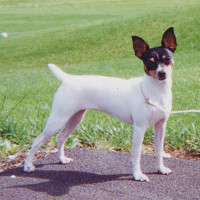
| Terrier breeds originated in England in the 1500s. The Toy Fox Terrier was created in the USA from the English Smooth Fox Terrier, which was crossed with smaller breeds such as the Manchester Terrier, Chihuahua, Miniature Pinscher and Italian Greyhound. The Smooth Fox Terrier came in a wide range of sizes, with dogs weighing up to 9 kilos and the smallest up to 3 kilos. The smaller dogs were the most popular, as they were more feisty and fearless. In 1912, the United Kennel Club recognized the Smooth Fox Terrier. All sizes were registered as the same breed until, in 1936, after several petitions, the UKC registered the smallest as the Toy Fox Terrier. The American Kennel Club recognized the Toy Fox Terrier in 2003. | ||
 |
||
| Presentation of the Toy Fox Terrier |
A little of the Dachshund |
| The Dachshund is a hunting dog developed in Germany. It is the result of crossing Braques with Pinschers, and probably French Bassets. This breed was known as the badger dog, or dachs hund in German. The Dachshund appears in 15th-century illustrations and is mentioned in 16th-century documents. At first, Dachshunds varied in size. Badger and wild boar hunters weighed between 13.5 and 16 kilos; fox and deer hunters weighed between 7 and 10 kilos, and 5.5-kilo Dachshunds were used to hunt hares and weasels. There were also 2.5-kilo Dachshunds for hunting cottontail rabbits. Originally, only the smooth-coated Dachshund existed, but cross-breeding led to the development of other types. Longhaired Dachshunds are thought to have originated from crosses with Spaniels, and wirehaired Dachshunds from Terriers. In the 1800s, the Dachshund became a popular pet. It became very popular in the royal courts of Europe, and Queen Victoria was a fan of the breed. Eventually, these dogs became smaller and a miniature version was developed. In 1879, the first breed standard was established. The American Kennel Club recognized the Dachshund in 1885. Although the breed suffered greatly during the First and Second World Wars, as it was associated with Germany, it regained its popularity shortly afterwards. |
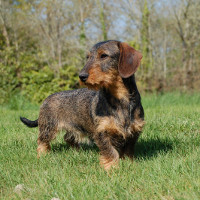 |
| Standard of the Dachshund |
Appearance of the Toy Foxie Doxie |
| The Toy Foxie Doxie is a small dog measuring between 20 and 28 centimeters and weighing between 3 and 8 kilos. It generally has longer legs than a Dachshund and a shorter back. It has a compact body, with strong legs and feet that make it a dexterous digger and runner. It has a small, rounded face with a narrower, pointed muzzle. His muzzle is usually shorter than that of the Dachshund. Its eyes are rounded and curious, and its ears fall to the sides. The coat can be black, brown, isabella, blue, tan or a mixture of two or three colors. The texture of this hybrid's coat varies according to its Dachshund parent, as it can be wirehaired, smooth or long-haired, with smooth being the most popular. |
Temperament of the Toy Foxie Doxie |
| This hybrid is a strong-tempered lapdog. These dogs are generally barkers and are very protective of their family and territory. They are loyal, affectionate family members who love to play all the time and be cuddled and petted. They are generally very friendly towards other dogs and get on well with children. Early socialization is recommended to avoid developing shyness and small dog syndrome. Toy Foxie Doxie can become destructive if bored or left alone for long periods. In general, they are easy to train and positive reinforcement is recommended to keep them motivated. These dogs are very likely to remain active even in old age. |
Needs and activities of the Toy Foxie Doxie |
| Both of the Toy Foxie Doxie's parent breeds are very active and energetic, so it's fair to say that this hybrid has the same characteristics. Despite their small size, these dogs love to play, run and dig. Two 15-minute walks a day will keep them fit and happy, although more often than not they'll be ready to go as soon as you suggest. These dogs are very playful, so they'll enjoy a game of fetch or play with other dogs. It's important to consider that if he has a long body like his Dachshund parent, care should be taken to avoid activities that could hurt his back. This hybrid is definitely an indoor dog and doesn't like living outdoors. As it can be a noisy little dog, an urban or rural home is ideal. He also prefers a warmer climate and enjoys sunbathing. |
Maintenance of the Toy Foxie Doxie |
| The Toy Foxie Doxie is a moderate shedder. Brushing him once a week with a toothbrush or paddle brush will remove loose hair and help keep your home free of dog hair. Of course, the length or texture of the coat can affect how often you need to brush it, depending on whether the length of the fur causes tangles or not. You should check your hybrid's ears every week, in case they become infected or red. You can clean his ears with ear cleaner and a cotton ball. Trim his nails once or twice a month, unless he wears them out. Since they don't often smell bad, it's likely that a monthly bath or less will suffice. We also recommend brushing his teeth at least three times a week to remove tartar build-up and bacteria. |



 English (United Kingdom)

Comments