
 |
Tibetanpei Spaniel |
|
He is not recognized by the F.C.I. |
Origin |
Tibet <> China -> U.S.A. | |
Translation |
Francis Vandersteen |
A brief presentation of the Tibetanpei Spaniel |
| The Tibetanpei Spaniel is a hybrid dog by design. It is a cross between the Tibetan Spaniel and the Shar Pei. It is playful and gentle with its owners, but typically reserved towards strangers. His aversion to strangers makes him an ideal watchdog. He is always on his guard. His natural distrust of strangers means he needs to be socialized at a young age to form a balanced temperament and not focus solely on his owner. The Tibetanpei tends to have a cat-like personality and is extremely clean. Its aloof nature means that it is not an over-demanding dog and tends to be rather independent. The dog generally grows to a height of 46 to 51 centimeters at the shoulder and a weight of 20.5 to 27 kilos. It doesn't need much exercise compared with other dogs of its size, and can generally live happily in an apartment as long as it enjoys an occasional walk. |
History of the Tibetanpei Spaniel |
| The Tibetanpei Spaniel is a fantastic combination of the personality and nature of its two parents. |
A little of the Tibetan Spaniel |
||
| The Tibetan Spaniel originated in Tibet, where the breed was used as a guard dog. The breed is thought to be over 2,000 years old. The Tibetan people have always cherished these dogs. The breed was never sold, but was often given as gifts. Buddhist monks and lamas were the owners of these dogs. They thrived in the monasteries of Tibet. In 1889, the breed made its way to England and finally to the United States in 1966. The American Kennel Club recognized the breed in 1994, listing it as a non-sporting dog. | ||
 |
||
| Standard of the Tibetan Spaniel |
A little of the Shar Pei |
| The Shar Pei is considered an ancient breed originating in China. The dogs were bred by local farmers to hunt, protect and guard flocks. The bravery and intelligence of these dogs were highly respected and made them popular throughout the country. The Chinese also bred the dogs to have loose skins so they could easily take part in dog fights. Unfortunately, when Communism broke out in China and the country became the People's Republic of China, the government considered dogs a luxury item and set about slaughtering all the dogs in the country. Thousands of dogs were destroyed, but a few Shar Pei remained in Taiwan and Hong Kong. A few Shar Pei were also imported to the USA to become foundation dogs in 1973, in an attempt to save the breed from total destruction by the Chinese government. In 1988, the Shar Pei was recognized by the American Kennel Club and entered in the Miscellaneous Dog group. The Shar Pei has bounced back since its inception. In 1978, the Guinness Book of World Records declared this dog to be the rarest breed in the world, with only 60 dogs remaining. |
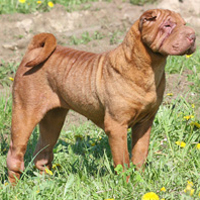 |
| Standard of the Shar Pei |
Appearance of the Tibetanpei Spaniel |
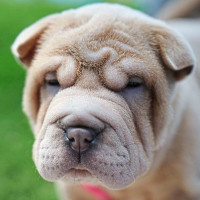
| The Tibetanpei Spaniel looks more like the Shar Pei than the Tibetan Spaniel. The breed has a short coat that comes in shades of tan, brown or black. Its tongue is generally purplish-black, but can be spotted with pink or purple. Its ears are small and a little floppy. He lacks the excessive wrinkles of the Shar Pei, but typically has a few jowls and wrinkles on his forehead. Excess skin around the eyes can be a problem, as with the Shar Pei. His tail is held high and often lifts over his back. |
Temperament of the Tibetanpei Spaniel |
| The Tibetanpei Spaniel's feline temperament is somewhat aloof. It's not a very affectionate dog, although it loves its family. It generally gets on well with older children, but care should always be taken with toddlers. He can be aggressive towards dogs, so early socialization is imperative. Owners should enroll their dog in an obedience class to learn the basics of good manners and the value of socialization. The Tibetanpei Spaniel is highly intelligent and a quick learner. |
Needs and activities of the Tibetanpei Spaniel |
| The Tibetanpei Spaniel is a laid-back dog. Unlike other dogs of its size, it doesn't need much exercise. A daily walk is usually enough to satisfy his activity needs. He's generally happy to lie down. Care must be taken to ensure that he doesn't put on too much weight due to his laid-back nature. He sometimes plays dodgeball and is always happy to please his owners. The Tibetanpei Spaniel doesn't bark much, but will start to sound the alarm if a stranger approaches or if he hears an unfamiliar noise. He can adapt to life in an apartment, but will be happiest in a home with a secure, enclosed garden where he can play and explore. |
Maintenance of the Tibetanpei Spaniel |
| The Tibetanpei Spaniel's short coat does not require frequent brushing. A long-haired brush can quickly remove loose hair. Its skin can take on a certain doggy odor, so frequent bathing is recommended. His toenails should be trimmed at least once a month if they don't wear down naturally from exercise. Some owners brush their dog's teeth several times a week to remove plaque and keep his mouth smelling clean. Ears can become clogged with greasy debris and wax, and should be cleaned once a week. |



 English (United Kingdom)

Comments