 |
Swissy Saint |
|
He is not recognized by the F.C.I. |
Origin |
Switzerland -> Switzerland | |
Translation |
Francis Vandersteen |
A brief presentation of the Swissy Saint |
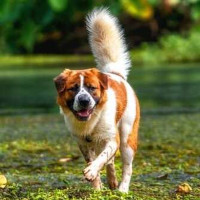
| The Swissy Saint is a beautiful dog bred for work, search, rescue and companionship. Not only is he ready to work and easy to train, he is also very gentle, affectionate and obedient. You may not find the Swissy Saint as affectionate as other breeds, but you'll know they're devoted to their family. They can take on the appearance of either of their parents, in terms of color, markings and facial expressions, and it's important to note that they shed seasonally. Make sure this breed gets plenty of exercise, and watch out for any signs of hip dysplasia, one of the most common health problems in this hybrid. |
History of the Swissy Saint |
| The name Swissy Saint comes from a combination of the names of the two parent breeds. Although the exact origin of the name is not known, we do know a little history about the parents. Both the Great Swiss Mountain Dog and the St. Bernard were used for work as well as search and rescue, particularly in their native part of the world. Even today, both dogs make excellent working and companion dogs. While the Great Swiss Mountain Dog has never been much in the media spotlight, the St. Bernard has been made popular not only by the many films and adverts extolling its rescue capabilities, but also by the ever-popular film Beethoven. |
A little of the Great Swiss Mountain Dog |
||
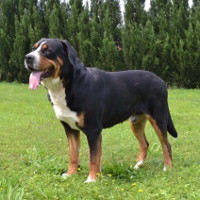
| The Great Swiss Mountain Dog is native to Switzerland, and its origins go back 2,000 years. It was bred from the Roman Mastiff for draft work, guarding and herding, but is also used for tracking, carting and obedience and agility trials. These dogs are thought to have been brought to the Alps by the Roman army. The breed was entered in the Swiss Herd Book in 1990 and recognized by the American Kennel Club five years later, where it ranks 78th among the most widespread dog breeds. | ||
 |
||
| Standard of the Great Swiss Mountain Dog |
A little of the St. Bernard |
| The St. Bernard, also originally bred in Switzerland and Italy, has been around since at least the early 1700s, with some references to the breed dating back to 57 BC. According to the American Kennel Club, the St. Bernard is thought to have been bred from the Asian Molossus, also introduced to the region by the Romans. Added to the AKC roster in 1885, the Saint Bernard Club, one of America's oldest clubs, was founded in 1888. |
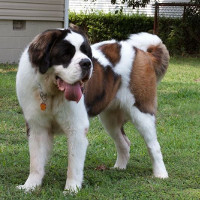 |
| Standard of the St. Bernard |
Appearance of the Swissy Saint |
| The Swissy Saint has brought with it the best of both parents. Their coat is a striking color of black, red, brown and white, and they can sometimes have a flame mark around the muzzle. The coat is generally short and very soft. However, they shed seasonally, making occasional grooming necessary. Their coat is not as dense as that of some other breeds, but they do exceptionally well in winter, as well as in water. You'll probably find that the Swissy Saint's body proportions closely resemble those of the St. Bernard Dog, although this isn't always the case. They are very majestic and obviously a dog well suited to work. The round, brown eyes can often appear droopy, and the markings around the muzzle give an impression of joviality, as if they were smiling. The short muzzle is more like a St. Bernard, with wide, heavy jaws and large teeth. The legs are large and round, enabling them to hold on well in snow and on other types of terrain. |
Temperament of the Swissy Saint |
| You'll find that this breed has a very balanced temperament and can be easy to train by a committed owner who is willing to work with the dog. You won't often find a Swissy Saint who is nervous or anxious, so they don't need to bark at every little thing, which your neighbors will appreciate. They will, however, bark if they see the need, and when they do, it's always best to find out what's causing the disturbance. He's excellent with other animals as well as children, and you'll probably find him very tolerant of both, as his even temperament extends to even the smallest members of the family. |
Needs and activities of the Swissy Saint |
| With an abundance of energy and a willingness to work and play, you'll find he's very easy to train. However, if given the opportunity, he'll lounge around the house for as long as he can. Exercise is extremely important, however, because of the health problems he may encounter. You don't want them to be overweight, as they're already predisposed to hip dysplasia, and you want them to have strong bones and muscles, for the best possible quality of life. Because of their size, apartment living isn't really ideal. A home with a large enclosed yard will give your big dog plenty of room to stretch and exercise. Daily walks will also be appreciated, giving the Swissy Saint the opportunity to meet and greet the neighbors. |
Maintenance of the Swissy Saint |
| The Swissy Saint doesn't need to be groomed as much as a long-haired breed, but occasional grooming is certainly necessary to keep it looking as beautiful as ever. The same goes for shampooing, especially if the dogs are used for work. Be prepared for extra cleaning when shedding season arrives, as well as extra brushing. A bristle brush is the best choice; it removes excess fur and eliminates any tangles that may form. A trimmer can be useful in the event of heavy shedding. Due to shedding, they cannot be considered hypoallergenic and, unlike the St. Bernard, they are not as prone to drooling, so their mouths remain dry. Unless necessary, bathing can be taken over every three or four weeks, and you can then check to see if they need their nails trimmed. |



 English (United Kingdom)

Comments