
 |
Staffy Bull Pit |
|
He is not recognized by the F.C.I. |
Origin |
U.S.A. -> U.S.A. | |
Translation |
Francis Vandersteen | |
This breed is also known as |
Staffpit Bull Terrier |
A brief presentation of the Staffy Bull Pit |
| The Staffy Bull Pit is uncommon as a designer dog, although unintentional cross-breeding is probably quite common. This hybrid, which can only be registered as a Staffy Bull Pit with the Dog Registry of America, is essentially the combination of two variations of the same dog: the American Staffordshire Terrier as recognized here in the U.S.A. and the American Pit Bull Terrier as recognized in the UK. As this is not a common hybrid, you may need to make special arrangements if you want a dog whose parents are officially registered on both sides of the family tree. Bull Terriers of all kinds need to be well socialized, and obedience training should begin at an early age to encourage a healthy, balanced temperament in your dog. |
History of the Staffy Bull Pit |
| The American Staffordshire Terrier and the American Pit Bull Terrier are now considered two distinct breeds of dog, the former recognized by the American Kennel Club in the USA and the latter recognized by the United Kennel Club in England, but their respective breed standards are written in such a way that individual dogs can be registered in both countries. Before different breeding centers separated these two breeds of dog when registrations were split, they came from essentially the same ancestry. The earliest ancestors of these dogs date back to England in the 1700s, when old-style English Bulldogs were crossed with various Terriers to give them agility and the ability to think quickly and independently. The results of these crosses were known as Bull and Terriers, extremely well-muscled yet agile dogs, brave and strong enough to help control bulls, help hunters shoot wild boar and bears, and finally, to fight each other to the death. When these dogs were imported to the USA in the 1800s, it was mainly as fighting dogs, and breeders focused on creating a larger, heavier animal, which was registered with the United Kennel Club as the American Pit Bull Terrier in 1898, but the American Kennel Club refused to recognize the breed as it wanted to distance itself from the history of dog fighting. In 1936, it recognized the American Staffordshire Terrier, which has stricter standards for size and coloring. With the exception of dogs registered in both countries, the two breeds have been bred separately since that time. |
A little of the American Staffordshire Terrier |
||
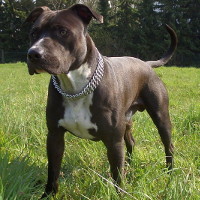
| With the American Staffordshire Terrier, also known as the Am Staff, we discover an interesting fact: this breed and the American Pit Bull Terrier have very similar origins. Created by combining the Bulldog and Terrier breeds, the Am Staff was mainly used for entertainment during the 19th and 20th centuries, when dog fighting was legal and popular in the USA. This was a terrible tradition, as it made dogs extremely aggressive and the mistreatment encouraged even more terrible behavior. While the Am Staff was used in these entertainment circles, it seems that the Pit Bull was most affected by these problems, as this breed wasn't even registered by the American Kennel Club, whereas the Am Staff was from 1936 onwards. These breeds weren't all bad, despite what people tried to make them believe. Both the Am Staff and the Pit Bull were also used by families as farm and guard dogs. They were excellent raiders and defenders against animals such as bears and wild pigs. Their fearlessness and bravery made them ideal for the job. Today, the Am Staff is still a working dog, but is mostly seen at shows and as a family companion. | ||
 |
||
| Standard of the American Staffordshire Terrier |
A little of the American Pit Bull Terrier |
| The American Pit Bull Terrier is descended from the Bull and Terrier breeds created in England in the 19th century for bull and bear baiting. Later, when these shows became illegal, the dogs were used for dog fighting instead. These "Bull Dogs" were developed for dog fighting, but it was necessary that they not bite their masters, so they got a dog aggression trait, but had an opposition to attacking humans. As a result, these dogs became known as strong, protective dogs, but also as affectionate and respectful family dogs. Later, when dogs were brought to America, people began to use them for hunting, protecting property and companionship. There, breeders also developed a dog larger than the original English dog. This larger breed was given the name American Pit Bull Terrier and was recognized by the American Kennel Club in 1936 as the American Staffordshire Terrier. The name was changed to separate the dogs from their fighting past. |
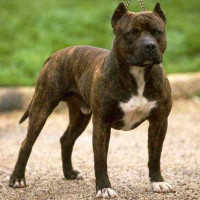 |
| Presentation of the American Pit Bull Terrier |
Appearance of the Staffy Bull Pit |
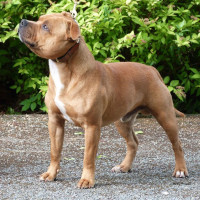
| The Staffy Bull Pit is a medium-sized dog with a solid build and compact, well-defined musculature. It has a fairly large, solid head with a broad, flat skull and a broad, deep muzzle with great jaw strength and clean, straight rather than pendulous lips. Their round or almond-shaped eyes are usually a darker brown, but thanks to the inclusion of the more permissive American Pit Bull standard, they can sometimes be any color except blue. Their natural ears are short and held in a rose or half peg configuration, and are generally preferred to cropped ears for both breeds. Their shoulders and neck are particularly well muscled compared to other breeds, and their legs should be straight with thick, round bones. This hybrid sports a single layer of short, stiff fur that can be any color, although merle is not recommended due to the deafness and blindness that often accompany this coloring. |
Temperament of the Staffy Bull Pit |
| Since the sport of dog fighting was banned in most countries in the late 1800s, most quality breeders of American Staffordshire Terriers and American Pit Bull Terriers have focused on creating a breed that is not only athletic and powerful, but gentle, loving and loyal. These dogs are extremely trusting of their owners and can be very eager to learn, but most of them have a short attention span, so training sessions need to be short and enjoyable, ideally ending just before they're ready to give up. Although these dogs have been bred to have a balanced, easy-going temperament for many decades, it is extremely important to supervise all interactions between these dogs and children, especially young children and toddlers, as Staffy Bull Pit dogs are often unaware of their strength and this can have disastrous results. Although a well-bred dog of this type may be too friendly with humans to make a suitable guard dog for the property, it can be very protective of its owners and is often combative with other dogs, often requiring extensive socialization to be friendly with other dogs. The presence of several dogs can make interactions with them less predictable and therefore less controlled. It's important to do your homework when choosing a puppy of this type, as some lines of American Staffordshire Terrier and American Pit Bull Terrier can still retain their aggression and fighting instinct. |
Needs and activities of the Staffy Bull Pit |
| These are active, athletic dogs that need a minimum of one hour of vigorous activity a day to maintain their impressive physique. While these hybrids are perfectly happy going for short jogs, long walks and playing ball, they are also very good at other activities such as Frisbee, flyball and even tracking trials. Some owners may choose to give their dogs pulling exercises, but this activity should be undertaken with extreme caution, as these dogs are known to overexert themselves dangerously. The single-layer coat and sensitive skin of these dogs can make them more susceptible to damage from UV rays. A dog sunscreen should therefore be used, especially for white or light-colored dogs, and for dogs with sensitive skin or skin problems. |
Maintenance of the Staffy Bull Pit |
| The Staffy Bull Pit doesn't usually need much grooming, and its coat can be kept clean and healthy with a minimum of effort. Unless your dog gets into mischief or starts smelling bad, baths are only necessary a few times a year and are pretty straightforward. A weekly brushing session with a long-hair brush or grooming glove is enough to keep the coat healthy and shiny. It's important to note that these dogs are prone to skin problems and the skin should be closely examined every time you groom your dog to ensure that any disorders or infections are treated immediately. |



 English (United Kingdom)

Comments