Staffy Bull Bullmastiff

He is not recognized by the F.C.I.

Origin
Great Britain -> U.S.A.
Translation
Francis Vandersteen

A brief presentation of the Staffy Bull Bullmastiff

Staffordshire Bull Terrier and Bullmastiff are crossed to create the Staffy Bull Bullmastiff hybrid, a medium to large dog with a gentle personality. These dogs may look big and scary, but in reality they are cuddly giants who love their families and are very protective of them. Because of their calm nature, Staffy Bull Bullmastiffs are excellent companions for children and can also live in apartments, provided they are large enough. They have a few health problems to watch out for, but have a good life expectancy of around 12 to 16 years.

History of the Staffy Bull Bullmastiff

The Staffy Bull Bullmastiff is a designer dog breed created by crossing a Staffordshire Bull Terrier and a Bullmastiff.


A little of the Staffordshire Bull Terrier

        
The Staffordshire Bull Terrier is also a centuries-old English breed. At that time, bull and bear hunting was a common sport in Britain. Once these practices were banned in 1835, dog fighting took their place. To create dogs capable of this sport, Bulldogs were crossed with Black and Tan Terriers, giving rise to the Staffordshire Bull Terrier. Dog fighting was banned in England in the 1930s, although it is still practiced illegally in the underground. The breed first appeared in the United States after the Second World War.
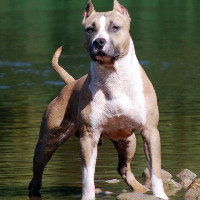
Standard of the Staffordshire Bull Terrier


A little of the Bullmastiff

The Bullmastiff is a dog that originated in England and was developed in the 1860s. These dogs were originally a cross between a Mastiff and a Bulldog. Gamekeepers were looking for a dog capable of guarding game reserves and large estates and keeping poachers away. They first tried the Mastiff, but it wasn't aggressive enough and was also too slow. Then they tried the English Bulldog, but it was too aggressive and also too small. After crossing these two dogs, they found the perfect combination. Bullmastiffs excelled at this task, as they were able to track poachers silently and hold them back without harming them. By the early 20th century, gamekeepers were no longer needed, although there were organized competitions in which the Bullmastiff continued to dominate.
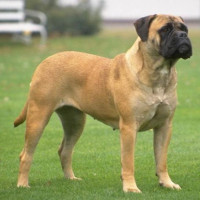
Standard of the Bullmastiff

Appearance of the Staffy Bull Bullmastiff

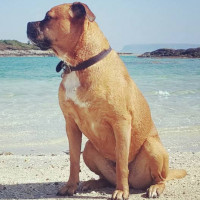
The Staffy Bull Bullmastiff is a solid, muscular breed of dog that will be medium to large in size once it reaches maturity. The general appearance of these dogs is a blend of the Staffordshire Bull Terrier and the Bullmastiff. However, if you look closely enough, you can see some characteristics of both breeds. The face, while generally resembling that of the Bullmastiff, will not be as wrinkled. The Bullmastiff is a large dog with a broad, wrinkled head, a short, dark muzzle and a slight underbite. Its ears are also dark and pendulous, and its tail, set high, is tapered and reaches down to the hock. The Staffordshire Bull Terrier is robust and agile, with a broad head and strong jaws that meet in a scissor bite. It has a short muzzle, a well-defined stop and distinct cheek muscles. Its eyes are round and dark, and its nose is black. The ears may be semi-erect or rose-shaped, and the neck is short but thick and very muscular. These dogs have broad chests and horizontal toplines. Your Staffy Bull Bullmastiff will be a lovely blend of the two, strong and majestic with a determined gait. One thing to note, his weight can vary to a large extent, depending on the parental mix.

Temperament of the Staffy Bull Bullmastiff

Both the Staffy Bull Bullmastiff's parents, the Staffordshire Bull Terrier and the Bullmastiff, are very strong and powerful dogs. For this reason, their offspring will certainly need constant training as they grow. The Bullmastiff is not known for being an intelligent breed and can be quite independent and stubborn. However, these qualities need to be balanced with the Staffordshire Bull Terrier's intelligent, eager-to-please personality. The best way to train these dogs is to be firm but gentle, and to give them rewards when they behave well. As both parent breeds can also be a little aggressive, it's essential to teach them to behave well and look to you for guidance from an early age. Although these dogs are large and powerful, they are actually quite affectionate, loyal and gentle, making them an ideal choice for families and children. They often see themselves as the guardians of the home, and will be kind and protective towards young children. This breed doesn't like to be left at home alone for long periods, and if bored and lonely, may start chewing or become destructive.

Needs and activities of the Staffy Bull Bullmastiff

The activity level of the Staffy Bull Bullmastiff is somewhere between that of the Staffordshire Bull Terrier and the Bullmastiff. The Staffordshire Bull Terrier is generally quite active, but as the Bullmastiff is more docile, we can assume that the Staffy Bull Bullmastiff will have a little less energy. That's why we can say that these dogs will probably have moderate energy levels, and will need to exercise for around 25 to 45 minutes a day. As they are not extremely energetic, these dogs can live well in an apartment, provided it's big enough for them. Don't give them too much exercise in the heat, as they prefer the cold and don't tolerate hot temperatures very well.

Maintenance of the Staffy Bull Bullmastiff

The Staffy Bull Bullmastiff will adopt a coat similar to that of the two parent dogs. The Staffordshire Bull Terrier has a short, smooth coat, while the Bullmastiff also has a short but rough coat. Both breeds don't need much grooming, although they do shed throughout the year. Occasional grooming will give the coat a smooth, clean appearance, and get your dog used to being handled. You should also look after your dog's dental hygiene, brushing at least two or three times a week. To prevent ear infections, Staffy Bull Bullmastiffs should have their ears cleaned once a week. You should also trim your dog's nails regularly. Although the exact frequency depends on the dog, you should check the length of his nails once or twice a month. If you hear your dog's nails clicking on the ground as he walks, it's a good indication that they're too long and need trimming.

Comments

Latest page updates

  • Telomian

    Telomian He is not recognized by the F.C.I. Origin Malaysia Translation Francis Vandersteen A brief presentation of the Telomian The Telomian is a very rare breed of dog, and the only one native to Malaysia to have been bred outside the country. They were originally bred by the indigenous people of Malaysia to combat parasites such as snakes, rats,...
  • King Wheaten -- Cavalier King Charles Spaniel X Irish Soft Coated Wheaten Terrier

    King Wheaten He is not recognized by the F.C.I. Origin Great Britain <> Ireland -> U.S.A. Translation Francis Vandersteen A brief presentation of the King Wheaten The King Wheaten is a small dog with a heart this big and a playful disposition. Borrowing the energy and soft-coated waves of the Irish Soft Coated Wheaten Terrier and the size and...
  • Spanierd -- English Springer Spaniel X German Shepherd

    Spanierd He is not recognized by the F.C.I. Origin Great Britain <> Germany -> U.S.A. Translation Francis Vandersteen A brief presentation of the Spanierd The Spanierd is a hybrid dog. Its parent breeds are the English Springer Spaniel and the German Shepherd. They have an affable personality. He's known for entertaining family and friends with his...
  • Alaskan Goldenmute -- Alaskan Malamute X Golden Retriever

    Alaskan Goldenmute He is not recognized by the F.C.I. Origin U.S.A. <> Great Britain -> U.S.A. Translation Francis Vandersteen This breed is also known as Alaskan GoldenGoldenmuteAlaskan Gold Retriever     A brief presentation of the Alaskan Goldenmute The Alaskan Goldenmute is a descendant of two great dog breeds: the Alaskan Malamute and the Golden...
  • French pointing dog Pyrenean type

    French pointing dog Pyrenean type FCI standard Nº 134 Origin France Translation Mrs. Peggy Davis Group Group 7 Pointing Dogs Section Section 1.1 Continental Pointing Dogs « Braque » Type Working With working trial Acceptance on a definitive basis by the FCI Tuesday 18 January 1955 Publication of the official valid standard Tuesday 01 August 2023 Last...
  • French pointing dog Gascogne type

    French pointing dog Gascogne type FCI standard Nº 133 Origin France Translation Mrs. Peggy Davis Group Group 7 Pointing Dogs Section Section 1.1 Continental Pointing Dogs « Braque » Type Working With working trial Acceptance on a definitive basis by the FCI Monday 17 January 1955 Publication of the official valid standard Tuesday 01 August 2023 Last...
  • Vucciriscu

    Vucciriscu He is not recognized by the F.C.I. Origin Sicily Translation Francis Vandersteen En français, cette race se dit Vucciriscu Diese Norm ist in deutscher Sprache sichtbar Vucciriscu En español, esta raza se dice Vucciriscu In het Nederlands, wordt dit ras gezegd Vucciriscu This breed is also known as Sicilian Vucciriscu Sicilian Butcher...

© 2026 Groupe Milouchouchou ASBL. Tous droits réservés. En savoir plus

Protected by Copyright01
We use cookies

We use cookies on our website. Some of them are essential for the operation of the site, while others help us to improve this site and the user experience (tracking cookies). You can decide for yourself whether you want to allow cookies or not. Please note that if you reject them, you may not be able to use all the functionalities of the site.

Ok