Shetinese

He is not recognized by the F.C.I.

Origin
Great Britain <> China -> U.S.A.
Translation
Francis Vandersteen

A brief presentation of the Shetinese

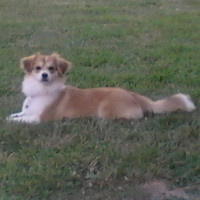
The Shetinese is a hybrid of the Pekingese and the Shetland Sheepdog. This hybrid combines a pure Pekingese breed that was bred and used solely to keep company with royalty in China, some of whom were small enough to be carried in the sleeves of the imperial family, with a pure Shetland Sheepdog breed that was bred and used for guarding and herding a variety of livestock in the Shetland Islands north of Scotland. The result is an active, loving, loyal and playful ball of fluff that makes an expert kneeler and an amazing companion, even if he is a little bigger.

History of the Shetinese

There's little or no information available on the hybrid itself, so we'll have to learn about it through the history of its parent breeds. Although there is no information available on the date and place of origin of the hybrid, we can assume that it originated in the USA, between the late 1900s and the early 2000s, when interest in crossing pure breeds for a number of reasons became popular. The Shetinese hybrid is recognized by the Designer Breed Registry and the International Designer Canine Registry.


A little of the Shetland Sheepdog

        
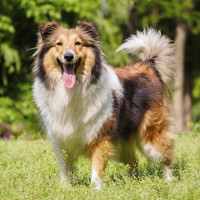
The Shetland Sheepdog originated in the Shetland Islands, north of Scotland, probably in the 1700s, and arrived in England in the 1800s. The Shetland pony, Shetland cattle and small Shetland sheep also originate from this region. The Shetland Sheepdog, then known as the Miniature Collie, was considered a farmer's best friend, verbally alerting them to the presence of strangers or anything abnormal in farms and gardens. Later, the Miniature Collie and Shetland Sheepdog were crossed with other Scottish herding dogs, which enabled them to acquire herding skills and become even more valuable to farmers. Other breeds thought to be among their ancestors include the black and tan King Charles Spaniel, Greenland Yakki dogs, Scandinavian Spitz-type dogs and Scottish Working Dogs, resulting in the beautiful, friendly and loyal companion dog we know today. The Shetland Sheepdog was officially recognized by the American Kennel Club in 1911, where it ranks 24th among the most popular breeds on its register.
Standard of the Shetland Sheepdog


A little of the Pekingese

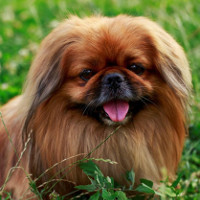
The Pekingese parent breed originated, as its name suggests, in China, more precisely in Peking (now Beijing), over 2,000 years ago. This ancient canine breed has been the darling of imperial families over the centuries, pampering them beyond all sense and reason, while maintaining their extremely pure bloodlines. It is said that some of them were so small that the ladies of the imperial families would slip them into the sleeves of their clothes to carry them from one place to another. Created in ancient times for the sole purpose of companionship, this breed continues in this role today, while adding an element of love and loyalty to the family that makes it so popular worldwide. The Pekingese breed was officially recognized by the American Kennel Club in 1906, where it ranks 93rd among the most popular breeds on this register.
Standard of the Pekingese

Appearance of the Shetinese

The Shetinese hybrid is a mixture of Pekingese and Shetland Sheepdog and, as such, can inherit appearance traits from either or both of its parent breeds. Your Shetinese hybrid may have an average height of 28 centimeters at the shoulders and an average weight of 8 kilos. His coat can be thick and long or double, with a short, soft undercoat and a longer, rougher topcoat. Coat colors can be white, gray, tan, black, brown, red, sable or blue merle. The tail can be set high, carried high and arched over the back, or set high and carried slightly upwards, the tail having a fringe to match the coat. Eyes may be large, round, bold and very dark, or medium-sized, almond-shaped and dark, although blue may be seen in merle-blue dogs. The muzzle can be long or short, with a black nose and a scissor bite or lower bite.

Temperament of the Shetinese

Your Shetinese hybrid is a mix of Pekinese and Shetland Sheepdog, and may inherit the temperament and personality of one or both parent breeds. Traits it can inherit include aggression, affection, kindness, courage, gentleness and independence. This Shetinese is also known for its intelligence, alertness, affectionate attitude, mischievousness, loyalty and responsiveness. This hybrid can be a little more difficult to train, sometimes showing a certain stubbornness. He's friendly if properly socialized at a young age to ensure that he'll get on well enough with children, the family cat and other dogs. He will be friendly with strangers if properly socialized, but expect him to be wary until he feels there is no danger to members of his human family. It's important to bear in mind that the Sheltie's parents have a strong herding instinct, so he may inherit enough of a herding instinct to “herd” the family's children, cat or dog. It can be a frequent barker, an important characteristic for those living in noise-restricted areas.

Needs and activities of the Shetinese

Your Shetinese hybrid is an active little companion who will need 1 to 2 hours of daily exercise to stay fit, healthy and happy. This exercise can take the form of several walks or jogs, playing in a dog park or fenced yard, interactive games such as fetch, Frisbee, flyball, agility training and obedience training. He has a strong urge to hunt and a moderate tendency to roam, so it's very important to keep him on a leash when you take him out of the house, fenced yard or other secure enclosure, unless you like to chase him through brambles and heather in pursuit of a small animal or an interesting scent that has caught his eye. Its small to medium size makes it a perfect dog for apartment or condominium living, provided it has sufficient opportunities for exercise and there are no noise pollution problems in these areas. He can also live very well in a family home with or without a fenced yard, in an urban or rural environment. It can tolerate colder as well as moderately warm temperatures, bearing in mind that it may need extra protection in extreme temperatures.

Maintenance of the Shetinese

Your Shetinese hybrid falls into the category of high-maintenance dogs, mainly due to the length and thickness of its coat, which is not hypoallergenic. It has moderate/seasonal shedding, requiring brushing several times a week, and daily brushing during periods of seasonal shedding. He should only be bathed when necessary, to avoid drying out the vital oils in his coat. These dogs are classified as high-moderate hunting dogs and moderate wandering dogs. It is therefore important to keep him on a leash when he is away from home or fenced property. He is classified in the low category for drooling and dog odor. His ears should be checked weekly and cleaned if necessary with absorbent cotton and a cleaning product approved for canine ears. While you're checking his ears, take a look at his nails and trim them if necessary, unless he's able to maintain them during normal daily activities. Be sure to brush his teeth at home at least two to three times a week to prevent the development of periodontal disease and subsequent tooth loss.

Comments

Latest page updates

  • Telomian

    Telomian He is not recognized by the F.C.I. Origin Malaysia Translation Francis Vandersteen A brief presentation of the Telomian The Telomian is a very rare breed of dog, and the only one native to Malaysia to have been bred outside the country. They were originally bred by the indigenous people of Malaysia to combat parasites such as snakes, rats,...
  • King Wheaten -- Cavalier King Charles Spaniel X Irish Soft Coated Wheaten Terrier

    King Wheaten He is not recognized by the F.C.I. Origin Great Britain <> Ireland -> U.S.A. Translation Francis Vandersteen A brief presentation of the King Wheaten The King Wheaten is a small dog with a heart this big and a playful disposition. Borrowing the energy and soft-coated waves of the Irish Soft Coated Wheaten Terrier and the size and...
  • Spanierd -- English Springer Spaniel X German Shepherd

    Spanierd He is not recognized by the F.C.I. Origin Great Britain <> Germany -> U.S.A. Translation Francis Vandersteen A brief presentation of the Spanierd The Spanierd is a hybrid dog. Its parent breeds are the English Springer Spaniel and the German Shepherd. They have an affable personality. He's known for entertaining family and friends with his...
  • Alaskan Goldenmute -- Alaskan Malamute X Golden Retriever

    Alaskan Goldenmute He is not recognized by the F.C.I. Origin U.S.A. <> Great Britain -> U.S.A. Translation Francis Vandersteen This breed is also known as Alaskan GoldenGoldenmuteAlaskan Gold Retriever     A brief presentation of the Alaskan Goldenmute The Alaskan Goldenmute is a descendant of two great dog breeds: the Alaskan Malamute and the Golden...
  • French pointing dog Pyrenean type

    French pointing dog Pyrenean type FCI standard Nº 134 Origin France Translation Mrs. Peggy Davis Group Group 7 Pointing Dogs Section Section 1.1 Continental Pointing Dogs « Braque » Type Working With working trial Acceptance on a definitive basis by the FCI Tuesday 18 January 1955 Publication of the official valid standard Tuesday 01 August 2023 Last...
  • French pointing dog Gascogne type

    French pointing dog Gascogne type FCI standard Nº 133 Origin France Translation Mrs. Peggy Davis Group Group 7 Pointing Dogs Section Section 1.1 Continental Pointing Dogs « Braque » Type Working With working trial Acceptance on a definitive basis by the FCI Monday 17 January 1955 Publication of the official valid standard Tuesday 01 August 2023 Last...
  • Vucciriscu

    Vucciriscu He is not recognized by the F.C.I. Origin Sicily Translation Francis Vandersteen En français, cette race se dit Vucciriscu Diese Norm ist in deutscher Sprache sichtbar Vucciriscu En español, esta raza se dice Vucciriscu In het Nederlands, wordt dit ras gezegd Vucciriscu This breed is also known as Sicilian Vucciriscu Sicilian Butcher...

© 2026 Groupe Milouchouchou ASBL. Tous droits réservés. En savoir plus

Protected by Copyright01
We use cookies

We use cookies on our website. Some of them are essential for the operation of the site, while others help us to improve this site and the user experience (tracking cookies). You can decide for yourself whether you want to allow cookies or not. Please note that if you reject them, you may not be able to use all the functionalities of the site.

Ok