Labrador Retriever

FCI standard Nº 122

Origin
Canada
Group
Group 8 Retrievers, Flushing dogs, Water dogs
Section
Section 1 Retrievers
Working
With working trial
Acceptance on a definitive basis by the FCI
Friday 24 December 1954
Publication of the official valid standard
Thursday 16 June 2022
Last update
Friday 30 September 2022
En français, cette race se dit
Retriever du Labrador
Diese Norm ist in deutscher Sprache sichtbar
Labrador Retriever
En español, esta raza se dice
Labrador Retriever
In het Nederlands, wordt dit ras gezegd
Labrador Retriever

Usage

Retriever.

Brief historical summary

It is popularly thought that the Labrador Retriever originated on the coast of Newfoundland where fishermen were seen to use a dog of similar appearance to retrieve fish. An excellent water dog, his weather resistant coat and unique tail, likened to that of an otter because of its shape, emphasise this trait.
Comparatively speaking, the Labrador is not a very old breed, its breed club having been formed in 1916 and the Yellow Labrador Club having been founded in 1925. It was in field trialling that the Labrador found early fame, having been originally introduced to these shores in the late 1800s by Col Peter Hawker and the Earl of Malmesbury. It was a dog called Malmesbury Tramp which was described by Lorna, Countess Howe as one of the ‘tap roots’ of the modern Labrador.

General appearance

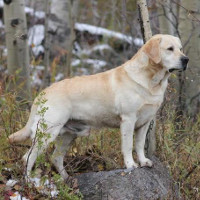
Strongly built, short-coupled, very active; (which precludes excessive body weight or substance) broad in skull; broad and deep through chest and ribs; broad and strong over loins and hindquarters.

Behaviour / temperament

Good-tempered, very agile. Excellent nose, soft mouth; keen lover of water. Adaptable, devoted companion.
Intelligent, keen and biddable, with a strong will to please. Kindly nature, with no trace of aggression or undue hyness.

Head

Cranial region

Skull
Broad. Clean-cut without fleshy cheeks.  
Stop
Defined.

Facial region

Nose
Wide, nostrils well developed.
Muzzle
Powerful, not snipy.
Jaws and teeth
Jaws of medium length, jaws and teeth strong with a perfect, regular and complete scissor bite, i.e. upper teeth closely overlapping lower teeth and set square to the jaws.
Eyes
Medium size, expressing intelligence and good temper; brown or hazel.
Ears
Not large or heavy, hanging close to head and set rather far back.

Neck

Clean, strong, powerful, set into well placed shoulders.

Body

Topline
Level.
Loin
Wide, short-coupled and strong.
Chest
Of good width and depth, with well sprung barrel ribs – this effect not to be produced by carrying excessive weight.

Tail

Distinctive feature, very thick towards base, gradually tapering towards tip, medium length, free from feat hering, but clothed thickly all round with short, thick, dense coat, thus giving “rounded” appearance described as “Otter” tail. May be carried gaily, but should not curl over back.

Limbs

Forequarters

Generality
Forelegs straight from elbow to ground when viewed from either front or side. Legs placed well under the body.
Shoulders
Long and well laid back.
Upper arm
Near equal in length to shoulder blade.
Forearm
Forelegs well boned and straight.
Forefeet
Round, compact; well-arched toes and well developed pads.

Hindquarters

Generality
Well developed hindquarters, not sloping to tail.
Stifle
Well turned.
Metatarsus
Hocks well let down. Cowhocks highly undesirable.
Hind feet
Round, compact; well-arched toes and well developed pads.

Gait and movement

Free, covering adequate ground; straight and true in front and rear.

Coat

Hair
Distinctive feature, short, dense, without wave or feathering, giving fairly hard feel to the touch; weather-resistant undercoat.
Colour
Wholly black, yellow or liver/chocolate. Yellows range from light cream to fox red, livers/chocolates range from light to dark. Small white spot on chest permissible.

Size and weight

Height at withers
Ideal height at the withers: Males: 56 – 57 cms. Females: 54 – 56 cms.

Faults

• Any departure from the foregoing points should be considered a fault and the seriousness with which the fault should be regarded should be in exact proportion to its degree and its effect upon the health and welfare of the dog and its ability to perform its traditional work.
• Faults listed should be in degree of seriousness.

Disqualifying faults

 Aggressive or overly shy.
 Any other coat colour or combination of colours.

NB :

• Any dog clearly showing physical or behavioural abnormalities shall be disqualified.
• The above mentioned faults when occurring to a highly marked degree or frequently are disqualifying.
• Male animals should have two apparently normal testicles fully descended into the scrotum.
• Only functionally and clinically healthy dogs, with breed typical conformation should be used for breeding.

Bibliography

https://www.fci.be/


Additional information from visitors

Originally one of the smaller variants of the old St.John's Water Dog, developed in the region off the Greenland coast and Newfoundland in Canada, the Labrador Dog was, alongside its larger cousin, the Newfie, used to help the fishermen by swimming out in the frozen waters and collecting their fishnets, as well as to pull smaller boats and retrieve fish that fell out of the net. The original incarnation of the Labrador wasn't as popular as the Newfoundland or other large St.John's dogs and this variety, known as the Lesser St.John's Dog or Small Water Dog at the time, was rapidly declining in numbers in the late 1700's. The modern Labrador Retriever breed was created in the early 19th century, when a number of surviving specimens was introduced to the Pole harbor in Dorset, onboard the trade ships delivering salted codfish and other merchandise from Canada. In England, hunters crossed these rugged water-loving dogs with a variety of common working and hunting breeds, resulting in an attractive, resilient and obedient stock of reliable gundogs that served as the foundation for the development of the famous breed we know today as the Labrador Retriever. It is uncertain which exact breeds were used in the Labrador's creation, but smaller specimens of the early British stock of Newfoundlands and old English Water Spaniels, as well as the Ca de Bestiar, Laboreiro Cattledog and even some variety of local bulldogges had been suggested. Whatever its true ancestry may be, the Labrador retriever was universally hailed as one of the most intelligent, friendly and obedient breeds ever created.
An excellent retriever, the Labrador also became an immensely popular family companion and Show Dog in Britain in the first decade of the 20th century, after receiving official recognition by the English Kennel Club in 1903. It wasn't very long before the breed conquered the United States and was recognized by the AKC in 1917. The Labrador retriever has enjoyed great worldwide popularity throughout the 20th century and has remained the favourite breed of American families to this day. This is an agile and resilient breed, posessing impressive working abilities, which, when coupled with its willingness to please and trainability rarely matched in the canine world, make the Labrador an ideal choice for a service dog, a role that the breed has been fulfilling for many years when employed by the Police or the Military as a drug and explosive detecion dog.
When bred properly, the Labrador Retriever is one of the most rewarding family pets and working dogs in the world, but the breed's popularity has resulted in a decline in quality, due to overbreeding and the appearance of bloodlines of questionable origin, especially in America. Uncharacteristic specimens are commonly encountered, slowly destroying the breed's well-deserved good reputation. Various health problems and unstable temperaments have been plaguing the Labrador for quite some time now, but there are still dedicated and serious breeders to be found, doing their best to preserve the true nature and proper type of this wonderful breed. A true Labrador is a rugged and solid dog of the light mastiff type, known for its massive, but muscular and athletic body, with a wide chest and sturdy legs. The muzzle and jaws are powerful and the proper head type is elegantly broad, known as the "Blockhead". However, there are too many untypical specimens with narrow heads and lightly built bodies, as well as being too tall and having shorter coats than preferred. In recent years, there has also been a growing number of aggressive examples reported, which many believe is a sure sign of unpure bloodlines.
When raised properly, the Labrador Retriever is an affectionate and playful urban pet, tolerant of other dogs and an obedient and even-tempered companion. The coat is moderately short, flat and very dense. Originally accepted only in solid black, the Labrador eventually became allowed in yellow and brown colourings during the WW1 years. Still the most popular one, the black variety should be uniformly black in colour, although a small white patch on the chest is acceptable. Yellow dogs can range from very light cream to almost red shades, while the brown type varies from liver to chocolate solids. The ideal height is around 23 inches, but taller examples exist.

Detailed history

Labrador is the first breed that, while not a watchdog and defense, claims universality. Indeed, it is generally not necessary that a dog shines in utilitarian areas to make a great companion, and that a race has famous "service" in a specialty does not automatically open the doors success. But, for a dog first became the most famous of the Retrievers, the fact of being used both in the fight against drugs and anti-terrorism and as a guide for the blind does not fail to sound lasting on his reputation. A breed showing such great qualities in such varied tasks can only be excellent in more ordinary roles.

Thus, the Labrador is moving in a parallel direction to that of the German Shepherd, in a style, with a personality and assets quite different. And, like the German Shepherd, he was born in the late nineteenth century, to find success after the 1914-1918 war.

As for the origins of Labrador, they remain enveloped in thick mists: those that surround the island of Newfoundland. There is no doubt that Labrador has had a long and profitable internship in this inhospitable land. It was there that he was able to endow himself with an extraordinary resistance, a pronounced taste for the liquid element, a sense of research and rapport to please his master. But it is unlikely that it is native, because Newfoundland was inhabited only from the seventeenth century, and it was probably at that time that various types of dogs were there introduced. For example, British settlers, who needed pack dogs and sleighs, imported very strong specimens from the Old Continent, which formed the basis of the Newfoundland breed, obviously related to mountain-type humps.

In addition, fishers from Newfoundland, to catch fish escaping from nets or landing lines, were helped by smaller dogs that were very adapted to the water. To obtain these dogs, they could not draw on what the European canine population offered of aquatic specialists (such as the Barbet, the Portuguese water dog or the Water Spaniels) since none of them resembles, from near and far in Labrador. If they did not come from the east, these dogs have logically arrived from the west: the American coast is, after all, only a stone's throw away from Newfoundland.

Based on the commonalities between the Newfoundland breed and the Retrievers (Chesapeake Bay, Golden, Flat Coated, Curly Coated and Labrador, of course), we can paint a plausible portrait of the ancestor of Labrador: a dog of medium size but very robustly built, with a broad head with drooping but not very large ears, covered with a pelisse more remarkable for its density and impermeability than for its length. Unfortunately, this assumption is not supported by any historical evidence. No explorer or settler a little curious, if not literate, has left a written record of this type of dog, native of the North American coasts.

This element of mystery, however, does not allow giving greater credit to other assumptions about the origin of Labrador. For example, Scandinavian dogs have been mentioned, relying on the fact that the Vikings were the first to discover these regions. But we can think that their dogs have not left more traces than their facilities. We also know that the Basque fishermen, from the sixteenth century, well before the installation of the British went to Newfoundland. From there to imagine that these Basques have left Pyrenean dogs or Barbets, it seems pretty chimerical. As for the third assumption, according to which the Labrador would come from the cross between a dog and an otter, it is neither more nor less of the purest fantasy.

The Labrador is probably, however, from American dogs, as its name also invites to think, and even authorizes, unlike what happens for many breeds canines. These dogs helped the Indian tribes to fish in the fishy but devilishly cold waters of the shores of the area that gave its name to our retriever. Western fishermen may have been quick to understand the value of bringing in such rude and enthusiastic companions, even though they apparently did not look good. The modesty of all these actors, Indians, fishermen and dogs, is undoubtedly the cause of which no written relation of their history has reached us.

However, Labrador almost disappeared. Moreover, if it landed on the Old Continent, if it exists today, it is thanks to a paradox, because it is due to the measures taken by the Newfoundland administration to limit, so drastic, the number of dogs on the island. At the end of the eighteenth century, the presence of dogs, both large for the trait and smaller for fishing, was no longer essential. Roads crisscrossed the island, fishing became almost industrial. In 1780, Governor Edwards decided to limit the number of dogs to one per household, and in 1815, the measure not being considered enough incentive, the Court of assignments redoubled severity: any dog not muzzled was to be slaughtered. What was the problem with dogs? We do not know exactly. Were they really too many? Would they have hindered sheep farming? Still, the message was well understood and the Newfoundlanders got rid of most of their dogs.

Many crossed the Atlantic and found themselves on the docks of Poole, the main home port of the British cod fishermen, to find a new master. The largest, spectacular with their beautiful and long coat, grabbed the attention, and they were attributed, besides the strength, great capacity of water dogs, abilities sometimes a little usurped, because we confused the big dogs of the inside, with those, smaller, shore. In principle, these were called "St. John's Newfoundland", but we can assume that everyone had an interest in maintaining the confusion: when the dog was a little small, he had the taste of water, while, very tall but not inclined to dive, he was none the less very handsome. One can also think that there was on the island many mixtures between these types of dogs, which did not facilitate a clear distinction.

Was the authentic Newfoundland of St. John's condemned to disappear, or at least to melt among the rescuing or so-called dogs? Fortunately, it was nothing, because they interested the hunters, who did not need huge dogs, who did not attach themselves to the beauty of their auxiliaries, but who wanted a game finder, able to go look for the room in icy and deep water. It is therefore the hunters who, by adopting this dog a little common pace, with the sole sight of its utilitarian qualities, saved it from the disappearance.

But these hunters were not just anyone; they should not be confused with those who, modestly, are satisfied with a versatile companion, evolving "under the gun". They were landlords who had at their disposal vast private areas, very rich in game, and the most sophisticated weapons of the moment. We understand that they have been very demanding about the performance of their auxiliaries. Their hounds became very specialized, endowed with an increasingly fine flair, and with such exceptional athletic abilities; they did not keep their noses stuck to the ground, they no longer adopted the little trot that goes hand in hand, but they galloped, their noses in search of the higher emanation, more subtle and more fleeting. These eminent specialists are named Pointers and Setters.

Obviously, they should not ask them to stop their quest as quick as stylish to report the game pulled, because it was annoying their nature and their training: this work requires to carefully examine each thicket, to patiently follow the bird wounded who fled, or to cross the river to bring back the one who fell on the other side of the bank. And then, how to be able to both stop, to sink and to observe precisely the point of fall of the game? And if the dog resets, it can take a long time.

And there is another style of hunting, for those who are particularly interested in their qualities of fine trigger: the battered. Despite a large staff, it often happens that the table does not correspond to the number of pieces fallen. In each case, it lacks a character, a dog that completes the work of the dogs, or that replaces the men beating the bush.

The great British hunters came to the conclusion that some dogs from Newfoundland had remarkable provisions, because, in addition to an incredible resistance to fatigue and bad weather, they showed great pleasure in reporting to their master what they were doing. throwing or pointing at them, even in cold, deep water, where the risk of losing game is greatest.

Admittedly, these newcomers were not hunting dogs strictly speaking, they probably lacked a bit of nose. They were also very diverse in appearance. To remedy these inconveniences, there were two solutions: either we crossed these dogs with hunting breeds, giving them at the same time more flair, greater hunting qualities, a more beautiful appearance; it was the fastest way; or else we decided to select, patiently, improving, eliminating, which promised to be longer. By the first method, Flat Coated, Curly Coated, Golden, which is normal, were undoubtedly the first Retrievers to appear. The other path would lead to Labrador.

The confrontations between the various races of Retrievers often gave reason for the second solution, but it took seventy years to reach the affirmation of this supremacy. This was the time between 1820-1830, when Lord Malmesbury, Lord Scott and other nobles in Britain began to choose their first Labradors from Newfoundland's newly arrived dogs, and end of the last century, when the race began to win in field-trials. If we note that the progress of Labrador was linked to that of the Pointers and Setters, that it was necessary to sort out all the Newfoundland dogs, of appearance and quality very variable, all this time, finally, was much needed for a modest fisherman's dog to become a brilliant hunting dog.

Anyone warned can only be surprised to hear that Labrador is a "brave quiet father", prototype of the dog companion adapting to all environments, including the most urbanized. It's like pretending to simply erase the decades of patient selection that truly created the breed. It can not be denied, however, that the distance between the Newfoundland dog and the retriever is less than the distance separating the Retriever from the urban idler whom one would sometimes like to see become and remain.

Officially recognized by the Kennel Club in 1903, the breed will live its full maturity during the inter-war period: Labrador triumphs in both work competitions and show rings, reaching the highest steps podiums (especially at Cruft). He is at this time the symbol of the British high society, hunting enthusiast: Lord Knutsford, the Countess Howe, who have contributed the most to the development of Labrador, they would not smile in disbelief if today they are claimed that their favorite breed has become one of the most popular in the world, created by and for an elite hunter.

This is what happened, especially in the Anglo-Saxon world, from the United States to Great Britain via Australia, where Labrador has been for many years in the first places in the box -office canine. No doubt, such a brilliant future is reserved for this dog in France, where the first subjects settled in 1896. From 1930, its numbers took on a more significant value, thanks to the Rothschild family, and, since the beginning of the eighties, they have increased noticeably.

Labrador owes some of its success to the fact that it appears as both a chic dog, and even posh, not afraid of words, and like a simple dog, brave in temperament and understated elegance. If he had posted a more showy bet, his vogue would have been smaller; and the result would have been the same if he had been only the companion of modest people. Of course, its popularity is not only the result of this contrast, it is also due to eminent and very valuable qualities, which derive directly from its original use.

A good Retriever; and Labrador proved he was one of the best, if not the best; must be obedient, easy to train, able to understand quickly and well, endowed with a great memory, and, still more, he must love to obey and work for his master (and not for himself). In fact, Labrador is part of the "early" dogs, which are not slow (about eight or ten months) to know how to fulfill their task effectively or, as a companion, to perfectly assimilate all the basics of canine etiquette. His first job is that he follows his master step by step, that he observes all his gestures and his indications, that is to say, he only sees the chase through his eyes. other eminent auxiliaries of the hunter take a more personal pleasure in their work, which corresponds more directly to their instinct, namely the search for game.

However, Labrador should not be just an eager valet. To his gifts of observation (this ability of the retriever to accurately locate the point of fall of the game is called marking), in his memory he joins endurance and courage (when it comes to diving into chilled water), as well as the sense of initiative. Some of these qualities predisposed him to become an excellent pet dog. Its robustness is not to make a regular customer of veterinary practices, and its dense hair requires only a minimum of maintenance. He is tall, or rather he is not small, and especially strong, active, obviously overflowing with energy and athletic. Tolerant, loving, educating without difficulty, having many affinities with children, able to adapt to many situations: what more?

It is not really a watchdog, even if it has, like all its congeners, the sense of the territory. Thus, in an isolated pavilion, he will serve very well as guardian, with his big voice and his corpulence, but without exaggerated aggressiveness, whereas, in a house where the door is constantly open to friends and visitors, it is his sociable nature that will be particularly appreciated.

This privileged guest of the Elysee who, for sixty years, has been known as Rothschild, is completely satisfied with a more modest living environment. A small garden is enough for him, provided that his masters associate him with their life, because one can take it everywhere: he does not seek chicane with the other dogs, he does not risk to bite the unknown who, attracted by his friendly aspect , would like to caress him. And nothing will please him more than long walks in nature; It should be noted in this connection that it is not difficult to teach him the reminder and that he is not a runaway. With children, he will be happy to spend, to release his overflow of energy, to deploy his patience and kindness, which will not stop him from being respected by little devils, thanks to his size.

Is there a possibility to go for a swim? That can fill him with happiness. But you must know that his innate taste for water does not dispense with a minimum of caution: a two-year-old Labrador who has never seen water, and who is suddenly forced to grow, is at risk. appreciate only moderately the experience; likewise, if you run along a river, its first movement may not be to take a dip in the water. But once the first contacts with the liquid element established in favorable conditions, he will love bathing, he will amaze everyone by its energy, its resistance to fatigue and indifference to cold.

This is clear, but it is not useless to emphasize it loud and clear: despite all good will, Labrador, in order to flourish, can not be satisfied with an exclusively urban and sedentary life, nor with a solitary existence. Under his apparent bonhomie, his pleasing curves (which are in fact a natural protection against the cold), he is a true sportsman, born to work in team with his master in full nature and whatever the conditions. So he must necessarily exercise (not just fast exits), the opportunity to go crazy on a lawn. But still, he needs to live with his masters. As much as using his athletic abilities, he likes to please the family, to make himself useful, even if it is not necessarily by hunting. In any case, he does not appreciate loneliness or indifference. Delivered to itself much of the day, this dog without problems and calm would not remain debonair and would be likely to commit damage. Nobody is perfect.

Labrador is not born educated and weighted. He does his best to accept the desires of his masters, but it will not be a model of wisdom if we do not show him a little firmness, patience, if we do not make the effort of instill in him the basis of dog training. To pass abruptly from indulgence, from indifference to fits of anger, to excesses of severity, is the best way of hurting him. If Labrador is undoubtedly a factor of balance in a family, it is necessary that it puts a little of hers.

In addition to its intelligence, Labrador has been endowed with an exceptional flair. In various countries, the services of the army, police, and customs have recognized the value of this dog for all functions; and they are numerous; other than guardian and defender. Its hardiness, the little maintenance it requires, its propensity to work, its ability to learn all combine with a fine nose that allows it to detect all kinds of objects and substances. He has become the most used drug detector dog. It has been found that it detects, in trace amounts, the presence of all drugs, in the most ingenious hiding places, even when mixed with very odorous substances such as garlic or onion. It is also an unparalleled explosives detector, even if this work is in perfect contradiction with its atavistic reporter, since it is important not to seize the deadly machine after marking its location. . In Great Britain, where the army has been confronted with terrorism for many years, it has been searched for weapons: in this case, it is the presence of fat that allows it to detect them. We have seen a Labrador find machine guns sealed in a wall. Of course, the dog does not dwell on weapons that are in their normal place, such as a shotgun hanging from his rack.

A task already implemented in other countries is currently being tested in France, in the gendarmerie: locate, in a public place, the individual carrying a firearm; thanks to his physique, Labrador does not worry the thug, because he just wiggles his tail when he feels a revolver. This dog can still do other valuable services: look for survivors in rubble, detect gas leaks. His humanitarian vocation as a guide dog for the blind, where his weighting, his initiative abilities are a marvel, certainly contributed greatly to his popularity. In this area too, He is the leader.

One could also cite his performances in disciplines that are more athletic than utilitarian, such as Obedience (obedience competitions, mainly found in Anglo-Saxon countries). As for emphasizing its traditional role as a retriever, this may not be necessary. Of course, few hunters are able to own several dogs (Retriever and Retriever), but Labrador is, par excellence, the auxiliary beats, which honors its owner by his obedience and his qualities as a finder , a protractor with a sweet tooth, strong enough to bring back without fatigue a large room, not reluctant to cross a river. Some, finally, use the Labrador in an unorthodox way, asking him to quest and bush. He usually does it very well.

The compliments do not dry, but they are very suitable for this dog capable of working in the most diverse conditions, which certainly represents the type of dog today and tomorrow, racy without ostentation and without artifice, in which the Behavior issues are not left in the background by aesthetic considerations. Labrador is the image of the good and brave dog who, as well, knows how to be attentive and quick to understand, the calm companion but able to deploy a tremendous energy. His vogue is well deserved; it is to be hoped that it does not begin its capital of sympathy and equilibrium.

In conclusion, we can only agree with the most determined amateurs in Labrador, who are committed to maintaining and consolidating their primary vocation as retrievers by organizing field trials; in French, the dog kept on a leash, or in English, in liberty; and looking for breeders rewarded with "work". If this specialty allowed the selection of a dog with so many qualities, why should it be abandoned?

Comments

Latest page updates

  • Samusky

    Samusky He is not recognized by the F.C.I. Origin Northern Russia and Siberia <> Siberia -> North America Translation Francis Vandersteen En français, cette race se dit Samusky Diese Norm ist in deutscher Sprache sichtbar Samusky En español, esta raza se dice Samusky In het Nederlands, wordt dit ras gezegd Samusky This breed is also known as SamhuskySamsky     A...
  • Agouti Husky

    Agouti Husky FCI standard Nº 270 Origin Siberian Translation Francis Vandersteen En français, cette race se dit Husky Agouti Diese Norm ist in deutscher Sprache sichtbar Agouti-Husky En español, esta raza se dice Husky Agouti In het Nederlands, wordt dit ras gezegd Agouti Husky   The "Agouti" Husky is not a distinct breed but a rare color variant...
  • White Husky

    White Husky   FCI standard Nº 270       Origin Siberia Translation Francis Vandersteen En français, cette race se dit Husky blanc Diese Norm ist in deutscher Sprache sichtbar Weißer Husky En español, esta raza se dice Husky blanco In het Nederlands, wordt dit ras gezegd Witte Husky   The white Husky is not a distinct breed, but rather a rare and striking...
  • Taimyr Wolf

    Taimyr Wolf He is not recognized by the F.C.I. Origin Siberia Translation Francis Vandersteen En français, cette race se dit Loup de Taïmyr Diese Norm ist in deutscher Sprache sichtbar Taimyr-Wolf En español, esta raza se dice Lobo de Taimyr In het Nederlands, wordt dit ras gezegd Taimyr-wolf   The Taimyr Wolf is no longer an extant breed, but it...
  • Manchurian Spitz

    Manchurian Spitz He is not recognized by the F.C.I. Origin Manchuria and Siberia region Translation Francis Vandersteen En français, cette race se dit Spitz de Mandchourie Diese Norm ist in deutscher Sprache sichtbar Mandschurischer Spitz En español, esta raza se dice Spitz de Manchuria In het Nederlands, wordt dit ras gezegd Mantsjoerije-spits   The...
  • White Swedish Elkhound

    White Swedish Elkhound He is not recognized by the F.C.I. Origin Sweden Translation Francis Vandersteen En français, cette race se dit Chien d'élan suédois blanc Diese Norm ist in deutscher Sprache sichtbar Schwedischer weißer Elchhund En español, esta raza se dice Perro de alce sueco blanco In het Nederlands, wordt dit ras gezegd Witte Zweedse...
  • Turkish Spitz

    Turkish Spitz He is not recognized by the F.C.I. Origin Turkey Translation Francis Vandersteen En français, cette race se dit Spitz turc Diese Norm ist in deutscher Sprache sichtbar Türkischer Spitz En español, esta raza se dice Spitz turco In het Nederlands, wordt dit ras gezegd Turkse spits This breed is also known as Tonya FinosuFino TonyaKobi   The Tonya...
  • Hunters Creek Feist

    Hunters Creek Feist He is not recognized by the F.C.I. Origin U.S.A. Translation Francis Vandersteen En français, cette race se dit Hunters Creek Feist Diese Norm ist in deutscher Sprache sichtbar Hunters Creek Feist En español, esta raza se dice Hunters Creek Feist In het Nederlands, wordt dit ras gezegd Hunters Creek Feist   The Hunters Creek Feist is...
  • Gray’s Mountain Feist

    Gray’s Mountain Feist He is not recognized by the F.C.I. Origin U.S.A. Translation Francis Vandersteen En français, cette race se dit Gray’s Mountain Feist Diese Norm ist in deutscher Sprache sichtbar Gray’s Mountain Feist En español, esta raza se dice Gray’s Mountain Feist In het Nederlands, wordt dit ras gezegd Gray’s Mountain Feist   The Gray’s...
  • Thornburg Feist

    Thornburg Feist He is not recognized by the F.C.I. Origin U.S.A. Translation Francis Vandersteen En français, cette race se dit Thornburg Feist Diese Norm ist in deutscher Sprache sichtbar Thornburg Feist En español, esta raza se dice Thornburg Feist In het Nederlands, wordt dit ras gezegd Thornburg Feist   The Thornburg Feist is a specialized line of...
  • Mullins Feist

    Mullins Feist He is not recognized by the F.C.I. Origin U.S.A. Translation Francis Vandersteen En français, cette race se dit Mullins Feist Diese Norm ist in deutscher Sprache sichtbar Mullins Feist En español, esta raza se dice Mullins Feist In het Nederlands, wordt dit ras gezegd Mullins Feist   The Mullins Feist is an American hunting dog breed...
  • Kemmer Stock Hybrid Squirrel Dog

    Kemmer Stock Hybrid Squirrel Dog He is not recognized by the F.C.I. Origin U.S.A. Translation Francis Vandersteen En français, cette race se dit Kemmer Stock Hybrid Squirrel Dog Diese Norm ist in deutscher Sprache sichtbar Kemmer Stock Hybrid Squirrel Dog En español, esta raza se dice Kemmer Stock Hybrid Squirrel Dog In het Nederlands, wordt dit...
  • Buckley Mountain Feist

    Buckley Mountain Feist He is not recognized by the F.C.I. Origin U.S.A. Translation Francis Vandersteen En français, cette race se dit Buckley Mountain Feist Diese Norm ist in deutscher Sprache sichtbar Buckley Mountain Feist En español, esta raza se dice Buckley Mountain Feist In het Nederlands, wordt dit ras gezegd Buckley Mountain Feist   The...
  • Charlie Feist

    Charlie Feist He is not recognized by the F.C.I. Origin United Kingdom, U.S.A. Translation Francis Vandersteen En français, cette race se dit Charlie Feist Diese Norm ist in deutscher Sprache sichtbar Charlie Feist En español, esta raza se dice Charlie Feist In het Nederlands, wordt dit ras gezegd Charlie Feist   The charming Charlie Feist is one of...
  • Barger Stock Feist

    Barger Stock Feist He is not recognized by the F.C.I. Origin U.S.A. Translation Francis Vandersteen En français, cette race se dit Barger Stock Feist Diese Norm ist in deutscher Sprache sichtbar Barger Stock Feist En español, esta raza se dice Barger Stock Feist In het Nederlands, wordt dit ras gezegd Barger Stock Feist   The Barger Stock Feist is a...
  • Toy Manchester Terrier

    Toy Manchester Terrier He is not recognized by the F.C.I. Origin U.S.A. Translation Francis Vandersteen En français, cette race se dit Manchester Terrier miniature Diese Norm ist in deutscher Sprache sichtbar Miniatur-Manchester-Terrier En español, esta raza se dice Manchester Terrier miniatura In het Nederlands, wordt dit ras gezegd Miniatuur-Manchesterterriër   The Toy...
  • Donggyeongi

    Donggyeongi He is not recognized by the F.C.I. Origin South Korea Translation Francis Vandersteen En français, cette race se dit Donggyeongi Diese Norm ist in deutscher Sprache sichtbar Donggyeongi En español, esta raza se dice Donggyeongi In het Nederlands, wordt dit ras gezegd Donggyeongi This breed is also known as Daeng GyeonDonggyeong Gae   The...
  • Mackenzie River Husky

    Mackenzie River Husky He is not recognized by the F.C.I. Origin Canada, U.S.A. Translation Francis Vandersteen En français, cette race se dit Husky du fleuve Mackenzie Diese Norm ist in deutscher Sprache sichtbar Mackenzie-River-Husky En español, esta raza se dice Husky del río Mackenzie In het Nederlands, wordt dit ras gezegd Mackenzie-rivier...
  • Danish Spitz

    Danish Spitz He is not recognized by the F.C.I. Origin Denmark Translation Francis VandersteenAuthoritative language (DK) Working No working trial required En français, cette race se dit Spitz danois Diese Norm ist in deutscher Sprache sichtbar Dänischer Spitz En español, esta raza se dice Spitz danés In het Nederlands, wordt dit ras gezegd Deense...
  • Hällefors Elkhound

    Hällefors Elkhound He is not recognized by the F.C.I. Origin Sweden Translation Francis Vandersteen En français, cette race se dit Chien d'élan de Hällefors Diese Norm ist in deutscher Sprache sichtbar Hällefors Elchhund En español, esta raza se dice Elkhound de Hällefors In het Nederlands, wordt dit ras gezegd Hällefors Elkhound   The Hällefors...
  • Great Fauve of Brittany

    Great Fauve of Brittany He is not recognized by the F.C.I. Origin France Translation Francis Vandersteen En français, cette race se dit Grand Fauve de Bretagne Diese Norm ist in deutscher Sprache sichtbar Großer Fauve der Bretagne En español, esta raza se dice Gran Fauve de Bretaña In het Nederlands, wordt dit ras gezegd Grote Fauvist van...
  • Timmon’s Biter Herding Dog

    Timmon’s Biter Herding Dog He is not recognized by the F.C.I. Origin Australia Translation Francis Vandersteen En français, cette race se dit Chien de berger Timmon’s Biter Diese Norm ist in deutscher Sprache sichtbar Timmon’s-Biter-Schäferhund En español, esta raza se dice Perro pastor Timmon’s Biter In het Nederlands, wordt dit ras gezegd Timmon’s...
  • Montemboeuf Dog

    Montemboeuf Dog He is not recognized by the F.C.I. Origin France Translation Francis Vandersteen En français, cette race se dit Chien Montemboeuf Diese Norm ist in deutscher Sprache sichtbar Montemboeuf-Hund En español, esta raza se dice Perro Montemboeuf In het Nederlands, wordt dit ras gezegd Montemboeuf-hond   The Montemboeuf is an extinct dog breed, developed...
  • Leauvenaar Dog

    Leauvenaar Dog He is not recognized by the F.C.I. Origin Belgium Translation Francis Vandersteen En français, cette race se dit Chien Leauvenaar Diese Norm ist in deutscher Sprache sichtbar Leauvenaar-Hund En español, esta raza se dice Perro Leauvenaar In het Nederlands, wordt dit ras gezegd Leauvenaar Hond   The Leauvenaar is an extinct dog breed that...
  • Larye Dog

    Larye Dog He is not recognized by the F.C.I. Origin France Translation Francis Vandersteen En français, cette race se dit Chien de Larye Diese Norm ist in deutscher Sprache sichtbar Larye-Hund En español, esta raza se dice Perro de Larye In het Nederlands, wordt dit ras gezegd Larye-hond This breed is also known as Layrre   The Larye is a...
  • Happa Dog

    Happa Dog He is not recognized by the F.C.I. Origin China Translation Francis Vandersteen En français, cette race se dit Chien Happa Diese Norm ist in deutscher Sprache sichtbar Happa-Hund En español, esta raza se dice Perro Happa In het Nederlands, wordt dit ras gezegd Happa-hond   The Happa Dog was a dog breed originating in China. Closely...
  • Han Epoch Dog

    Han Epoch Dog He is not recognized by the F.C.I. Origin China Translation Francis Vandersteen En français, cette race se dit Chien de l'époque Han Diese Norm ist in deutscher Sprache sichtbar Hund der Han-Zeit En español, esta raza se dice Perro de la época Han In het Nederlands, wordt dit ras gezegd Hond uit de Han-periode This breed is also known...
  • Stable Griffon

    Stable Griffon He is not recognized by the F.C.I. Origin Belgium Translation Francis Vandersteen En français, cette race se dit Griffon d’écurie Diese Norm ist in deutscher Sprache sichtbar Stallgriffon En español, esta raza se dice Grifón de establo In het Nederlands, wordt dit ras gezegd Stalgriffon   The Stable Griffon was developed to hunt rats...
  • Red Decoy Dog

    Red Decoy Dog He is not recognized by the F.C.I. Origin England Translation Francis Vandersteen En français, cette race se dit Chien d'appel rouge Diese Norm ist in deutscher Sprache sichtbar Roter Lockhund En español, esta raza se dice Perro de reclamo rojo In het Nederlands, wordt dit ras gezegd Lokjachthond This breed is also known as Decoy...
  • Coton from Réunion

    Coton from Réunion He is not recognized by the F.C.I. Origin Réunion Island En français, cette race se dit Coton de Réunion Diese Norm ist in deutscher Sprache sichtbar Coton von Réunion En español, esta raza se dice Cotón de Reunión In het Nederlands, wordt dit ras gezegd Coton van Réunion This breed is also known as Réunion Dog   The Coton from...
  • Céris Dog

    Céris Dog He is not recognized by the F.C.I. Origin France Translation Francis Vandersteen En français, cette race se dit Chien Céris Diese Norm ist in deutscher Sprache sichtbar Céris Hund En español, esta raza se dice Perro Céris In het Nederlands, wordt dit ras gezegd Céris Hond   The Céris is an extinct dog breed, created in France by Monsieur de...
  • Roulers Cattle Dog

    Roulers Cattle Dog He is not recognized by the F.C.I. Origin Belgium Translation Francis Vandersteen En français, cette race se dit Bouvier des Roulers Diese Norm ist in deutscher Sprache sichtbar Roulers Treibhund En español, esta raza se dice Boyero de Roulers In het Nederlands, wordt dit ras gezegd Roulers Koehond   The Roulers Cattle Dog was...
  • Paret Cattle Dog

    Paret Cattle Dog He is not recognized by the F.C.I. Origin Belgium Translation Francis Vandersteen En français, cette race se dit Bouvier des Paret Diese Norm ist in deutscher Sprache sichtbar Paret Treibhund En español, esta raza se dice Boyero de Paret In het Nederlands, wordt dit ras gezegd Paret Koehond   The Paret Cattle Dog was one of five...
  • Moerman Cattle Dog

    Moerman Cattle Dog He is not recognized by the F.C.I. Origin Belgium Translation Francis Vandersteen En français, cette race se dit Bouvier des Moerman Diese Norm ist in deutscher Sprache sichtbar Moerman Treibhund En español, esta raza se dice Boyero de Moerman In het Nederlands, wordt dit ras gezegd Moerman Koehond   The Moerman Cattle Dog was...
  • Blanquito de la Habana

    Blanquito de la Habana He is not recognized by the F.C.I. Origin Cuba Translation Francis Vandersteen En français, cette race se dit Blanquito de la Habana Diese Norm ist in deutscher Sprache sichtbar Blanquito de la Habana En español, esta raza se dice Blanquito de La Habana In het Nederlands, wordt dit ras gezegd Blanquito de la Habana   The...
  • Black and Tan Terrier

    Black and Tan Terrier He is not recognized by the F.C.I. Origin United Kingdom Translation Francis Vandersteen En français, cette race se dit Terrier noir et feu Diese Norm ist in deutscher Sprache sichtbar Schwarzer und feuriger Terrier En español, esta raza se dice Terrier Negro y Fuego In het Nederlands, wordt dit ras gezegd Zwart-bruine...
  • Saintonge Hound

    Saintonge Hound He is not recognized by the F.C.I. Origin France Translation Francis Vandersteen En français, cette race se dit Chien de Saintonge Diese Norm ist in deutscher Sprache sichtbar Saintonge-Laufhund En español, esta raza se dice Perro de Saintonge In het Nederlands, wordt dit ras gezegd Saintonge-hond   The Saintonge Hound is an extinct breed that...
  • Basset Saintongeois

    Basset Saintongeois He is not recognized by the F.C.I. Origin France Translation Francis Vandersteen En français, cette race se dit Basset saintongeois Diese Norm ist in deutscher Sprache sichtbar Basset Saintongeois En español, esta raza se dice Basset saintongeois In het Nederlands, wordt dit ras gezegd Basset Saintongeois   The Basset...
  • Basset Normand

    Basset Normand He is not recognized by the F.C.I. Origin France Translation Francis Vandersteen En français, cette race se dit Basset normand Diese Norm ist in deutscher Sprache sichtbar Basset Normand En español, esta raza se dice Basset normando In het Nederlands, wordt dit ras gezegd Basset Normand   The Basset Normand was a Basset-type hound...
  • Basset d'Artois

    Basset d'Artois He is not recognized by the F.C.I. Origin France Translation Francis Vandersteen En français, cette race se dit Basset d'Artois Diese Norm ist in deutscher Sprache sichtbar Basset d’Artois En español, esta raza se dice Basset de Artois In het Nederlands, wordt dit ras gezegd Basset d'Artois   The Basset d’Artois was a basset-type hound...
  • Tenerife Dog

    Tenerife Dog He is not recognized by the F.C.I. Origin Island of Tenerife (Canary Islands) Translation Francis Vandersteen En français, cette race se dit Chien de Tenerife Diese Norm ist in deutscher Sprache sichtbar Teneriffa-Hund En español, esta raza se dice Perro de Tenerife In het Nederlands, wordt dit ras gezegd Tenerife-hond This breed is also known...
  • Welsh Hillman

    Welsh Hillman He is not recognized by the F.C.I. Origin Wales Translation Francis Vandersteen En français, cette race se dit Welsh Hillman Diese Norm ist in deutscher Sprache sichtbar Welsh Hillman En español, esta raza se dice Welsh Hillman In het Nederlands, wordt dit ras gezegd Welsh Hillman   The Welsh Hillman was an old local breed or type of...
  • Turnspit Dog

    Turnspit Dog He is not recognized by the F.C.I. Origin United Kingdom Translation Francis Vandersteen En français, cette race se dit Chien de tournebroche Diese Norm ist in deutscher Sprache sichtbar Rotisserie-Hund En español, esta raza se dice Perro asador In het Nederlands, wordt dit ras gezegd Turnspit-hond   The Turnspit dog was a...
  • Toy Trawler Spaniel

    Toy Trawler Spaniel He is not recognized by the F.C.I. Origin United Kingdom Translation Francis Vandersteen En français, cette race se dit Epagneul Miniature Trawler Diese Norm ist in deutscher Sprache sichtbar Miniatur-Trawler-Spaniel En español, esta raza se dice Spaniel de Trawler en miniatura In het Nederlands, wordt dit ras gezegd Miniatuur...
  • Cão de Fila da Terceira

    Cão de Fila da Terceira He is not recognized by the F.C.I. Origin Terceira Island in the Azores Translation Francis Vandersteen The Terceira Mastiff (Portuguese : Cão de Fila da Terceira) is a local Portuguese dog breed, also known as the Rabo Torto (rabo = tail, torto = twisted). Neither the Fédération Cynologique Internationale nor the Local...
  • Talbot Hound

    Talbot Hound He is not recognized by the F.C.I. Origin France Translation Francis Vandersteen En français, cette race se dit Chien de Talbot Diese Norm ist in deutscher Sprache sichtbar Talbot-Hund En español, esta raza se dice Sabueso Talbot In het Nederlands, wordt dit ras gezegd Talbot-hond This breed is also known as Talbot BloodhoundFrench...
  • English Staghound

    English Staghound He is not recognized by the F.C.I. Origin England Translation Francis Vandersteen En français, cette race se dit Staghound anglais Diese Norm ist in deutscher Sprache sichtbar Englischer Staghound En español, esta raza se dice Staghound inglés In het Nederlands, wordt dit ras gezegd Engelse Staghound   The Staghound is an extinct...
  • Southern Hound

    Southern Hound He is not recognized by the F.C.I. Origin Great Britain Translation Francis Vandersteen En français, cette race se dit Chien du Sud Diese Norm ist in deutscher Sprache sichtbar Südlicher Laufhund En español, esta raza se dice Sabueso del sur In het Nederlands, wordt dit ras gezegd Zuidelijke Hond   The Southern Hound was a large...
  • St. John's Water Dog

    St. John's Water Dog He is not recognized by the F.C.I. Origin Canada Translation Francis Vandersteen En français, cette race se dit Chien d’eau de St. John's Diese Norm ist in deutscher Sprache sichtbar St. John's Wasserhund En español, esta raza se dice Perro de aguas de San Juan In het Nederlands, wordt dit ras gezegd St. John's Water Dog The St...
  • Rache Hound

    Rache Hound He is not recognized by the F.C.I. Origin Middle Ages Translation Francis Vandersteen En français, cette race se dit Chien courant Rache Diese Norm ist in deutscher Sprache sichtbar Rache-Laufhund En español, esta raza se dice Sabueso Rache In het Nederlands, wordt dit ras gezegd Rache-hond This breed is also known as RacchRachRatch   The term...
  • Welsh Grey Sheepdog

    Welsh Grey Sheepdog He is not recognized by the F.C.I. Origin Wales Translation Francis Vandersteen En français, cette race se dit Chien de berger gallois gris Diese Norm ist in deutscher Sprache sichtbar Waliser Grauer Schäferhund En español, esta raza se dice Pastor Gris Galés In het Nederlands, wordt dit ras gezegd Welsh Grey Herdershond This breed is...
  • Old Croatian Sighthound

    Old Croatian Sighthound He is not recognized by the F.C.I. Origin Croatia Translation Francis Vandersteen En français, cette race se dit Lévrier croate ancien Diese Norm ist in deutscher Sprache sichtbar Alter kroatischer Windhund En español, esta raza se dice Viejo lebrel croata In het Nederlands, wordt dit ras gezegd Oude Kroatische Windhond This...
  • Norman Hound

    Norman Hound He is not recognized by the F.C.I. Origin France Translation Francis Vandersteen En français, cette race se dit Chien normand Diese Norm ist in deutscher Sprache sichtbar Normannischer Laufhund En español, esta raza se dice Sabueso Normando In het Nederlands, wordt dit ras gezegd Normandische Brak   Little is known about the origins of...
  • Moscow Water Dog

    Moscow Water Dog He is not recognized by the F.C.I. Origin Russia Translation Francis Vandersteen En français, cette race se dit Chien d'eau de Moscou Diese Norm ist in deutscher Sprache sichtbar Moskauer Wasserhund En español, esta raza se dice Perro de agua de Moscú In het Nederlands, wordt dit ras gezegd Moskou-waterhond This breed is also...
  • Tracking Hound

    Tracking Hound He is not recognized by the F.C.I. Origin Middle Ages Translation Francis Vandersteen En français, cette race se dit Chien pisteur Diese Norm ist in deutscher Sprache sichtbar Spürhund En español, esta raza se dice Sabueso de rastro In het Nederlands, wordt dit ras gezegd Speurhond This breed is also known as LimerLymerLyam...
  • Laconian

    Laconian He is not recognized by the F.C.I. Origin Ancient Laconia, Greece Translation Francis Vandersteen En français, cette race se dit Laconien Diese Norm ist in deutscher Sprache sichtbar Lakonier En español, esta raza se dice Laconio In het Nederlands, wordt dit ras gezegd Laconisch This breed is also known as SpartanCastorian   The Laconian is an...
  • Halls Heeler

    Halls Heeler He is not recognized by the F.C.I. Origin Australia Translation Francis Vandersteen En français, cette race se dit Halls Heeler Diese Norm ist in deutscher Sprache sichtbar Halls Heeler En español, esta raza se dice Halls Heeler In het Nederlands, wordt dit ras gezegd Halls Heeler   The Halls Heeler is the presumed ancestor of two...
  • Dogo Cubano

    Dogo Cubano He is not recognized by the F.C.I. Origin Cuba Translation Francis Vandersteen The Dogo Cubano, also known as the Cuban Dogue, Cuban Bloodhound and Cuban Mastiff, is an extinct breed of dog from Cuba. It was of the Bullmastiff type and was used for bull and dog fighting. The breed was introduced to Cuba to capture runaway slaves...
  • Dalbo Dog

    Dalbo Dog He is not recognized by the F.C.I. Origin Sweden Translation Francis Vandersteen En français, cette race se dit Chien de Dalbo Diese Norm ist in deutscher Sprache sichtbar Dalbo-Hund En español, esta raza se dice Perro Dalbo In het Nederlands, wordt dit ras gezegd Dalbo-hond This breed is also known as DalbohundDalsland Mastiff   Icelandic...
  • Cordoba Fighting Dog

    Cordoba Fighting Dog He is not recognized by the F.C.I. Origin Argentina Translation Francis Vandersteen En français, cette race se dit Chien de combat de Cordoue Diese Norm ist in deutscher Sprache sichtbar Córdoba-Kampfhund En español, esta raza se dice Perro de pelea de Córdoba In het Nederlands, wordt dit ras gezegd Cordoba-vechthond This breed is...
  • Celtic Greyhound

    Celtic Greyhound He is not recognized by the F.C.I. Origin Celtic Mythology Translation Francis Vandersteen En français, cette race se dit Lévrier celte Diese Norm ist in deutscher Sprache sichtbar Keltische Windhund En español, esta raza se dice Lebrel celta In het Nederlands, wordt dit ras gezegd Keltische windhond   The Celtic Greyhound is an...
  • Belgian Mastiff

    Belgian Mastiff He is not recognized by the F.C.I. Origin Belgium Translation Francis VandersteenOrigin SRSH-KMSH - Belgian Royal Canine SocietyAuthentic language FR Group Group 2 : Pinscher and Schnauzer - Molossoid and Swiss Mountain and Cattle Dogs Section Section 2.1 : Molossoids, mastiff type Working Without working trial En français, cette...
  • Argentine polar dog

    Argentine polar dog He is not recognized by the F.C.I. Origin Argentina Translation Francis Vandersteen The Argentine polar dog (perro polar argentino) was a breed of Argentine dog that is now extinct. Argentine polar dogs were developed by the Argentine army to provide sled dogs for their Antarctic bases. The breed was the result of a cross...
  • Alaunt

    Alaunt He is not recognized by the F.C.I. Origin Central Asia Translation Francis Vandersteen This breed is also known as Kavkaz AlauntCaucasian AlauntAlan DoggePersian AlauntContinental AlauntEnglish AlauntFrench AlauntSpanish AlauntAlan DogArnaut Dogge The legendary Alaunt is one of the most important Molosse breeds in history, but also one of...
  • Small Dutch Hound

    Small Dutch Hound He is not recognized by the F.C.I. Origin The Netherlands Translation Francis Vandersteen En français, cette race se dit Petit Chien courant néerlandais Diese Norm ist in deutscher Sprache sichtbar Kleiner niederländischer Brackenhund En español, esta raza se dice Sabueso holandés pequeño In het Nederlands, wordt dit ras gezegd Kleine...
  • Sri Lankan Hound

    Sri Lankan Hound He is not recognized by the F.C.I. Origin Sri Lankan Translation Francis Vandersteen En français, cette race se dit Chien courant du Sri Lanka Diese Norm ist in deutscher Sprache sichtbar Sri-Lanka-Hund En español, esta raza se dice Sabueso de Sri Lanka In het Nederlands, wordt dit ras gezegd Sri Lankaanse Brak This breed is also...
  • Bulgarian Tricolour Hound

    Bulgarian Tricolour Hound He is not recognized by the F.C.I. Origin Bulgaria Translation Francis Vandersteen En français, cette race se dit Chien courant tricolore bulgare Diese Norm ist in deutscher Sprache sichtbar Bulgarischer Dreifarbiger Laufhund En español, esta raza se dice Sabueso tricolor búlgaro In het Nederlands, wordt dit ras gezegd Bulgaarse...
  • Međimurje Small Dog

    Međimurje Small Dog He is not recognized by the F.C.I. Origin Northwestern Croatia Translation Francis Vandersteen En français, cette race se dit Petit chien du Međimurje Diese Norm ist in deutscher Sprache sichtbar Međimurje-Kleinhund En español, esta raza se dice Perro pequeño de Međimurje In het Nederlands, wordt dit ras gezegd Međimurje-hondje This...
  • Serbian Yellow Hound

    Serbian Yellow Hound He is not recognized by the F.C.I. Origin Serbia (Balkans, Southeast Europe) Translation Francis Vandersteen En français, cette race se dit Chien jaune serbe Diese Norm ist in deutscher Sprache sichtbar Serbischer Gelber Laufhund En español, esta raza se dice Sabueso Amarillo Serbio In het Nederlands, wordt dit ras gezegd Servische...
  • Gotland Hound

    Gotland Hound He is not recognized by the F.C.I. Origin Sweden Translation Francis Vandersteen En français, cette race se dit Chien de chasse de Gotland Diese Norm ist in deutscher Sprache sichtbar Gotlandhund En español, esta raza se dice Sabueso de Gotland In het Nederlands, wordt dit ras gezegd Gotlandhond This breed is also known as Gotland...
  • Westerwald Mountain Dog

    Westerwald Mountain Dog He is not recognized by the F.C.I. Origin Germany Translation Francis Vandersteen En français, cette race se dit Bouvier du Westerwald Diese Norm ist in deutscher Sprache sichtbar Westerwalder Sennenhund En español, esta raza se dice Perro de Montaña de Westerwald In het Nederlands, wordt dit ras gezegd Westerwaldse...
  • Carnia Hound

    Carnia Hound He is not recognized by the F.C.I. Origin Italy Translation Francis Vandersteen En français, cette race se dit Chien courant de Carnia Diese Norm ist in deutscher Sprache sichtbar Carnia-Hund En español, esta raza se dice Sabueso de Carnia In het Nederlands, wordt dit ras gezegd Carnia-hond This breed is also known as Segugio Carnico   The...
  • Kemmer Feist

    Kemmer Feist He is not recognized by the F.C.I. Origin Southern United States Translation Francis Vandersteen En français, cette race se dit Kemmer Feist Diese Norm ist in deutscher Sprache sichtbar Kemmer Feist En español, esta raza se dice Kemmer Feist In het Nederlands, wordt dit ras gezegd Kemmer Feist   The Kemmer Feist originates from the...
  • Alpine Spaniel

    Alpine Spaniel He is not recognized by the F.C.I. Origin Switzerland Translation Francis Vandersteen En français, cette race se dit Epagneul Alpin Diese Norm ist in deutscher Sprache sichtbar Alpenspaniel En español, esta raza se dice Spaniel Alpino In het Nederlands, wordt dit ras gezegd Alpenspaniël   Alpine Spaniels were bred by canons in Alpine...
  • Alpine Mastiff

    Alpine Mastiff He is not recognized by the F.C.I. Origin Switzerland Translation Francis Vandersteen En français, cette race se dit Mâtin alpin Diese Norm ist in deutscher Sprache sichtbar Alpenmastiff En español, esta raza se dice Mastín Alpino In het Nederlands, wordt dit ras gezegd Alpenmastiff   The Alpine Mastiff was an ancient, giant working...
  • Hairless Chihuahua

    Hairless Chihuahua He is not recognized by the F.C.I. Origin Mexico Translation Francis Vandersteen En français, cette race se dit Chihuahua nu Diese Norm ist in deutscher Sprache sichtbar Nackter Chihuahua En español, esta raza se dice Chihuahua sin pelo In het Nederlands, wordt dit ras gezegd Haarloze Chihuahua   The Chihuahua is a small, lively,...
  • Argentine Pila

    Argentine Pila He is not recognized by the F.C.I. Origin Argentina Translation Francis Vandersteen En français, cette race se dit Pila Argentin Diese Norm ist in deutscher Sprache sichtbar Argentinischer Pila En español, esta raza se dice Pila Argentino In het Nederlands, wordt dit ras gezegd Argentijnse Pila This breed is also known as Perro...
  • Ecuadorian Hairless Dog

    Ecuadorian Hairless Dog He is not recognized by the F.C.I. Origin Ecuador Translation Francis Vandersteen En français, cette race se dit Chien nu équatorien Diese Norm ist in deutscher Sprache sichtbar Ecuadorianischer Nackthund En español, esta raza se dice Perro sin pelo ecuatoriano In het Nederlands, wordt dit ras gezegd Ecuadoriaanse...
  • Tesem

    Tesem He is not recognized by the F.C.I. Origin Egypt Translation Francis Vandersteen En français, cette race se dit Tesem Diese Norm ist in deutscher Sprache sichtbar Tesem En español, esta raza se dice Tesem In het Nederlands, wordt dit ras gezegd Tesem   The Tesem was a hunting dog from ancient Egypt. Now extinct, its ancestry is believed to...
  • Salish Woolly Dog

    Salish Woolly Dog He is not recognized by the F.C.I. Origin British Columbia, Canada Translation Francis Vandersteen En français, cette race se dit Chien laineux Salish Diese Norm ist in deutscher Sprache sichtbar Salish-Wollhund En español, esta raza se dice Perro Lanudo Salish In het Nederlands, wordt dit ras gezegd Salish wollige hond This...
  • Tierra del Fuego Dog

    Tierra del Fuego Dog He is not recognized by the F.C.I. Origin South America Translation Francis Vandersteen En français, cette race se dit Chien de Terre de Feu Diese Norm ist in deutscher Sprache sichtbar Feuerlandhund En español, esta raza se dice Perro de Tierra del Fuego In het Nederlands, wordt dit ras gezegd Tierra del Fuego-hond This...
  • Techichi

    Techichi He is not recognized by the F.C.I. Origin Mexico Translation Francis Vandersteen En français, cette race se dit Techichi Diese Norm ist in deutscher Sprache sichtbar Techichi En español, esta raza se dice Techichi In het Nederlands, wordt dit ras gezegd Techichi   The Techichi was an indigenous dog of Mesoamerica, specifically associated...
  • Hare Indian Dog

    Hare Indian Dog He is not recognized by the F.C.I. Origin Canada Translation Francis Vandersteen The Hare Indian Dog is an extinct domesticated dog; possibly a breed of domestic dog, hybrid coyote/dog or domestic coyote; previously found and originally bred in northern Canada by the Hare Indians for hunting. It had the speed and certain...
  • Tahitian Dog

    Tahitian Dog He is not recognized by the F.C.I. Origin Tahiti Translation Francis Vandersteen En français, cette race se dit Chien de Tahiti Diese Norm ist in deutscher Sprache sichtbar Tahiti-Hund En español, esta raza se dice Perro Tahitiano In het Nederlands, wordt dit ras gezegd Tahitiaanse hond   The Tahitian Dog is an extinct Polynesian breed,...
  • Polynesian Dog

    Polynesian Dog He is not recognized by the F.C.I. Origin Polynesia Translation Francis Vandersteen En français, cette race se dit Chien polynésien Diese Norm ist in deutscher Sprache sichtbar Polynesischer Hund En español, esta raza se dice Perro polinesio In het Nederlands, wordt dit ras gezegd Polynesische hond   The term "Polynesian dog" does...
  • Marquesan Dog

    Marquesan Dog He is not recognized by the F.C.I. Origin Marquesas Islands Translation Francis Vandersteen En français, cette race se dit Chien des Marquises Diese Norm ist in deutscher Sprache sichtbar Marquesas-Hund En español, esta raza se dice Perro Marquesano In het Nederlands, wordt dit ras gezegd De Marquesaanse hond This breed is also...
  • Kuri

    Kuri He is not recognized by the F.C.I. Origin New Zealand, between "Waikava" & Mataura plains, Catlins Translation Francis Vandersteen This breed is also known as Maori dog Kurī, or Pacific dog, were a unique breed, brought to Aotearoa New Zealand by ancestors of Māori. These animals were prized – not necessarily as friends, but as valuable...
  • Chiribaya Dog

    Chiribaya Dog He is not recognized by the F.C.I. Origin Peru Translation Francis Vandersteen The Chiribaya Dog (perro Chiribaya) or Peruvian Shepherd Dog (perro pastor Peruano) was a pre-Columbian breed of dog from southwestern Peru, identified by the 42 mummies discovered by anthropologist Sonia Guillén Oneglio in the Ilo district, Moquegua...
  • Philippine Forest Dog

    Philippine Forest Dog He is not recognized by the F.C.I. Origin Philippines Translation Francis Vandersteen En français, cette race se dit Chien des forêts des Philippines Diese Norm ist in deutscher Sprache sichtbar Philippinischer Waldhund En español, esta raza se dice Perro del Bosque Filipino In het Nederlands, wordt dit ras gezegd Filipijnse...
  • Lai Dog

    Lai Dog He is not recognized by the F.C.I. Origin Vietnam Translation Francis Vandersteen En français, cette race se dit Chien de Lai Diese Norm ist in deutscher Sprache sichtbar Lai-Hund En español, esta raza se dice Perro Lai In het Nederlands, wordt dit ras gezegd Lai-hond   With its unique appearance and hunting dog origins, the Lai Dog is...
  • Pampas Hound

    Pampas Hound He is not recognized by the F.C.I. Origin Brazil, Argentina, and Uruguay Translation Francis Vandersteen En français, cette race se dit Chien de chasse des Pampas Diese Norm ist in deutscher Sprache sichtbar Pampashund En español, esta raza se dice Sabueso de las Pampas In het Nederlands, wordt dit ras gezegd Pampashond   The Pampas Hound...
  • Zerdava

    Zerdava He is not recognized by the F.C.I. Origin Turkey and Georgia Translation Francis Vandersteen En français, cette race se dit Zerdava Diese Norm ist in deutscher Sprache sichtbar Zerdava En español, esta raza se dice Zerdava In het Nederlands, wordt dit ras gezegd Zerdava This breed is also known as Eastern Black Sea SpitzKapi Kopegi   The...
  • I-Twina

    I-Twina He is not recognized by the F.C.I. Origin Southern/Eastern Africa Translation Francis Vandersteen En français, cette race se dit I-Twina Diese Norm ist in deutscher Sprache sichtbar I-Twina En español, esta raza se dice I-Twina In het Nederlands, wordt dit ras gezegd I-Twina   The I-Twina is a specific variety of Africanis, an ancient dog breed...
  • Greek Greyhound

    Greek Greyhound He is not recognized by the F.C.I. Origin Greece Translation Francis Vandersteen En français, cette race se dit Lévrier grec Diese Norm ist in deutscher Sprache sichtbar Griechischer Windhund En español, esta raza se dice Galgo Griego In het Nederlands, wordt dit ras gezegd Griekse Windhond   The Greek Greyhound is medium-sized, and its...
  • Khoikhoi Hottentot Dog

      Khoikhoi Hottentot Dog He is not recognized by the F.C.I. Origin South Africa Translation Francis Vandersteen En français, cette race se dit Chien Khoïkhoï Hottentot Diese Norm ist in deutscher Sprache sichtbar Khoikhoi-Hottentottenhund En español, esta raza se dice Perro Hotentote Khoikhoi In het Nederlands, wordt dit ras gezegd Khoikhoi...
  • Santal Hound

    Santal Hound He is not recognized by the F.C.I. Origin India Translation Francis Vandersteen En français, cette race se dit Chien de chasse Santal Diese Norm ist in deutscher Sprache sichtbar Santal-Hund En español, esta raza se dice Sabueso Santal In het Nederlands, wordt dit ras gezegd Santal jachthond   The Santal Hound is an indigenous Indian...
  • Middle Eastern Village Dog

    Middle Eastern Village Dog He is not recognized by the F.C.I. Origin Middle East Translation Francis Vandersteen En français, cette race se dit Chien de village du Moyen-Orient Diese Norm ist in deutscher Sprache sichtbar Dorfhund aus dem Nahen Osten En español, esta raza se dice Perro de aldea de Oriente Medio In het Nederlands, wordt dit ras...
  • Avuvi

    Avuvi He is not recognized by the F.C.I. Origin Ghana and Togo Translation Francis Vandersteen En français, cette race se dit Avuvi Diese Norm ist in deutscher Sprache sichtbar Avuvi En español, esta raza se dice Avuvi In het Nederlands, wordt dit ras gezegd Avuvi This breed is also known as Ghana Stray Dog   Ghana stray dogs are free-roaming dogs that...
  • Old Spanish Pointer

    Old Spanish Pointer He is not recognized by the F.C.I. Origin Spain Translation Francis Vandersteen En français, cette race se dit Braque espagnol ancien Diese Norm ist in deutscher Sprache sichtbar Altspanischer Vorstehhund En español, esta raza se dice Pointer Español Antiguo In het Nederlands, wordt dit ras gezegd Oude Spaanse Pointer This breed...
  • Paisley Terrier

    Paisley Terrier He is not recognized by the F.C.I. Origin Scotland Translation Francis Vandersteen The Paisley Terrier is a descendant of its ancestor, the Skye Terrier, with a similar temperament and appearance.Records from 1440 use the word terrier, telling us that the Skye Terrier was not the first of this group, although we have little...

© 2026 Groupe Milouchouchou ASBL. Tous droits réservés. En savoir plus

Protected by Copyright01

