 |
Labrador Retriever |
|
FCI Standard No. 122 |
Origin |
Canada | |
Group |
Group 8 Retrievers, Flushing dogs, Water dogs | |
Section |
Section 1 Retrievers | |
Working |
With working trial | |
Date of acceptance on a definitive basis by the FCI |
Friday 24 December 1954 | |
Date of publication of the official valid standard |
Tuesday 08 September 2026 | |
Date of the last update |
Tuesday 06 October 2026 | |
En français, cette race se dit |
 |
Retriever du Labrador |
Diese Norm ist in deutscher Sprache sichtbar |
 |
Labrador Retriever |
En español, esta raza se dice |
 |
Labrador Retriever |
In het Nederlands, wordt dit ras gezegd |
 |
Labrador Retriever |
Usage |
| Retriever. |
Brief historical summary |
| It is popularly thought that the Labrador Retriever originated on the coast of Newfoundland where fishermen were seen to use a dog of similar appearance to retrieve fish. An excellent water dog, his weather resistant coat and unique tail, likened to that of an otter because of its shape, emphasise this trait. Comparatively speaking, the Labrador is not a very old breed, its breed club having been formed in 1916 and the Yellow Labrador Club having been founded in 1925. It was in field trialling that the Labrador found early fame, having been originally introduced to these shores in the late 1800s by Col Peter Hawker and the Earl of Malmesbury. It was a dog called Malmesbury Tramp which was described by Lorna, Countess Howe as one of the ‘tap roots’ of the modern Labrador. |
General appearance |
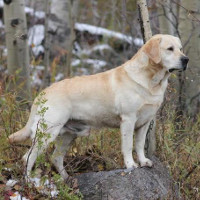
| Strongly built, short-coupled, very active; (which precludes excessive body weight or substance) broad in skull; broad and deep through chest and ribs; broad and strong over loins and hindquarters. |
Behaviour / temperament |
| Good-tempered, very agile. Excellent nose, soft mouth; keen lover of water. Adaptable, devoted companion. Intelligent, keen and biddable, with a strong will to please. Kindly nature, with no trace of aggression or undue hyness. |
Head |
||
Cranial region |
||
Skull |
Broad. Clean-cut without fleshy cheeks. | |
Stop |
Defined. | |
Facial region |
||
Nose |
Wide, nostrils well developed. | |
Muzzle |
Powerful, not snipy. | |
Jaws and teeth |
Jaws of medium length, jaws and teeth strong with a perfect, regular and complete scissor bite, i.e. upper teeth closely overlapping lower teeth and set square to the jaws. | |
Eyes |
Medium size, expressing intelligence and good temper; brown or hazel. | |
Ears |
Not large or heavy, hanging close to head and set rather far back. | |
Neck |
| Clean, strong, powerful, set into well placed shoulders. |
Body |
||
Topline |
Level. | |
Loin |
Wide, short-coupled and strong. | |
Chest |
Of good width and depth, with well sprung barrel ribs – this effect not to be produced by carrying excessive weight. | |
Tail |
| Distinctive feature, very thick towards base, gradually tapering towards tip, medium length, free from feat hering, but clothed thickly all round with short, thick, dense coat, thus giving “rounded” appearance described as “Otter” tail. May be carried gaily, but should not curl over back. |
Limbs |
Forequarters |
||
Generality |
Forelegs straight from elbow to ground when viewed from either front or side. Legs placed well under the body. | |
Shoulders |
Long and well laid back. | |
Upper arm |
Near equal in length to shoulder blade. | |
Forearm |
Forelegs well boned and straight. | |
Forefeet |
Round, compact; well-arched toes and well developed pads. | |
Hindquarters |
||
Generality |
Well developed hindquarters, not sloping to tail. | |
Stifle |
Well turned. | |
Metatarsus |
Hocks well let down. Cowhocks highly undesirable. | |
Hind feet |
Round, compact; well-arched toes and well developed pads. | |
Gait and movement |
| Free, covering adequate ground; straight and true in front and rear. |
Coat |
||
Hair |
Distinctive feature, short, dense, without wave or feathering, giving fairly hard feel to the touch; weather-resistant undercoat. | |
Colour |
Wholly black, yellow or liver/chocolate. Yellows range from light cream to fox red, livers/chocolates range from light to dark. Small white spot on chest permissible. Any other colour or combination of colours unacceptable. |
|
Size and weight |
||
Height at withers |
Ideal height at the withers: Males: 56 – 57 cms. Females: 54 – 56 cms. | |
Faults |
| • Any departure from the foregoing points should be considered a fault and the seriousness with which the fault should be regarded should be in exact proportion to its degree and its effect upon the health and welfare of the dog and its ability to perform its traditional work. • Faults listed should be in degree of seriousness. |
Disqualifying faults |
 Aggressive or overly shy. Any other coat colour or combination of colours. |
NB : |
| • Any dog clearly showing physical or behavioural abnormalities shall be disqualified. • The above mentioned faults when occurring to a highly marked degree or frequently are disqualifying. • Male animals should have two apparently normal testicles fully descended into the scrotum. • Only functionally and clinically healthy dogs, with breed typical conformation should be used for breeding. |
Additional information related to this breed Labrador Retriever |
| Originally one of the smaller variants of the old St.John's Water Dog, developed in the region off the Greenland coast and Newfoundland in Canada, the Labrador Dog was, alongside its larger cousin, the Newfie, used to help the fishermen by swimming out in the frozen waters and collecting their fishnets, as well as to pull smaller boats and retrieve fish that fell out of the net. The original incarnation of the Labrador wasn't as popular as the Newfoundland or other large St.John's dogs and this variety, known as the Lesser St.John's Dog or Small Water Dog at the time, was rapidly declining in numbers in the late 1700's. The modern Labrador Retriever breed was created in the early 19th century, when a number of surviving specimens was introduced to the Pole harbor in Dorset, onboard the trade ships delivering salted codfish and other merchandise from Canada. In England, hunters crossed these rugged water-loving dogs with a variety of common working and hunting breeds, resulting in an attractive, resilient and obedient stock of reliable gundogs that served as the foundation for the development of the famous breed we know today as the Labrador Retriever. It is uncertain which exact breeds were used in the Labrador's creation, but smaller specimens of the early British stock of Newfoundlands and old English Water Spaniels, as well as the Ca de Bestiar, Laboreiro Cattledog and even some variety of local bulldogges had been suggested. Whatever its true ancestry may be, the Labrador retriever was universally hailed as one of the most intelligent, friendly and obedient breeds ever created. An excellent retriever, the Labrador also became an immensely popular family companion and Show Dog in Britain in the first decade of the 20th century, after receiving official recognition by the English Kennel Club in 1903. It wasn't very long before the breed conquered the United States and was recognized by the AKC in 1917. The Labrador retriever has enjoyed great worldwide popularity throughout the 20th century and has remained the favourite breed of American families to this day. This is an agile and resilient breed, posessing impressive working abilities, which, when coupled with its willingness to please and trainability rarely matched in the canine world, make the Labrador an ideal choice for a service dog, a role that the breed has been fulfilling for many years when employed by the Police or the Military as a drug and explosive detecion dog. When bred properly, the Labrador Retriever is one of the most rewarding family pets and working dogs in the world, but the breed's popularity has resulted in a decline in quality, due to overbreeding and the appearance of bloodlines of questionable origin, especially in America. Uncharacteristic specimens are commonly encountered, slowly destroying the breed's well-deserved good reputation. Various health problems and unstable temperaments have been plaguing the Labrador for quite some time now, but there are still dedicated and serious breeders to be found, doing their best to preserve the true nature and proper type of this wonderful breed. A true Labrador is a rugged and solid dog of the light mastiff type, known for its massive, but muscular and athletic body, with a wide chest and sturdy legs. The muzzle and jaws are powerful and the proper head type is elegantly broad, known as the "Blockhead". However, there are too many untypical specimens with narrow heads and lightly built bodies, as well as being too tall and having shorter coats than preferred. In recent years, there has also been a growing number of aggressive examples reported, which many believe is a sure sign of unpure bloodlines. When raised properly, the Labrador Retriever is an affectionate and playful urban pet, tolerant of other dogs and an obedient and even-tempered companion. The coat is moderately short, flat and very dense. Originally accepted only in solid black, the Labrador eventually became allowed in yellow and brown colourings during the WW1 years. Still the most popular one, the black variety should be uniformly black in colour, although a small white patch on the chest is acceptable. Yellow dogs can range from very light cream to almost red shades, while the brown type varies from liver to chocolate solids. The ideal height is around 23 inches, but taller examples exist. |
Detailed history |
| Labrador is the first breed that, while not a watchdog and defense, claims universality. Indeed, it is generally not necessary that a dog shines in utilitarian areas to make a great companion, and that a race has famous "service" in a specialty does not automatically open the doors success. But, for a dog first became the most famous of the Retrievers, the fact of being used both in the fight against drugs and anti-terrorism and as a guide for the blind does not fail to sound lasting on his reputation. A breed showing such great qualities in such varied tasks can only be excellent in more ordinary roles. Thus, the Labrador is moving in a parallel direction to that of the German Shepherd, in a style, with a personality and assets quite different. And, like the German Shepherd, he was born in the late nineteenth century, to find success after the 1914-1918 war. As for the origins of Labrador, they remain enveloped in thick mists: those that surround the island of Newfoundland. There is no doubt that Labrador has had a long and profitable internship in this inhospitable land. It was there that he was able to endow himself with an extraordinary resistance, a pronounced taste for the liquid element, a sense of research and rapport to please his master. But it is unlikely that it is native, because Newfoundland was inhabited only from the seventeenth century, and it was probably at that time that various types of dogs were there introduced. For example, British settlers, who needed pack dogs and sleighs, imported very strong specimens from the Old Continent, which formed the basis of the Newfoundland breed, obviously related to mountain-type humps. In addition, fishers from Newfoundland, to catch fish escaping from nets or landing lines, were helped by smaller dogs that were very adapted to the water. To obtain these dogs, they could not draw on what the European canine population offered of aquatic specialists (such as the Barbet, the Portuguese water dog or the Water Spaniels) since none of them resembles, from near and far in Labrador. If they did not come from the east, these dogs have logically arrived from the west: the American coast is, after all, only a stone's throw away from Newfoundland. Based on the commonalities between the Newfoundland breed and the Retrievers (Chesapeake Bay, Golden, Flat Coated, Curly Coated and Labrador, of course), we can paint a plausible portrait of the ancestor of Labrador: a dog of medium size but very robustly built, with a broad head with drooping but not very large ears, covered with a pelisse more remarkable for its density and impermeability than for its length. Unfortunately, this assumption is not supported by any historical evidence. No explorer or settler a little curious, if not literate, has left a written record of this type of dog, native of the North American coasts. This element of mystery, however, does not allow giving greater credit to other assumptions about the origin of Labrador. For example, Scandinavian dogs have been mentioned, relying on the fact that the Vikings were the first to discover these regions. But we can think that their dogs have not left more traces than their facilities. We also know that the Basque fishermen, from the sixteenth century, well before the installation of the British went to Newfoundland. From there to imagine that these Basques have left Pyrenean dogs or Barbets, it seems pretty chimerical. As for the third assumption, according to which the Labrador would come from the cross between a dog and an otter, it is neither more nor less of the purest fantasy. The Labrador is probably, however, from American dogs, as its name also invites to think, and even authorizes, unlike what happens for many breeds canines. These dogs helped the Indian tribes to fish in the fishy but devilishly cold waters of the shores of the area that gave its name to our retriever. Western fishermen may have been quick to understand the value of bringing in such rude and enthusiastic companions, even though they apparently did not look good. The modesty of all these actors, Indians, fishermen and dogs, is undoubtedly the cause of which no written relation of their history has reached us. However, Labrador almost disappeared. Moreover, if it landed on the Old Continent, if it exists today, it is thanks to a paradox, because it is due to the measures taken by the Newfoundland administration to limit, so drastic, the number of dogs on the island. At the end of the eighteenth century, the presence of dogs, both large for the trait and smaller for fishing, was no longer essential. Roads crisscrossed the island, fishing became almost industrial. In 1780, Governor Edwards decided to limit the number of dogs to one per household, and in 1815, the measure not being considered enough incentive, the Court of assignments redoubled severity: any dog not muzzled was to be slaughtered. What was the problem with dogs? We do not know exactly. Were they really too many? Would they have hindered sheep farming? Still, the message was well understood and the Newfoundlanders got rid of most of their dogs. Many crossed the Atlantic and found themselves on the docks of Poole, the main home port of the British cod fishermen, to find a new master. The largest, spectacular with their beautiful and long coat, grabbed the attention, and they were attributed, besides the strength, great capacity of water dogs, abilities sometimes a little usurped, because we confused the big dogs of the inside, with those, smaller, shore. In principle, these were called "St. John's Newfoundland", but we can assume that everyone had an interest in maintaining the confusion: when the dog was a little small, he had the taste of water, while, very tall but not inclined to dive, he was none the less very handsome. One can also think that there was on the island many mixtures between these types of dogs, which did not facilitate a clear distinction. Was the authentic Newfoundland of St. John's condemned to disappear, or at least to melt among the rescuing or so-called dogs? Fortunately, it was nothing, because they interested the hunters, who did not need huge dogs, who did not attach themselves to the beauty of their auxiliaries, but who wanted a game finder, able to go look for the room in icy and deep water. It is therefore the hunters who, by adopting this dog a little common pace, with the sole sight of its utilitarian qualities, saved it from the disappearance. But these hunters were not just anyone; they should not be confused with those who, modestly, are satisfied with a versatile companion, evolving "under the gun". They were landlords who had at their disposal vast private areas, very rich in game, and the most sophisticated weapons of the moment. We understand that they have been very demanding about the performance of their auxiliaries. Their hounds became very specialized, endowed with an increasingly fine flair, and with such exceptional athletic abilities; they did not keep their noses stuck to the ground, they no longer adopted the little trot that goes hand in hand, but they galloped, their noses in search of the higher emanation, more subtle and more fleeting. These eminent specialists are named Pointers and Setters. Obviously, they should not ask them to stop their quest as quick as stylish to report the game pulled, because it was annoying their nature and their training: this work requires to carefully examine each thicket, to patiently follow the bird wounded who fled, or to cross the river to bring back the one who fell on the other side of the bank. And then, how to be able to both stop, to sink and to observe precisely the point of fall of the game? And if the dog resets, it can take a long time. And there is another style of hunting, for those who are particularly interested in their qualities of fine trigger: the battered. Despite a large staff, it often happens that the table does not correspond to the number of pieces fallen. In each case, it lacks a character, a dog that completes the work of the dogs, or that replaces the men beating the bush. The great British hunters came to the conclusion that some dogs from Newfoundland had remarkable provisions, because, in addition to an incredible resistance to fatigue and bad weather, they showed great pleasure in reporting to their master what they were doing. throwing or pointing at them, even in cold, deep water, where the risk of losing game is greatest. Admittedly, these newcomers were not hunting dogs strictly speaking, they probably lacked a bit of nose. They were also very diverse in appearance. To remedy these inconveniences, there were two solutions: either we crossed these dogs with hunting breeds, giving them at the same time more flair, greater hunting qualities, a more beautiful appearance; it was the fastest way; or else we decided to select, patiently, improving, eliminating, which promised to be longer. By the first method, Flat Coated, Curly Coated, Golden, which is normal, were undoubtedly the first Retrievers to appear. The other path would lead to Labrador. The confrontations between the various races of Retrievers often gave reason for the second solution, but it took seventy years to reach the affirmation of this supremacy. This was the time between 1820-1830, when Lord Malmesbury, Lord Scott and other nobles in Britain began to choose their first Labradors from Newfoundland's newly arrived dogs, and end of the last century, when the race began to win in field-trials. If we note that the progress of Labrador was linked to that of the Pointers and Setters, that it was necessary to sort out all the Newfoundland dogs, of appearance and quality very variable, all this time, finally, was much needed for a modest fisherman's dog to become a brilliant hunting dog. Anyone warned can only be surprised to hear that Labrador is a "brave quiet father", prototype of the dog companion adapting to all environments, including the most urbanized. It's like pretending to simply erase the decades of patient selection that truly created the breed. It can not be denied, however, that the distance between the Newfoundland dog and the retriever is less than the distance separating the Retriever from the urban idler whom one would sometimes like to see become and remain. Officially recognized by the Kennel Club in 1903, the breed will live its full maturity during the inter-war period: Labrador triumphs in both work competitions and show rings, reaching the highest steps podiums (especially at Cruft). He is at this time the symbol of the British high society, hunting enthusiast: Lord Knutsford, the Countess Howe, who have contributed the most to the development of Labrador, they would not smile in disbelief if today they are claimed that their favorite breed has become one of the most popular in the world, created by and for an elite hunter. This is what happened, especially in the Anglo-Saxon world, from the United States to Great Britain via Australia, where Labrador has been for many years in the first places in the box -office canine. No doubt, such a brilliant future is reserved for this dog in France, where the first subjects settled in 1896. From 1930, its numbers took on a more significant value, thanks to the Rothschild family, and, since the beginning of the eighties, they have increased noticeably. Labrador owes some of its success to the fact that it appears as both a chic dog, and even posh, not afraid of words, and like a simple dog, brave in temperament and understated elegance. If he had posted a more showy bet, his vogue would have been smaller; and the result would have been the same if he had been only the companion of modest people. Of course, its popularity is not only the result of this contrast, it is also due to eminent and very valuable qualities, which derive directly from its original use. A good Retriever; and Labrador proved he was one of the best, if not the best; must be obedient, easy to train, able to understand quickly and well, endowed with a great memory, and, still more, he must love to obey and work for his master (and not for himself). In fact, Labrador is part of the "early" dogs, which are not slow (about eight or ten months) to know how to fulfill their task effectively or, as a companion, to perfectly assimilate all the basics of canine etiquette. His first job is that he follows his master step by step, that he observes all his gestures and his indications, that is to say, he only sees the chase through his eyes. other eminent auxiliaries of the hunter take a more personal pleasure in their work, which corresponds more directly to their instinct, namely the search for game. However, Labrador should not be just an eager valet. To his gifts of observation (this ability of the retriever to accurately locate the point of fall of the game is called marking), in his memory he joins endurance and courage (when it comes to diving into chilled water), as well as the sense of initiative. Some of these qualities predisposed him to become an excellent pet dog. Its robustness is not to make a regular customer of veterinary practices, and its dense hair requires only a minimum of maintenance. He is tall, or rather he is not small, and especially strong, active, obviously overflowing with energy and athletic. Tolerant, loving, educating without difficulty, having many affinities with children, able to adapt to many situations: what more? It is not really a watchdog, even if it has, like all its congeners, the sense of the territory. Thus, in an isolated pavilion, he will serve very well as guardian, with his big voice and his corpulence, but without exaggerated aggressiveness, whereas, in a house where the door is constantly open to friends and visitors, it is his sociable nature that will be particularly appreciated. This privileged guest of the Elysee who, for sixty years, has been known as Rothschild, is completely satisfied with a more modest living environment. A small garden is enough for him, provided that his masters associate him with their life, because one can take it everywhere: he does not seek chicane with the other dogs, he does not risk to bite the unknown who, attracted by his friendly aspect , would like to caress him. And nothing will please him more than long walks in nature; It should be noted in this connection that it is not difficult to teach him the reminder and that he is not a runaway. With children, he will be happy to spend, to release his overflow of energy, to deploy his patience and kindness, which will not stop him from being respected by little devils, thanks to his size. Is there a possibility to go for a swim? That can fill him with happiness. But you must know that his innate taste for water does not dispense with a minimum of caution: a two-year-old Labrador who has never seen water, and who is suddenly forced to grow, is at risk. appreciate only moderately the experience; likewise, if you run along a river, its first movement may not be to take a dip in the water. But once the first contacts with the liquid element established in favorable conditions, he will love bathing, he will amaze everyone by its energy, its resistance to fatigue and indifference to cold. This is clear, but it is not useless to emphasize it loud and clear: despite all good will, Labrador, in order to flourish, can not be satisfied with an exclusively urban and sedentary life, nor with a solitary existence. Under his apparent bonhomie, his pleasing curves (which are in fact a natural protection against the cold), he is a true sportsman, born to work in team with his master in full nature and whatever the conditions. So he must necessarily exercise (not just fast exits), the opportunity to go crazy on a lawn. But still, he needs to live with his masters. As much as using his athletic abilities, he likes to please the family, to make himself useful, even if it is not necessarily by hunting. In any case, he does not appreciate loneliness or indifference. Delivered to itself much of the day, this dog without problems and calm would not remain debonair and would be likely to commit damage. Nobody is perfect. Labrador is not born educated and weighted. He does his best to accept the desires of his masters, but it will not be a model of wisdom if we do not show him a little firmness, patience, if we do not make the effort of instill in him the basis of dog training. To pass abruptly from indulgence, from indifference to fits of anger, to excesses of severity, is the best way of hurting him. If Labrador is undoubtedly a factor of balance in a family, it is necessary that it puts a little of hers. In addition to its intelligence, Labrador has been endowed with an exceptional flair. In various countries, the services of the army, police, and customs have recognized the value of this dog for all functions; and they are numerous; other than guardian and defender. Its hardiness, the little maintenance it requires, its propensity to work, its ability to learn all combine with a fine nose that allows it to detect all kinds of objects and substances. He has become the most used drug detector dog. It has been found that it detects, in trace amounts, the presence of all drugs, in the most ingenious hiding places, even when mixed with very odorous substances such as garlic or onion. It is also an unparalleled explosives detector, even if this work is in perfect contradiction with its atavistic reporter, since it is important not to seize the deadly machine after marking its location. . In Great Britain, where the army has been confronted with terrorism for many years, it has been searched for weapons: in this case, it is the presence of fat that allows it to detect them. We have seen a Labrador find machine guns sealed in a wall. Of course, the dog does not dwell on weapons that are in their normal place, such as a shotgun hanging from his rack. A task already implemented in other countries is currently being tested in France, in the gendarmerie: locate, in a public place, the individual carrying a firearm; thanks to his physique, Labrador does not worry the thug, because he just wiggles his tail when he feels a revolver. This dog can still do other valuable services: look for survivors in rubble, detect gas leaks. His humanitarian vocation as a guide dog for the blind, where his weighting, his initiative abilities are a marvel, certainly contributed greatly to his popularity. In this area too, He is the leader. One could also cite his performances in disciplines that are more athletic than utilitarian, such as Obedience (obedience competitions, mainly found in Anglo-Saxon countries). As for emphasizing its traditional role as a retriever, this may not be necessary. Of course, few hunters are able to own several dogs (Retriever and Retriever), but Labrador is, par excellence, the auxiliary beats, which honors its owner by his obedience and his qualities as a finder , a protractor with a sweet tooth, strong enough to bring back without fatigue a large room, not reluctant to cross a river. Some, finally, use the Labrador in an unorthodox way, asking him to quest and bush. He usually does it very well. The compliments do not dry, but they are very suitable for this dog capable of working in the most diverse conditions, which certainly represents the type of dog today and tomorrow, racy without ostentation and without artifice, in which the Behavior issues are not left in the background by aesthetic considerations. Labrador is the image of the good and brave dog who, as well, knows how to be attentive and quick to understand, the calm companion but able to deploy a tremendous energy. His vogue is well deserved; it is to be hoped that it does not begin its capital of sympathy and equilibrium. In conclusion, we can only agree with the most determined amateurs in Labrador, who are committed to maintaining and consolidating their primary vocation as retrievers by organizing field trials; in French, the dog kept on a leash, or in English, in liberty; and looking for breeders rewarded with "work". If this specialty allowed the selection of a dog with so many qualities, why should it be abandoned? |



 English (United Kingdom)


Comments