 |
Parson Russell Terrier |
|
FCI Standard No. 339 |
Origin |
Great Britain | |
Group |
Group 3 Terriers | |
Section |
Section 1 Large and medium sized Terriers | |
Working |
Working trial optional | |
Date of acceptance on a definitive basis by the FCI |
Monday 04 June 2001 | |
Date of acceptance on a provisional basis by the FCI |
Monday 02 July 1990 | |
Date of publication of the official valid standard |
Tuesday 08 September 2026 | |
Date of the last update |
Tuesday 06 October 2026 | |
En français, cette race se dit |
 |
Parson Russell Terrier |
Diese Norm ist in deutscher Sprache sichtbar |
 |
Parson Russell Terrier |
En español, esta raza se dice |
 |
Parson Russell Terrier |
In het Nederlands, wordt dit ras gezegd |
 |
Parson Russell Terrier |
Usage |
| Working terrier with ability to go to ground. |
Brief historical summary |
| For many years, great controversy existed in the ranks of the terrier fanciers over a type of terrier called somewhat vaguely ‘the Jack Russell’. Applications were received by the Kennel Club from a considerable number of devotees of a strain of Fox Terriers bred by a Victorian hunting parson, the Reverend John Russell. Eventually this robust and workmanlike type of terrier was recognised and given the breed name – Parson Russell Terrier. |
General appearance |
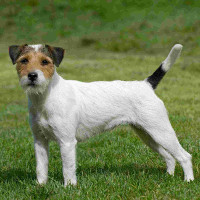
| Workmanlike, active and agile, without exaggeration. Built for stamina and endurance, overall picture of balance and flexibility. Honourable scars permissible. |
Important proportions |
| Well balanced. Overall length from point of shoulder to point of buttock slightly longer than height from withers to ground. Length from nose to stop slightly shorter than from stop to occiput. |
Behaviour / temperament |
| Originally a terrier bred to work fox, a confident, energetic and happy dog that has the ability and conformation to go to ground. Bold and friendly. |
Head |
||
Cranial region |
||
Head |
Head wedge shaped. | |
Skull |
Flat, moderately broad, gradually narrowing to the eyes. | |
Stop |
Shallow. | |
Facial region |
||
Nose |
Black. | |
Jaws and teeth |
Jaws strong, muscular. Teeth of a good size and set square to the jaws, with a perfect, regular and complete scissor bite, i.e. upper teeth closely overlapping the lower teeth and set square to the jaws. | |
Cheeks |
Not prominent. | |
Eyes |
Dark, almond shaped, never prominent. Keen, intelligent expression. | |
Ears |
Size in proportion with the head. V-shaped, dropping forward, tip of ear to be level with outer corner of eye. Fold not above top of skull. Leather of moderate thickness. | |
Neck |
| Clean, muscular, of good length, gradually widening and well set into the shoulders. |
Body |
||
Back |
Strong, straight and flexible. | |
Loin |
Strong and slightly arched. | |
Chest |
Of moderate depth, not extending below point of elbow. Capable of being spanned behind the shoulders by average size hands. | |
Ribs |
Ribs carried well back, not over-sprung nor slab-sided. | |
Tail |
| Previously customarily docked. Docked: Length complementing the body. Strong, preferably straight, moderately high set, carried well up on the move, may be carried lower when relaxed. Undocked: Of moderated length, preferably straight, giving a general balance to the dog. Thick at the root and tapering towards the tip. Moderately high set, carried well up on the move, may be carried lower when relaxed. |
Limbs |
Forequarters |
||
Generality |
Moderate width between the forelegs, well set under the body. | |
Shoulders |
Long and sloping, well laid back, cleanly cut at withers. | |
Upper arm |
Of equal length to the shoulder and at such an angle that legs are carried well back under the body, below the point of the withers. | |
Elbows |
Close to body, working free of the sides. | |
Forearm |
Strong and straight, turning neither in nor out. Length of forelegs should be slightly greater than depth of body. | |
Pastern |
Strong and flexible. | |
Hindquarters |
||
Generality |
Strong, muscular, with good angulation. | |
Lower thigh |
Well developed. | |
Stifle |
Good bend of stifle, without exaggeration. | |
Metatarsus |
Parallel, giving plenty of drive. | |
Hock |
Set low. | |
Feet |
| Compact with firm pads, toes moderately arched, never flat or open, turning neither in nor out. |
Gait and movement |
| Free-striding, ground covering gait, without exaggeration. Strides should be of good length, never stilted or high-stepping. Hindquarters providing plenty of drive. Well co-ordinated; straight action front and behind. |
Skin |
| Thick and loose. |
Coat |
||
Hair |
Whether rough, broken or smooth naturally harsh, flat, straight, close and dense with good undercoat. Weather-resistant. Belly and undersides coated. The prepared (i.e. trimmed) coat should appear natural, never clipped. | |
Colour |
White or predominantly white with tan, lemon or black markings, or any combination of these colours. The colour preferably confined to the head and/or root of tail, but a little body colour is acceptable. Any other colour or combination of colours unacceptable. |
|
Size and weight |
||
Height at withers |
Males: Ideal height 36 cms. Females: Ideal height 33 cms. Most importantly soundness and balance should be maintained whilst taking into account that this terrier, bred to work fox, should be capable of being spanned behind the shoulders by average sized hands. With these provisos, lower heights are acceptable, however. |
|
Faults |
| • Any departure from the foregoing points should be considered a fault and the seriousness with which the fault should be regarded should be in exact proportion to its degree and its effect upon the health and welfare of the dog and its ability to perform its traditional work. • Faults listed should be in degree of seriousness. |
Disqualifying faults |
 Aggressive or overly shy. Aggressive or overly shy. |
NB : |
| • Any dog clearly showing physical or behavioural abnormalities shall be disqualified. • The above mentioned faults when occurring to a highly marked degree or frequently are disqualifying. • Male animals should have two apparently normal testicles fully descended into the scrotum. • Only functionally and clinically healthy dogs, with breed typical conformation should be used for breeding. |



 English (United Kingdom)

Comments