
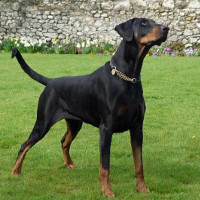
Dobermann

FCI standard Nº 143

Origin
Germany
Translation
Dobermann Council of K.U.S.A. (Kennel Union of Southern Africa)
Group
Group 2 Pinscher and Schnauzer type-Molossian type and Swiss Mountain and Cattle Dogs
Section
Section 1 Pinscher and Schnauzer type
Working
With working trial
Acceptance on a definitive basis by the FCI
Saturday 01 January 1955
Publication of the official valid standard
Friday 13 November 2015
Last update
Thursday 17 December 2015
En français, cette race se dit
Dobermann
Diese Norm ist in deutscher Sprache sichtbar
Dobermann
En español, esta raza se dice
Dobermann
In het Nederlands, wordt dit ras gezegd
Dobermann

Usage

Companion, protection and working dog.

Brief historical summary

The Dobermann is the only German breed which bears the name of its original breeder, Friedrich Louis Dobermann (02.01.1834 – 09.06.1894).
He was believed to be a tax collector, offal abbatoir manager (knacker) and a part time dog catcher, legally able to catch all stray dogs. He bred with animals from this reservoir that were particularly sharp. The so called “butcher’s dogs” which were already considered a relatively pure breed at that time, played a most important role in the origination of the Dobermann breed. These dogs were an early type of Rottweiler, mixed with a type of shepherd which existed in “Thüringen” as a black dog with rust red markings. Herr Dobermann bred with this mixture of dogs in the Eighteen Seventies. Thus he obtained “his breed” : not only alert, but highly protective working and housedogs. They were often used as guard and police dogs. Their extensive use in police work led to the nickname “Gendarme dog”. They were used in hunting to control large vermin.
In these circumstances it was a matter of course that the Dobermann was recognized officially as a Police Dog by the beginning of the century. The Dobermann breed requires a medium sized, powerful, muscular dog. Despite his substance he shall be elegant and noble, which will be evident in his body line. He must be exceptionally suitable as a companion, protection and working dog and also as a family dog.

General appearance

The Dobermann is of medium size, strong and muscularly built. Through the elegant lines of its body, its proud stature, and its expression of determination, it conforms to the ideal picture of dog.

Important proportions

The body of the Dobermann appears to be almost square, particularly in males. The length of the body measured from the point of the shoulder to the point of the buttock shall not be more than 5% longer than the height from the withers to the ground in males, and 10% in females.

Behaviour / temperament

The disposition of the Dobermann is friendly and calm; very devoted to the family it loves children. Medium temperament and medium sharpness (alertness) is desired. A medium threshold of irritation is required with a good contact to the owner. Easy to train, The Dobermann enjoys working, and shall have good working ability, courage and hardness. The particular values of self confidence and intrepidness are requied, and also adaptability and attention to fit the social environment.

Head

Cranial region

Skull
Strong and in proportion to the body. Seen from the top the head is shaped in the form of a blunt wedge. Viewed form the front the crown line shall be almost level and not dropping off to the ears. The muzzle line extends almost straight to the top line of the skull which falls, gently rounded, into the neck line. The superciliary ridge is well developed without protruding.
The forehead furrow is still visible. The occiput shall not be conspicuous. Seen from the front and the top the sides of the head must not bulge. The slight bulge between the rear of the upper jawbone and the cheek bone shall be in harmony with the total length of the head. The head muscles shall be well developed.  
Stop
Shall be slight but visibly developed.

Facial region

Nose
Nostrils well developed, more broad than round, with large openings without overall protrusion. Black – on black dogs; on brown dogs, corresponding lighter shades.
Muzzle
The muzzle must be in the right proportion with the upper head and must be strongly developed. The muzzle shall have depth. The mouth opening shall be wide, reaching to the molars. A good muzzle width must also be present on the upper and lower incisor area.
Lips
They shall be tight and lie close to the jaw which will ensure a tight closure of the mouth. The pigment of the gum to be dark; on brown dogs a corresponding lighter shade.
Jaws and teeth
Powerful broad upper and under jaw, scissor bite, 42 teeth correctly placed and normal size.
Eyes
Middle sized, oval and dark in colour. Lighter shades are permitted for brown dogs. Close lying eyelids. Eyelids shall be covered with hair. Baldness around the rim of the eye is highly undesirable.
Ears
The ear, which is set high, is carried erect and cropped to a length in proportion to the head. In a country where cropping is not permitted the uncropped ear is equally recognized. (Medium size preferred and with the front edge lying close to the cheeks).

Neck

The neck must have a good length and be in proportion to the body and the head. It is dry and muscular. Its outline rises gradually and is softly curved. Its carriage is upright and shows much nobility.

Body

Withers
Shall be pronounced in height and length, especially in males and thereby determine the slope of the topline rising from the croup to the withers.
Back
Short and tight, of good width and well muscled.
Loin
Of good width and well muscled. The bitch can be slightly longer in loin because she requires space for suckling.
Croup
It shall fall slightly, hardly perceptible from sacrum to the root of the tail, and appears well rounded, being neither straight nor noticeably sloping, of good width and well muscled.
Chest
Length and depth of chest must be in the right proportion to the body length. The depth with slightly arched ribs should be approximately 50% the height of the dog at the withers. The chest has got a good width with especially well developed forechest.
Underline and belly
From the bottom of the breastbone to the pelvis the underline is noticeably tucked up.

Tail

It is high set and docked short whereby approximately two tail vertebrae remain visible. In countries where docking is legally not permitted the tail may remain natural.

Limbs

Forequarters

Generality
The front legs as seen from all sides are almost straight, vertical to the ground and strongly developed.
Shoulders
The shoulder-blade lies close against the chest, and both sides of the shoulder-blade edge are well muscled and reach over the top of the thoracic vertebra, slanting as much as possible and well set back. The angle to the horizontal is approximately 50%.
Upper arm
Good length, well muscled, the angle to the shoulder- blade is approximately 105° to 110°.
Elbows
Close in, not turned out.
Forearm
Strong and straight. Well muscled. Length in harmony with the whole body.
Carpal
Strong.
Pastern
Bones strong. Straight seen from the front. Seen from the side, only slightly sloping, maximum 10°.
Forefeet
The feet are short and tight. The toes are arched towards the top (cat like). Nails short and black.

Hindquarters

Generality
Seen from the back the Dobermann looks, because of his well developed pelvic muscles in hips and croup, wide and rounded off. The muscles running from the pelvic towards the upper and lower thigh result in good width development, as well as in the upper thigh area, in the knee joint area and at the lower thigh. The strong hind legs are straight and stand parallel.
Upper thigh
Good length and width, well muscled. Good angulation to the hip joint. Angulation to the horizontal approximately between 80° to 85°.
Lower thigh
Medium length and in harmony with the total length of the hindquarter.
Stifle
The knee joint is strong and is formed by the upper and lower thigh as well as the knee cap. The knee angulation is approximately 130°.
Metatarsus
It is short and stands vertical to the ground.
Hock
Medium strength and parallel. The lower thigh bone is joined to the metatarsal at the hock joint (angle about 140°).
Hind feet
Like the front feet, the toes of the back feet are short, arched and closed. Nails are short and black.

Gait and movement

The gait is of special importance to both the working ability as well as the exterior appearance. The gait is elastic, elegant, agile, free and ground covering. The front legs reach out as far as possible. The hind quarter gives far reaching and necessary elastic drive. The front leg of one side and back leg of the other side move forward at the same time. There should be good stability of the back, the ligaments and the joints.

Skin

The skin fits closely all over and is of good pigment.

Coat

Hair
The hair is short, hard and thick. It lies tight and smooth and is equally distributed over the whole surface. Undercoat is not allowed.
Colour
The colour is black or brown, with rust red clearly defined and clean markings. Markings on the muzzle, as a spot on the cheeks and the top of the eyebrow, on the throat, two spots on the forechest, on the metacarpus, metatarsus and feet, on the inside of the back thigh, on the arms and below the tail.

Size and weight

Height at withers
Males : 68 – 72 cm. Bitches : 63 – 68 cm. Medium size desirable.
Weight
Males : about 40 – 45 kg. Bitches : about 32 – 35 kg.

Faults

• Any departure from the foregoing points should be considered a fault and the seriousness with which the fault should be regarded should be in exact proportion to its degree and its effect upon the health and welfare of the dog and its ability to perform its traditional work.
• Faults listed should be in degree of seriousness.

General faults

 General Appearance : Reversal of sexual impression; little substance; too light; too heavy; too leggy; weak bones.
 Head : Too heavy, too narrow, too short, too long, too much or too little stop; Roman nose, bad slope of the top line of the skull; weak underjaw; round or slit eyes; light eye; cheeks too heavy; loose flews; eyes too open or too deepset; ear set too high or too low; open mouth angle.
 Neck : Slightly short; too short; loose skin around the throat; dewlap; too long (not in harmony); ewe neck.
 Body : Black not tight; sloping croup; sway back; roach back; insufficient or too much spring of rib; insufficient depth or width of chest; back too long overall; too little forechest; tail set too high or too low; too little or too much tuck up.
 Limbs : Too little or too much angulation front or hindquarters; loose elbow; deviations from the standard position and length of bones and joints; feet too close together or too wide apart; cow-hocks, spread hocks, close hocks; open or soft paws, crooked toes; pale nails.
 Coat : Markings too light or not sharply defined; smudged markings; mask too dark; big black spot on the legs; chest markings hardly visible or too large; hair long, soft, curly or dull.
 Thin coat; bald patches; large tufts of hair particularly on the body; visible undercoat.
 Character : Inadequate self confidence; temperament too high; sharpness too high; too high or too low a threshold of irritation.
 Size : Deviation of size up to two centimetres from the standard should result in a lowering of the quality grading.
 Gait : Wobbly; restricted or stiff gait; pacing.

Abnormalities

 Aggressive or overly shy dogs.
 General : Pronounced reversal of sexual impressions.
 Eyes : Yellow eyes (bird of prey eye); wall eye.
 Dentition : Overshot; level bite; undershot; missing teeth.
 Coat : White spots; pronounced long and wavy hair; pronounced thin coat or large bald patches.
 Size : Dogs which deviate more than two centimetres over or under the standard.

NB :

• Any dog clearly showing physical or behavioural abnormalities shall be disqualified.
• The above mentioned faults when occurring to a highly marked degree or frequently are disqualifying.
• Male animals should have two apparently normal testicles fully descended into the scrotum.
• Only functionally and clinically healthy dogs, with breed typical conformation should be used for breeding.

Bibliography

https://www.fci.be/


Detailed history

The Dobermann is a breed that has a century of existence: the first specimens appeared around 1885; about ten years before those of two other famous breeds, the German Shepherd and the Boxer. There is also an important difference between them: the German Shepherd and the Boxer can in fact boast of being the modern result of an ancestral type, lupoid shepherd dog in one case, fighting dog in the while the Dobermann represents a truly new type (one would be hard-pressed to find, in writings or old paintings, a similar dog).

The very name of the breed reflects its originality in the canine world, since it bears the name of its creator, a certain Friedrich Ludwig Dobermann (1834 - 1894). This man is often presented as either a pound-keeper or a bailiff of the town of Apolda in Thuringia. In fact, this communal employee had multiple functions: he controlled slaughterhouses, handled rendering, picked up stray dogs, and also collected fines, rent, and various royalties. In short, the burgomaster of Apolda charged him with all sorts of ungrateful tasks and difficult steps.

Because of his role, it is likely that the character was not to find many friends in the late-paying citizens or ordered to pay a fine. Moreover, when he was riding on horseback, alone, in this hilly and wooded corner of Thuringia, carrying sometimes large sums of money, he might be afraid of attempting some mischief. It is natural, therefore, that he thought of bringing with him dogs with a temperament, capable of helping him in case of difficulty. Such dogs, he must have noticed among those he had to drive in the pound or those he had to rub on the farms, when he was greeted without amenity. The selection was rudimentary, certainly, but effective. And since, by his functions, he had access to the slaughterhouses, the problem of food, to maintain a large pack of heavy dogs, did not arise.

We do not know exactly which dogs he used to create the breed that was to bear his name, because he left no written record of his selection work. In the beginning, moreover, he probably did not plan to "make" exactly one breed, and he contented himself with uniting dogs whose character corresponded to what he was looking for. But the reputation that his dogs quickly acquired in the region decided otherwise, because many were dog enthusiasts interested in the type he had very empirically obtained.

Given the lack of documents on Friedrich Ludwig Dobermann's experiments, specialists are reduced to speculating to try to reconstruct their journey, by finding the racial roots of the dog we know today.

Thus, French cynologists, considering its characteristic black and fire dress, thought of our national Beauceron. It may be objected that the morphological types of the two races are quite far apart; but did the French breeders of the 1920s not select a distinctly "dobermannised" Low-Red, that is to say, refined and short-haired, almost flabby? And to explain the presence of the French dog in Thuringia, it has been suggested that the Napoleonic armies could have left specimens in their campaigns.

It must be admitted that this hypothesis, if it satisfies a certain cocardier spirit, appears above all as a manifestation of the Germanophobia of a certain period, which led for example to deny, despite the evidence, a German ancestry to the German Shepherd, qualified "Alsatian". Let us add that France did not have the exclusivity of ancient and solid mastiffs with black and fire dress. On the other hand, they were also widespread and gave birth, for example, to Rottweiler or Hovawart. They are also the ancestors of the first German Shepherds. It is reasonable to conclude that they are partly responsible for the Doberman's characteristic color and size.

But the Dobermann is reminiscent of another canine type: the Pinscher. In mid-nineteenth century Germany, this dog was one of the most widespread dogs: while the horse was still ubiquitous, both as a horse and as a hitch, the presence of a rodent destroyer was essential in all the stables and farms The Pinscher, the name comes from the English to pinch, tighten, pinch, can be considered as the German version of French dog breeds and Terriers (not bassets) that possessed the English. very old, its morphological type could be compared to that of the Neolithic Canis palustris, well known thanks to archeology, it could have a short or scribbled hair, tawny, black or gray wolf. that is to say the Schnauzer, has quickly met a great success.The Pinscher with short hair, it almost did not perpetuate itself through the Dobermann.In fact, the latter, which originally had significantly the name of Pinscher, was characterized before the middle Pinscher. It is therefore legitimate to consider the Dobermann as a sort of giant Pinscher; he possessed the qualities of pugnacity and vivacity; and up to the way of biting; German ratier, with the advantage of a larger size, allowing him to become a watchdog and defense. The idea of creating a giant Terrier was in the air of the time: it resulted, in Britain, in the development of the Airedale, while the people of Munich created the first Giant Schnauzers.

The oldest documents showing the first Dobermanns tend to confirm the Pinscher's part in their ancestry, FL Dobermann having probably recognized in this canine type the courage and the mordant he sought. This was also the opinion of the German magazine Unsere Hunde (quoted by J. Mézières and A. Whilhelm, authors of reference books on race), which, in its December 1898 issue, wrote the following : "About 1870, Dietsch, owner at the time of sandpits in Apolda, owned a blue-gray bitch, a kind of Pinscher that he made out by a black butcher's dog. This stallion already possessed the characteristic fire stains and came from a cross between a sheepdog and a butcher's dog. The Dobermann rendering machine, which, unfortunately, died too early, crossed the descendants of these two dogs, who had become good guard dogs with German Pinschers. Here is the origin of the current Dobermann. As it is established that this man first selected these dogs, we have no objection to them perpetuating his name. "

This Pinscher ancestry is recognized, but half a dozen other breeds are cited for service; or serve; to the development of this eminently tonic mixture that has Doberman name. Thus, to see a Dobermann wearing drooping ears (their natural port when they are not cut), we can assume the contribution of Braques Germans, even Braques Weimar, the role of these dogs, it is true, not only to quest, stop, bring back the game, but also including the destruction of harmful animals and the guard of the game. But since the Dobermann is often cited as responsible for this biting character, we must ask ourselves who brought the most to the other.

To explain the elegance of Dobermann lines, some have thought of the Greyhound. In particular, we often mention the use of a Greyhound lice, with a black coat and a very aggressive temperament. The Great Dane also regularly returns as probable ascendant, for its size and the blue color that it would have transmitted. Such filiation is admissible, if we consider that this dog was, at the end of the nineteenth century, less gigantic than today, since the male was between 75 and 80 centimeters at most. Finally, in the Dobermann's veins, Terrier Black and Tan (Black and Fire) blood would have been refined, which would have refined the morphology and given more sustained fires.

In fact, the future of the race would have been different if Mr. Dobermann had not had friends and successors to continue his work. In particular, Otto Goller's intervention was instrumental in moving from the primitive, compact, very medium-sized Doberman Dobermann (50 to 60 cm) and the rather short and thick head to the superb athlete without contests one of the most beautiful canine types.

Another founding father, Goswin Tischler, watched over the destiny of the Dobermann by founding a famous kennel named "von Greenland" after a street in Apolda. To the first subjects approved by FL Dobermann; Lux, Landgraf, Rambo, Schnupp (this one bearing the number 1 in the breeding book of the breed); Tischler's subjects were added: his dogs Bosco and Caesi, for example, produced the first champion of the breed, Prinz Matzi von Groenland, born on August 15, 1895.

Otto Goller, who had the affix "von Thüringen", obtained his subjects from 1901. Among the stallions he produced and who are considered patriarchs of the breed, there is Hellegraf von Thüringen, born on June 12, 1904. Previously, he had acquired from Tischler a subject which revealed in his hands a remarkable racer, Graf Belling. In 1910, with the birth of two other great racers, Bodo and Bob von Egenfeld, whose heads already had almost the carving and elegance of the current dogs, ends the period of elaboration of the race. It is undoubtedly after this date that various infusions of other races were tried, with, it must be said, more or less happiness: the Manchester Terrier, for example, could bring finesse and more sustained colors. and regular, but also a template too light.

As for the English Greyhound, it seems to have given higher sizes, but also a flat rib cage and a body too long. These crossings had thus brought undesirable characteristics, which the farmers had to strive to root out during the inter-war period. With the choice between two options: to preserve the race's native qualities, already legendary, tenacity and courage or evolve to a more flexible type of character, with a finer morphology. This is, in the main, the first solution that has been adopted.

The Dobermann quickly conquered many amateurs, German and European. This phenomenon, rarely emphasized, shows what was the potential qualities of the breed, in its infancy. The first club was founded by Otto Goller at Apolda in 1899. Quickly, a dozen other associations were born, especially in the south of Germany, to federate in 1912 as part of a large club covering all Germany. Given its seductive power, the Dobermann was presented very early in exhibitions. In Cologne, in 1910, there was a record 105 commitments.

Outside of Germany, it was the Swiss who had the quickest reflexes: as early as 1902, when they founded a club at Arau, they showed how much they liked this dog with a clean, easy-to-care silhouette. The Dutch followed suit in 1909, and they were the first to notice its adaptation to tropical climates, when they took it to their distant colonies, especially in the Philippines. At the same time, the Alsatians discovered it in turn, and a first local club was formed in 1913. A national club, intended in principle to cover all the Hexagon, was created in 1920 in Strasbourg, but it was necessary to wait until almost sixties for the Doberman to really spread in most French regions.

The Americans experienced at their expense the qualities of this dog of war, used by the German army during the first world conflict; reacting in a very pragmatic way, they did not hesitate, after the war, to acquire good breeders, to acclimate at home a race which had proved itself. Thus was born, in 1922, an American club. Austria and Italy have also adopted the Dobermann, and then, in turn, countries with hot climates such as Uruguay and Brazil have quickly made them their favorite watchdog. In the end, it was Britain, for once, that used the wagon. Because, no doubt, of the obligatory quarantine of six months in this country and especially of the prohibition to prune the ears (which modifies considerably the silhouette of the dog), the race did not really take root there until 1947 So, quickly appreciated - in most cases; as soon as it was discovered, the Dobermann became one of the most effective guard dogs, so the most widespread in the world.

Designed to be a service dog, the Dobermann was essentially confined in the first quarter of the twentieth century, in this function, whether serving individuals or the administrations. Because it represented the "must" in terms of courage, tenacity, speed of intervention, its users have tended, to exalt its qualities, to add, making it a reputation as a dog inconvenient, very hard, difficult to control. In the twenties, a renowned Swiss breeder, Gottfried Liechti, expressed this mentality very well: "They were certainly robust and were not afraid of anything; not even the devil himself; and it took a good deal of courage to own one. "

The same is true of Philipp Gruenig, historian of the breed, who reports about Alarich von Thüringen, born in 1897: "He was known for his incredible intelligence and was feared all the same. Of course, the intelligence combined with a certain roughness characterizes these dogs, but it is not essential, for all that, to qualify their daring as absolute and their intelligence as incredible, as if they were trying to scare themselves describing an animal almost diabolical (the color of the dress helping). It is also necessary to place these somewhat exaggerated remarks in their context: the competition was great at the time between Germanic races selected at about the same time, for similar jobs, but from "families" radically different canines; German Shepherd, Boxer, Rottweiler, Dobermann all sought the title of best guard dog.

Today, this image only partially corresponds to the reality: if the Dobermann, dog of round and intervention in the "civil", also remains an excellent animal of work, suitable for the contests of dogs of defense, of such utilitarian dogs are only a small part of the population of Dobermanns, who, for their greatest happiness and the pleasure of their master, spend most of their time comfortably seated in an armchair or cushion, being driven by car, who takes the air in the garden, who shoulders the last to walk straight.

Of course, it should not be deduced that the Doberman is suitable for all teachers and any situation. This dog, who is not overly nervous, is never mean; or simply aggressive; without reason. It is a balanced animal but of character. The master of a Dobermann is not, can not and must not be the same as that of a Poodle. To give the full measure of its many qualities, this dog requires in return that his master has some. It is therefore prudent for anyone who is not familiar with the breed or who has not yet handled a manly dog, to choose a female, if he wants to start in the "Dobermannia". More supple in temperament, more demonstrative in her affection, and sweeter, she nevertheless possesses vigilance equal to that of the male. On the other hand, for those who have a firm hand (but not brutal) and the "feeling" with the dogs, in the absence of a vast experience in dressage, the whole character of a male Dobermann can only be source of joys and pride. One condition, however: to this gloved velvet firmness, the master of a Dobermann will have to add calmness and patience. So let's not bluntly advise this dog to the vellitarians, the debonair, to those who are reluctant to show authority.

A good teacher must therefore be well informed of the deep nature of the Dobermann. First of all, it's a domineering dog; if the neophyte does not detect this characteristic in his three-month-old puppy, she will jump at him when the puppy becomes an ungainly eight-month-old. In fact, the dog is simply trying to become pack leader, to see if "it works". And sometimes, indeed, he reaches his goal: it will have been enough to scold him, to show his teeth, to impose his will. It is imperative, however, not to be intimidated by these intimidating maneuvers. The master must behave as such, with a fair but solid grip.

This mixture of justice and authority is all the more necessary because pride and independence are two other fundamental components of Doberman's behavior. While being very attached to its masters, it is a dog which often tends to do as its head, since the educative pressure of the master is revealed to be insufficient. It is therefore necessary to practice a rigorous learning in the leash, then without leash, and finally for the recall. Many owners of Dobermanns walk their dogs more than they take out.

As for the pride of the Dobermann, which is one of its most fascinating features, it expresses itself through aesthetics: its majestic head-wear, its confident gait are not only apparent and perfectly reflect its type of character, for the least reserved; in fact, not being those who tend to party to strangers, this dog is insensitive to marks of cordiality; possibly a little forced guests.

It is understood that this distant attitude supposes the presence of the master. If not, the dog will be much more active; intractable, even fierce; in the surveillance of the house or the car. His instinct of protection of the territory being innate and hyper-developed, his vigilance is never faulted. In this area, there is no need for specific training: the dog reacts spontaneously. It naturally extends its protection to all those who live in the family territory, especially children, who will have to learn to respect this partner. With other dogs, the Dobermann does not necessarily look for a fight, but it will not be allowed to dominate. Also caution requires avoiding opportunities for confrontation.

The Dobermann, born and selected exclusively for the protection of property and people, is a very observant animal, endowed with a great memory, adaptable, understanding everything quickly, sensing, even guessing what his master does not tell him. He therefore has great training skills, although his psychology differs significantly from that of sheepdogs, which are most often used as a reference for trainers; he is hierarchizing much less easily than a Shepherd, he always keeps a dominating background, as well as a certain tendency to independence, which must be kept in check. To effectively channel his energy, the training will have to spare his susceptibility, take into account his native pride and especially motivate him. Because the Doberrnann is an enthusiast, who only works well out of love for his master. His attachment for this one is very deep, almost exclusive; hence, sometimes, a certain tendency to jealousy; and always goes with extreme mistrust towards strangers.

Unlike the reputation that is often made to him, the Dobermann is not a difficult dog but a demanding dog, which one must take care seriously. It may therefore be regretted that he is not more frequently presented in the work competitions (the trainers who try to make him work are, in fact, few). In his home country, but also in the United States and many other countries, Dobermann's favorite sport is the "Schutzhund" (compulsory in Germany for breeding). The Germans, who have exported their defensive dogs, have at the same time managed to impose their work program almost everywhere in the world. This is composed of tests of obedience, relaxation, biting and defense of the master; it relies less on athletic performance or the finesse of dressage than on a perfect performance.

Tracking is also a contest where the Dobermann can be illustrated; several subjects have in recent years reached the highest levels. He finds the opportunity to demonstrate his sense of initiative and to take advantage, at best, of his natural passion and flair; training in this discipline (accessible to the neophyte) has a great psychological interest because it reinforces the connivance with the master. It's probably in the ring that the Dobermann is the least comfortable. His athletic abilities are obviously not in question, but his bite is not adapted to the requirements of this discipline: the dog must indeed make a solid hold, bottom mouth, for fifteen seconds, while the Dobermann tends, him, to bite in successive shots, with the anterior teeth.

Work competitions are, of course, only a small number of dogs, most Dobermanns do not have such an opportunity for release. But their balance requires, imperiously, intense physical activities; they must therefore be offered long walks and frequent (but short) exercises. It would be same. frankly aberrant to leave such dogs at home, in a kennel, or to make warehouse keepers. Because the Dobermann needs human contacts: if possible varied and early, these contacts are essential to "civilize" the young dog and will not diminish his vigilance. On the other hand, if he is sentenced to solitary confinement, the animal may then become difficult to control.

In terms of health, the Dobermann is a robust dog, elegant, full of "substance". It does not present particular weak points; at most, one can detect in some subjects a sensitivity to skin diseases and external parasites (especially in the rare and very beautiful subjects blue and fire). It must be pointed out, however, the relative frequency of cardiac accidents; a problem common to many sport breeds, both full of passion and power. When counting dogs who have suffered a heart attack, the average longevity of Dobermann, a dozen years (subjects reaching fourteen years are rare), can go down to ten years. A rigorous lifestyle throughout one's life, more attention and monitoring when it reaches six or eight years are recommended.

The Dobermann was born and still lives today. under the sign of passion. His temperament can not be satisfied with compromises or half measures and it arouses in humans extreme reactions: on one side a victim of prejudice, on the other, it is defended with energy by its amateurs. You will probably be among them, if you are as demanding of yourself as your dog.

Comments

Latest page updates

  • Southern Hound

    Southern Hound He is not recognized by the F.C.I. Origin Great Britain Translation Francis Vandersteen En français, cette race se dit Chien du Sud Diese Norm ist in deutscher Sprache sichtbar Südlicher Laufhund En español, esta raza se dice Sabueso del sur In het Nederlands, wordt dit ras gezegd Zuidelijke Hond The Southern Hound was a large...
  • St. John's Water Dog

    St. John's Water Dog He is not recognized by the F.C.I. Origin Canada Translation Francis Vandersteen En français, cette race se dit Chien d’eau de St. John's Diese Norm ist in deutscher Sprache sichtbar St. John's Wasserhund En español, esta raza se dice Perro de aguas de San Juan In het Nederlands, wordt dit ras gezegd St. John's Water Dog The St...
  • Rache Hound

    Rache Hound He is not recognized by the F.C.I. Origin Middle Ages Translation Francis Vandersteen En français, cette race se dit Chien courant Rache Diese Norm ist in deutscher Sprache sichtbar Rache-Laufhund En español, esta raza se dice Sabueso Rache In het Nederlands, wordt dit ras gezegd Rache-hond This breed is also known as RacchRachRatch   The term...
  • Welsh Grey Sheepdog

    Welsh Grey Sheepdog He is not recognized by the F.C.I. Origin Wales Translation Francis Vandersteen En français, cette race se dit Chien de berger gallois gris Diese Norm ist in deutscher Sprache sichtbar Waliser Grauer Schäferhund En español, esta raza se dice Pastor Gris Galés In het Nederlands, wordt dit ras gezegd Welsh Grey Herdershond This breed is...
  • Old Croatian Sighthound

    Old Croatian Sighthound He is not recognized by the F.C.I. Origin Croatia Translation Francis Vandersteen En français, cette race se dit Lévrier croate ancien Diese Norm ist in deutscher Sprache sichtbar Alter kroatischer Windhund En español, esta raza se dice Viejo lebrel croata In het Nederlands, wordt dit ras gezegd Oude Kroatische Windhond This...
  • Norman Hound

    Norman Hound He is not recognized by the F.C.I. Origin France Translation Francis Vandersteen En français, cette race se dit Chien normand Diese Norm ist in deutscher Sprache sichtbar Normannischer Laufhund En español, esta raza se dice Sabueso Normando In het Nederlands, wordt dit ras gezegd Normandische Brak   Little is known about the origins of...
  • Moscow Water Dog

    Moscow Water Dog He is not recognized by the F.C.I. Origin Russia Translation Francis Vandersteen En français, cette race se dit Chien d'eau de Moscou Diese Norm ist in deutscher Sprache sichtbar Moskauer Wasserhund En español, esta raza se dice Perro de agua de Moscú In het Nederlands, wordt dit ras gezegd Moskou-waterhond This breed is also...
  • Tracking Hound

    Tracking Hound He is not recognized by the F.C.I. Origin Middle Ages Translation Francis Vandersteen En français, cette race se dit Chien pisteur Diese Norm ist in deutscher Sprache sichtbar Spürhund En español, esta raza se dice Sabueso de rastro In het Nederlands, wordt dit ras gezegd Speurhond This breed is also known as LimerLymerLyam...
  • Laconian

    Laconian He is not recognized by the F.C.I. Origin Ancient Laconia, Greece Translation Francis Vandersteen En français, cette race se dit Laconien Diese Norm ist in deutscher Sprache sichtbar Lakonier En español, esta raza se dice Laconio In het Nederlands, wordt dit ras gezegd Laconisch This breed is also known as SpartanCastorian   The Laconian is an...
  • Halls Heeler

    Halls Heeler He is not recognized by the F.C.I. Origin Australia Translation Francis Vandersteen En français, cette race se dit Halls Heeler Diese Norm ist in deutscher Sprache sichtbar Halls Heeler En español, esta raza se dice Halls Heeler In het Nederlands, wordt dit ras gezegd Halls Heeler   The Halls Heeler is the presumed ancestor of two...
  • Dogo Cubano

    Dogo Cubano He is not recognized by the F.C.I. Origin Cuba Translation Francis Vandersteen The Dogo Cubano, also known as the Cuban Dogue, Cuban Bloodhound and Cuban Mastiff, is an extinct breed of dog from Cuba. It was of the Bullmastiff type and was used for bull and dog fighting. The breed was introduced to Cuba to capture runaway slaves...
  • Dalbo Dog

    Dalbo Dog He is not recognized by the F.C.I. Origin Sweden Translation Francis Vandersteen En français, cette race se dit Chien de Dalbo Diese Norm ist in deutscher Sprache sichtbar Dalbo-Hund En español, esta raza se dice Perro Dalbo In het Nederlands, wordt dit ras gezegd Dalbo-hond This breed is also known as DalbohundDalsland Mastiff   Icelandic...
  • Cordoba Fighting Dog

    Cordoba Fighting Dog He is not recognized by the F.C.I. Origin Argentina Translation Francis Vandersteen En français, cette race se dit Chien de combat de Cordoue Diese Norm ist in deutscher Sprache sichtbar Córdoba-Kampfhund En español, esta raza se dice Perro de pelea de Córdoba In het Nederlands, wordt dit ras gezegd Cordoba-vechthond This breed is...
  • Celtic Greyhound

    Celtic Greyhound He is not recognized by the F.C.I. Origin Celtic Mythology Translation Francis Vandersteen En français, cette race se dit Lévrier celte Diese Norm ist in deutscher Sprache sichtbar Keltische Windhund En español, esta raza se dice Lebrel celta In het Nederlands, wordt dit ras gezegd Keltische windhond   The Celtic Greyhound is an...
  • Belgian Mastiff

    Belgian Mastiff He is not recognized by the F.C.I. Origin Belgium Translation Francis VandersteenOrigin SRSH-KMSH - Belgian Royal Canine SocietyAuthentic language FR Group Group 2 : Pinscher and Schnauzer - Molossoid and Swiss Mountain and Cattle Dogs Section Section 2.1 : Molossoids, mastiff type Working Without working trial En français, cette...
  • Argentine polar dog

    Argentine polar dog He is not recognized by the F.C.I. Origin Argentina Translation Francis Vandersteen The Argentine polar dog (perro polar argentino) was a breed of Argentine dog that is now extinct. Argentine polar dogs were developed by the Argentine army to provide sled dogs for their Antarctic bases. The breed was the result of a cross...
  • Alaunt

    Alaunt He is not recognized by the F.C.I. Origin Central Asia Translation Francis Vandersteen This breed is also known as Kavkaz AlauntCaucasian AlauntAlan DoggePersian AlauntContinental AlauntEnglish AlauntFrench AlauntSpanish AlauntAlan DogArnaut Dogge The legendary Alaunt is one of the most important Molosse breeds in history, but also one of...
  • Small Dutch Hound

    Small Dutch Hound He is not recognized by the F.C.I. Origin The Netherlands Translation Francis Vandersteen En français, cette race se dit Petit Chien courant néerlandais Diese Norm ist in deutscher Sprache sichtbar Kleiner niederländischer Brackenhund En español, esta raza se dice Sabueso holandés pequeño In het Nederlands, wordt dit ras gezegd Kleine...
  • Sri Lankan Hound

    Sri Lankan Hound He is not recognized by the F.C.I. Origin Sri Lankan Translation Francis Vandersteen En français, cette race se dit Chien courant du Sri Lanka Diese Norm ist in deutscher Sprache sichtbar Sri-Lanka-Hund En español, esta raza se dice Sabueso de Sri Lanka In het Nederlands, wordt dit ras gezegd Sri Lankaanse Brak This breed is also...
  • Bulgarian Tricolour Hound

    Bulgarian Tricolour Hound He is not recognized by the F.C.I. Origin Bulgaria Translation Francis Vandersteen En français, cette race se dit Chien courant tricolore bulgare Diese Norm ist in deutscher Sprache sichtbar Bulgarischer Dreifarbiger Laufhund En español, esta raza se dice Sabueso tricolor búlgaro In het Nederlands, wordt dit ras gezegd Bulgaarse...
  • Međimurje Small Dog

    Međimurje Small Dog He is not recognized by the F.C.I. Origin Northwestern Croatia Translation Francis Vandersteen En français, cette race se dit Petit chien du Međimurje Diese Norm ist in deutscher Sprache sichtbar Međimurje-Kleinhund En español, esta raza se dice Perro pequeño de Međimurje In het Nederlands, wordt dit ras gezegd Međimurje-hondje This...
  • Serbian Yellow Hound

    Serbian Yellow Hound He is not recognized by the F.C.I. Origin Serbia (Balkans, Southeast Europe) Translation Francis Vandersteen En français, cette race se dit Chien jaune serbe Diese Norm ist in deutscher Sprache sichtbar Serbischer Gelber Laufhund En español, esta raza se dice Sabueso Amarillo Serbio In het Nederlands, wordt dit ras gezegd Servische...
  • Gotland Hound

    Gotland Hound He is not recognized by the F.C.I. Origin Sweden Translation Francis Vandersteen En français, cette race se dit Chien de chasse de Gotland Diese Norm ist in deutscher Sprache sichtbar Gotlandhund En español, esta raza se dice Sabueso de Gotland In het Nederlands, wordt dit ras gezegd Gotlandhond This breed is also known as Gotland...
  • Westerwald Mountain Dog

    Westerwald Mountain Dog He is not recognized by the F.C.I. Origin Germany Translation Francis Vandersteen En français, cette race se dit Bouvier du Westerwald Diese Norm ist in deutscher Sprache sichtbar Westerwalder Sennenhund En español, esta raza se dice Perro de Montaña de Westerwald In het Nederlands, wordt dit ras gezegd Westerwaldse...
  • Carnia Hound

    Carnia Hound He is not recognized by the F.C.I. Origin Italy Translation Francis Vandersteen En français, cette race se dit Chien courant de Carnia Diese Norm ist in deutscher Sprache sichtbar Carnia-Hund En español, esta raza se dice Sabueso de Carnia In het Nederlands, wordt dit ras gezegd Carnia-hond This breed is also known as Segugio Carnico   The...
  • Kemmer Feist

    Kemmer Feist He is not recognized by the F.C.I. Origin Southern United States Translation Francis Vandersteen En français, cette race se dit Kemmer Feist Diese Norm ist in deutscher Sprache sichtbar Kemmer Feist En español, esta raza se dice Kemmer Feist In het Nederlands, wordt dit ras gezegd Kemmer Feist   The Kemmer Feist originates from the...
  • Alpine Spaniel

    Alpine Spaniel He is not recognized by the F.C.I. Origin Switzerland Translation Francis Vandersteen En français, cette race se dit Epagneul Alpin Diese Norm ist in deutscher Sprache sichtbar Alpenspaniel En español, esta raza se dice Spaniel Alpino In het Nederlands, wordt dit ras gezegd Alpenspaniël   Alpine Spaniels were bred by canons in Alpine...
  • Alpine Mastiff

    Alpine Mastiff He is not recognized by the F.C.I. Origin Switzerland Translation Francis Vandersteen En français, cette race se dit Mâtin alpin Diese Norm ist in deutscher Sprache sichtbar Alpenmastiff En español, esta raza se dice Mastín Alpino In het Nederlands, wordt dit ras gezegd Alpenmastiff   The Alpine Mastiff was an ancient, giant working...
  • Hairless Chihuahua

    Hairless Chihuahua He is not recognized by the F.C.I. Origin Mexico Translation Francis Vandersteen En français, cette race se dit Chihuahua nu Diese Norm ist in deutscher Sprache sichtbar Nackter Chihuahua En español, esta raza se dice Chihuahua sin pelo In het Nederlands, wordt dit ras gezegd Haarloze Chihuahua   The Chihuahua is a small, lively,...
  • Argentine Pila

    Argentine Pila He is not recognized by the F.C.I. Origin Argentina Translation Francis Vandersteen En français, cette race se dit Pila Argentin Diese Norm ist in deutscher Sprache sichtbar Argentinischer Pila En español, esta raza se dice Pila Argentino In het Nederlands, wordt dit ras gezegd Argentijnse Pila This breed is also known as Perro...
  • Ecuadorian Hairless Dog

    Ecuadorian Hairless Dog He is not recognized by the F.C.I. Origin Ecuador Translation Francis Vandersteen En français, cette race se dit Chien nu équatorien Diese Norm ist in deutscher Sprache sichtbar Ecuadorianischer Nackthund En español, esta raza se dice Perro sin pelo ecuatoriano In het Nederlands, wordt dit ras gezegd Ecuadoriaanse...
  • Tesem

    Tesem He is not recognized by the F.C.I. Origin Egypt Translation Francis Vandersteen En français, cette race se dit Tesem Diese Norm ist in deutscher Sprache sichtbar Tesem En español, esta raza se dice Tesem In het Nederlands, wordt dit ras gezegd Tesem   The Tesem was a hunting dog from ancient Egypt. Now extinct, its ancestry is believed to...
  • Salish Woolly Dog

    Salish Woolly Dog He is not recognized by the F.C.I. Origin British Columbia, Canada Translation Francis Vandersteen En français, cette race se dit Chien laineux Salish Diese Norm ist in deutscher Sprache sichtbar Salish-Wollhund En español, esta raza se dice Perro Lanudo Salish In het Nederlands, wordt dit ras gezegd Salish wollige hond This...
  • Tierra del Fuego Dog

    Tierra del Fuego Dog He is not recognized by the F.C.I. Origin South America Translation Francis Vandersteen En français, cette race se dit Chien de Terre de Feu Diese Norm ist in deutscher Sprache sichtbar Feuerlandhund En español, esta raza se dice Perro de Tierra del Fuego In het Nederlands, wordt dit ras gezegd Tierra del Fuego-hond This...
  • Techichi

    Techichi He is not recognized by the F.C.I. Origin Mexico Translation Francis Vandersteen En français, cette race se dit Techichi Diese Norm ist in deutscher Sprache sichtbar Techichi En español, esta raza se dice Techichi In het Nederlands, wordt dit ras gezegd Techichi   The Techichi was an indigenous dog of Mesoamerica, specifically associated...
  • Hare Indian Dog

    Hare Indian Dog He is not recognized by the F.C.I. Origin Canada Translation Francis Vandersteen The Hare Indian Dog is an extinct domesticated dog; possibly a breed of domestic dog, hybrid coyote/dog or domestic coyote; previously found and originally bred in northern Canada by the Hare Indians for hunting. It had the speed and certain...
  • Tahitian Dog

    Tahitian Dog He is not recognized by the F.C.I. Origin Tahiti Translation Francis Vandersteen En français, cette race se dit Chien de Tahiti Diese Norm ist in deutscher Sprache sichtbar Tahiti-Hund En español, esta raza se dice Perro Tahitiano In het Nederlands, wordt dit ras gezegd Tahitiaanse hond   The Tahitian Dog is an extinct Polynesian breed,...
  • Polynesian Dog

    Polynesian Dog He is not recognized by the F.C.I. Origin Polynesia Translation Francis Vandersteen En français, cette race se dit Chien polynésien Diese Norm ist in deutscher Sprache sichtbar Polynesischer Hund En español, esta raza se dice Perro polinesio In het Nederlands, wordt dit ras gezegd Polynesische hond   The term "Polynesian dog" does...
  • Marquesan Dog

    Marquesan Dog He is not recognized by the F.C.I. Origin Marquesas Islands Translation Francis Vandersteen En français, cette race se dit Chien des Marquises Diese Norm ist in deutscher Sprache sichtbar Marquesas-Hund En español, esta raza se dice Perro Marquesano In het Nederlands, wordt dit ras gezegd De Marquesaanse hond This breed is also...
  • Kuri

    Kuri He is not recognized by the F.C.I. Origin New Zealand, between "Waikava" & Mataura plains, Catlins Translation Francis Vandersteen This breed is also known as Maori dog Kurī, or Pacific dog, were a unique breed, brought to Aotearoa New Zealand by ancestors of Māori. These animals were prized – not necessarily as friends, but as valuable...
  • Chiribaya Dog

    Chiribaya Dog He is not recognized by the F.C.I. Origin Peru Translation Francis Vandersteen The Chiribaya Dog (perro Chiribaya) or Peruvian Shepherd Dog (perro pastor Peruano) was a pre-Columbian breed of dog from southwestern Peru, identified by the 42 mummies discovered by anthropologist Sonia Guillén Oneglio in the Ilo district, Moquegua...
  • Philippine Forest Dog

    Philippine Forest Dog He is not recognized by the F.C.I. Origin Philippines Translation Francis Vandersteen En français, cette race se dit Chien des forêts des Philippines Diese Norm ist in deutscher Sprache sichtbar Philippinischer Waldhund En español, esta raza se dice Perro del Bosque Filipino In het Nederlands, wordt dit ras gezegd Filipijnse...
  • Lai Dog

    Lai Dog He is not recognized by the F.C.I. Origin Vietnam Translation Francis Vandersteen En français, cette race se dit Chien de Lai Diese Norm ist in deutscher Sprache sichtbar Lai-Hund En español, esta raza se dice Perro Lai In het Nederlands, wordt dit ras gezegd Lai-hond   With its unique appearance and hunting dog origins, the Lai Dog is...
  • Pampas Hound

    Pampas Hound He is not recognized by the F.C.I. Origin Brazil, Argentina, and Uruguay Translation Francis Vandersteen En français, cette race se dit Chien de chasse des Pampas Diese Norm ist in deutscher Sprache sichtbar Pampashund En español, esta raza se dice Sabueso de las Pampas In het Nederlands, wordt dit ras gezegd Pampashond   The Pampas Hound...
  • Zerdava

    Zerdava He is not recognized by the F.C.I. Origin Turkey and Georgia Translation Francis Vandersteen En français, cette race se dit Zerdava Diese Norm ist in deutscher Sprache sichtbar Zerdava En español, esta raza se dice Zerdava In het Nederlands, wordt dit ras gezegd Zerdava This breed is also known as Eastern Black Sea SpitzKapi Kopegi   The...
  • I-Twina

    I-Twina He is not recognized by the F.C.I. Origin Southern/Eastern Africa Translation Francis Vandersteen En français, cette race se dit I-Twina Diese Norm ist in deutscher Sprache sichtbar I-Twina En español, esta raza se dice I-Twina In het Nederlands, wordt dit ras gezegd I-Twina   The I-Twina is a specific variety of Africanis, an ancient dog breed...
  • Greek Greyhound

    Greek Greyhound He is not recognized by the F.C.I. Origin Greece Translation Francis Vandersteen En français, cette race se dit Lévrier grec Diese Norm ist in deutscher Sprache sichtbar Griechischer Windhund En español, esta raza se dice Galgo Griego In het Nederlands, wordt dit ras gezegd Griekse Windhond   The Greek Greyhound is medium-sized, and its...
  • Khoikhoi Hottentot Dog

      Khoikhoi Hottentot Dog He is not recognized by the F.C.I. Origin South Africa Translation Francis Vandersteen En français, cette race se dit Chien Khoïkhoï Hottentot Diese Norm ist in deutscher Sprache sichtbar Khoikhoi-Hottentottenhund En español, esta raza se dice Perro Hotentote Khoikhoi In het Nederlands, wordt dit ras gezegd Khoikhoi...
  • Santal Hound

    Santal Hound He is not recognized by the F.C.I. Origin India Translation Francis Vandersteen En français, cette race se dit Chien de chasse Santal Diese Norm ist in deutscher Sprache sichtbar Santal-Hund En español, esta raza se dice Sabueso Santal In het Nederlands, wordt dit ras gezegd Santal jachthond   The Santal Hound is an indigenous Indian...
  • Middle Eastern Village Dog

    Middle Eastern Village Dog He is not recognized by the F.C.I. Origin Middle East Translation Francis Vandersteen En français, cette race se dit Chien de village du Moyen-Orient Diese Norm ist in deutscher Sprache sichtbar Dorfhund aus dem Nahen Osten En español, esta raza se dice Perro de aldea de Oriente Medio In het Nederlands, wordt dit ras...
  • Avuvi

    Avuvi He is not recognized by the F.C.I. Origin Ghana and Togo Translation Francis Vandersteen En français, cette race se dit Avuvi Diese Norm ist in deutscher Sprache sichtbar Avuvi En español, esta raza se dice Avuvi In het Nederlands, wordt dit ras gezegd Avuvi This breed is also known as Ghana Stray Dog   Ghana stray dogs are free-roaming dogs that...
  • Old Spanish Pointer

    Old Spanish Pointer He is not recognized by the F.C.I. Origin Spain Translation Francis Vandersteen En français, cette race se dit Braque espagnol ancien Diese Norm ist in deutscher Sprache sichtbar Altspanischer Vorstehhund En español, esta raza se dice Pointer Español Antiguo In het Nederlands, wordt dit ras gezegd Oude Spaanse Pointer This breed...
  • Paisley Terrier

    Paisley Terrier He is not recognized by the F.C.I. Origin Scotland Translation Francis Vandersteen The Paisley Terrier is a descendant of its ancestor, the Skye Terrier, with a similar temperament and appearance.Records from 1440 use the word terrier, telling us that the Skye Terrier was not the first of this group, although we have little...
  • Blue Bay Shepherd

    Blue Bay Shepherd He is not recognized by the F.C.I. Origin U.S.A. Translation Francis Vandersteen En français, cette race se dit Berger de la Baie Bleue Diese Norm ist in deutscher Sprache sichtbar Blue Bay Schäferhund En español, esta raza se dice Pastor Azul de la Bahía In het Nederlands, wordt dit ras gezegd Blauwe Baai Herdershond   The Blue...
  • Tweed Water Spaniel

    Tweed Water Spaniel He is not recognized by the F.C.I. Origin Great Britain Translation Francis Vandersteen En français, cette race se dit Epagneul d'eau du Tweed Diese Norm ist in deutscher Sprache sichtbar Tweed Wasserspaniel En español, esta raza se dice Spaniel de Agua del Tweed In het Nederlands, wordt dit ras gezegd Tweed Waterspaniël   The...
  • Old English Terrier

    Old English Terrier He is not recognized by the F.C.I. Origin Great Britain Translation Francis Vandersteen En français, cette race se dit Terrier anglais ancien Diese Norm ist in deutscher Sprache sichtbar Alte Englische Terrier En español, esta raza se dice Terrier Inglés Antiguo In het Nederlands, wordt dit ras gezegd Oude Engelse Terriër   Also...
  • Old English Bulldog

    Old English Bulldog He is not recognized by the F.C.I. Origin Great Britain Translation Francis Vandersteen En français, cette race se dit Bouledogue anglais ancien Diese Norm ist in deutscher Sprache sichtbar Altenglische Bulldogge En español, esta raza se dice Bulldog Inglés Antiguo In het Nederlands, wordt dit ras gezegd Oude Engelse Bulldog   When...
  • North Country Beagle

    North Country Beagle He is not recognized by the F.C.I. Origin Great Britain Translation Francis Vandersteen Few records remain describing the appearance of the North Country Beagle, except that it resembled the Southern Hound, the English Foxhound and the modern Harrier. It has been said that the North Country Beagle was shorter than the...
  • Norfolk Spaniel

    Norfolk Spaniel He is not recognized by the F.C.I. Origin Great Britain Translation Francis Vandersteen The Norfolk Spaniel or Shropshire Spaniel is a dog breed that has been extinct since the early 20th century. It was originally thought to have originated from the work of one of the Dukes of Norfolk, but this theory was disproved after being...
  • English White Terrier

    English White Terrier He is not recognized by the F.C.I. Origin Great Britain Translation Francis Vandersteen This breed is also known as White TerrierOlde English White TerrierEnglish WhiteOld White Manchester TerrierBirmingham White Terrier A brief presentation of the English White Terrier The English White Terrier was one of the first, if not...
  • English Water Spaniel

    English Water Spaniel He is not recognized by the F.C.I. Origin Great Britain Translation Francis Vandersteen En français, cette race se dit Epagneul d'eau anglais Diese Norm ist in deutscher Sprache sichtbar Englischer Wasserspaniel En español, esta raza se dice Spaniel de Agua Inglés In het Nederlands, wordt dit ras gezegd Engelse Waterspaniël   The...
  • Cur Dog

    Cur Dog He is not recognized by the F.C.I. Origin U.S.A. Translation Francis Vandersteen En français, cette race se dit Chien Cur Diese Norm ist in deutscher Sprache sichtbar Cur-Hunde En español, esta raza se dice Perros Cur In het Nederlands, wordt dit ras gezegd Curhond   Cur dogs are a diverse group of intelligent, energetic, and loyal working breeds...
  • Cumberland Sheepdog

    Cumberland Sheepdog He is not recognized by the F.C.I. Origin Great Britain Translation Francis Vandersteen En français, cette race se dit Berger de Cumberland Diese Norm ist in deutscher Sprache sichtbar Cumberland Shepherd En español, esta raza se dice Pastor de Cumberland In het Nederlands, wordt dit ras gezegd Cumberland Shepherd   The...
  • Buckhound

    Buckhound He is not recognized by the F.C.I. Origin Great Britain Translation Francis Vandersteen En français, cette race se dit Buckhound Diese Norm ist in deutscher Sprache sichtbar Buckhound En español, esta raza se dice Buckhound In het Nederlands, wordt dit ras gezegd Buckhound   The Buckhound is an extinct breed of English hound, formerly...
  • Miniature Bulldog

    Miniature Bulldog He is not recognized by the F.C.I. Origin Great Britain Translation Francis Vandersteen En français, cette race se dit Bouledogue Miniature Diese Norm ist in deutscher Sprache sichtbar Zwergbulldogge En español, esta raza se dice Bulldog Miniatura In het Nederlands, wordt dit ras gezegd Miniatuur Bulldog   The Toy Bulldog was a...
  • Bullenbeisser

    Bullenbeisser He is not recognized by the F.C.I. Origin Germany and the Netherlands Translation Francis Vandersteen The Bullenbeisser was a Molosser-type dog native to Germany and the Netherlands. Bred for a variety of purposes, the Bullenbeisser specialized in bull-baiting and wild boar hunting. Also known as the Barenbeiszer, Bullenbijter,...
  • Panda German Shepherd

    Panda German Shepherd He is not recognized by the F.C.I. Origin Germany Translation Francis Vandersteen En français, cette race se dit Berger Allemand Panda Diese Norm ist in deutscher Sprache sichtbar Panda-Schäferhund En español, esta raza se dice Pastor Alemán Panda In het Nederlands, wordt dit ras gezegd Panda Duitse Herder   Panda German...
  • Russian Shepherd Dog

    Russian Shepherd Dog He is not recognized by the F.C.I. Origin Russia Translation Francis Vandersteen En français, cette race se dit Chien de berger russe Diese Norm ist in deutscher Sprache sichtbar Russischer Schäferhund En español, esta raza se dice Pastor Ruso In het Nederlands, wordt dit ras gezegd Russische Herdershond This breed is also known...
  • Sulimov Dog

    Sulimov Dog He is not recognized by the F.C.I. Origin Russia Translation Francis Vandersteen En français, cette race se dit Chien Sulimov Diese Norm ist in deutscher Sprache sichtbar Sulimov-Hund En español, esta raza se dice Perro Sulimov In het Nederlands, wordt dit ras gezegd Sulimov-hond This breed is also known as Shalaika   The Sulimov dog is a...
  • Kamchatka Sled Dog

    Kamchatka Sled Dog He is not recognized by the F.C.I. Origin Russia Translation Francis Vandersteen En français, cette race se dit Chien de traîneau du Kamtchatka Diese Norm ist in deutscher Sprache sichtbar Kamtschatka-Schlittenhund En español, esta raza se dice Perro de trineo de Kamchatka In het Nederlands, wordt dit ras gezegd Kamtsjatka-sledehond This...
  • Chukotka Sled Dog

    Chukotka Sled Dog He is not recognized by the F.C.I. Origin Russia Translation Francis Vandersteen En français, cette race se dit Chien de traîneau de Tchoukotka Diese Norm ist in deutscher Sprache sichtbar Tschukotkas Schlittenhund En español, esta raza se dice Perro de Trineo de Chukotka In het Nederlands, wordt dit ras gezegd Tsjoekotka-sledehond   The...
  • Dupuy Pointing Dog

    Dupuy Pointing Dog FCI standard Nº 178 Origin France Translation Mrs. Peggy Davis Group Group 7 Pointing Dogs Section Section 1.1 Continental Pointing Dogs « Braque » Type Working With working trial Acceptance on a definitive basis by the FCI Friday 21 June 1963 Publication of the official valid standard Friday 07 August 1998 En français, cette race...
  • Sanyo Dog

    Sanyo Dog He is not recognized by the F.C.I. Origin Japan Translation Francis Vandersteen En français, cette race se dit Chien de Sanyo Diese Norm ist in deutscher Sprache sichtbar Sanyo-Hund En español, esta raza se dice Perro de Sanyo In het Nederlands, wordt dit ras gezegd Sanyo-hond   The dogs of the Sanyo region more closely resemble those of...
  • Satsuma Dog

    Satsuma Dog He is not recognized by the F.C.I. Origin Japan Translation Francis Vandersteen En français, cette race se dit Chien de Satsuma Diese Norm ist in deutscher Sprache sichtbar Satsuma-Hund En español, esta raza se dice Perro Satsuma In het Nederlands, wordt dit ras gezegd Satsuma-hond   The Satsuma Dog was used as a hunting dog in the...
  • Neri Dog

    Neri Dog He is not recognized by the F.C.I. Origin Japan Translation Francis Vandersteen En français, cette race se dit Chien Neri Diese Norm ist in deutscher Sprache sichtbar Neri-Hund En español, esta raza se dice Perro Neri In het Nederlands, wordt dit ras gezegd Neri-hond   This dog breed originated in the village of Akagin, Tone district...
  • Kumano Dog

    Kumano Dog He is not recognized by the F.C.I. Origin Japan Translation Francis Vandersteen En français, cette race se dit Chien de Kumano Diese Norm ist in deutscher Sprache sichtbar Kumano-Hund En español, esta raza se dice Perro de Kumano In het Nederlands, wordt dit ras gezegd Kumano-hond   This is apparently a map of the estimated distribution...
  • Kurosakaishi Dog

    Kurosakaishi Dog He is not recognized by the F.C.I. Origin Japan Translation Francis Vandersteen En français, cette race se dit Chien de Kurosakaishi Diese Norm ist in deutscher Sprache sichtbar Kurosakaishi-Hund En español, esta raza se dice Perro Kurosakaishi In het Nederlands, wordt dit ras gezegd Kurosakaishi-hond   Three or four ri (12 to 16 km)...
  • Hane Dog

    Hane Dog He is not recognized by the F.C.I. Origin Japan Translation Francis Vandersteen En français, cette race se dit Chien de Hane Diese Norm ist in deutscher Sprache sichtbar Hane-Hund En español, esta raza se dice Perro de Hane In het Nederlands, wordt dit ras gezegd Hane-hond This breed is also known as Hane Inu   A local dog from the city of...
  • Amami Dog

    Amami Dog He is not recognized by the F.C.I. Origin Japan Translation Francis Vandersteen En français, cette race se dit Chien d'Amami Diese Norm ist in deutscher Sprache sichtbar Amami-Hund En español, esta raza se dice Perro de Amami In het Nederlands, wordt dit ras gezegd Amami-hond   Boar hunting is a common practice on the Amami Islands...
  • Iwate Dog

    Iwate Dog He is not recognized by the F.C.I. Origin Japan Translation Francis Vandersteen En français, cette race se dit Chien d'Iwate Diese Norm ist in deutscher Sprache sichtbar Iwate-Hund En español, esta raza se dice Perro de Iwate In het Nederlands, wordt dit ras gezegd Iwate-hond   Historically, the term "Iwate dog" refers to the medium-sized...
  • Yayoi Dog

    Yayoi Dog He is not recognized by the F.C.I. Origin Japan Translation Francis Vandersteen En français, cette race se dit Chien Yayoi Diese Norm ist in deutscher Sprache sichtbar Yayoi-Hund En español, esta raza se dice Perro Yayoi In het Nederlands, wordt dit ras gezegd Yayoi-hond   An ancient breed, the Yayoi is one of the two main ancestors of...
  • Yamakariya Dog

    Yamakariya Dog He is not recognized by the F.C.I. Origin Japan Translation Francis Vandersteen En français, cette race se dit Chien de Yamakariya Diese Norm ist in deutscher Sprache sichtbar Yamakariya-Hund En español, esta raza se dice Perro Yamakariya In het Nederlands, wordt dit ras gezegd Yamakariya-hond This breed is also known as Yamakariya...
  • Yakushima Hound

    Yakushima Hound He is not recognized by the F.C.I. Origin Japan Translation Francis Vandersteen En français, cette race se dit Chien de Yakushima Diese Norm ist in deutscher Sprache sichtbar Yakushima-Hund En español, esta raza se dice Sabueso de Yakushima In het Nederlands, wordt dit ras gezegd Yakushima-hond   Originating from Shimagai Island, where dogs...
  • Tsugaru Dog

    Tsugaru Dog He is not recognized by the F.C.I. Origin Japan Translation Francis Vandersteen En français, cette race se dit Chien de Tsugaru Diese Norm ist in deutscher Sprache sichtbar Tsugaru-Hund En español, esta raza se dice Perro Tsugaru In het Nederlands, wordt dit ras gezegd Tsugaru-hond This breed is also known as Aomori Dog   The Tsugaru...
  • Sendai Dog

    Sendai Dog He is not recognized by the F.C.I. Origin Japan Translation Francis Vandersteen En français, cette race se dit Chien de Sendai Diese Norm ist in deutscher Sprache sichtbar Sendai-Hund En español, esta raza se dice Perro de Sendai In het Nederlands, wordt dit ras gezegd Sendai-hond   The Sendai Dog (from Sendai Prefecture) is a land dog...
  • Sekishu Dog

    Sekishu Dog He is not recognized by the F.C.I. Origin Japan Translation Francis Vandersteen En français, cette race se dit Chien Sekishu Diese Norm ist in deutscher Sprache sichtbar Sekishu-Hund En español, esta raza se dice Perro Sekishu In het Nederlands, wordt dit ras gezegd Sekishu-hond   Originally, the Shiba Inu Sanin consisted of two lines. The...
  • Sanin-Tora

    Sanin-Tora He is not recognized by the F.C.I. Origin Japan Translation Francis Vandersteen En français, cette race se dit Sanin-Tora Diese Norm ist in deutscher Sprache sichtbar Sanin-Tora En español, esta raza se dice Sanin-Tora In het Nederlands, wordt dit ras gezegd Sanin-Tora   The term "Sanin-Tora" refers to the Kai Ken (also called Tora Inu...
  • Mikawa Land Dog

    Mikawa Land Dog He is not recognized by the F.C.I. Origin Japan Translation Francis Vandersteen En français, cette race se dit Chien terrestre de Mikawa Diese Norm ist in deutscher Sprache sichtbar Mikawa-Erdhund En español, esta raza se dice Perro de Tierra de Mikawa In het Nederlands, wordt dit ras gezegd Mikawa Aardhond This breed is also known...
  • Mikawa Dog

    Mikawa Dog He is not recognized by the F.C.I. Origin Japan Translation Francis Vandersteen En français, cette race se dit Chien Mikawa Diese Norm ist in deutscher Sprache sichtbar Mikawa-Hund En español, esta raza se dice Perro Mikawa In het Nederlands, wordt dit ras gezegd Mikawa-hond This breed is also known as Mikawa InuMikawa KenAichi Dog   The...
  • Maeda Dog

    Maeda Dog He is not recognized by the F.C.I. Origin Japan Translation Francis Vandersteen En français, cette race se dit Chien Maeda Diese Norm ist in deutscher Sprache sichtbar Maeda-Hund En español, esta raza se dice Perro Maeda In het Nederlands, wordt dit ras gezegd Maeda-hond This breed is also known as Maeda KenKaga Dog   The Maeda dog is a...
  • Koyasu Dog

    Koyasu Dog He is not recognized by the F.C.I. Origin Japan Translation Francis Vandersteen En français, cette race se dit Chien de Koyasu Diese Norm ist in deutscher Sprache sichtbar Koyasu-Hund En español, esta raza se dice Perro Koyasu In het Nederlands, wordt dit ras gezegd Koyasu-hond This breed is also known as Koyasu InuTakayasu Inu   The...
  • Koshino Dog

    Koshino Dog He is not recognized by the F.C.I. Origin Japan Translation Francis Vandersteen En français, cette race se dit Chien Koshino Diese Norm ist in deutscher Sprache sichtbar Koshino-Hund En español, esta raza se dice Perro Koshino In het Nederlands, wordt dit ras gezegd Koshino-hond This breed is also known as Koshino InuTateyama...
  • Koshikiyama Dog

    Koshikiyama Dog He is not recognized by the F.C.I. Origin Japan Translation Francis Vandersteen En français, cette race se dit Chien de Koshikiyama Diese Norm ist in deutscher Sprache sichtbar Koshikiyama-Hund En español, esta raza se dice Perro Koshikiyama In het Nederlands, wordt dit ras gezegd Koshikiyama-hond   Koshikiyama dogs originated on the...
  • Karafuto Dog

    Karafuto Dog He is not recognized by the F.C.I. Origin Japan Translation Francis Vandersteen En français, cette race se dit Chien de Karafuto Diese Norm ist in deutscher Sprache sichtbar Karafuto-Hund En español, esta raza se dice Perro Karafuto In het Nederlands, wordt dit ras gezegd Karafuto-hond   This breed is a spitz-type dog related to other...
  • Jōmon Dog

    Jōmon Dog He is not recognized by the F.C.I. Origin Japan Translation Francis Vandersteen En français, cette race se dit Chien Jōmon Diese Norm ist in deutscher Sprache sichtbar Jōmon-Hund En español, esta raza se dice Perro Jōmon In het Nederlands, wordt dit ras gezegd Jōmon-hond   The term "Jōmon dog" refers to the ancestral canine ancestor of...
  • Iki Dog

    Iki Dog He is not recognized by the F.C.I. Origin Japan Translation Francis Vandersteen En français, cette race se dit Chien d'Iki Diese Norm ist in deutscher Sprache sichtbar Iki-Hund En español, esta raza se dice Perro Iki In het Nederlands, wordt dit ras gezegd Iki-hond This breed is also known as Iki Inu   An ancient Japanese dog breed. The Iki...
  • Hyuga Dog Okufru Nitta

    Hyuga Dog Okufru Nitta He is not recognized by the F.C.I. Origin Japan Translation Francis Vandersteen En français, cette race se dit Chien Hyuga Okufuru Nitta Diese Norm ist in deutscher Sprache sichtbar Hyuga-Hund Okufru Nitta En español, esta raza se dice Perro Hyuga Okufru Nitta In het Nederlands, wordt dit ras gezegd Hyuga-hond Okufru Nitta   Its...
  • Hinata Dog of Hyuga

    Hinata Dog of Hyuga He is not recognized by the F.C.I. Origin Japan Translation Francis Vandersteen En français, cette race se dit Chien Hinata de Hyuga Diese Norm ist in deutscher Sprache sichtbar Hinata-Hund der Hyuga En español, esta raza se dice Perro Hinata de Hyuga In het Nederlands, wordt dit ras gezegd Hinata-hond van de Hyuga-clan   Probably not...
  • Azusayama Dog

    Azusayama Dog He is not recognized by the F.C.I. Origin Japan Translation Francis Vandersteen En français, cette race se dit Chien d'Azusayama Diese Norm ist in deutscher Sprache sichtbar Azusayama-Hund En español, esta raza se dice Perro Azusayama In het Nederlands, wordt dit ras gezegd Azusayama-hond This breed is also known as Azusayama InuJikkoku...
  • Higo Wolfdog

    Higo Wolfdog He is not recognized by the F.C.I. Origin Japan Translation Francis Vandersteen En français, cette race se dit Chien-loup de Higo Diese Norm ist in deutscher Sprache sichtbar Higo-Wolfshund En español, esta raza se dice Perro lobo de Higo In het Nederlands, wordt dit ras gezegd De Higo-wolfhond This breed is also known as Higo Rou...
  • Ichigo-Shiba

    Ichigo-Shiba He is not recognized by the F.C.I. Origin Japan Translation Francis Vandersteen En français, cette race se dit Ichigo-Shiba Diese Norm ist in deutscher Sprache sichtbar Ichigo-Shiba En español, esta raza se dice Ichigo-Shiba In het Nederlands, wordt dit ras gezegd Ichigo-Shiba   "Ichigo-Shiba" does not refer to a specific dog breed, but...
  • Daito Dog

    Daito Dog He is not recognized by the F.C.I. Origin Japan Translation Francis Vandersteen En français, cette race se dit Chien Daito Diese Norm ist in deutscher Sprache sichtbar Daito-Hund En español, esta raza se dice Perro Daito In het Nederlands, wordt dit ras gezegd Daito-hond This breed is also known as Daito InuDaito Ken   The Daito dog is a...
  • Chichibu Dog

    Chichibu Dog He is not recognized by the F.C.I. Origin Japan Translation Francis Vandersteen En français, cette race se dit Chien de Chichibu Diese Norm ist in deutscher Sprache sichtbar Chichibu-Hund En español, esta raza se dice Perro de Chichibu In het Nederlands, wordt dit ras gezegd Chichibu-hond   Originating from Chichibu, this dog is said to be closely related to the...
  • Ayachi Dog

    Ayachi Dog He is not recognized by the F.C.I. Origin Japan Translation Francis Vandersteen En français, cette race se dit Chien Ayachi Diese Norm ist in deutscher Sprache sichtbar Ayachi-Hund En español, esta raza se dice Perro Ayachi In het Nederlands, wordt dit ras gezegd Ayachi-hond This breed is also known as Ayachi InuAyachi Ken   The "Ayachi Dog"...
  • Awa Dog

    Awa Dog He is not recognized by the F.C.I. Origin Japan Translation Francis Vandersteen En français, cette race se dit Chien Awa Diese Norm ist in deutscher Sprache sichtbar Awa-Hund En español, esta raza se dice Perro Awa In het Nederlands, wordt dit ras gezegd Awa-hond This breed is also known as Awa KenAwa Inu   The Awa dog is a breed...
  • Atsuma Dog

    Atsuma Dog He is not recognized by the F.C.I. Origin Japan Translation Francis Vandersteen En français, cette race se dit Chien Atsuma Diese Norm ist in deutscher Sprache sichtbar Atsuma-Hund En español, esta raza se dice Perro Atsuma In het Nederlands, wordt dit ras gezegd Atsuma-hond   The term « Atsuma dog » most likely refers to the historical Atsuma...
  • Amagi Dog

    Amagi Dog He is not recognized by the F.C.I. Origin Japan Translation Francis Vandersteen En français, cette race se dit Chien Amagi Diese Norm ist in deutscher Sprache sichtbar Amagi-Hund En español, esta raza se dice Perro Amagi In het Nederlands, wordt dit ras gezegd Amagi-hond   The Amagi dog is a rare local breed of dog, originating from the...
  • Akagi dog

    Akagi dog He is not recognized by the F.C.I. Origin Japan Translation Francis Vandersteen En français, cette race se dit Chien Akagi Diese Norm ist in deutscher Sprache sichtbar Akagi-Hund En español, esta raza se dice Perro Akagi In het Nederlands, wordt dit ras gezegd Akagi-hond   Its characteristics were probably similar to those of the Shiba Inu.
  • Aizu Dog

    Aizu Dog He is not recognized by the F.C.I. Origin Japan Translation Francis Vandersteen En français, cette race se dit Chien Aizu Diese Norm ist in deutscher Sprache sichtbar Aizu-Hund En español, esta raza se dice Perro Aizu In het Nederlands, wordt dit ras gezegd Aizu hond This breed is also known as Ainu DogHokkaido Dog   The Aizu is an ancient...
  • Talbot Hound

    Talbot Hound He is not recognized by the F.C.I. Origin France Translation Francis Vandersteen This breed is also known as Talbot BloodhoundFrench Talbot HoundEnglish Talbot Hound The Talbot was a type of white hunting dog. It is now extinct and has been credited with being an ancestor of the modern beagle and bloodhound. The term Talbot is used...
  • The King's White Hound

    The King's White Hound He is not recognized by the F.C.I. Origin France Translation Francis Vandersteen En français, cette race se dit Chien Blanc du Roi Diese Norm ist in deutscher Sprache sichtbar Der Königliche Weiße Hund En español, esta raza se dice El Sabueso Blanco del Rey In het Nederlands, wordt dit ras gezegd De Koningswitte Hond   The...
  • Grey-Hound

      Grey-Hound He is not recognized by the F.C.I.     Origin   France Translation   Francis Vandersteen En français, cette race se dit Chien-gris Diese Norm ist in deutscher Sprache sichtbar Grau-Hund En español, esta raza se dice Perro-Gris In het Nederlands, wordt dit ras gezegd Grijs-hound This breed is also known as   Grey Saint-Louis Hound   The Grey-Hound was...
  • Odate Inu

    Odate Inu He is not recognized by the F.C.I. Origin Japan Translation Francis Vandersteen En français, cette race se dit Odate Inu Diese Norm ist in deutscher Sprache sichtbar Odate Inu En español, esta raza se dice Odate Inu In het Nederlands, wordt dit ras gezegd Odate Inu   The « Odate Inu » refers to a breed of Akita dog, named after the city...
  • Satsuma Inu

    Satsuma Inu He is not recognized by the F.C.I. Origin Japan Translation Francis Vandersteen En français, cette race se dit Satsuma Inu Diese Norm ist in deutscher Sprache sichtbar Satsuma Inu En español, esta raza se dice Satsuma Inu In het Nederlands, wordt dit ras gezegd Satsuma Inu This breed is also known as Satsuma Ken   The Satsuma Inu is a...
  • Sakhalin Husky

    Sakhalin Husky He is not recognized by the F.C.I. Origin Japan Translation Francis Vandersteen En français, cette race se dit Husky de Sakhaline Diese Norm ist in deutscher Sprache sichtbar Sachalin-Husky En español, esta raza se dice Husky de Sajalín In het Nederlands, wordt dit ras gezegd Sachalin Husky This breed is also known as Karafuto Ken   The...
  • Shiba Mino

    Shiba Mino He is not recognized by the F.C.I. Origin Japan Translation Francis Vandersteen En français, cette race se dit Shiba Mino Diese Norm ist in deutscher Sprache sichtbar Shiba Mino En español, esta raza se dice Shiba Mino In het Nederlands, wordt dit ras gezegd Shiba Mino   The Shiba Mino refers to a historical and regional variety of Shiba Inu...
  • Ryukyu Dog

    Ryukyu Dog He is not recognized by the F.C.I. Origin Japan Translation Francis Vandersteen En français, cette race se dit Chien Ryukyu Diese Norm ist in deutscher Sprache sichtbar Ryukyu-Hund En español, esta raza se dice Perro Ryukyu In het Nederlands, wordt dit ras gezegd Ryukyu-hond This breed is also known as Ryukyu KenRyukyu Inu   The Ryukyu...
  • Kawakami Dog

    Kawakami Dog He is not recognized by the F.C.I. Origin Japan Translation Francis Vandersteen En français, cette race se dit Chien Kawakami Diese Norm ist in deutscher Sprache sichtbar Kawakami-Hund En español, esta raza se dice Perro Kawakami In het Nederlands, wordt dit ras gezegd Kawakami-hond This breed is also known as Kawakami KenKawakami...
  • Tugou

    Tugou He is not recognized by the F.C.I. Origin China Translation Francis Vandersteen En français, cette race se dit Tugou Diese Norm ist in deutscher Sprache sichtbar Tugou En español, esta raza se dice Tugou In het Nederlands, wordt dit ras gezegd Tugou   Tugou literally means "earth dog" in Chinese. It is a diverse group of dogs originating in...
  • Fu Quan

    Fu Quan He is not recognized by the F.C.I. Origin China Translation Francis Vandersteen En français, cette race se dit Fu Quan Diese Norm ist in deutscher Sprache sichtbar Fu Quan En español, esta raza se dice Fu Quan In het Nederlands, wordt dit ras gezegd Fu Quan This breed is also known as Xiong QuanLong QuanTian QuanChinese Foo DogChinese Temple...
  • Bone-Mouth

    Bone-Mouth He is not recognized by the F.C.I. Origin China Translation Francis Vandersteen En français, cette race se dit Shar Pei à gueule osseuse Diese Norm ist in deutscher Sprache sichtbar Knochenmaul En español, esta raza se dice Shar Pei de hocico óseo In het Nederlands, wordt dit ras gezegd Botbek This breed is also known as Guzui   Both the Bone-Mouth...
  • Chuandong Hound

    Chuandong Hound He is not recognized by the F.C.I. Origin China Translation Francis Vandersteen En français, cette race se dit Chien courant de Chuandong Diese Norm ist in deutscher Sprache sichtbar Chuandong-Hund En español, esta raza se dice Sabueso Chuandong In het Nederlands, wordt dit ras gezegd Chuandong Hound   The Chuandong Hound is an...
  • Pungsan dog

    Pungsan dog He is not recognized by the F.C.I. Origin North Korea Translation Francis Vandersteen En français, cette race se dit Pungsan dog Diese Norm ist in deutscher Sprache sichtbar Pungsan dog En español, esta raza se dice Pungsan dog In het Nederlands, wordt dit ras gezegd Pungsan dog This breed is also known as PhungsanKorean PhungsanPoongsan...
  • Sanshu

    Sanshu He is not recognized by the F.C.I. Origin Japan Translation Francis Vandersteen En français, cette race se dit Sanshu Diese Norm ist in deutscher Sprache sichtbar Sanshu En español, esta raza se dice Sanshu In het Nederlands, wordt dit ras gezegd Sanshu   The Sanshu was developed in 1912 in Japan and is not recognized by the AKC/FCI. It is...
  • Alaskan Noble Companion Dog

    Alaskan Noble Companion Dog He is not recognized by the F.C.I. Origin Alaska Translation Francis Vandersteen En français, cette race se dit Chien de compagnie noble d'Alaska Diese Norm ist in deutscher Sprache sichtbar Edler Begleithund Alaskas En español, esta raza se dice Perro de Compañía Noble de Alaska In het Nederlands, wordt dit ras gezegd Edele...
  • Smithfield

    Smithfield He is not recognized by the F.C.I. Origin Great Britain, now Australia Translation Francis Vandersteen En français, cette race se dit Smithfield Diese Norm ist in deutscher Sprache sichtbar Smithfield En español, esta raza se dice Smithfield In het Nederlands, wordt dit ras gezegd Smithfield This breed is also known as Smithfield...
  • Perro Leonés de Pastor

    Perro Leonés de Pastor He is not recognized by the F.C.I. Origin Spain Translation Francis Vandersteen En français, cette race se dit Perro Leonés de Pastor Diese Norm ist in deutscher Sprache sichtbar Perro Leonés de Pastor En español, esta raza se dice Perro Leonés de Pastor In het Nederlands, wordt dit ras gezegd Perro Leonés de Pastor This breed...
  • Pencil-tailed Feist

    Pencil-tailed Feist He is not recognized by the F.C.I. Origin U.S.A., Spain Translation Francis Vandersteen En français, cette race se dit Feist à queue de crayon Diese Norm ist in deutscher Sprache sichtbar Bleistiftschwanz-Feist En español, esta raza se dice Lucha de cola de lápiz In het Nederlands, wordt dit ras gezegd Potloodstaart Feist   The...
  • Moscow Dragon

    Moscow Dragon He is not recognized by the F.C.I. Origin Russia Translation Francis Vandersteen En français, cette race se dit Dragon de Moscou Diese Norm ist in deutscher Sprache sichtbar Moskauer Drache En español, esta raza se dice Dragón de Moscú In het Nederlands, wordt dit ras gezegd Moskou Draak   Preambule The breed was created in the...
  • Hameerpura Sikar Sighthound

    Hameerpura Sikar Sighthound He is not recognized by the F.C.I. Origin India Translation Francis Vandersteen En français, cette race se dit Lévrier de Sikar d'Hameerpura Diese Norm ist in deutscher Sprache sichtbar Hameerpura Sikar Windhund En español, esta raza se dice Lebrel Hameerpura Sikar In het Nederlands, wordt dit ras gezegd Hameerpura...
  • Dhangari Kutta

    Dhangari Kutta He is not recognized by the F.C.I. Origin India Translation Francis Vandersteen En français, cette race se dit Dhangari Kutta Diese Norm ist in deutscher Sprache sichtbar Dhangari Kutta En español, esta raza se dice Dhangari Kutta In het Nederlands, wordt dit ras gezegd Dhangari Kutta This breed is also known as Maharashtra Shepherd...
  • Sarail Dog

    Sarail Dog He is not recognized by the F.C.I. Origin Bangladesh Translation Francis Vandersteen En français, cette race se dit Chien de Sarail Diese Norm ist in deutscher Sprache sichtbar Sarail-Hund En español, esta raza se dice Perro Sarail In het Nederlands, wordt dit ras gezegd Sarail Hond This breed is also known as Bengal GreyhoundSoriala...
  • Soneri Kutta

    Soneri Kutta He is not recognized by the F.C.I. Origin India Translation Francis Vandersteen En français, cette race se dit Soneri Kutta Diese Norm ist in deutscher Sprache sichtbar Soneri Kutta En español, esta raza se dice Soneri Kutta In het Nederlands, wordt dit ras gezegd Soneri Kutta   The Soneri Kutta is a rare and endangered Indian breed of...
  • Marwari Shepherd

    Marwari Shepherd He is not recognized by the F.C.I. Origin India Translation Francis Vandersteen En français, cette race se dit Berger Marwari Diese Norm ist in deutscher Sprache sichtbar Marwari-Schäferhund En español, esta raza se dice Pastor Marwari In het Nederlands, wordt dit ras gezegd Marwari Herder This breed is also known as Rajasthan...
  • Vikhan Sheepdog

    Vikhan Sheepdog He is not recognized by the F.C.I. Origin India and Pakistan Translation Francis Vandersteen En français, cette race se dit Chien de berger Vikhan Diese Norm ist in deutscher Sprache sichtbar Vikhan-Schäferhund En español, esta raza se dice Pastor Vikhan In het Nederlands, wordt dit ras gezegd Vikhan Herdershond   The Vikhan...
  • Ramanathapuram Mandai

    Ramanathapuram Mandai He is not recognized by the F.C.I. Origin India Translation Francis Vandersteen En français, cette race se dit Ramanathapuram Mandai Diese Norm ist in deutscher Sprache sichtbar Ramanathapuram Mandai En español, esta raza se dice Ramanathapuram Mandai In het Nederlands, wordt dit ras gezegd Ramanathapuram Mandai   The...
  • Haofa Tangkhul Hui

    Haofa Tangkhul Hui He is not recognized by the F.C.I. Origin India Translation Francis Vandersteen En français, cette race se dit Haofa Tangkhul Hui Diese Norm ist in deutscher Sprache sichtbar Haofa Tangkhul Hui En español, esta raza se dice Haofa Tangkhul Hui In het Nederlands, wordt dit ras gezegd Haofa Tangkhul Hui   The Haofa Tangkhul Hui is a...
  • Miniature Bullmastiff

    Miniature Bullmastiff He is not recognized by the F.C.I. Origin Great Britain Translation Francis Vandersteen En français, cette race se dit Bullmastiff miniature Diese Norm ist in deutscher Sprache sichtbar Miniatur-Bullmastiff En español, esta raza se dice Bullmastiff Miniatura In het Nederlands, wordt dit ras gezegd Miniatuur Bullmastiff   This...
  • Durmitor Shepherd

    Durmitor Shepherd He is not recognized by the F.C.I. Origin Montenegro Translation Francis Vandersteen En français, cette race se dit Berger du Durmitor Diese Norm ist in deutscher Sprache sichtbar Durmitor-Schäferhund En español, esta raza se dice Pastor Durmitor In het Nederlands, wordt dit ras gezegd Durmitor Herdershond This breed is also...
  • Kopaonik Guard Dog

    Kopaonik Guard Dog He is not recognized by the F.C.I. Origin Serbia Translation Francis Vandersteen En français, cette race se dit Chien de garde Kopaonik Diese Norm ist in deutscher Sprache sichtbar Kopaonik-Wachhund En español, esta raza se dice Perro Guardián Kopaonik In het Nederlands, wordt dit ras gezegd Kopaonik waakhond This breed is also...
  • Kurdish Shepherd Dog

    Kurdish Shepherd Dog He is not recognized by the F.C.I. Origin Kurdistan Translation Francis Vandersteen En français, cette race se dit Berger kurde Diese Norm ist in deutscher Sprache sichtbar Kurdischer Schäferhund En español, esta raza se dice Pastor Kurdo In het Nederlands, wordt dit ras gezegd Koerdische Herdershond This breed is also known...
  • Mojee

    Mojee He is not recognized by the F.C.I. Origin China Translation Francis Vandersteen En français, cette race se dit Mojee Diese Norm ist in deutscher Sprache sichtbar Mojee En español, esta raza se dice Mojee In het Nederlands, wordt dit ras gezegd Mojee This breed is also known as Mojee QuanHeilang QuanMojie QuanChinese black wolfdog   The Mojee (or...
  • Mongolian Xigou

    Mongolian Xigou He is not recognized by the F.C.I. Origin China Translation Francis Vandersteen En français, cette race se dit Xigou de Mongolie Diese Norm ist in deutscher Sprache sichtbar Mongolischer Xigou En español, esta raza se dice Xigou mongol In het Nederlands, wordt dit ras gezegd Mongoolse Xigou This breed is also known as Menggu...
  • Hebei Xigou

    Hebei Xigou He is not recognized by the F.C.I. Origin China Translation Francis Vandersteen En français, cette race se dit Xigou du Hebei Diese Norm ist in deutscher Sprache sichtbar Hebei Xigou En español, esta raza se dice Hebei Xigou In het Nederlands, wordt dit ras gezegd Hebei Xigou This breed is also known as Kangxi Imperial Dog   The Hebei...
  • Shaanxi Hound

    Shaanxi Hound He is not recognized by the F.C.I. Origin China Translation Francis Vandersteen En français, cette race se dit Lévrier du Shaanxi Diese Norm ist in deutscher Sprache sichtbar Shaanxi-Hund En español, esta raza se dice Sabueso de Shaanxi In het Nederlands, wordt dit ras gezegd Shaanxi-Hond This breed is also known as Shaanxi Xian...
  • Laizhou Hong Dog

    Laizhou Hong Dog He is not recognized by the F.C.I. Origin China Translation Francis Vandersteen En français, cette race se dit Chien rouge de Laizhou Diese Norm ist in deutscher Sprache sichtbar Laizhou-Hund En español, esta raza se dice Perro de Laizhou In het Nederlands, wordt dit ras gezegd Laizhou-Hond This breed is also known as Zhuqiao...
  • Tang Dog

    Tang Dog He is not recognized by the F.C.I. Origin China Translation Francis Vandersteen En français, cette race se dit Chien Tang Diese Norm ist in deutscher Sprache sichtbar Tang-Hund En español, esta raza se dice Perro Tang In het Nederlands, wordt dit ras gezegd Tang-Hond This breed is also known as Tong GauTugou   The Tang dog is an ancient,...

© 2026 Groupe Milouchouchou ASBL. Tous droits réservés. En savoir plus

Protected by Copyright01

