Bordeaux Mastiff

FCI standard Nº 116

Origin
France
Translation
Tim Taylor and Raymond Triquet. Revised by Jennifer Mulholland 2007
Group
Group 2 Pinscher and Schnauzer-Molossoid breeds- Swiss mountain and Cattle Dogs
Section
Section 2.1 Molossoid breeds
Working
Without working trial
Acceptance on a definitive basis by the FCI
Friday 01 January 1954
Publication of the official valid standard
Tuesday 04 November 2008
Last update
Friday 23 January 2009
En français, cette race se dit
Dogue de Bordeaux
Diese Norm ist in deutscher Sprache sichtbar
Bordeaux dogge
En español, esta raza se dice
Dogo de Burdeos
In het Nederlands, wordt dit ras gezegd
Bordeaux Dog

Usage

Guard, defence and dissuasion.

Brief historical summary

The dogue de Bordeaux is one of the most ancient French breeds, probably a descendant of the Alans and, in particular, the alan vautre of which Gaston Phebus (or Febus), Count of Foix, wrote in the 14th century, in hisLivre de Chasse that “he holds his bite stronger than three sighthounds”. The word “dogue” appeared at the end of the 14th century.
In the middle of the 19th century these ancient dogues were hardly renowned outside the region of Aquitaine. They were used for hunting large game such as boar, for fighting (often codified), for the guarding of houses and cattle and in the service of butchers. In 1863 the first French dog show took place in Paris in the Jardin d’Acclimatation. The Dogues de Bordeaux were entered under their present name. There have been different types : The Toulouse type, the Paris type and the Bordeaux type, which is the origin of today’s Dogue.
The breed, which had suffered greatly during the two world wars, to the point of being threat ened with extinction after the second world war, got off to a fresh start in the 1960’s.
1st standard (“Caractère des vrais dogues”) in Pierre Megnin, Le Dogue de Bordeaux , 1896.
2nd standard in J. Kunstler, Etude critique du Dogue de Bordeaux, 1910.
3rd standard by Raymond Triquet, with the collaboration of Vet. Dr. Maurice Luquet, 1971.
4th standard reformulated according to Jerusalem model (FCI) by Raymond Triquet, with the collaboration of Philippe Serouil, President of the French Dogue de Bordeaux Club and its Committee, 1993.
Precisions were added in 2007 by Raymond Triquet (Honorary President of the SADB), Sylviane Tompousky (President of the SADB) and Philippe Sérouil (committee member of the SADB).

General appearance

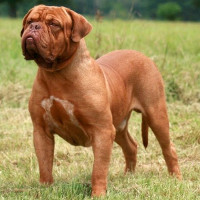
Typical concave lined brachycephalic molossoid. The Dogue de Bordeaux is a very powerful dog, with a very muscular body yet retaining a harmonious general outline. It is built rather close to the ground, the distance sternum-ground being slightly less than the depth of the chest. Stocky, athletic and imposing, it has a very dissuasive aspect.

Important proportions

• The length of the body, measured from the point of the shoulder to the point of the buttock, is superior to the height at the withers, in the proportion of 11/10.
• The depth of the chest is more than half the height at the withers.
• The maximum length of the muzzle is equal to one third of the length of the head.
• The minimum length of the muzzle is equal to one quarter of the length of the head.
• In the male, the perimeter of the skull corresponds more or less to the height at the withers.

Behaviour / temperament

An ancient fighting dog, the Dogue de Bordeaux is gifted for guarding, which it assumes with vigilance and great courage but without aggressiveness. A good companion, very attached to its master and very affectionate. Calm, balanced with a high stimulus threshold. The male normally has a dominant character.

Head

Cranial region

Head
Voluminous, angular, broad, rather short, trapezoid when viewed from above and in front. The longitudinal axes of the skull out of the bridge of nose are convergent (towards the front). The head is furrowed with symmetrical wrinkles, each side of the median groove. These deep ropes of wrinkle are mobile depending on whether the dog is attentive or not. The wrinkle which runs from the inner corner of the eye to the corner of the mouth is typical. If present, the wrinkle running from the outer corner of the eye to either the corner of the mouth or the dewlap should be discreet.
Skull
- In the male: the perimeter of the skull measured at the level of its greatest width corresponds roughly to the height at the withers.
- In bitches : it may be slightly less.
Its volume and shape are the consequences of the very important development of the temporals, supra-orbital arches, zygomatic arches and the spacing of the branches of the lower jaw. The upper region of the skull is slightly convex from one side to the other. The frontal groove is deep, diminishing towards the posterior end of the head. The forehead dominates the face but does not overhang it. Howeverit is still wider than high.  
Stop
Very pronounced, almost forming a right angle with the muzzle (95° to 100°).

Facial region

Nose
Broad, well opened nostrils, well pigmented according to the colour of the mask. Upturned nose permissible but not if it is set back towards the eyes.
Muzzle
Powerful, broad, thick, but not fleshy below the eyes, rather short, upper profile very slightly concave, with moderately obvious folds. Its width hardly decreasing towards the tip of the muzzle, when viewed from above it has the general shape of a square. In relation to the upper region of the skull, the line of the muzzle forms a very obtuse angle upwards. When the head is held horizontally the tip of the muzzle, truncated, thick and broad at the base, is in front of a vertical tangent to the anterior face of the nose. Its perimeter is almost two thirds of that of the head. Its length varies between one third and minimum one quarter of the total length of the head, from the nose to the occipital crest. The limits stated (maximum one third and minimum one quarter of the total length of the head) are permissible but not sought after, the ideal length of the muzzle being between these two extremes.
Lips
Upper lip thick, moderately pendulous, rectractile. When viewed in profile it shows a rounded lower line. It covers the lower jaw on the sides. In front the edge of the upper lip is in contact with the lower lip, then drops on either side thus forming an inverted wide V.
Jaws and teeth
Jaws : Jaws powerful, broad. Undershot (the unders hot condition being a characteristic of the breed). The back of the lower incisors is in front of and not in contact with the front face of the upper incisors. The lower jaw curves upwards. The chin is well marked and must neither overlap the upper lip exaggeratedly nor be covered by it. Teeth : Strong, particularly the canines. Lower canines set wide apart and slightly curved. Incisors well aligned especially in the lower jaw where they form an apparently straight line.
Cheeks
Prominent, due to the very strong development of the muscles.
Eyes
Oval, set wide apart. The space between the two inner corners of the eyelids is equal to about twice the length of the eye (eye opening). Frank expression. The haw must not be visible. Colour : hazel to dark brown for a dog with a black mask, lighter colour tolerated but not sought after in dogs with either a brown mask or without a mask.
Ears
Relatively small, of a slightly darker colour than the coat. At its set on, the front of the base of the ear is slightly raised. They must fall down, but not hang limply, the front edge being close to the cheek when the dog is attentive. The tip of the ear is slightly rounded; it must not reach beyond the eye. Set rather high, at the level of the upper line of the skull, thus appearing to accentuate its width even more.

Neck

Very strong, muscular, almost cylindrical. This skin is supple, ample and loose. The average circumference almost equals that of the head. It is separated from the head by a slightly accentuated transversal furrow, slightly curved. Its upper edge is slightly convex. The well defined dewlap starts at the level of the throat forming folds down to the chest, without hanging exaggeratedly. The neck, very broad at its base, merges smoothly with the shoulders.

Body

Topline
Well sustained.
Withers
Well marked.
Back
Broad and muscular.
Loin
Broad. Rather short and solid.
Croup
Moderately sloping down to the root of the tail.
Chest
Powerful, long, deep, broad, let down lower than the elbows. Broad and powerful forechest whose lower line (inter-axillae) is convex towards the bottom. Ribs well let down and well sprung but not barrel shaped. The circumference of the chest must be between 25 cm to 35 cm greater than the height at the withers.
Underline and belly
Curved from the deep brisket to the rather tucked up, firm abdomen, being neither pendulous nor too tucked up.

Tail

Very thick at the base. Its tip preferably reaching the hock and not below. Carried low, it is neither broken nor kinked but supple. Hanging when the dog is at rest, generally rising by 90° to 120° from that position when the dog is in action, without curving over the back or being curled.

Limbs

Forequarters

Generality
Strong bone structure, legs very muscular.
Shoulders
Powerful, prominent muscles. Slant of shoulder-blade medium (about 45° to the horizontal), angle of the scapular-humeral articulation a little more than 90°.
Upper arm
Very muscular.
Elbows
In the axis of the body, neither too close to the ribcage nor turned out.
Forearm
Viewed from the front, straight or inclining slightly inwards thus getting closer to the median plane, especially in dogs with a very broad chest. Viewed in profile, vertical.
Pastern
Powerful. Viewed in profile, slightly sloping. Viewed from the front sometimes slightly outwards compensating for the slight inclination of the forearm inwards.
Forefeet
Strong. Toes tight, nails curved and strong, pads well developed and supple : the Dogue is well up on his toes despite his weight.

Hindquarters

Generality
Robust legs with strong bone structure; well angulated. When viewed from behind the hindquarter s are parallel and vertical thus giving an impression of power even though the hindquarters are not quite as broad as the forequarters.
Upper thigh
Very developed and thick with visible muscles.
Lower thigh
Relatively short, muscled, descending low.
Stifle
In a parallel plane to the median plane or very slightly out.
Metatarsus
Robust, no dewclaws.
Hock
Short, sinewy, angle of the hock joint moderately open.
Hind feet
Slightly longer than the front feet, toes tight.

Gait and movement

Quite supple for a molossoid. When walking the movement is free and supple, close to the ground. Good drive from the hindquarters, good extension of the forelegs, especially when trotting, which is the preferred gait. When the trot quickens, the head tends to drop, the topline inclines towards the front, and the front feet get closer to the median plane while striding out with a long reaching movement of the front legs. Canter with rather important vertical movement. Capable of great speed over short distances by bolting along close to the ground.

Skin

Thick and sufficiently loose fitting, without excessive wrinkles.

Coat

Hair
Fine, short and soft to the touch.
Colour
Self-coloured, in all shades of fawn, from mahogany to isabella. A good pigmentation is desirable. Limit ed white patches are permissible on the forechest and the extremities of the limbs.
• Black mask : The mask is often only slightly spread out and must not invade the cranial region. There may be slight black shading on the skull, ears, neck and top of body. The nose is black.
• Brown mask : (used to be called red or bistre). The nose is brown; the eyerims and edges of the lips are also brown. There may be non-invasive brown shading; each hair having a fawn or sandy zone and a brown zone. In this case the inclined parts of the body are a paler colour.
• No mask : The coat is fawn : the skin appears red (also formerly called “red mask”). The nose can then be reddish.

Size and weight

Height at withers
Height should more or less correspond to the perimeter of the skull.
Height at the withers : For males: 60-68 cm. For females : 58-66 cm. 1 cm under and 2 cm over will be tolerated.
Weight
Dogs : at least 50 kg. Bitches : at least 45 kg.
Females: Identical characteristics but less pronounced.

Faults

• Any departure from the foregoing points should be considered a fault and the seriousness with which the fault should be regarded should be in exact proportion to its degree and its effect upon the health and welfare of the dog and its ability to perform its traditional work.
• Faults listed should be in degree of seriousness.

Serious faults

 Disproportioned head (too small or exaggerately voluminous).
 Bulldoggy hypertype : Flat skull, muzzle measuring less than a quarter of the total length of the head.
 Swollen fold (roll) behind the nose.
 Important fold around the head.
 Important lateral deviation of the lower jaw.
 Incisors constantly visible when the mouth is closed.
 Very small incisors, unevenly set.
 Arched back (convex).
 Fused but not deviated vertebrae of the tail.
 Forefeet turning inwards (even slightly).
 Forefeet turning outwards too much.
 Flat thighs.
 Angle of hock too open (straight angulation).
 Angle of the hock too closed, dog standing under himself behind.
 Cow hocks or barrel hocks.
 Stilted movement or serious rolling of rear.
 Excessive shortness of breath, rasping.
 White on tip of tail or on the front part of the forelegs, above the carpus (wrist) and the tarsus (hock) or white, without interruption, on the front of the body from the forechest to the throat.

Disqualifying faults

 Aggressive or overly shy.
 Long, narrow head with insufficiently pronounced stop, with a muzzle measuring more than a third of the total length of the head (lack of type in head).
 Muzzle parallel to the top line of the skull or downfaced, Roman nose.
 Twisted jaw.
 Mouth not undershot.
 Canines constantly visible when the mouth is closed.
 Tongue constantly hanging out when the mouth is closed.
 Blue eyes; bulging eyes.
 Tail knotted and laterally deviated or twisted (screw tail, kink tail).
 Atrophied tail.
 Fiddle front and down on pasterns.
 Angle of the hock open towards the rear (inverted hock).
 White on the head or body, any other colour of the coat than fawn (shaded or not) and in particular brindle or solid brown called “chocolate” (each hair being entirely brown).
 Identifiable disabling defect.

NB :

• Any dog clearly showing physical or behavioural abnormalities shall be disqualified.
• The above mentioned faults when occurring to a highly marked degree or frequently are disqualifying.
• Male animals should have two apparently normal testicles fully descended into the scrotum.
• Only functionally and clinically healthy dogs, with breed typical conformation should be used for breeding.

Bibliography

https://www.fci.be/


Detailed history

The Dogue de Bordeaux, whose history, like that of all the Dogues, goes back to the dawn of time, had the incomparable privilege of being recognized by the cynophile authorities of the last century as the most important French Mastiff. According to the famous veterinarian Pierre Mégnin, the Dogue de Bordeaux is derived from the Alans (also called Allants), these powerful molossoids that accompanied the Alans, a tribe of Indo-European origin settled between the Urals and the Caucasus, when pushed by the Huns, they swept over the lands of the Roman Empire, as far as Gaul and Spain. The Alans disappeared in the fifth century, but in Aquitaine and northern Spain, their famous Molosses crossed with autochthonous dogs with rather similar characteristics (we found some bones dating from prehistory), would have given birth to Dogue de Bordeaux and the Dogue de Burgos (which was represented in Spain from the Middle Ages). This is also the thesis defended by the eminent Professor Kunstler, who taught comparative anatomy at the University of Bordeaux.

Used mainly as fighting dogs, the Aquitaine Dogs; they will only be called "masters of Bordeaux" in the nineteenth century; attacked in packs, and apparently, because, in the twelfth century, they contributed largely to the defeat of the English troops. It is only much later, in the eighteenth century, that we find trace of the Great Dane, and this, as noted by Dr. Maurice Luquet in his work Dogs and Bulldogs, under the brush of the famous animal painter Jean -Baptist Oudry who makes him appear in two of his works. As for Buffon, he also mentions it in his Histoire naturelle.

Still, and it is an almost universal case in the history of the canine gent, it is only in the nineteenth century that the race was recognized a very specific identity. In 1863, in fact, the first dog show took place in the Jardin d'Acclimatation in Paris. If, in the minds of the cynologists of the time, it was not to judge the dogs against each other, but rather to draw up an inventory as complete as possible of the breeds existing in the second half of the nineteenth century, this exhibition allowed the Dogue d'Aquitaine to conquer its letters of nobility among a large public. Imposing himself quickly against the other Mastiffs of French origin thanks to his obvious peculiarities, especially in the type, the Dogue of Aquitaine, which one began to call Dogue de Bordeaux, polarized all the attention of the breeders who, during nearly thirty years old were going to fight each other to shape the future of this singular breed. These quarrels, which naturally concerned the definite characters to be definitively attributed to the Dogue de Bordeaux, especially its size, its conformation, the shape and length of its muzzle, but also the color of its mask, the existence of the prognathism and the importance of giving him, finally, over the color of his dress, had no other consequence than to delay the fixing of the race. In 1880, after certain breeders, without precise knowledge of the animal, had enriched the Dogue de Bordeaux with Mastiff blood, Pierre Mégnin and, with him, the Marquis de Cherville alerted the Committee of the Central Canine Society to put an end to these retreats, carried out indiscriminately and which threatened to distort the race for ever, and to finally endeavor to develop a standard worthy of the name. The action of these two enlightened cynologists was not without result, since one of the first acts of the committee, as noted humorously Dr. Luquet, was to "send back to their dear studies these judges, mostly British and Dutch, having never seen or studied this breed and who certainly knew better the recipes of making cocktails than the pedigrees of the races which they judged ".

In any case, no standard had yet been written in 1910, and we were still unable to give the Dogue de Bordeaux precise morphological criteria, the specialists hesitating especially between the red mask and the black. As for the size, the weight and the type of head, they were so diverse that we began to distinguish three types of dogs: Bordeaux, Toulouse and Paris (some specimens being in fact implanted in France). of France).

Professor Kunstler then published a very thorough study on the breed, Prolegomena to be used to establish the standard of the Dogue de Bordeaux, which, if it had not been presented to a French club Dogue de Bordeaux whose members s' confronted in sterile quarrels, would have had every chance of clarifying things once and for all. This club was dissolved, and from its ashes were born two other clubs in 1913: the Central Society of Dogue de Bordeaux and the Bordeaux Club of Dogue de Bordeaux. In sharp discussions, Paul Mégnin and Professor Kunstler were still the first to argue that the Dogue de Bordeaux had to have a normal jaw, the second, which referred to the practices of the breeders of the Aquitaine region, showing himself to be a strong supporter. of prognathism. It was not until 1926 that the two clubs finally agreed. A standard could be written, its authors taking care to spare the susceptibilities of each, admitting from now on the existence of two masks, red and black.

The Bordeaux Dogs suffered terribly from the two world wars. Many breeders either dispersed or had almost disappeared; and in 1966, the only existing club had only about ten members. In 1970, however, the publication, under the leadership of Raymond Triquet and with the collaboration of Dr. Luquet, of a more complete and especially more precise standard than that elaborated at the end of the twenties, allowed the breed to be definitively recognized. by the International Cynological Federation.

Since 1972, the Society of the amateurs of Dogues de Bordeaux has for task to develop the race in France; fortunately, after a particularly difficult post-war period, we can consider that the Dogue de Bordeaux is now well established there: in a logical way, in the South-West, but also in Provence, in the Paris region, in the East and in the North; and the herd can be estimated at about two thousand subjects, which is more than honorable. The breed is also established in Germany, the Netherlands, Italy, Switzerland, Spain and on the American, African and Asian continents.

The forbidding aspect and heavy past of this fighting dog may suggest that the Dogue de Bordeaux is a formidable animal. It is not so. All the owners even agree that these dogs are above all dogs very friendly, sweet, who aspire to one thing: to be near, very close to their master. Especially with the children, this mastiff weighing more than 50 kilos shows no aggression; on the contrary, he plays with them the role of protector, with a kindness that, given its size, might seem somewhat paradoxical.

However, to be certain of having a well-balanced dog with you, that is to say of all confidence, it is advisable to educate him from an early age. It is the sine qua non to make him both an outstanding caretaker and a true companion, who will fit into the family environment. The Dogue de Bordeaux would hardly bear to be left attached all day outside the house. Of course, his training must not go through any form of coercion. Force and brutality, under the pretext that one is faced with an animal endowed with an extraordinary power, would only end up with contrary results. Admittedly, you have to be able to win against the puppy as soon as he is four or five months old, but always with justice. The master will know how to be warm, caress his dog, flatter him even if he has answered a command.

Of course, that the ancestors of the Dogue de Bordeaux were fighting dogs does not mean that they were animals without great intelligence. This Great Dane, if we know how to do it, understands very well what is expected of him. Well trained, he reacts to any word expressed by his master, and is sometimes as eager to obey as some hunting dogs. The Dogue de Bordeaux is naturally fit for the guard; even if certain specimens, because their master wished it to be so, welcome the stranger in the most perfect indifference. In addition, with proper training, he is quite effective as a defense dog. Even detonations are not enough to impress him, as testified by a printer from Bordeaux, Barès, at the beginning of the century.

When it comes to the expenses of food, it is true that they can put off more than one potential buyer. Because it is just as certain that, during his first two years, this dog has meat requirements well above average, which is not very surprising given its size. That being the case, we must know that this effort is essential to avoid any insufficiency of its skeleton. The breed, impressive in many ways, can indeed prove to be fragile health. The Dogues de Bordeaux, tragically too, live a little less old than the average of their congeners, perhaps precisely because of their massive nature. Nevertheless, this Dogue, for the some two thousand French families who have welcomed him, is a precious and endearing companion.

Comments

Latest page updates

  • Yorkshire Terrier

    Yorkshire Terrier FCI Standard No. 86 Origin Great Britain Group Group 3 Terriers Section Section 4 Toy Terriers Working Without working trial Date of acceptance on a definitive basis by the FCI Saturday 30 October 1954 Date of publication of the official valid standard Tuesday 08 September 2026 Date of the last update Tuesday 06 October 2026 En...
  • West Highland White Terrier

    West Highland White Terrier FCI Standard No. 85 Origin Great Britain Group Group 3 Terriers Section Section 2 Small-sized Terriers Working Without working trial Date of acceptance on a definitive basis by the FCI Friday 29 October 1954 Date of publication of the official valid standard Tuesday 08 September 2026 Date of the last update Tuesday 06...
  • Welsh Terrier

    Welsh Terrier FCI Standard No. 78 Origin Great Britain Group Group 3 Terriers Section Section 1 Large- and medium sized Terriers Working Without working trial Date of acceptance on a definitive basis by the FCI Saturday 23 October 1954 Date of publication of the official valid standard Tuesday 08 September 2026 Date of the last update Tuesday 06...
  • Welsh Springer Spaniel

    Welsh Springer Spaniel FCI Standard No. 126 Origin Great Britain Group Group 8 Retrievers-Flushing Dogs-Water Dogs Section Section 2 Flushing Dogs Working With working trial Date of acceptance on a definitive basis by the FCI Thursday 30 December 1954 Date of publication of the official valid standard Tuesday 08 September 2026 Date of the last...
  • Welsh Corgi Pembroke

    Welsh Corgi Pembroke FCI Standard No. 39 Origin Great Britain Group Group 1 Sheepdogs and Cattle Dogs (except Swiss Cattle Dogs) Section Section 2 Cattledogs (except Swiss Cattledogs) Working Without working trial Date of acceptance on a definitive basis by the FCI Wednesday 13 November 1963 Date of publication of the official valid standard Tuesday 08...
  • Welsh Corgi Cardigan

    Welsh Corgi Cardigan FCI Standard No. 38 Origin Great Britain Group Group 1 Sheepdogs and Cattle Dogs (except Swiss Cattle Dogs) Section Section 2 Cattledogs (except Swiss Cattledogs) Working Without working trial Date of acceptance on a definitive basis by the FCI Tuesday 12 November 1963 Date of publication of the official valid standard Tuesday 08...
  • Sussex Spaniel

    Sussex Spaniel FCI Standard No. 127 Origin Great Britain Group Group 8 Retrievers, Flushing dogs, Water dogs. Section Section 2 Flushing dogs Working With working trial Date of acceptance on a definitive basis by the FCI Friday 31 December 1954 Date of publication of the official valid standard Tuesday 08 September 2026 Date of the last update Tuesday 06...
  • Staffordshire Bull Terrier

    Staffordshire Bull Terrier FCI Standard No. 76 Origin Great Britain Group Group 3 Terriers Section Section 3 Bull type Terriers Working Without working trial Date of acceptance on a definitive basis by the FCI Thursday 21 October 1954 Date of publication of the official valid standard Tuesday 08 September 2026 Date of the last update Tuesday 06...
  • Skye Terrier

    Skye Terrier FCI Standard No. 75 Origin Great Britain Group Group 3 Terriers Section Section 2 Small-sized Terriers Working Without working trial Date of acceptance on a definitive basis by the FCI Wednesday 20 October 1954 Date of publication of the official valid standard Tuesday 08 September 2026 Date of the last update Tuesday 06 October 2026 En...
  • Shetland Sheepdog

    Shetland Sheepdog FCI Standard No. 88 Origin Great Britain Group Group 1 Sheepdogs and Cattle Dogs Section Section 1 Sheepdogs Working Without working trial Date of acceptance on a definitive basis by the FCI Tuesday 09 November 1954 Date of publication of the official valid standard Tuesday 08 September 2026 Date of the last update Tuesday 06...
  • Sealyham Terrier

    Sealyham Terrier FCI Standard No. 74 Origin Great Britain Group Group 3 Terriers Section Section 2 Small sized Terriers Working Without working trial Date of acceptance on a definitive basis by the FCI Tuesday 19 October 1954 Date of publication of the official valid standard Tuesday 08 September 2026 Date of the last update Tuesday 06 October...
  • Scottish Terrier

    Scottish Terrier FCI Standard No. 73 Origin Great Britain Group Group 3 Terriers Section Section 2 Small-sized Terriers Working Without working trial Date of acceptance on a definitive basis by the FCI Monday 18 October 1954 Date of publication of the official valid standard Tuesday 08 September 2026 Date of the last update Tuesday 06 October...
  • Old English Sheepdog (Bobtail)

      Old English Sheepdog (Bobtail) FCI Standard No. 16     Origin   Great Britain Group   Group 1 Sheepdogs and Cattle Dogs (except Swiss Cattle Dogs) Section   Section 1 Sheepdogs Working   Without working trial Date of acceptance on a definitive basis by the FCI   Monday 25 November 1963 Date of publication of the official valid standard   Tuesday 08 September...
  • Norwich Terrier

    Norwich Terrier FCI Standard No. 72 Origin Great Britain Group Group 3 Terriers Section Section 2 Small-sized Terriers Working Without working trial Date of acceptance on a definitive basis by the FCI Saturday 16 October 1954 Date of publication of the official valid standard Tuesday 08 September 2026 Date of the last update Tuesday 06 October...
  • Norfolk Terrier

    Norfolk Terrier FCI Standard No. 272 Origin Great Britain Group Group 3 Terriers Section Section 2 Small-sized Terriers Working Without working trial Date of acceptance on a definitive basis by the FCI Saturday 01 October 1966 Date of publication of the official valid standard Tuesday 08 September 2026 Date of the last update Tuesday 06 October...
  • Manchester Terrier

    Manchester Terrier FCI Standard No. 71 Origin Great Britain Group Group 3 Terriers Section Section 1 Large and medium sized Terriers Working Without working trial Date of acceptance on a definitive basis by the FCI Friday 15 October 1954 Date of publication of the official valid standard Tuesday 08 September 2026 Date of the last update Tuesday 06 October...
  • Lakeland Terrier

    Lakeland Terrier FCI Standard No. 70 Origin Great Britain Group Group 3 Terriers Section Section 1 Large and medium-sized Terriers Working Without working trial Date of acceptance on a definitive basis by the FCI Thursday 14 October 1954 Date of publication of the official valid standard Tuesday 08 September 2026 Date of the last update Tuesday 06 October...
  • Labrador Retriever

      Labrador Retriever FCI Standard No. 122     Origin   Canada Group   Group 8 Retrievers, Flushing dogs, Water dogs Section   Section 1 Retrievers Working   With working trial Date of acceptance on a definitive basis by the FCI   Friday 24 December 1954 Date of publication of the official valid standard   Tuesday 08 September 2026 Date of the last update   Tuesday 06...
  • King Charles Spaniel

    King Charles Spaniel FCI Standard No. 128 Origin Great Britain Group Group 9 Companion and Toy Dogs Section Section 7 English Toy Spaniels Working Without working trial Date of acceptance on a definitive basis by the FCI Monday 03 January 1955 Date of publication of the official valid standard Tuesday 08 September 2026 Date of the last update Tuesday 06...
  • Harrier

      Harrier FCI Standard No. 295     Origin   Great Britain Translation   Mrs. Peggy Davis, brought up to day by Dr. Paschoud Group   Group 6 Scenthounds and related breeds Section   Section 1.2 Medium-sized Hounds Working   With working trial Date of acceptance on a definitive basis by the FCI   Wednesday 27 November 1974 Date of publication of the official valid...
  • Greyhound

    Greyhound FCI Standard No. 158 Origin Great Britain Group Group 10 Sighthounds Section Section 3 Short-haired sighthounds Working Without working trial Date of acceptance on a definitive basis by the FCI Saturday 23 April 1955 Date of publication of the official valid standard Tuesday 08 September 2026 Date of the last update Tuesday 06 October...
  • Gordon Setter

    Gordon Setter FCI Standard No. 6 Origin Great Britain Group Group 7 Pointing Dogs Section Section 2.2 British and Irish Pointers and Setters; Setters Working With working trial Date of acceptance on a definitive basis by the FCI Tuesday 28 May 1963 Date of publication of the official valid standard Tuesday 08 September 2026 Date of the last...
  • Golden Retriever

    Golden Retriever FCI Standard No. 111 Origin Great Britain Group Group 8 Retrievers, Flushing Dogs, Water Dogs Section Section 1 Retrievers Working With working trial Date of acceptance on a definitive basis by the FCI Thursday 02 December 1954 Date of publication of the official valid standard Tuesday 28 July 2009 Date of the last update Wednesday...
  • Fox Terrier Wire

    Fox Terrier Wire FCI Standard No. 169 Origin Great Britain Group Group 3 Terriers Section Section 1 Large and medium-sized Terriers Working Working trial optional Date of acceptance on a definitive basis by the FCI Friday 13 May 1955 Date of publication of the official valid standard Tuesday 08 September 2026 Date of the last update Tuesday 06...
  • Fox Terrier Smooth

    Fox Terrier Smooth FCI Standard No. 12 Origin Great Britain Group Group Terriers Section Section 1 Large and medium sized Terriers Working Working trial optional Date of acceptance on a definitive basis by the FCI Wednesday 26 June 1963 Date of publication of the official valid standard Tuesday 08 September 2026 Date of the last update Tuesday 06...
  • Flat Coated Retriever

    Flat Coated Retriever FCI Standard No. 121 Origin Great Britain Group Group 8 Retrievers-Flushing Dogs-Water Dogs Section Section 1 Retrievers Working With working trial Date of acceptance on a definitive basis by the FCI Thursday 23 December 1954 Date of publication of the official valid standard Tuesday 08 September 2026 Date of the last update Tuesday...
  • Field Spaniel

    Field Spaniel FCI Standard No. 123 Origin Great-Britain Group Group 8 Retrievers, Flushing Dogs, Water Dogs Section Section 2 Flushing Dogs Working With working trial Date of acceptance on a definitive basis by the FCI Monday 27 December 1954 Date of publication of the official valid standard Tuesday 08 September 2026 Date of the last update Tuesday...
  • English Toy Terrier

    English Toy Terrier FCI Standard No. 13 Origin Great Britain Group Group 3 Terriers Section Section 4 Toy Terriers Working Without working trial Date of acceptance on a definitive basis by the FCI Tuesday 17 September 1963 Date of publication of the official valid standard Tuesday 08 September 2026 Date of the last update Tuesday 06 October 2026 En...
  • English Springer Spaniel

    English Springer Spaniel FCI Standard No. 125 Origin Great Britain Group Group 8 Retrievers-Flushing Dogs-Water Dogs Section Section 2 Flushing Dogs Working With working trial Date of acceptance on a definitive basis by the FCI Wednesday 29 December 1954 Date of publication of the official valid standard Tuesday 08 September 2026 Date of the last...
  • English Setter

    English Setter FCI Standard No. 2 Origin Great Britain Group Group 7 Pointing Dogs Section Section 2.2 British and Irish Pointers and Setters, Setter Working With working trial Date of acceptance on a definitive basis by the FCI Wednesday 06 March 1963 Date of publication of the official valid standard Tuesday 08 September 2026 Date of the last...
  • English Pointer

    English Pointer FCI Standard No. 1 Origin Great Britain Group Group 7 Pointing Dogs Section Section 2.1 British and Irish Pointers and Setters, Pointer Working With working trial Date of acceptance on a definitive basis by the FCI Tuesday 05 March 1963 Date of publication of the official valid standard Tuesday 08 September 2026 Date of the last...
  • English Foxhound

    English Foxhound FCI Standard No. 159 Origin Great Britain Group Group 6 Scenthounds and related breeds Section Section 1.1 Large-sized Scent hounds Working With working trial Date of acceptance on a definitive basis by the FCI Monday 25 April 1955 Date of publication of the official valid standard Thursday 26 March 2009 Date of the last update Wednesday...
  • English Cocker Spaniel

    English Cocker Spaniel FCI Standard No. 5 Origin Great Britain Group Group 8 Retrievers, Flushing Dogs, Water Dogs Section Section 2 Flushing dogs Working With working trial Date of acceptance on a definitive basis by the FCI Wednesday 10 April 1963 Date of publication of the official valid standard Tuesday 08 September 2026 Date of the last...
  • Tibetan Mastiff

    Tibetan Mastiff FCI Standard No. 230 Origin Tibet (China)Patronage FCI Group Group 2 Pinscher and Schnauzer- Molossoid breeds- Swiss Mountain and Cattle Dogs Section Section 2.2 Molossoid breeds, Mountain type Working Without working trial Date of acceptance on a definitive basis by the FCI Tuesday 22 August 1961 Date of publication of the...
  • Deerhound

    Deerhound FCI Standard No. 164 Origin Great Britain Group Group 10 Sighthounds Section Section 2 Rough-haired Sighthounds Working Without working trial Date of acceptance on a definitive basis by the FCI Friday 29 April 1955 Date of publication of the official valid standard Tuesday 08 September 2026 Date of the last update Tuesday 06 October...
  • Dandie Dinmont Terrier

    Dandie Dinmont Terrier FCI Standard No. 168 Origin Great Britain Group Group 3 Terriers Section Section 2 Small-sized Terriers Working Without working trial Date of acceptance on a definitive basis by the FCI Thursday 12 May 1955 Date of publication of the official valid standard Tuesday 08 September 2026 Date of the last update Tuesday 06...
  • Curly Coated Retriever

    Curly Coated Retriever FCI Standard No. 110 Origin Great Britain Group Group 8 Retrievers, Flushing Dogs, Water Dogs Section Section 1 Retrievers Working With working trial Date of acceptance on a definitive basis by the FCI Friday 10 December 1954 Date of publication of the official valid standard Tuesday 08 September 2026 Date of the last...
  • Collie Smooth

    Collie Smooth FCI Standard No. 296 Origin Great Britain Group Group 1 Sheepdogs and Cattle Dogs (except Swiss Cattle Dogs) Section Section 1 Sheepdogs Working Without working trial Date of acceptance on a definitive basis by the FCI Wednesday 18 December 1974 Date of publication of the official valid standard Tuesday 08 September 2026 Date of the...
  • Collie Rough

    Collie Rough FCI Standard No. 156 Origin Great Britain Group Group 1 Sheepdogs and Cattle Dogs (except Swiss Cattle Dogs) Section Section 1 Sheepdogs Working Without working trial Date of acceptance on a definitive basis by the FCI Wednesday 13 April 1955 Date of publication of the official valid standard Tuesday 08 September 2026 Date of the...
  • Clumber Spaniel

    Clumber Spaniel FCI Standard No. 109 Origin Great Britain Group Group 8 Retrievers, Flushing dogs, Water dogs Section Section 2 Flushing dogs Working With working trial Date of acceptance on a definitive basis by the FCI Thursday 09 December 1954 Date of publication of the official valid standard Tuesday 08 September 2026 Date of the last update Tuesday...
  • Chow Chow

    Chow Chow FCI Standard No. 205 Origin China, patronage : Great Britain Group Group 5 Spitz and primitive type Section Section 5 Asian Spitz and related breeds Working Without working trial Date of acceptance on a definitive basis by the FCI Tuesday 10 December 1957 Date of publication of the official valid standard Tuesday 08 September 2026 Date...
  • Chinese Crested Dog

    Chinese Crested Dog FCI Standard No. 288 Origin China, patronage Great Britain Group Group 9 Companion and Toy Dogs Section Section 4 Hairless breeds Working Without working trial Date of acceptance on a definitive basis by the FCI Monday 17 July 1972 Date of publication of the official valid standard Tuesday 08 September 2026 Date of the last...
  • Cairn Terrier

    Cairn Terrier FCI Standard No. 4 Origin Great Britain Group Group 3 Terriers Section Section 2 Small-sized Terriers Working Without working trial Date of acceptance on a definitive basis by the FCI Saturday 06 April 1963 Date of publication of the official valid standard Tuesday 08 September 2026 Date of the last update Tuesday 06 October 2026 En...
  • Bullmastiff

    Bullmastiff FCI Standard No. 157 Origin Great Britain Group Group 2 Pinscher and Schnauzer Molossoid breeds - Swiss Mountain and Cattle Dogs Section Section 2.1 Molossoid breeds, Mastiff Type Working Without working trial Date of acceptance on a definitive basis by the FCI Saturday 23 April 1955 Date of publication of the official valid standard Tuesday...
  • English Bulldog

    English Bulldog FCI Standard No. 149 Origin Great Britain Group Group 2 Pinscher and Schnauzer Molossoid breeds-Swiss Mountain and Cattle Dogs Section Section 2.1 Molossoid breeds, Mastiff Type Working Without working trial Date of acceptance on a definitive basis by the FCI Monday 14 March 1955 Date of publication of the official valid standard Tuesday...
  • Bull Terrier

    Bull Terrier FCI Standard No. 11 Origin Grande-Bretagne Group Group 3 Terriers Section Section 3 Bull type Terriers Working Working trial optional Date of acceptance on a definitive basis by the FCI Saturday 26 June 1993 Date of publication of the official valid standard Tuesday 08 September 2026 Date of the last update Tuesday 06 October 2026 En...
  • Border Terrier

    Border Terrier FCI Standard No. 10 Origin Great Britain Group Group 3 Terriers Section Section 1 Large and medium-sized terriers Working Without working trial Date of acceptance on a definitive basis by the FCI Wednesday 26 June 1963 Date of publication of the official valid standard Tuesday 08 September 2026 Date of the last update Tuesday 06...
  • Bedlington Terrier

    Bedlington Terrier FCI Standard No. 9 Origin Great Britain Group Group 3 Terriers Section Section 1 Large and medium sized Terriers Working Without working trial Date of acceptance on a definitive basis by the FCI Thursday 20 June 1963 Date of publication of the official valid standard Tuesday 08 September 2026 Date of the last update Tuesday 06...
  • Bearded Collie

    Bearded Collie FCI Standard No. 271 Origin Great-Britain Group Group 1 Sheepdogs and Cattle Dogs (except Swiss Cattle Dogs) Section Section 1 Sheepdogs Working Without working trial Date of acceptance on a definitive basis by the FCI Wednesday 30 August 1967 Date of publication of the official valid standard Tuesday 08 September 2026 Date of the...
  • Beagle

    Beagle FCI Standard No. 161 Origin Great Britain Translation Prof. R. Triquet Group Group 6 Scent hounds and related breeds Section Section 1.3 Small-sized hounds Date of acceptance on a definitive basis by the FCI Tuesday 26 April 1955 Date of publication of the official valid standard Tuesday 08 September 2026 Date of the last update Tuesday 06...
  • Basset Hound

    Basset Hound FCI Standard No. 163 Origin Great Britain Group Group 6 Scent hounds and related breeds Section Section 1.3 Small-sized hounds Working With working trial Date of acceptance on a definitive basis by the FCI Thursday 28 April 1955 Date of publication of the official valid standard Tuesday 08 September 2026 Date of the last update Tuesday...
  • Basenji

    Basenji FCI Standard No. 43 Origin Democratic Republic of Congo, under the patronage of Great Britain Group Group 5 Spitz and primitive types Section Section 6 Primitive type Working Without working trial Date of acceptance on a definitive basis by the FCI Thursday 26 March 1964 Date of publication of the official valid standard Tuesday 08...
  • Airedale Terrier

    Airedale Terrier FCI Standard No. 7 Origin Great Britain Group Group 3 Terriers Section Section 1 Large and medium sized Terriers Working Working trial optional Date of acceptance on a definitive basis by the FCI Tuesday 28 May 1963 Date of publication of the official valid standard Tuesday 08 September 2026 Date of the last update Tuesday 06...
  • Afghan Hound

    Afghan Hound FCI Standard No. 228 Origin AfghanistanPatronage Great Britain Group Group 10 Sighthounds Section Section 1 Long-haired or fringed sighthounds Working Without working trial Date of acceptance on a definitive basis by the FCI Tuesday 12 December 1961 Date of publication of the official valid standard Tuesday 08 September 2026 Date of the...
  • Romagna Water Dog

    Romagna Water Dog FCI Standard No. 298 Origin Italy Translation Antonio Morsiani, Renée Sporre-Willes and Prof. R. TriquetRevised by ENCI and Renée Sporre-WillesRevised by the FCI Head OfficeOfficial language (EN). Group Group 8 Retrievers –Flushing Dogs –Water Dogs Section Section 3 Water Dogs Working Working trial optional Date of acceptance on a...
  • Whippet

    Whippet FCI Standard No. 162 Origin Great Britain Group Group 10 Sighthounds Section Section 3 Short-haired Sighthounds Working Without working trial Date of acceptance on a definitive basis by the FCI Wednesday 27 April 1955 Date of publication of the official valid standard Tuesday 08 September 2026 Date of the last update Tuesday 06 October...
  • Tibetan Terrier

    Tibetan Terrier FCI Standard No. 209 Origin Tibet, patronage Great Britain Group Group 9 Companion and Toy Dogs Section Section 5 Tibetan breeds Working Without working trial Date of acceptance on a definitive basis by the FCI Wednesday 18 December 1957 Date of publication of the official valid standard Tuesday 08 September 2026 Date of the last...
  • Tibetan Spaniel

    Tibetan Spaniel FCI Standard No. 231 Origin Tibet (China)Patronage Great Britain Group Group 9 Companion and Toy Dogs Section Section 5 Tibetan breeds Working Without working trial Date of acceptance on a definitive basis by the FCI Tuesday 22 August 1961 Date of publication of the official valid standard Tuesday 08 September 2026 Date of the...
  • Shih Tzu

    Shih Tzu FCI Standard No. 208 Origin Tibet, patronage Great Britain Group Group 9 Companion and Toy Dogs Section Section 5 Tibetan breeds Working Without working trial Date of acceptance on a definitive basis by the FCI Monday 16 December 1957 Date of publication of the official valid standard Tuesday 08 September 2026 Date of the last update Tuesday 06...
  • Pug

    Pug FCI Standard No. 253 Origin China, patronage Great Britain Group Group 9 Companion and Toy Dogs Section Section 11 Small Molossian type dogs Working Without working trial Date of acceptance on a definitive basis by the FCI Friday 04 November 1966 Date of publication of the official valid standard Tuesday 08 September 2026 Date of the last...
  • Pharaoh Hound

    Pharaoh Hound FCI Standard No. 248 Origin Malta, patronage Great Britain Group Group 5 Spitz and primitive types Section Section 6 Primitive type Working Without working trial Date of acceptance on a definitive basis by the FCI Friday 09 August 1963 Date of publication of the official valid standard Tuesday 08 September 2026 Date of the last...
  • Pekingese

    Pekingese FCI Standard No. 207 Origin China, patronage Great Britain Group Group 9 Companion and Toy Dogs Section Section 8 Japan Chin and Pekingese Working Without working trial Date of acceptance on a definitive basis by the FCI Thursday 03 November 1966 Date of publication of the official valid standard Tuesday 08 September 2026 Date of the last...
  • Parson Russell Terrier

    Parson Russell Terrier FCI Standard No. 339 Origin Great Britain Group Group 3 Terriers Section Section 1 Large and medium sized Terriers Working Working trial optional Date of acceptance on a definitive basis by the FCI Monday 04 June 2001 Date of acceptance on a provisional basis by the FCI Monday 02 July 1990 Date of publication of the...
  • Otterhound

    Otterhound FCI Standard No. 294 Origin Great Britain Group Group 6 Scenthounds and related breeds Section Section 1.1 Large-sized hounds Working Without working trial Date of acceptance on a definitive basis by the FCI Thursday 12 September 1974 Date of publication of the official valid standard Tuesday 08 September 2026 Date of the last update Tuesday 06...
  • Miniature Bull Terrier

    Miniature Bull Terrier FCI Standard No. 359 Origin Grande-Bretagne Group Group 3 Terriers Section Section 3 Bull type Terriers Working Working trial optional Date of acceptance on a definitive basis by the FCI Tuesday 05 July 2011 Date of acceptance on a provisional basis by the FCI Tuesday 05 July 2011 Date of publication of the official valid...
  • Mastiff

    Mastiff FCI Standard No. 264 Origin Great Britain Group Group 2 Pinscher and Schnauzer – Molossoid breeds - Swiss Mountain and Cattle Dogs Section Section 2.1 Molossoid breeds, Mastiff Type Working Without working trial Date of acceptance on a definitive basis by the FCI Thursday 05 November 1964 Date of publication of the official valid standard Tuesday 08...
  • Lhassa Apso

    Lhassa Apso FCI Standard No. 227 Origin Tibet (China)Patronage Great Britain Group Group 9 Companion and Toy Dogs Section Section 5 Tibetan breeds Working Without working trial Date of acceptance on a definitive basis by the FCI Saturday 19 November 1960 Date of publication of the official valid standard Tuesday 08 September 2026 Date of the last...
  • Lancashire-Heeler

    Lancashire-Heeler FCI Standard No. 360 Origin England, patronage : FCI Group Group 1 Sheepdogs and Cattle Dogs (except Swiss Cattle Dogs) Section Section 1 Sheepdogs Working Without working trial Date of acceptance on a provisional basis by the FCI Sunday 01 May 2016 Date of publication of the official valid standard Tuesday 08 September 2026 Date...

© 2026 Groupe Milouchouchou ASBL. Tous droits réservés. En savoir plus

Protected by Copyright01
