Briard

FCI standard Nº 113

Origin
France
Group
Group 1 Sheepdogs and Cattle Dogs (except Swiss Cattle Dogs)
Section
Section 1 Sheepdogs
Working
With working trial
Acceptance on a definitive basis by the FCI
Tuesday 14 December 1954
Publication of the official valid standard
Tuesday 04 November 2008
Last update
Friday 23 January 2009
En français, cette race se dit
Berger de Brie
Diese Norm ist in deutscher Sprache sichtbar
Berger de Brie
En español, esta raza se dice
Pastor de Brie
In het Nederlands, wordt dit ras gezegd
Briard

Usage

Sheepdog and guard dog.

Brief historical summary

Known for a long time as Chiens de Berger français de Plaine (French Lowlands Sheepdog). It was in 1809, in the Abbot Rozier’s "Complete Agricultural Course", that the name "chien de Brie" appeared for the first time. It was bred and selected for its herd-driving and guarding aptitudes. The French army also used it during the two world wars as, among other activities, sentinel and ambulance dog searching for the wounded in the war fields.

General appearance

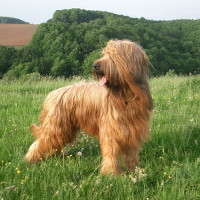
The Briard is hardy, supple, muscled and well proportioned; lively and alert.

Important proportions

The Briard is of medium build. The length of the body, from the point of shoulder to the point of buttock, should be slightly greater that the height at withers. The head is long: 2/5th of the height at withers. The width of the skull is slightly less than ½ of the length of the head. The skull and the muzzle are of equal length.

Behaviour / temperament

Balanced temperament, neither aggressive nor timid. The Briard should be steady and fearless.

Head

Cranial region

Head
Strong, long, covered with hair forming beard, moustache and eyebrows slightly veiling the eyes. Seen from the side, the lines of the skull and muzzle are parallel.
Skull
Strong, very slightly rounded seen from the side. 
Stop
Pronounced; at equal distance from the occiput and the tip of the nose.

Facial region

Nose
Strong. The nostrils are well open. The nose is always black except in blue dogs which have either a blue or bluish nose.
Muzzle
strong, sufficiently broad and never pointed.
Lips
Lips are tight fitting.
Nasal bridge
Straight.
Jaws and teeth
Strong jaws; white teeth. Scissors bite.
Eyes
Oval. Horizontal, well open, rather large and of dark colour. In blue dogs, paler coloured eyes are permitted.
Ears
Set on high, not plastered against the head and rather short if left natural. The length of the cartilage of the uncropped ear should be equal to or slightly less than half the length of the head. The ears are always flat and covered with long hair. If cropped, in countries where this practice is not forbidden, they should be carried erect, neither divergent nor convergent.

Neck

Muscled and springing well up from the shoulders.

Body

Back
The back is straight.
Loin
The loin is short and firm.
Croup
Only slightly sloping, of slightly rounded shape.
Chest
Wide and long, well let down to the elbows: ribs well sprung.

Tail

Natural, carried low, it reaches at least the hock joint, without deviation, forming a slight hook like a “J”. In action, the tail may be carried at the highest in prolongation of the topline.

Limbs

Forequarters

Generality
Well muscled with strong bone and upright.
Shoulders
Oblique, well angulated, moderately long, fitting closely to the thoracic wall.
Elbows
In line with the body.
Forearm
Straight and muscled.
Pastern
Slightly sloping, seen from the side.
Forefeet
Strong, round and well in axis with the body. The nails are always black (except in blues) and the pads hard. Toes should be well knit and arched.

Hindquarters

Generality
Well muscled with strong bone and upright.
Upper thigh
Muscled.
Metatarsus
Perfectly vertical, seen from behind.
Hock
Not too low down and well angulated.
Hind feet
Strong, round. The nails are always black (except in blues) and the pads hard. Toes should be well knit. Dewclaws : By tradition, the shepherds want to keep the double dewclaws. The dewclaws form thumbs, well separated and with nails, relatively close to the foot.

Gait and movement

Regular, supple, harmonious, in a manner which allows the dog to cover ground and accomplish its work with a minimum of effort and fatigue. The Briard should have a long trot with good reach and good thrust from behind.

Coat

Hair
Goat-like texture, dry, supple, long, with slight undercoat.
Colour
Black, fawn, fawn with black overlay (slight to medium) often with mask, grey or blue. A coat of warm fawn colour may show a lighter colour on the points and on the inclined parts of the body (fawn marked with sandy colour). Black, grey and blue coats can likewise display zones of a lighter shade. All colours may show different degrees of greying.

Size and weight

Height at withers
Males 62 – 68 cm, females 56 – 64 cm.

Faults

• Any departure from the foregoing points should be considered a fault and the seriousness with which the fault should be regarded should be in exact proportion to its degree and its effect upon the health and welfare of the dog and its ability to perform its traditional work.
• Faults listed should be in degree of seriousness.

Serious faults

 Severe faults in limbs.
 Overall coat colour too light.
 Coat: insufficient length (less than 7cm), hair soft or woolly.

Disqualifying faults

 Aggressive or overly shy.
 Stop absolutely not marked.
 Nose of colour other than black or blue; presence of pink (unpigmented areas).
 Overshot or undershot with loss of contact of incisors; absence of 2 lower PM4 or absence of 3 teeth or more whichever they are (except for PM1).
 Eye too light (yellow), wall eye.
 Ears curling inwards, set on too low beneath eye level, covered with short hair, naturally erect.
 Tail curled up or carried vertically.
 Single dewclaw or total absence of dewclaws on hindlegs.
 White, brown or mahogany colour; coat of two distinct colours; white blaze, white hairs on the extremities of the limbs, fawn coat with saddle.
 Size outside the limits of the standard with tolerance of +2cm or -1cm.
 Fraudulent modification of the dog or evidence of such practice by use of substances or surgery.

NB :

• Any dog clearly showing physical or behavioural abnormalities shall be disqualified.
• The above mentioned faults when occurring to a highly marked degree or frequently are disqualifying.
• Male animals should have two apparently normal testicles fully descended into the scrotum.
• Only functionally and clinically healthy dogs, with breed typical conformation should be used for breeding.

Bibliography

https://www.fci.be/


Detailed history

As his close cousin Beauceron, Berger de Brie, or Briard, probably does not draw his name from its geographical origin, and we can not say with certainty that this breed very old, perhaps from the dog peat bogs known from prehistory, was born in this or that province.

Although some lend it a more distant origin, linked to the legend of the dog Montargis, the name of Berger de Brie appears for the first time in 1809 in the course of agriculture of the abbot Rozier, which differentiates the two big Shepherds' families then present on our territory: "In the countries of plain, open hillsides and in the daytime walks of woolly animals, the dog of Brie is the one who is employed. This dog has short ears and tail directed horizontally or curved upwards or sometimes hanging, his hair is long on the whole body, black is the dominant color. It is not his beauty that makes his merit, his perfections are born of his obedience, his activity, his industry. We do not see what is the custom of cutting his tail and ears, but we can see why it is prudent to cut the hooks at six months if he announces to become too ardent. His job is to make the wool beasts obey by his voice and his combined movements and not by his bites. For countries of woods and mountains, rugged or strewn with thick bushes or for night-watch, and finally for all the places which favor the voracity of the wolves, the shepherds will have to join to the dog of Brie more robust defenders, mastiffs of strong race. "

To the Berger de Brie, therefore, the role of herdsman, to the ancestor of the Beauceron, since it is him who is at stake, the guard of the beasts against their predators. If the description of the abbot Rozier evokes in certain points the Briard as we know it today, it also reveals the rather great heterogeneity which reigned at the time within the same group of dogs. This is not surprising, considering that, until the end of the nineteenth century, the evolution of animal races was more a part of natural self-selection than of rational breeding and, on the other hand, as the quoted text clearly shows, that the aesthetics of the animal was then quite negligible in its working qualities.

The first modern document available to us was a photograph taken in 1863 by Léon Crémière as part of the first canine exhibition in Paris, an event of which he immortalized all the laureates. She shows a dog named Charmante who, ranked first among the sheepdogs, has some similarities with our Briard today.

In 1888, in his newspaper L'Éleveur, the military veterinarian Pierre Mégnin returns to the distinction between the Long-haired Shepherd called "de Brie" and the short-haired shepherd that he suggested to christen "de Beauce" to better differentiate him from the Briard: "Brie's dog," he writes, "is the result of crossing Barbet with the Beauceron. It has the same proportions, as it has short ears and straight, but differs in its long fur and woolly, usually slate, dark or black dyed. He is often cut off the tail. It has the same qualities as the old French sheepdog. And, to complete his description, Pierre Mégnin publishes a drawing of a dog of this type, baptized Sans Gêne, first prize and gold medal of the Minister of Agriculture.

It will still take five years for these two categories of dogs to be truly recognized because, as Pierre Mégnin later wrote, "Until 1893, even in dog shows, no race was distinguished; the various appellations: dogs of Brie, Beauce, Pyrenees, Picard, Crau, Languedoc, Ardennes, etc., only related to their country of origin.

It was finally in January 1896 that a commission, composed of competent personalities gathered for the occasion in the great market hall of La Villette under the presidency of Emmanuel Boulet, was to lay the foundations of the first standards and encourage the creation of the Club. French Shepherd Dog, which, sponsored and subsidized by the Ministry of Agriculture, will meet for the first time the following year. Its statutes, as published shortly thereafter in the Official Journal, assign it precise objectives, summed up by veterinarian, judge and international cynological expert Maurice Luquet in his book Les Chiens de Berger français: "Encourage, by all possible means, the breeding, raising and training of our very useful breeds of French Shepherds, by organizing sheepdog competitions at work and exhibitions, by popularizing by engraving the beautiful types and by adding the description of each variety so to facilitate the choice of breeders and to inform the breeders, by inviting the members to register their students well typed in the French Book of Origins (LOF), in order to make known to the amateurs the dogs of the race followed ". For some time, the standard of the Berger de Brie distinguished two varieties of dogs, one with woolly hair, the other with goat hair, but only the latter survived because the hair the ineux had too many disadvantages, including a significant tendency to felting. Thanks to the foundation, in 1909, at the initiative of Mr. Lamarque, the club "Friends of Briard", thanks also to the efforts of breeders and exhibitors, the Berger de Brie was soon to know a very large success in his country of origin first, then abroad, while progressively evolving towards the type we know today.

Under the pseudonym of Sédir, Yvon Le Loup published in 1926 a study on Briard called The Shepherd of Brie, dog of France, in which he wrote in particular: "In a general way, I think that the dogs with long hair seem to be smarter than those with short hair. They understand better what their master asks of them, and learn faster. They have a gentleness, a loyalty, a fidelity above average. Brie's dog possesses these qualities to the highest degree. If Sedir's thesis is far, and for good reason, to be unanimous among dog-lovers, he is not, on the other hand, an amateur of Briard who does not share his enthusiasm for the moral qualities of a dog of which Gaby Morlay said with a consumed sense of the formula: "It's a heart with hair around. Indeed, a true Briard seduces at first sight with his equilibrium, his calmness, his delicacy also, astonishing in such a powerful athlete, and by love; the word is not for once too strong; that he is devoted to his master and his family. A love that is read in his big dark eyes and which, born of mutual respect, feeds on instinctive understanding; some even say divination; of what can satisfy his entourage.

It is only to observe a Briard in his family circle to measure his innate sense of adaptation to situations and people: big plush soft for the little ones on which he watches, without seeming, with a jealous care, complicit in games and playfulness of the greatest, tireless partner of adults walking, skiing or on the beach, he also knows how to temper his natural exuberance in the presence of the weaker or the elderly, and even, supreme virtue in this great sensitive always looking for affection, to be forgotten at the restaurant or traveling. But, make no mistake. This great companion dog, that fat, ruffled man who is so gentle with children, has remained a shepherd dog in his soul, and woe to whom his loved ones or their property would be threatened. Because, beneath his outside of big friendly teddy bear, the Briard is also a guardian-born, heir of a long tradition of dedication and courage, which will defend until the end those whom he likes.

Distrustful by nature with strangers, it is not aggressive, provided that it is not attached to a chain or locked in a kennel. The Briard indeed needs a permanent contact with his master to flourish and develop his intelligence, which is great. With him, no problem of training. He knows instinctively what is expected of him, and his excellent memory allows him to quickly assimilate the notions taught to him. His education will be undertaken from an early age, firmly, certainly, but above all with tenderness. Because, with him, brutality really does not pay: it is on the contrary the surest way to "break" the character, to make a dog fearful or, worse, vindictive, which will never be a real Briard. And all the experts confirm it: the best watchdogs and defense dogs are not recruited from the tainted subjects, but, on the contrary, among the balanced dogs, sure of themselves and their strength.

Comments

Latest page updates

  • Yorkshire Terrier

    Yorkshire Terrier FCI Standard No. 86 Origin Great Britain Group Group 3 Terriers Section Section 4 Toy Terriers Working Without working trial Date of acceptance on a definitive basis by the FCI Saturday 30 October 1954 Date of publication of the official valid standard Tuesday 08 September 2026 Date of the last update Tuesday 06 October 2026 En...
  • West Highland White Terrier

    West Highland White Terrier FCI Standard No. 85 Origin Great Britain Group Group 3 Terriers Section Section 2 Small-sized Terriers Working Without working trial Date of acceptance on a definitive basis by the FCI Friday 29 October 1954 Date of publication of the official valid standard Tuesday 08 September 2026 Date of the last update Tuesday 06...
  • Welsh Terrier

    Welsh Terrier FCI Standard No. 78 Origin Great Britain Group Group 3 Terriers Section Section 1 Large- and medium sized Terriers Working Without working trial Date of acceptance on a definitive basis by the FCI Saturday 23 October 1954 Date of publication of the official valid standard Tuesday 08 September 2026 Date of the last update Tuesday 06...
  • Welsh Springer Spaniel

    Welsh Springer Spaniel FCI Standard No. 126 Origin Great Britain Group Group 8 Retrievers-Flushing Dogs-Water Dogs Section Section 2 Flushing Dogs Working With working trial Date of acceptance on a definitive basis by the FCI Thursday 30 December 1954 Date of publication of the official valid standard Tuesday 08 September 2026 Date of the last...
  • Welsh Corgi Pembroke

    Welsh Corgi Pembroke FCI Standard No. 39 Origin Great Britain Group Group 1 Sheepdogs and Cattle Dogs (except Swiss Cattle Dogs) Section Section 2 Cattledogs (except Swiss Cattledogs) Working Without working trial Date of acceptance on a definitive basis by the FCI Wednesday 13 November 1963 Date of publication of the official valid standard Tuesday 08...
  • Welsh Corgi Cardigan

    Welsh Corgi Cardigan FCI Standard No. 38 Origin Great Britain Group Group 1 Sheepdogs and Cattle Dogs (except Swiss Cattle Dogs) Section Section 2 Cattledogs (except Swiss Cattledogs) Working Without working trial Date of acceptance on a definitive basis by the FCI Tuesday 12 November 1963 Date of publication of the official valid standard Tuesday 08...
  • Sussex Spaniel

    Sussex Spaniel FCI Standard No. 127 Origin Great Britain Group Group 8 Retrievers, Flushing dogs, Water dogs. Section Section 2 Flushing dogs Working With working trial Date of acceptance on a definitive basis by the FCI Friday 31 December 1954 Date of publication of the official valid standard Tuesday 08 September 2026 Date of the last update Tuesday 06...
  • Staffordshire Bull Terrier

    Staffordshire Bull Terrier FCI Standard No. 76 Origin Great Britain Group Group 3 Terriers Section Section 3 Bull type Terriers Working Without working trial Date of acceptance on a definitive basis by the FCI Thursday 21 October 1954 Date of publication of the official valid standard Tuesday 08 September 2026 Date of the last update Tuesday 06...
  • Skye Terrier

    Skye Terrier FCI Standard No. 75 Origin Great Britain Group Group 3 Terriers Section Section 2 Small-sized Terriers Working Without working trial Date of acceptance on a definitive basis by the FCI Wednesday 20 October 1954 Date of publication of the official valid standard Tuesday 08 September 2026 Date of the last update Tuesday 06 October 2026 En...
  • Shetland Sheepdog

    Shetland Sheepdog FCI Standard No. 88 Origin Great Britain Group Group 1 Sheepdogs and Cattle Dogs Section Section 1 Sheepdogs Working Without working trial Date of acceptance on a definitive basis by the FCI Tuesday 09 November 1954 Date of publication of the official valid standard Tuesday 08 September 2026 Date of the last update Tuesday 06...
  • Sealyham Terrier

    Sealyham Terrier FCI Standard No. 74 Origin Great Britain Group Group 3 Terriers Section Section 2 Small sized Terriers Working Without working trial Date of acceptance on a definitive basis by the FCI Tuesday 19 October 1954 Date of publication of the official valid standard Tuesday 08 September 2026 Date of the last update Tuesday 06 October...
  • Scottish Terrier

    Scottish Terrier FCI Standard No. 73 Origin Great Britain Group Group 3 Terriers Section Section 2 Small-sized Terriers Working Without working trial Date of acceptance on a definitive basis by the FCI Monday 18 October 1954 Date of publication of the official valid standard Tuesday 08 September 2026 Date of the last update Tuesday 06 October...
  • Old English Sheepdog (Bobtail)

      Old English Sheepdog (Bobtail) FCI Standard No. 16     Origin   Great Britain Group   Group 1 Sheepdogs and Cattle Dogs (except Swiss Cattle Dogs) Section   Section 1 Sheepdogs Working   Without working trial Date of acceptance on a definitive basis by the FCI   Monday 25 November 1963 Date of publication of the official valid standard   Tuesday 08 September...
  • Norwich Terrier

    Norwich Terrier FCI Standard No. 72 Origin Great Britain Group Group 3 Terriers Section Section 2 Small-sized Terriers Working Without working trial Date of acceptance on a definitive basis by the FCI Saturday 16 October 1954 Date of publication of the official valid standard Tuesday 08 September 2026 Date of the last update Tuesday 06 October...
  • Norfolk Terrier

    Norfolk Terrier FCI Standard No. 272 Origin Great Britain Group Group 3 Terriers Section Section 2 Small-sized Terriers Working Without working trial Date of acceptance on a definitive basis by the FCI Saturday 01 October 1966 Date of publication of the official valid standard Tuesday 08 September 2026 Date of the last update Tuesday 06 October...
  • Manchester Terrier

    Manchester Terrier FCI Standard No. 71 Origin Great Britain Group Group 3 Terriers Section Section 1 Large and medium sized Terriers Working Without working trial Date of acceptance on a definitive basis by the FCI Friday 15 October 1954 Date of publication of the official valid standard Tuesday 08 September 2026 Date of the last update Tuesday 06 October...
  • Lakeland Terrier

    Lakeland Terrier FCI Standard No. 70 Origin Great Britain Group Group 3 Terriers Section Section 1 Large and medium-sized Terriers Working Without working trial Date of acceptance on a definitive basis by the FCI Thursday 14 October 1954 Date of publication of the official valid standard Tuesday 08 September 2026 Date of the last update Tuesday 06 October...
  • Labrador Retriever

      Labrador Retriever FCI Standard No. 122     Origin   Canada Group   Group 8 Retrievers, Flushing dogs, Water dogs Section   Section 1 Retrievers Working   With working trial Date of acceptance on a definitive basis by the FCI   Friday 24 December 1954 Date of publication of the official valid standard   Tuesday 08 September 2026 Date of the last update   Tuesday 06...
  • King Charles Spaniel

    King Charles Spaniel FCI Standard No. 128 Origin Great Britain Group Group 9 Companion and Toy Dogs Section Section 7 English Toy Spaniels Working Without working trial Date of acceptance on a definitive basis by the FCI Monday 03 January 1955 Date of publication of the official valid standard Tuesday 08 September 2026 Date of the last update Tuesday 06...
  • Harrier

      Harrier FCI Standard No. 295     Origin   Great Britain Translation   Mrs. Peggy Davis, brought up to day by Dr. Paschoud Group   Group 6 Scenthounds and related breeds Section   Section 1.2 Medium-sized Hounds Working   With working trial Date of acceptance on a definitive basis by the FCI   Wednesday 27 November 1974 Date of publication of the official valid...
  • Greyhound

    Greyhound FCI Standard No. 158 Origin Great Britain Group Group 10 Sighthounds Section Section 3 Short-haired sighthounds Working Without working trial Date of acceptance on a definitive basis by the FCI Saturday 23 April 1955 Date of publication of the official valid standard Tuesday 08 September 2026 Date of the last update Tuesday 06 October...
  • Gordon Setter

    Gordon Setter FCI Standard No. 6 Origin Great Britain Group Group 7 Pointing Dogs Section Section 2.2 British and Irish Pointers and Setters; Setters Working With working trial Date of acceptance on a definitive basis by the FCI Tuesday 28 May 1963 Date of publication of the official valid standard Tuesday 08 September 2026 Date of the last...
  • Golden Retriever

    Golden Retriever FCI Standard No. 111 Origin Great Britain Group Group 8 Retrievers, Flushing Dogs, Water Dogs Section Section 1 Retrievers Working With working trial Date of acceptance on a definitive basis by the FCI Thursday 02 December 1954 Date of publication of the official valid standard Tuesday 28 July 2009 Date of the last update Wednesday...
  • Fox Terrier Wire

    Fox Terrier Wire FCI Standard No. 169 Origin Great Britain Group Group 3 Terriers Section Section 1 Large and medium-sized Terriers Working Working trial optional Date of acceptance on a definitive basis by the FCI Friday 13 May 1955 Date of publication of the official valid standard Tuesday 08 September 2026 Date of the last update Tuesday 06...
  • Fox Terrier Smooth

    Fox Terrier Smooth FCI Standard No. 12 Origin Great Britain Group Group Terriers Section Section 1 Large and medium sized Terriers Working Working trial optional Date of acceptance on a definitive basis by the FCI Wednesday 26 June 1963 Date of publication of the official valid standard Tuesday 08 September 2026 Date of the last update Tuesday 06...
  • Flat Coated Retriever

    Flat Coated Retriever FCI Standard No. 121 Origin Great Britain Group Group 8 Retrievers-Flushing Dogs-Water Dogs Section Section 1 Retrievers Working With working trial Date of acceptance on a definitive basis by the FCI Thursday 23 December 1954 Date of publication of the official valid standard Tuesday 08 September 2026 Date of the last update Tuesday...
  • Field Spaniel

    Field Spaniel FCI Standard No. 123 Origin Great-Britain Group Group 8 Retrievers, Flushing Dogs, Water Dogs Section Section 2 Flushing Dogs Working With working trial Date of acceptance on a definitive basis by the FCI Monday 27 December 1954 Date of publication of the official valid standard Tuesday 08 September 2026 Date of the last update Tuesday...
  • English Toy Terrier

    English Toy Terrier FCI Standard No. 13 Origin Great Britain Group Group 3 Terriers Section Section 4 Toy Terriers Working Without working trial Date of acceptance on a definitive basis by the FCI Tuesday 17 September 1963 Date of publication of the official valid standard Tuesday 08 September 2026 Date of the last update Tuesday 06 October 2026 En...
  • English Springer Spaniel

    English Springer Spaniel FCI Standard No. 125 Origin Great Britain Group Group 8 Retrievers-Flushing Dogs-Water Dogs Section Section 2 Flushing Dogs Working With working trial Date of acceptance on a definitive basis by the FCI Wednesday 29 December 1954 Date of publication of the official valid standard Tuesday 08 September 2026 Date of the last...
  • English Setter

    English Setter FCI Standard No. 2 Origin Great Britain Group Group 7 Pointing Dogs Section Section 2.2 British and Irish Pointers and Setters, Setter Working With working trial Date of acceptance on a definitive basis by the FCI Wednesday 06 March 1963 Date of publication of the official valid standard Tuesday 08 September 2026 Date of the last...
  • English Pointer

    English Pointer FCI Standard No. 1 Origin Great Britain Group Group 7 Pointing Dogs Section Section 2.1 British and Irish Pointers and Setters, Pointer Working With working trial Date of acceptance on a definitive basis by the FCI Tuesday 05 March 1963 Date of publication of the official valid standard Tuesday 08 September 2026 Date of the last...
  • English Foxhound

    English Foxhound FCI Standard No. 159 Origin Great Britain Group Group 6 Scenthounds and related breeds Section Section 1.1 Large-sized Scent hounds Working With working trial Date of acceptance on a definitive basis by the FCI Monday 25 April 1955 Date of publication of the official valid standard Thursday 26 March 2009 Date of the last update Wednesday...
  • English Cocker Spaniel

    English Cocker Spaniel FCI Standard No. 5 Origin Great Britain Group Group 8 Retrievers, Flushing Dogs, Water Dogs Section Section 2 Flushing dogs Working With working trial Date of acceptance on a definitive basis by the FCI Wednesday 10 April 1963 Date of publication of the official valid standard Tuesday 08 September 2026 Date of the last...
  • Tibetan Mastiff

    Tibetan Mastiff FCI Standard No. 230 Origin Tibet (China)Patronage FCI Group Group 2 Pinscher and Schnauzer- Molossoid breeds- Swiss Mountain and Cattle Dogs Section Section 2.2 Molossoid breeds, Mountain type Working Without working trial Date of acceptance on a definitive basis by the FCI Tuesday 22 August 1961 Date of publication of the...
  • Deerhound

    Deerhound FCI Standard No. 164 Origin Great Britain Group Group 10 Sighthounds Section Section 2 Rough-haired Sighthounds Working Without working trial Date of acceptance on a definitive basis by the FCI Friday 29 April 1955 Date of publication of the official valid standard Tuesday 08 September 2026 Date of the last update Tuesday 06 October...
  • Dandie Dinmont Terrier

    Dandie Dinmont Terrier FCI Standard No. 168 Origin Great Britain Group Group 3 Terriers Section Section 2 Small-sized Terriers Working Without working trial Date of acceptance on a definitive basis by the FCI Thursday 12 May 1955 Date of publication of the official valid standard Tuesday 08 September 2026 Date of the last update Tuesday 06...
  • Curly Coated Retriever

    Curly Coated Retriever FCI Standard No. 110 Origin Great Britain Group Group 8 Retrievers, Flushing Dogs, Water Dogs Section Section 1 Retrievers Working With working trial Date of acceptance on a definitive basis by the FCI Friday 10 December 1954 Date of publication of the official valid standard Tuesday 08 September 2026 Date of the last...
  • Collie Smooth

    Collie Smooth FCI Standard No. 296 Origin Great Britain Group Group 1 Sheepdogs and Cattle Dogs (except Swiss Cattle Dogs) Section Section 1 Sheepdogs Working Without working trial Date of acceptance on a definitive basis by the FCI Wednesday 18 December 1974 Date of publication of the official valid standard Tuesday 08 September 2026 Date of the...
  • Collie Rough

    Collie Rough FCI Standard No. 156 Origin Great Britain Group Group 1 Sheepdogs and Cattle Dogs (except Swiss Cattle Dogs) Section Section 1 Sheepdogs Working Without working trial Date of acceptance on a definitive basis by the FCI Wednesday 13 April 1955 Date of publication of the official valid standard Tuesday 08 September 2026 Date of the...
  • Clumber Spaniel

    Clumber Spaniel FCI Standard No. 109 Origin Great Britain Group Group 8 Retrievers, Flushing dogs, Water dogs Section Section 2 Flushing dogs Working With working trial Date of acceptance on a definitive basis by the FCI Thursday 09 December 1954 Date of publication of the official valid standard Tuesday 08 September 2026 Date of the last update Tuesday...
  • Chow Chow

    Chow Chow FCI Standard No. 205 Origin China, patronage : Great Britain Group Group 5 Spitz and primitive type Section Section 5 Asian Spitz and related breeds Working Without working trial Date of acceptance on a definitive basis by the FCI Tuesday 10 December 1957 Date of publication of the official valid standard Tuesday 08 September 2026 Date...
  • Chinese Crested Dog

    Chinese Crested Dog FCI Standard No. 288 Origin China, patronage Great Britain Group Group 9 Companion and Toy Dogs Section Section 4 Hairless breeds Working Without working trial Date of acceptance on a definitive basis by the FCI Monday 17 July 1972 Date of publication of the official valid standard Tuesday 08 September 2026 Date of the last...
  • Cairn Terrier

    Cairn Terrier FCI Standard No. 4 Origin Great Britain Group Group 3 Terriers Section Section 2 Small-sized Terriers Working Without working trial Date of acceptance on a definitive basis by the FCI Saturday 06 April 1963 Date of publication of the official valid standard Tuesday 08 September 2026 Date of the last update Tuesday 06 October 2026 En...
  • Bullmastiff

    Bullmastiff FCI Standard No. 157 Origin Great Britain Group Group 2 Pinscher and Schnauzer Molossoid breeds - Swiss Mountain and Cattle Dogs Section Section 2.1 Molossoid breeds, Mastiff Type Working Without working trial Date of acceptance on a definitive basis by the FCI Saturday 23 April 1955 Date of publication of the official valid standard Tuesday...
  • English Bulldog

    English Bulldog FCI Standard No. 149 Origin Great Britain Group Group 2 Pinscher and Schnauzer Molossoid breeds-Swiss Mountain and Cattle Dogs Section Section 2.1 Molossoid breeds, Mastiff Type Working Without working trial Date of acceptance on a definitive basis by the FCI Monday 14 March 1955 Date of publication of the official valid standard Tuesday...
  • Bull Terrier

    Bull Terrier FCI Standard No. 11 Origin Grande-Bretagne Group Group 3 Terriers Section Section 3 Bull type Terriers Working Working trial optional Date of acceptance on a definitive basis by the FCI Saturday 26 June 1993 Date of publication of the official valid standard Tuesday 08 September 2026 Date of the last update Tuesday 06 October 2026 En...
  • Border Terrier

    Border Terrier FCI Standard No. 10 Origin Great Britain Group Group 3 Terriers Section Section 1 Large and medium-sized terriers Working Without working trial Date of acceptance on a definitive basis by the FCI Wednesday 26 June 1963 Date of publication of the official valid standard Tuesday 08 September 2026 Date of the last update Tuesday 06...
  • Bedlington Terrier

    Bedlington Terrier FCI Standard No. 9 Origin Great Britain Group Group 3 Terriers Section Section 1 Large and medium sized Terriers Working Without working trial Date of acceptance on a definitive basis by the FCI Thursday 20 June 1963 Date of publication of the official valid standard Tuesday 08 September 2026 Date of the last update Tuesday 06...
  • Bearded Collie

    Bearded Collie FCI Standard No. 271 Origin Great-Britain Group Group 1 Sheepdogs and Cattle Dogs (except Swiss Cattle Dogs) Section Section 1 Sheepdogs Working Without working trial Date of acceptance on a definitive basis by the FCI Wednesday 30 August 1967 Date of publication of the official valid standard Tuesday 08 September 2026 Date of the...
  • Beagle

    Beagle FCI Standard No. 161 Origin Great Britain Translation Prof. R. Triquet Group Group 6 Scent hounds and related breeds Section Section 1.3 Small-sized hounds Date of acceptance on a definitive basis by the FCI Tuesday 26 April 1955 Date of publication of the official valid standard Tuesday 08 September 2026 Date of the last update Tuesday 06...
  • Basset Hound

    Basset Hound FCI Standard No. 163 Origin Great Britain Group Group 6 Scent hounds and related breeds Section Section 1.3 Small-sized hounds Working With working trial Date of acceptance on a definitive basis by the FCI Thursday 28 April 1955 Date of publication of the official valid standard Tuesday 08 September 2026 Date of the last update Tuesday...
  • Basenji

    Basenji FCI Standard No. 43 Origin Democratic Republic of Congo, under the patronage of Great Britain Group Group 5 Spitz and primitive types Section Section 6 Primitive type Working Without working trial Date of acceptance on a definitive basis by the FCI Thursday 26 March 1964 Date of publication of the official valid standard Tuesday 08...
  • Airedale Terrier

    Airedale Terrier FCI Standard No. 7 Origin Great Britain Group Group 3 Terriers Section Section 1 Large and medium sized Terriers Working Working trial optional Date of acceptance on a definitive basis by the FCI Tuesday 28 May 1963 Date of publication of the official valid standard Tuesday 08 September 2026 Date of the last update Tuesday 06...
  • Afghan Hound

    Afghan Hound FCI Standard No. 228 Origin AfghanistanPatronage Great Britain Group Group 10 Sighthounds Section Section 1 Long-haired or fringed sighthounds Working Without working trial Date of acceptance on a definitive basis by the FCI Tuesday 12 December 1961 Date of publication of the official valid standard Tuesday 08 September 2026 Date of the...
  • Romagna Water Dog

    Romagna Water Dog FCI Standard No. 298 Origin Italy Translation Antonio Morsiani, Renée Sporre-Willes and Prof. R. TriquetRevised by ENCI and Renée Sporre-WillesRevised by the FCI Head OfficeOfficial language (EN). Group Group 8 Retrievers –Flushing Dogs –Water Dogs Section Section 3 Water Dogs Working Working trial optional Date of acceptance on a...
  • Whippet

    Whippet FCI Standard No. 162 Origin Great Britain Group Group 10 Sighthounds Section Section 3 Short-haired Sighthounds Working Without working trial Date of acceptance on a definitive basis by the FCI Wednesday 27 April 1955 Date of publication of the official valid standard Tuesday 08 September 2026 Date of the last update Tuesday 06 October...
  • Tibetan Terrier

    Tibetan Terrier FCI Standard No. 209 Origin Tibet, patronage Great Britain Group Group 9 Companion and Toy Dogs Section Section 5 Tibetan breeds Working Without working trial Date of acceptance on a definitive basis by the FCI Wednesday 18 December 1957 Date of publication of the official valid standard Tuesday 08 September 2026 Date of the last...
  • Tibetan Spaniel

    Tibetan Spaniel FCI Standard No. 231 Origin Tibet (China)Patronage Great Britain Group Group 9 Companion and Toy Dogs Section Section 5 Tibetan breeds Working Without working trial Date of acceptance on a definitive basis by the FCI Tuesday 22 August 1961 Date of publication of the official valid standard Tuesday 08 September 2026 Date of the...
  • Shih Tzu

    Shih Tzu FCI Standard No. 208 Origin Tibet, patronage Great Britain Group Group 9 Companion and Toy Dogs Section Section 5 Tibetan breeds Working Without working trial Date of acceptance on a definitive basis by the FCI Monday 16 December 1957 Date of publication of the official valid standard Tuesday 08 September 2026 Date of the last update Tuesday 06...
  • Pug

    Pug FCI Standard No. 253 Origin China, patronage Great Britain Group Group 9 Companion and Toy Dogs Section Section 11 Small Molossian type dogs Working Without working trial Date of acceptance on a definitive basis by the FCI Friday 04 November 1966 Date of publication of the official valid standard Tuesday 08 September 2026 Date of the last...
  • Pharaoh Hound

    Pharaoh Hound FCI Standard No. 248 Origin Malta, patronage Great Britain Group Group 5 Spitz and primitive types Section Section 6 Primitive type Working Without working trial Date of acceptance on a definitive basis by the FCI Friday 09 August 1963 Date of publication of the official valid standard Tuesday 08 September 2026 Date of the last...
  • Pekingese

    Pekingese FCI Standard No. 207 Origin China, patronage Great Britain Group Group 9 Companion and Toy Dogs Section Section 8 Japan Chin and Pekingese Working Without working trial Date of acceptance on a definitive basis by the FCI Thursday 03 November 1966 Date of publication of the official valid standard Tuesday 08 September 2026 Date of the last...
  • Parson Russell Terrier

    Parson Russell Terrier FCI Standard No. 339 Origin Great Britain Group Group 3 Terriers Section Section 1 Large and medium sized Terriers Working Working trial optional Date of acceptance on a definitive basis by the FCI Monday 04 June 2001 Date of acceptance on a provisional basis by the FCI Monday 02 July 1990 Date of publication of the...
  • Otterhound

    Otterhound FCI Standard No. 294 Origin Great Britain Group Group 6 Scenthounds and related breeds Section Section 1.1 Large-sized hounds Working Without working trial Date of acceptance on a definitive basis by the FCI Thursday 12 September 1974 Date of publication of the official valid standard Tuesday 08 September 2026 Date of the last update Tuesday 06...
  • Miniature Bull Terrier

    Miniature Bull Terrier FCI Standard No. 359 Origin Grande-Bretagne Group Group 3 Terriers Section Section 3 Bull type Terriers Working Working trial optional Date of acceptance on a definitive basis by the FCI Tuesday 05 July 2011 Date of acceptance on a provisional basis by the FCI Tuesday 05 July 2011 Date of publication of the official valid...
  • Mastiff

    Mastiff FCI Standard No. 264 Origin Great Britain Group Group 2 Pinscher and Schnauzer – Molossoid breeds - Swiss Mountain and Cattle Dogs Section Section 2.1 Molossoid breeds, Mastiff Type Working Without working trial Date of acceptance on a definitive basis by the FCI Thursday 05 November 1964 Date of publication of the official valid standard Tuesday 08...
  • Lhassa Apso

    Lhassa Apso FCI Standard No. 227 Origin Tibet (China)Patronage Great Britain Group Group 9 Companion and Toy Dogs Section Section 5 Tibetan breeds Working Without working trial Date of acceptance on a definitive basis by the FCI Saturday 19 November 1960 Date of publication of the official valid standard Tuesday 08 September 2026 Date of the last...
  • Lancashire-Heeler

    Lancashire-Heeler FCI Standard No. 360 Origin England, patronage : FCI Group Group 1 Sheepdogs and Cattle Dogs (except Swiss Cattle Dogs) Section Section 1 Sheepdogs Working Without working trial Date of acceptance on a provisional basis by the FCI Sunday 01 May 2016 Date of publication of the official valid standard Tuesday 08 September 2026 Date...

© 2026 Groupe Milouchouchou ASBL. Tous droits réservés. En savoir plus

Protected by Copyright01