Weimaraner

FCI standard Nº 99

Origin
Germany
Translation
C. Seidler
Group
Group 7 Pointing Dogs
Section
Section 1.1 Continental Pointing Dogs « Braque » Type
Working
With working trial
Acceptance on a definitive basis by the FCI
Saturday 27 November 1954
Publication of the official valid standard
Thursday 19 March 2015
Last update
Tuesday 26 May 2015
En français, cette race se dit
Braque de Weimar
Diese Norm ist in deutscher Sprache sichtbar
Weimaraner
En español, esta raza se dice
Braco de Weimar
In het Nederlands, wordt dit ras gezegd
Weimarse staande hond

Usage

Versatile hunting dog, pointing dog.

Brief historical summary

There are numerous theories regarding the origin of the Weimaraner Pointing Dog. Only so much is certain : That the Weimaraner, which at that time still contained a great deal of liam hound blood (« Leithund ») was already kept at the Weimar court in the first third of the 19th century.
In the middle of the century, before pure breeding was started, breeding was mainly in the hands of professional hunters and game keepers in central Germany, mostly in the regions round Weimar and in Thuringia. As the days of the liam hounds passed, the dogs were crossed with the « Hühnerhund » and breeding was continued with this cross.
From about 1890 on, the breed was produced according to a plan and regarded as suitable for registration in a stud book. Apart from the short-haired Weimaraner, a long-haired variety occurred, if only singly, since the turn of the century. Since being admitted to the stud book, the Weimaraner has been pure bred, remaining mostly free from crosses with any other breeds, in particular, Pointers. Therefore the Weimaraner is likely to be the oldest German « pointing » breed, which has been pure bred for about a hundred years.

General appearance

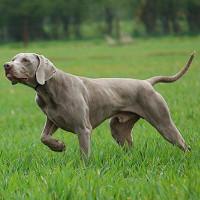
Medium to large size hunting dog. Functional working type, pleasing in shape, sinewy and very muscular. Difference in type between dogs and bitches easily distinguished.

Important proportions

• Length of body to height at withers approximately 12 : 11.
• Proportions of the head : From tip of nose to stop slightly longer than from stop to occiput.
• Forequarters : Distance from elbow to mid-pastern and distance from elbow to point of withers about equal.

Behaviour / temperament

Versatile, easily trained steady and passionate hunting dog. Persevering in systematic search, yet not too lively. Remarkable ability to pick up scent. Ready to seize game and other prey; he is a good watchdog, without aggressiveness however. Reliable pointing dog and worker in water. Remarkable inclination to work after the shot.

Head

Cranial region

Skull
In balance with size of body and facial region. Broader in dogs than bitches, yet in both, the relationship between width of cranial region to total length of head must be in good proportion. Median groove on forehead. Slightly to moderately protruding occipital bone. Zygomatic arches easily traceable behind the eyes. 
Stop
Extremely slight.

Facial region

Nose
Nose leather large, protruding over the underjaw. Dark flesh colour, merging gradually into gray towards the rear.
Muzzle
Long and, specially in the male, powerful, appearing almost angular. Region of canines and carnassial teeth equally strong.
Lips
Moderately deep, flesh coloured, as are the gums. Slight labial corner.
Nasal bridge
Bridge of nose straight, often slightly arched, never with a concave curve.
Jaws and teeth
Jaws strong; teeth complete, regular and strong. Top and bottom incisors closely touching (scissor bite).
Cheeks
Muscular, clearly defined. Definitely « clean » head.
Eyes
Amber colour, dark to pale, with intelligent expression. Sky-blue in puppies. Round, set barely slanting. Lids well fitting.
Ears
Lobular, broad and fairly long, just reaching to corner of mouth. Set on high and narrow, forming a rounded off point at tip. In alterness, turned slightly forward, folded.

Neck

Noble appearance and carriage. Upper line arched in profile. Muscular, nearly round, not too short, clean. Becoming stronger towards the shoulders and merging harmoniously into the topline and chest.

Body

Topline
From the arched neckline, over the well defined withers the topline merges gradually into the relatively long, firm back.
Withers
Well defined.
Back
Firm and muscular, without a dip. Not running up towards the rear. A slightly longer back, a breed characteristic, is not a fault.
Croup
Pelvis long and moderately sloped.
Chest
Strong but not unduly broad, with sufficient depth to reach almost to elbows and of sufficient length. Well sprung without being barrel-shaped and with long ribs. Forechest well developed.
Underline and belly
Rising slightly, but belly not tucked up.

Tail

Set on slightly lower than with other similar breeds. Tail strong and well coated. Carried hanging down in repose. When alert or working, carried level or higher.

Limbs

Forequarters

Generality
High on leg, sinewy, straight and parallel, but not standing wide.
Shoulders
Long and sloping. Well fitting, strongly muscled. Well angulated shoulder joint.
Upper arm
Sloping, sufficiently long and strong.
Elbows
Free and lying parallel to median plane of body. Turned neither in nor out.
Forearm
Long, straight and vertical.
Carpal
Strong and taut.
Pastern
Sinewy, slightly sloping.
Forefeet
Firm and strong. Standing straight in relation to median plane of body. Toes arched. Longer middle toes are a breed characteristic and therefore not a fault. Nails light to dark gray. Pads well pigmented, coarse.

Hindquarters

Generality
High on leg, sinewy i.e. well muscled. Standing parallel, turning neither in nor out.
Upper thigh
Sufficiently long, strong and well muscled.
Lower thigh
Long with clearly visible tendons.
Stifle
Strong and taut.
Metatarsus
Sinewy, almost vertical in position.
Hock
Strong and taut.
Hind feet
Tight and firm, without dewclaws, otherwise like front feet.

Gait and movement

Movement in all gaits is ground covering and smooth. Hind and front legs set parallel to each other. Gallop long and flat. Back remains level when trotting. Pacing is undesirable.

Skin

Strong. Well but not too tight fitting.

Coat

Hair
Short-haired : Short (but longer and thicker than with most comparable breeds), strong, very dense, smooth lying topcoat. Without or with only very sparse undercoat.
Long-haired : Soft, long topcoat with or without undercoat. Smooth or slightly wavy. Long flowing hair at ear set on. Velvety hair is permissible on tips of leathers. Length of coat on flanks 3 - 5 cm. On lower side of neck, forechest and belly, generally somewhat longer. Good feathering and breeching, yet less long towards ground. Tail with good flag. Hair between toes. Hair on head less long. A type of coat similar to a double-coat (Stockhaar) with medium length, dense, close fitting topcoat, thick undercoat and moderately developed feathering and breeching, sometimes occurs in dogs of mixed ancestry.
Colour
Silver, roe or mouse grey, as well as shades of these colours. Head and leathers generally slightly paler. Only small white markings on chest and toes permitted. Sometimes a more or less defined trace occurs along the back. Dog with definite reddish-yellow marking (« Brand ») may only be given the classification « good ». Brown marking is a serious fault.

Size and weight

Height at withers
Dogs 59 - 70 cm (ideal measurement 62 - 67 cm), bitches 57 - 65 cm (ideal measurement 59 - 63 cm).
Weight
Dogs about 30 - 40 kg, bitches about 25 - 35 kg.

Faults

• Any departure from the foregoing points should be considered a fault and the seriousness with which the fault should be regarded should be in exact proportion to its degree and its effect upon the health and welfare of the dog and its ability to perform its traditional work.
• Faults listed should be in degree of seriousness.

Serious faults

 Clear deviation from type.
 Untypical sexual characteristics.
 Gross deviations from size and proportions.
 Groos deviation for example too strong flews, short or pointed muzzle.
 Lack of more than two PM1 or M3.
 Eyes slight faults, above all slight and unilateral faults in eyelids.
 Leathers definitely short or long, not folded.
 Throatiness (dewlap), great deviation in neck shape and muscle.
 Back definite sway or roach back.
 Rump higher than withers.
 Barrel shaped chest.
 Insufficient depth or length of chest.
 Tucked up belly.
 Lack of angulation, out at elbows, splay feet.
 Pronounced bow legs or cow hocks.
 Bad movement in different gaits, also lack of free forward movement or drive, pacing.
 Skin very fine or very coarse.
 Mixture of coat varieties defined in the standard.
 Lack of feathering on belly or leathers (leather ears).
 Widely spread woolly coat in the short-haired Weimaraner or curly or sparse feathering in the long-haired variety.
 Departure from shades of gray, such as yellow or brownish.
 Tan marking (« Brand »).
 Strong departure from correct height or weight (for example more than 2 cm from measurements given in the standard).
 Slight deficiency in temperament.
 Other serious faults.

Disqualifying faults

 Faulty temperament, shy or nervous.
 Completely untypical, above all too heavy or too light in build.
 Completely unbalanced.
 Absolutely untypical, for example bulldog - type head.
 Absolutely untypical for example distinctly concave nasal bridge.
 Overshot, undershot, missing further teeth other than quoted.
 Entropion, ectropion.
 Absolutely untypical, for example stand-off.
 Particularly pronounced dewlap.
 Severe sway or roach back.
 Definitely overbuilt at croup.
 Markedly barrel shaped or malformed chest.
 Legs rickety or malformed.
 Chronic lameness.
 Totally restricted movement.
 Skin defects and malformations.
 Partial or total hair loss.
 White markings other than on chest and feet.
 Colour other than gray.
 Widespread brown marking.
 Definitely over-or undersize.
 Other malformation.
 Illnesses which must be considered hereditary, for example epilepsy.

NB :

• Any dog clearly showing physical or behavioural abnormalities shall be disqualified.
• The above mentioned faults when occurring to a highly marked degree or frequently are disqualifying.
• Male animals should have two apparently normal testicles fully descended into the scrotum.
• Only functionally and clinically healthy dogs, with breed typical conformation should be used for breeding.

Bibliography

https://www.fci.be/


Additional information from visitors

This popular German breed was originally much more massive and stockier than its present-day incarnation and was used as a large game hunter and property guardian. The early Weimaraner is believed to had been developed from old Schweisshunds and Leithunds, as well as Bloodhounds and the Italian Cane Corso. The ghost-gray colouring is thought by some to come directly from the Cane Corso. Through selecting the gray specimens and crossing them with English and Spanish pointers and Hungarian Vizslas, the hunters improved the Weimaraner's scenting and retrieving abilities, making it an excellent bird dog. The appearance was also modified and these new, much lighter Weimaraners were no longer used to hunt boars and bears.
Karl August, the Grand Duke of Thueringia's capitol Weimar was a great fancier of the breed and he started a dedicated breeding programme in order to standardize and promote the Weimar Pointer. By the end of the 1800's, the type was fully established and the breed standards were set. During the 20th century the Weimaraner's popularity increased and this is a common show breed, gun dog and family pet today. It responds well to obedience training which is needed to control its stubborn personality and confrontational nature. The Weimaraner also makes a capable watchdog. The coat comes in two variants, the smooth shorthaired type being more common and popular than the longhaired variety. Ghost-gray is the only colouring accepted, coming in a range of silver shades. Average height is around 26 inches.

Detailed history

Is it a coincidence that the Americans have dubbed the Weimaraner (the Weimaraner in his country) The Crey Chast? Maybe not, if we know that this dog, like a ghost, arises and disappears since the Middle Ages.

If this dog owes its name to the Grand Dukes of Saxe-Weimar who raised and guarded it jealously in the eighteenth century, it seems to look a little closer that its origins are more specifically French than Germanic. They go back to the 13th century, when St. Louis began the 7th crusade to liberate the holy places from the sultan of Egypt. Louis IX, as we know, was taken prisoner and had to remain in Palestine between 1250 and 1254, after which he brought back to France a few couples of mysterious gray dogs, who for three centuries proved to be the most beautiful subjects of the royal packs.

No one really knows what was the appearance of the Gray Dogs of St. Louis (except of course their characteristic dress). Some say it was Tartar Griffins tall and wolf gray hair; who are thought to be at the origin of some of the oldest French current dogs, such as the Griffon du Nivernais; while others think rather that these dogs were the result of crossings made by the sovereign during his captivity between subjects close to St. Hubert and Arab Arab Greyhounds, in order to give the first more ardor and speed. Be that as it may, these dogs were adopted by a good part of the French nobility.

We begin to know their appearance better from the end of the Middle Ages, but in a place that may seem at first sight very unusual: the Canary Islands. On the forecourt of the Cathedral of Las Palmas are indeed two canine statues whose resemblance to the current Weimaraner is disturbing to say the least. After what circumstances did they arrive in the Mediterranean archipelago? Nobody really knows, or, as some have been able to advance, their representation was intended to celebrate the discovery of the islands in 1402 by the Norman gentleman Jean de Bethencourt?

Nevertheless, the ancestors of the Weimaraners were no longer part of the royal packs in the sixteenth century. Charles IX, though very passionate about dog-eating, held these dogs in very low esteem: "They are, to tell you the truth, rabid dogs, because you have to break your neck and your legs to hold them". The monarch would prefer white dogs to them, and until the 18th century we have no trace of them except a painting by Van Dyck painted around 1630 representing gray dogs close to the Weimaraner. It was in Germany that they again appeared at the court of Carl August, Grand Duke of Saxony-Weimar, patron of the arts and great friend of Goethe, who knew, as it is mentioned in the book of the Dr. Lansard-Oudard, "select this dog and fix its genotypic and phenotypic characters as we see them today".

Some writers, however, question the relationship between the Gray Dogs of St. Louis and the Weimaraners. They believe either that the Duke of Weimar created his lineages from a white and orange Pointer and a bitch of unknown breed, or that the close inbreeding of German Braques resulted in some puppies of Weimar kennels a defect pigmentation. This is particularly the thesis defended by the German cynologist Strebel. If we accept this hypothesis, it is nevertheless clear that the Pointer had not yet acquired at that time the reputation he enjoys today and was not known outside the British Isles. It seems unlikely that anyone thought of using it in Germany. Moreover, to argue that the gray coloring is due to excessive consanguinity does not correspond to any scientific truth, the gray can not in any case be the consequence of any degeneration.

What seems less questionable, however, is that, following the dissolution of the Holy Roman Empire by Napoleon I and the death of Prince Carl August in 1828, the gray dogs of Weimar gradually fell into forgetfulness and that only a few hunters pursued the selection. Mr. André Harmand says indeed "that their traces are found in the archives and cynegetic stories of the nineteenth century, when they were used to search and hold the farm wild boar and destroy the wolves and lynx still numerous in Europe". These same hunters tried to combine the characteristics of these common dogs; especially the delicacy of nose; the special qualities of stop dogs (like the Pointer and the German Pointer), to make them versatile hunting dogs. It is also said that they sought to make the Weimaraner an animal capable of being a good retriever in the aquatic environment. These dogs, however, nearly disappeared in the second half of the nineteenth century, so much so that the Emperor William I authorized their possession only to the members of the court can justify four quarters of nobility. Thus, Bismark himself, though Prime Minister of Prussia, was judged too small to be allowed to acquire such a dog.

The exposure of a couple of; Brails of Weimar at the Berlin Zoo was at the origin of a renewed interest. From then on, several amateurs would be concerned to save the race. The first initiative was to have it officially recognized in Germany, a recognition that took place in 1896. Then, on June 20, 1897, the owners of Braques de Weimar met in Erfurt to found the first club. They agreed on a set of draconian rules, covering both breeding and ways to permanently save the breed. Thus, no one could own a Weimaraner without first joining the Club. As for the breeding proper, it was strictly regulated, any parent must be confirmed by a specialist commissioned by the association to be allowed to reproduce.

During the inter-war period, and despite the first conflict, the population of Weimaraners was estimated at 1,000 subjects. The guidelines of the Club, under the chairmanship of Major Herber, remained as strict as ever, and although developed as early as 1925, the basics of the current standard were not formalized until 1969, reflecting the policy of systematic closure followed by the Club, which first wished to improve the qualities and preserve the purity of the race, whose diffusion was only secondary.

It was the American Howard Knight (of Providence) who allowed the Weimaraners to cross the borders. This enlightened cynophile had the opportunity of hunting in Germany in the company of owners of Braques de Weimar, and he was impressed by the appearance and the hunting qualities of these dogs, which incited him to acquire several specimens; to do this, he succeeds, probably not without difficulty, to be elected a member of the Club. So, having brought a couple of dogs to Rhode Island, Knight quickly discovered that these dogs had been neutered, but he did not give up. In 1938, he imported a non-castrated male, Mars aus der Wolfsweide, a breeder, Dorle von Schwarzen Kamp, and a full bitch, Aura von Guilberg, who all three were at the base of the American breeding.

Howard Knight did not sell his Weimaraners, he gave them to hunting friends. Then, shortly before the war, he handed over his kennel to the Gafmar establishments belonging to Mr. and Mrs. AF Horn, who controlled the first American owners and breeders. In 1941, the Weimaraner Club of America was created, with H. Knight as president; Two years later, the American Kennel Club officially recognized the breed, which, at least initially, adopted the rules dictated by the German Club. Very quickly, however, because of the large size of the United States, he found himself unable to control the situation. In just a few years, however, it had become one of the most successful clubs on the other side of the Atlantic, even allowing itself numerous commercials in specialized magazines. The Weimaraner was now a much sought-after animal, adored by the police for the services he was able to render, and a brilliant competitor in the obedience trials, and some subjects reached enormous prices.

Thus, thanks to Howard Knight, the race was not affected by the Second World War. In 1945, she had almost disappeared from Germany. Only a few subjects were then scattered throughout Europe. From 1950, in fact, the first of these dogs from the United States began to arrive, especially in the Rhine. A. - L. Blatt states in particular that he received a Weimaraner in 1955, thanks to a hunting dog lover who held him from an American soldier. In France, however, the Weimaraner remained for a long time confidential, while its breeding was developed in parallel in Anglo-Saxon countries. In 1969, the French Book of Origins recorded only 16 births. French breeding, in fact, remained very modest until 1975. Three years later was born the Circle of lovers of the Weimaraner, whose aim was to promote the breed as a hunting dog, and, on June 1, 1980, this club was definitely affiliated with the SCC. Since then, the Weimaraner has been pursuing an ascending career in France, where, in addition to his hunting skills, he is recognized as a companion dog. Thus, every two years, the Circle of lovers of the Braque of Weimar organizes a national exhibition, making it possible to take stock of the orientation of the breeding. The first edition, which took place in Chantilly in 1983, brought together 152 subjects; the second, at Beauvais, 186; the third, at Chambord, 196.

The Weimaraner is first and foremost a hunting dog, which some consider excellent after the shot, that is to say, he is an admirable retriever, bringing back the game without damaging it. all circumstances and in all territories. The Race Club also has this characteristic of a reporter, which is currently one of the basic qualities required by the Natural Skills Test (TAN) he has set up. It is in the aquatic environment, in particular, that this dog is a first-rate retriever, not hesitating to dive to seize a duck, especially as his short but thick hair protects him from the cold as of moisture, which allows it to be an effective hunter in the marsh. The Weimaraner can be used to search for wounded game, but also as a red dog (a discipline that is starting to develop in France). A. Hermand notes that "its casting is very characteristic and gives it a particular look. In the long run, he behaves like a good bloodhound to hunt deer and wild boar."

Does this mean that he is less good stopping? Certainly not. His flair is excellent, his stopping firm, both on the hair and the feather; it adapts to the hunt in front of oneself, particularly appreciated in France, like the battered ones. In fact, he has a predilection without limit for the hunt, passion which he kept intact, in spite of his great elegance, which led him quite naturally towards the living rooms. It is also easy to train. Contrary to what some cynophiles claim to be unfounded on the German races, the Weimaraner is a submissive dog, who easily complies with the wishes of his master. It is not devoid of character, especially the male that requires a minimum of firmness. He is otherwise; and German dog enthusiasts insist on this point; an excellent watchdog, who will watch over the game or the car, without ever giving up his position. In some US states, including Wisconsin, it is also used as a police dog.

However, the Weimaraner is not yet widespread among hunters, nor is it known to professional trainers, even though no specialist doubts its great hunting qualities. For K. -G. The Moing, "he stops very well, work with water is familiar to him", while A.-L. Blatt says "none of the dogs that have been subjected to training have caused him any problems."

All the qualities he deploys with the hunter are found in family life. His gentle and submissive character makes him a pleasant companion, and despite his rather imposing physique, he knows how to be discreet and calm at home. He also gets along wonderfully with the children; the female accepts the company of the little ones on whom she will watch jealously; and, when they grow up; she will become their ideal gaming partner, just like the male by the way. The integration of the Weimaraner into a family is therefore very easy, as he does not tend to want to dominate his entourage.

Comments

Latest page updates

  • Yorkshire Terrier

    Yorkshire Terrier FCI Standard No. 86 Origin Great Britain Group Group 3 Terriers Section Section 4 Toy Terriers Working Without working trial Date of acceptance on a definitive basis by the FCI Saturday 30 October 1954 Date of publication of the official valid standard Tuesday 08 September 2026 Date of the last update Tuesday 06 October 2026 En...
  • West Highland White Terrier

    West Highland White Terrier FCI Standard No. 85 Origin Great Britain Group Group 3 Terriers Section Section 2 Small-sized Terriers Working Without working trial Date of acceptance on a definitive basis by the FCI Friday 29 October 1954 Date of publication of the official valid standard Tuesday 08 September 2026 Date of the last update Tuesday 06...
  • Welsh Terrier

    Welsh Terrier FCI Standard No. 78 Origin Great Britain Group Group 3 Terriers Section Section 1 Large- and medium sized Terriers Working Without working trial Date of acceptance on a definitive basis by the FCI Saturday 23 October 1954 Date of publication of the official valid standard Tuesday 08 September 2026 Date of the last update Tuesday 06...
  • Welsh Springer Spaniel

    Welsh Springer Spaniel FCI Standard No. 126 Origin Great Britain Group Group 8 Retrievers-Flushing Dogs-Water Dogs Section Section 2 Flushing Dogs Working With working trial Date of acceptance on a definitive basis by the FCI Thursday 30 December 1954 Date of publication of the official valid standard Tuesday 08 September 2026 Date of the last...
  • Welsh Corgi Pembroke

    Welsh Corgi Pembroke FCI Standard No. 39 Origin Great Britain Group Group 1 Sheepdogs and Cattle Dogs (except Swiss Cattle Dogs) Section Section 2 Cattledogs (except Swiss Cattledogs) Working Without working trial Date of acceptance on a definitive basis by the FCI Wednesday 13 November 1963 Date of publication of the official valid standard Tuesday 08...
  • Welsh Corgi Cardigan

    Welsh Corgi Cardigan FCI Standard No. 38 Origin Great Britain Group Group 1 Sheepdogs and Cattle Dogs (except Swiss Cattle Dogs) Section Section 2 Cattledogs (except Swiss Cattledogs) Working Without working trial Date of acceptance on a definitive basis by the FCI Tuesday 12 November 1963 Date of publication of the official valid standard Tuesday 08...
  • Sussex Spaniel

    Sussex Spaniel FCI Standard No. 127 Origin Great Britain Group Group 8 Retrievers, Flushing dogs, Water dogs. Section Section 2 Flushing dogs Working With working trial Date of acceptance on a definitive basis by the FCI Friday 31 December 1954 Date of publication of the official valid standard Tuesday 08 September 2026 Date of the last update Tuesday 06...
  • Staffordshire Bull Terrier

    Staffordshire Bull Terrier FCI Standard No. 76 Origin Great Britain Group Group 3 Terriers Section Section 3 Bull type Terriers Working Without working trial Date of acceptance on a definitive basis by the FCI Thursday 21 October 1954 Date of publication of the official valid standard Tuesday 08 September 2026 Date of the last update Tuesday 06...
  • Skye Terrier

    Skye Terrier FCI Standard No. 75 Origin Great Britain Group Group 3 Terriers Section Section 2 Small-sized Terriers Working Without working trial Date of acceptance on a definitive basis by the FCI Wednesday 20 October 1954 Date of publication of the official valid standard Tuesday 08 September 2026 Date of the last update Tuesday 06 October 2026 En...
  • Shetland Sheepdog

    Shetland Sheepdog FCI Standard No. 88 Origin Great Britain Group Group 1 Sheepdogs and Cattle Dogs Section Section 1 Sheepdogs Working Without working trial Date of acceptance on a definitive basis by the FCI Tuesday 09 November 1954 Date of publication of the official valid standard Tuesday 08 September 2026 Date of the last update Tuesday 06...
  • Sealyham Terrier

    Sealyham Terrier FCI Standard No. 74 Origin Great Britain Group Group 3 Terriers Section Section 2 Small sized Terriers Working Without working trial Date of acceptance on a definitive basis by the FCI Tuesday 19 October 1954 Date of publication of the official valid standard Tuesday 08 September 2026 Date of the last update Tuesday 06 October...
  • Scottish Terrier

    Scottish Terrier FCI Standard No. 73 Origin Great Britain Group Group 3 Terriers Section Section 2 Small-sized Terriers Working Without working trial Date of acceptance on a definitive basis by the FCI Monday 18 October 1954 Date of publication of the official valid standard Tuesday 08 September 2026 Date of the last update Tuesday 06 October...
  • Old English Sheepdog (Bobtail)

      Old English Sheepdog (Bobtail) FCI Standard No. 16     Origin   Great Britain Group   Group 1 Sheepdogs and Cattle Dogs (except Swiss Cattle Dogs) Section   Section 1 Sheepdogs Working   Without working trial Date of acceptance on a definitive basis by the FCI   Monday 25 November 1963 Date of publication of the official valid standard   Tuesday 08 September...
  • Norwich Terrier

    Norwich Terrier FCI Standard No. 72 Origin Great Britain Group Group 3 Terriers Section Section 2 Small-sized Terriers Working Without working trial Date of acceptance on a definitive basis by the FCI Saturday 16 October 1954 Date of publication of the official valid standard Tuesday 08 September 2026 Date of the last update Tuesday 06 October...
  • Norfolk Terrier

    Norfolk Terrier FCI Standard No. 272 Origin Great Britain Group Group 3 Terriers Section Section 2 Small-sized Terriers Working Without working trial Date of acceptance on a definitive basis by the FCI Saturday 01 October 1966 Date of publication of the official valid standard Tuesday 08 September 2026 Date of the last update Tuesday 06 October...
  • Manchester Terrier

    Manchester Terrier FCI Standard No. 71 Origin Great Britain Group Group 3 Terriers Section Section 1 Large and medium sized Terriers Working Without working trial Date of acceptance on a definitive basis by the FCI Friday 15 October 1954 Date of publication of the official valid standard Tuesday 08 September 2026 Date of the last update Tuesday 06 October...
  • Lakeland Terrier

    Lakeland Terrier FCI Standard No. 70 Origin Great Britain Group Group 3 Terriers Section Section 1 Large and medium-sized Terriers Working Without working trial Date of acceptance on a definitive basis by the FCI Thursday 14 October 1954 Date of publication of the official valid standard Tuesday 08 September 2026 Date of the last update Tuesday 06 October...
  • Labrador Retriever

      Labrador Retriever FCI Standard No. 122     Origin   Canada Group   Group 8 Retrievers, Flushing dogs, Water dogs Section   Section 1 Retrievers Working   With working trial Date of acceptance on a definitive basis by the FCI   Friday 24 December 1954 Date of publication of the official valid standard   Tuesday 08 September 2026 Date of the last update   Tuesday 06...
  • King Charles Spaniel

    King Charles Spaniel FCI Standard No. 128 Origin Great Britain Group Group 9 Companion and Toy Dogs Section Section 7 English Toy Spaniels Working Without working trial Date of acceptance on a definitive basis by the FCI Monday 03 January 1955 Date of publication of the official valid standard Tuesday 08 September 2026 Date of the last update Tuesday 06...
  • Harrier

      Harrier FCI Standard No. 295     Origin   Great Britain Translation   Mrs. Peggy Davis, brought up to day by Dr. Paschoud Group   Group 6 Scenthounds and related breeds Section   Section 1.2 Medium-sized Hounds Working   With working trial Date of acceptance on a definitive basis by the FCI   Wednesday 27 November 1974 Date of publication of the official valid...
  • Greyhound

    Greyhound FCI Standard No. 158 Origin Great Britain Group Group 10 Sighthounds Section Section 3 Short-haired sighthounds Working Without working trial Date of acceptance on a definitive basis by the FCI Saturday 23 April 1955 Date of publication of the official valid standard Tuesday 08 September 2026 Date of the last update Tuesday 06 October...
  • Gordon Setter

    Gordon Setter FCI Standard No. 6 Origin Great Britain Group Group 7 Pointing Dogs Section Section 2.2 British and Irish Pointers and Setters; Setters Working With working trial Date of acceptance on a definitive basis by the FCI Tuesday 28 May 1963 Date of publication of the official valid standard Tuesday 08 September 2026 Date of the last...
  • Golden Retriever

    Golden Retriever FCI Standard No. 111 Origin Great Britain Group Group 8 Retrievers, Flushing Dogs, Water Dogs Section Section 1 Retrievers Working With working trial Date of acceptance on a definitive basis by the FCI Thursday 02 December 1954 Date of publication of the official valid standard Tuesday 28 July 2009 Date of the last update Wednesday...
  • Fox Terrier Wire

    Fox Terrier Wire FCI Standard No. 169 Origin Great Britain Group Group 3 Terriers Section Section 1 Large and medium-sized Terriers Working Working trial optional Date of acceptance on a definitive basis by the FCI Friday 13 May 1955 Date of publication of the official valid standard Tuesday 08 September 2026 Date of the last update Tuesday 06...
  • Fox Terrier Smooth

    Fox Terrier Smooth FCI Standard No. 12 Origin Great Britain Group Group Terriers Section Section 1 Large and medium sized Terriers Working Working trial optional Date of acceptance on a definitive basis by the FCI Wednesday 26 June 1963 Date of publication of the official valid standard Tuesday 08 September 2026 Date of the last update Tuesday 06...
  • Flat Coated Retriever

    Flat Coated Retriever FCI Standard No. 121 Origin Great Britain Group Group 8 Retrievers-Flushing Dogs-Water Dogs Section Section 1 Retrievers Working With working trial Date of acceptance on a definitive basis by the FCI Thursday 23 December 1954 Date of publication of the official valid standard Tuesday 08 September 2026 Date of the last update Tuesday...
  • Field Spaniel

    Field Spaniel FCI Standard No. 123 Origin Great-Britain Group Group 8 Retrievers, Flushing Dogs, Water Dogs Section Section 2 Flushing Dogs Working With working trial Date of acceptance on a definitive basis by the FCI Monday 27 December 1954 Date of publication of the official valid standard Tuesday 08 September 2026 Date of the last update Tuesday...
  • English Toy Terrier

    English Toy Terrier FCI Standard No. 13 Origin Great Britain Group Group 3 Terriers Section Section 4 Toy Terriers Working Without working trial Date of acceptance on a definitive basis by the FCI Tuesday 17 September 1963 Date of publication of the official valid standard Tuesday 08 September 2026 Date of the last update Tuesday 06 October 2026 En...
  • English Springer Spaniel

    English Springer Spaniel FCI Standard No. 125 Origin Great Britain Group Group 8 Retrievers-Flushing Dogs-Water Dogs Section Section 2 Flushing Dogs Working With working trial Date of acceptance on a definitive basis by the FCI Wednesday 29 December 1954 Date of publication of the official valid standard Tuesday 08 September 2026 Date of the last...
  • English Setter

    English Setter FCI Standard No. 2 Origin Great Britain Group Group 7 Pointing Dogs Section Section 2.2 British and Irish Pointers and Setters, Setter Working With working trial Date of acceptance on a definitive basis by the FCI Wednesday 06 March 1963 Date of publication of the official valid standard Tuesday 08 September 2026 Date of the last...
  • English Pointer

    English Pointer FCI Standard No. 1 Origin Great Britain Group Group 7 Pointing Dogs Section Section 2.1 British and Irish Pointers and Setters, Pointer Working With working trial Date of acceptance on a definitive basis by the FCI Tuesday 05 March 1963 Date of publication of the official valid standard Tuesday 08 September 2026 Date of the last...
  • English Foxhound

    English Foxhound FCI Standard No. 159 Origin Great Britain Group Group 6 Scenthounds and related breeds Section Section 1.1 Large-sized Scent hounds Working With working trial Date of acceptance on a definitive basis by the FCI Monday 25 April 1955 Date of publication of the official valid standard Thursday 26 March 2009 Date of the last update Wednesday...
  • English Cocker Spaniel

    English Cocker Spaniel FCI Standard No. 5 Origin Great Britain Group Group 8 Retrievers, Flushing Dogs, Water Dogs Section Section 2 Flushing dogs Working With working trial Date of acceptance on a definitive basis by the FCI Wednesday 10 April 1963 Date of publication of the official valid standard Tuesday 08 September 2026 Date of the last...
  • Tibetan Mastiff

    Tibetan Mastiff FCI Standard No. 230 Origin Tibet (China)Patronage FCI Group Group 2 Pinscher and Schnauzer- Molossoid breeds- Swiss Mountain and Cattle Dogs Section Section 2.2 Molossoid breeds, Mountain type Working Without working trial Date of acceptance on a definitive basis by the FCI Tuesday 22 August 1961 Date of publication of the...
  • Deerhound

    Deerhound FCI Standard No. 164 Origin Great Britain Group Group 10 Sighthounds Section Section 2 Rough-haired Sighthounds Working Without working trial Date of acceptance on a definitive basis by the FCI Friday 29 April 1955 Date of publication of the official valid standard Tuesday 08 September 2026 Date of the last update Tuesday 06 October...
  • Dandie Dinmont Terrier

    Dandie Dinmont Terrier FCI Standard No. 168 Origin Great Britain Group Group 3 Terriers Section Section 2 Small-sized Terriers Working Without working trial Date of acceptance on a definitive basis by the FCI Thursday 12 May 1955 Date of publication of the official valid standard Tuesday 08 September 2026 Date of the last update Tuesday 06...
  • Curly Coated Retriever

    Curly Coated Retriever FCI Standard No. 110 Origin Great Britain Group Group 8 Retrievers, Flushing Dogs, Water Dogs Section Section 1 Retrievers Working With working trial Date of acceptance on a definitive basis by the FCI Friday 10 December 1954 Date of publication of the official valid standard Tuesday 08 September 2026 Date of the last...
  • Collie Smooth

    Collie Smooth FCI Standard No. 296 Origin Great Britain Group Group 1 Sheepdogs and Cattle Dogs (except Swiss Cattle Dogs) Section Section 1 Sheepdogs Working Without working trial Date of acceptance on a definitive basis by the FCI Wednesday 18 December 1974 Date of publication of the official valid standard Tuesday 08 September 2026 Date of the...
  • Collie Rough

    Collie Rough FCI Standard No. 156 Origin Great Britain Group Group 1 Sheepdogs and Cattle Dogs (except Swiss Cattle Dogs) Section Section 1 Sheepdogs Working Without working trial Date of acceptance on a definitive basis by the FCI Wednesday 13 April 1955 Date of publication of the official valid standard Tuesday 08 September 2026 Date of the...
  • Clumber Spaniel

    Clumber Spaniel FCI Standard No. 109 Origin Great Britain Group Group 8 Retrievers, Flushing dogs, Water dogs Section Section 2 Flushing dogs Working With working trial Date of acceptance on a definitive basis by the FCI Thursday 09 December 1954 Date of publication of the official valid standard Tuesday 08 September 2026 Date of the last update Tuesday...
  • Chow Chow

    Chow Chow FCI Standard No. 205 Origin China, patronage : Great Britain Group Group 5 Spitz and primitive type Section Section 5 Asian Spitz and related breeds Working Without working trial Date of acceptance on a definitive basis by the FCI Tuesday 10 December 1957 Date of publication of the official valid standard Tuesday 08 September 2026 Date...
  • Chinese Crested Dog

    Chinese Crested Dog FCI Standard No. 288 Origin China, patronage Great Britain Group Group 9 Companion and Toy Dogs Section Section 4 Hairless breeds Working Without working trial Date of acceptance on a definitive basis by the FCI Monday 17 July 1972 Date of publication of the official valid standard Tuesday 08 September 2026 Date of the last...
  • Cairn Terrier

    Cairn Terrier FCI Standard No. 4 Origin Great Britain Group Group 3 Terriers Section Section 2 Small-sized Terriers Working Without working trial Date of acceptance on a definitive basis by the FCI Saturday 06 April 1963 Date of publication of the official valid standard Tuesday 08 September 2026 Date of the last update Tuesday 06 October 2026 En...
  • Bullmastiff

    Bullmastiff FCI Standard No. 157 Origin Great Britain Group Group 2 Pinscher and Schnauzer Molossoid breeds - Swiss Mountain and Cattle Dogs Section Section 2.1 Molossoid breeds, Mastiff Type Working Without working trial Date of acceptance on a definitive basis by the FCI Saturday 23 April 1955 Date of publication of the official valid standard Tuesday...
  • English Bulldog

    English Bulldog FCI Standard No. 149 Origin Great Britain Group Group 2 Pinscher and Schnauzer Molossoid breeds-Swiss Mountain and Cattle Dogs Section Section 2.1 Molossoid breeds, Mastiff Type Working Without working trial Date of acceptance on a definitive basis by the FCI Monday 14 March 1955 Date of publication of the official valid standard Tuesday...
  • Bull Terrier

    Bull Terrier FCI Standard No. 11 Origin Grande-Bretagne Group Group 3 Terriers Section Section 3 Bull type Terriers Working Working trial optional Date of acceptance on a definitive basis by the FCI Saturday 26 June 1993 Date of publication of the official valid standard Tuesday 08 September 2026 Date of the last update Tuesday 06 October 2026 En...
  • Border Terrier

    Border Terrier FCI Standard No. 10 Origin Great Britain Group Group 3 Terriers Section Section 1 Large and medium-sized terriers Working Without working trial Date of acceptance on a definitive basis by the FCI Wednesday 26 June 1963 Date of publication of the official valid standard Tuesday 08 September 2026 Date of the last update Tuesday 06...
  • Bedlington Terrier

    Bedlington Terrier FCI Standard No. 9 Origin Great Britain Group Group 3 Terriers Section Section 1 Large and medium sized Terriers Working Without working trial Date of acceptance on a definitive basis by the FCI Thursday 20 June 1963 Date of publication of the official valid standard Tuesday 08 September 2026 Date of the last update Tuesday 06...
  • Bearded Collie

    Bearded Collie FCI Standard No. 271 Origin Great-Britain Group Group 1 Sheepdogs and Cattle Dogs (except Swiss Cattle Dogs) Section Section 1 Sheepdogs Working Without working trial Date of acceptance on a definitive basis by the FCI Wednesday 30 August 1967 Date of publication of the official valid standard Tuesday 08 September 2026 Date of the...
  • Beagle

    Beagle FCI Standard No. 161 Origin Great Britain Translation Prof. R. Triquet Group Group 6 Scent hounds and related breeds Section Section 1.3 Small-sized hounds Date of acceptance on a definitive basis by the FCI Tuesday 26 April 1955 Date of publication of the official valid standard Tuesday 08 September 2026 Date of the last update Tuesday 06...
  • Basset Hound

    Basset Hound FCI Standard No. 163 Origin Great Britain Group Group 6 Scent hounds and related breeds Section Section 1.3 Small-sized hounds Working With working trial Date of acceptance on a definitive basis by the FCI Thursday 28 April 1955 Date of publication of the official valid standard Tuesday 08 September 2026 Date of the last update Tuesday...
  • Basenji

    Basenji FCI Standard No. 43 Origin Democratic Republic of Congo, under the patronage of Great Britain Group Group 5 Spitz and primitive types Section Section 6 Primitive type Working Without working trial Date of acceptance on a definitive basis by the FCI Thursday 26 March 1964 Date of publication of the official valid standard Tuesday 08...
  • Airedale Terrier

    Airedale Terrier FCI Standard No. 7 Origin Great Britain Group Group 3 Terriers Section Section 1 Large and medium sized Terriers Working Working trial optional Date of acceptance on a definitive basis by the FCI Tuesday 28 May 1963 Date of publication of the official valid standard Tuesday 08 September 2026 Date of the last update Tuesday 06...
  • Afghan Hound

    Afghan Hound FCI Standard No. 228 Origin AfghanistanPatronage Great Britain Group Group 10 Sighthounds Section Section 1 Long-haired or fringed sighthounds Working Without working trial Date of acceptance on a definitive basis by the FCI Tuesday 12 December 1961 Date of publication of the official valid standard Tuesday 08 September 2026 Date of the...
  • Romagna Water Dog

    Romagna Water Dog FCI Standard No. 298 Origin Italy Translation Antonio Morsiani, Renée Sporre-Willes and Prof. R. TriquetRevised by ENCI and Renée Sporre-WillesRevised by the FCI Head OfficeOfficial language (EN). Group Group 8 Retrievers –Flushing Dogs –Water Dogs Section Section 3 Water Dogs Working Working trial optional Date of acceptance on a...
  • Whippet

    Whippet FCI Standard No. 162 Origin Great Britain Group Group 10 Sighthounds Section Section 3 Short-haired Sighthounds Working Without working trial Date of acceptance on a definitive basis by the FCI Wednesday 27 April 1955 Date of publication of the official valid standard Tuesday 08 September 2026 Date of the last update Tuesday 06 October...
  • Tibetan Terrier

    Tibetan Terrier FCI Standard No. 209 Origin Tibet, patronage Great Britain Group Group 9 Companion and Toy Dogs Section Section 5 Tibetan breeds Working Without working trial Date of acceptance on a definitive basis by the FCI Wednesday 18 December 1957 Date of publication of the official valid standard Tuesday 08 September 2026 Date of the last...
  • Tibetan Spaniel

    Tibetan Spaniel FCI Standard No. 231 Origin Tibet (China)Patronage Great Britain Group Group 9 Companion and Toy Dogs Section Section 5 Tibetan breeds Working Without working trial Date of acceptance on a definitive basis by the FCI Tuesday 22 August 1961 Date of publication of the official valid standard Tuesday 08 September 2026 Date of the...
  • Shih Tzu

    Shih Tzu FCI Standard No. 208 Origin Tibet, patronage Great Britain Group Group 9 Companion and Toy Dogs Section Section 5 Tibetan breeds Working Without working trial Date of acceptance on a definitive basis by the FCI Monday 16 December 1957 Date of publication of the official valid standard Tuesday 08 September 2026 Date of the last update Tuesday 06...
  • Pug

    Pug FCI Standard No. 253 Origin China, patronage Great Britain Group Group 9 Companion and Toy Dogs Section Section 11 Small Molossian type dogs Working Without working trial Date of acceptance on a definitive basis by the FCI Friday 04 November 1966 Date of publication of the official valid standard Tuesday 08 September 2026 Date of the last...
  • Pharaoh Hound

    Pharaoh Hound FCI Standard No. 248 Origin Malta, patronage Great Britain Group Group 5 Spitz and primitive types Section Section 6 Primitive type Working Without working trial Date of acceptance on a definitive basis by the FCI Friday 09 August 1963 Date of publication of the official valid standard Tuesday 08 September 2026 Date of the last...
  • Pekingese

    Pekingese FCI Standard No. 207 Origin China, patronage Great Britain Group Group 9 Companion and Toy Dogs Section Section 8 Japan Chin and Pekingese Working Without working trial Date of acceptance on a definitive basis by the FCI Thursday 03 November 1966 Date of publication of the official valid standard Tuesday 08 September 2026 Date of the last...
  • Parson Russell Terrier

    Parson Russell Terrier FCI Standard No. 339 Origin Great Britain Group Group 3 Terriers Section Section 1 Large and medium sized Terriers Working Working trial optional Date of acceptance on a definitive basis by the FCI Monday 04 June 2001 Date of acceptance on a provisional basis by the FCI Monday 02 July 1990 Date of publication of the...
  • Otterhound

    Otterhound FCI Standard No. 294 Origin Great Britain Group Group 6 Scenthounds and related breeds Section Section 1.1 Large-sized hounds Working Without working trial Date of acceptance on a definitive basis by the FCI Thursday 12 September 1974 Date of publication of the official valid standard Tuesday 08 September 2026 Date of the last update Tuesday 06...
  • Miniature Bull Terrier

    Miniature Bull Terrier FCI Standard No. 359 Origin Grande-Bretagne Group Group 3 Terriers Section Section 3 Bull type Terriers Working Working trial optional Date of acceptance on a definitive basis by the FCI Tuesday 05 July 2011 Date of acceptance on a provisional basis by the FCI Tuesday 05 July 2011 Date of publication of the official valid...
  • Mastiff

    Mastiff FCI Standard No. 264 Origin Great Britain Group Group 2 Pinscher and Schnauzer – Molossoid breeds - Swiss Mountain and Cattle Dogs Section Section 2.1 Molossoid breeds, Mastiff Type Working Without working trial Date of acceptance on a definitive basis by the FCI Thursday 05 November 1964 Date of publication of the official valid standard Tuesday 08...
  • Lhassa Apso

    Lhassa Apso FCI Standard No. 227 Origin Tibet (China)Patronage Great Britain Group Group 9 Companion and Toy Dogs Section Section 5 Tibetan breeds Working Without working trial Date of acceptance on a definitive basis by the FCI Saturday 19 November 1960 Date of publication of the official valid standard Tuesday 08 September 2026 Date of the last...
  • Lancashire-Heeler

    Lancashire-Heeler FCI Standard No. 360 Origin England, patronage : FCI Group Group 1 Sheepdogs and Cattle Dogs (except Swiss Cattle Dogs) Section Section 1 Sheepdogs Working Without working trial Date of acceptance on a provisional basis by the FCI Sunday 01 May 2016 Date of publication of the official valid standard Tuesday 08 September 2026 Date...

© 2026 Groupe Milouchouchou ASBL. Tous droits réservés. En savoir plus

Protected by Copyright01
