Newfoundland

FCI standard Nº 50

Origin
Canada
Group
Group 2 Pinscher and Schnauzer- Molossoid breeds- Swiss Mountain and Cattle Dogs
Section
Section 2.2 Molossoid breeds, Mountain type
Working
Without working trial
Acceptance on a definitive basis by the FCI
Wednesday 04 August 1954
Publication of the official valid standard
Tuesday 29 October 1996
Last update
Wednesday 06 November 1996
En français, cette race se dit
Chien de Terre-Neuve
Diese Norm ist in deutscher Sprache sichtbar
Neufundländer
En español, esta raza se dice
Terranova
In het Nederlands, wordt dit ras gezegd
Newfoundlander

Usage

Sledge dog for heavy loads, water dog.

Brief historical summary

The breed originated in the island of Newfoundland from indigenous dogs and the big black bear dog introduced by the Vikings after the year 1100. With the advent of European fishermen a variety of new breeds helped to shape and reinvigorate the breed, but the essential characteristics remained. When the colonization of the island began in 1610, the Newfoundland Dog was already largely in possession of his proper morphology and natural behaviour. These features allowed him to withstand the rigours of the extreme climate and sea’s adversity while pulling heavy loads on land or serving as water and lifeguard dog.

General appearance

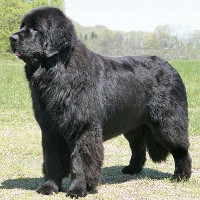
The Newfoundland is massive, with powerful body, well muscled and well coordinated in his movements.

Important proportions

The length of the body from the point of shoulders to the point of buttock is greater than the height at the withers.
The body is compact. The body of the bitch may be slightly longer and is less massive than that of the dog.
The distance from the withers to the underside of the chest is slightly greater than the distance from the underside of the chest to the ground.

Behaviour / temperament

The Newfoundland’s expression reflects benevolence and softness. Dignified, joyful and creative, he is known for his sterling gentleness and serenity.

Head

Cranial region

Head
Massive. The head of the bitch follows the same general conformation as the male’s one, but is less massive.
Skull
Broad, with slightly arched crown and strongly developed occipital bone. 
Stop
Evident, but never abrupt.

Facial region

Nose
Large, well pigmented, nostrils well developed. Colour : Black on black and white and black dogs, brown on brown dogs.
Muzzle
Definitely square, deep and moderately short, covered with short, fine hair and free from wrinkles. The corners of the mouth are evident, but not excessively pronounced. Flews soft.
Jaws and teeth
Scissors or level bite.
Eyes
Relatively small, moderately deep set ; they are wide apart and show no haw. Colour : Dark brown in black and white and black dogs, lighter shades permitted in brown dogs.
Ears
Relatively small, triangular with rounded tips, well set back on the side of the head and close lying. When the ear of the adult dog is brought forward, it reaches to the inner corner of the eye on the same side.

Neck

Strong, muscular, well set in the shoulders, long enough to permit dignified head carriage. The neck should not show excessive dewlap.

Body

Body
Bone structure is massive throughout. Viewed from the side, the body is deep and vigorous.
Topline
Level and firm from the withers to the croup.
Back
Broad.
Loin
Strong and well muscled.
Croup
Broad, sloping at an angle of about 30°.
Chest
Broad, full and deep, with good spread of ribs.
Underline and belly
Almost level and never tucked up.

Tail

The tail acts as a rudder when the Newfoundland is swimming ; therefore it is strong and broad at the base. When the dog is standing, the tail hangs down with, possibly, a little curve at the tip ; reaching to or slightly below the hocks. When the dog is in motion or excited, the tail is carried straight out with slight upward curve, but never curled over the back nor curved inward between the legs.

Limbs

Forequarters

Generality
The forelegs are straight and parallel also when the dog is walking or slowly trotting.
Shoulders
Very well muscled and well laid back.
Elbows
Close to the chest.
Pastern
Slightly sloping.
Forefeet
Large and proportionate to the body, well rounded and tight, with firm and compact toes. Webbing of toes is present.

Hindquarters

Generality
Because driving power for pulling loads, swimming or covering ground efficiently is largely dependent upon the hindquarters, the rear structure of the Newfoundland is of prime importance. The pelvis has to be strong, broad and long.
Upper thigh
Wide and muscular.
Lower thigh
Strong and fairly long.
Stifle
Well bent, but not so as to give a crouching appearance.
Hock
Relatively short, well let down and well apart, parallel to each other ; they turn neither in nor out.
Hind feet
Firm and tight. Dewclaws, if present, should have been removed

Gait and movement

The Newfoundland moves with good reach of the forelegs and strong drive of the hindquarters, giving the impression of effortless power. A slight roll of the back is natural. As the speed increases, the dog tends to single track with the topline remaining level.

Coat

Hair
The Newfoundland has a water resistent double coat. The outer coat is moderately long and straight with no curl. A slight wave is permissible. The undercoat is soft and dense, more dense in winter than in summer, but always found to some extent on the croup and chest. The hair on the head, muzzle and ears is short and fine. The front and rear legs are feathered. The tail is completely covered with long, dense hair, but does not form a flag. Trimming and scissoring are not encouraged.
Colour
Black, white and black and brown.
Black : The traditional colour is black. The colour has to be even as much as possible, but a slight tinge of sunburn is permissible. White markings on chest, toes and/or tip of tail are permissible.
White and black : This variety is of historical significance for the breed. The preferred pattern of markings is black head with, preferably, a white blaze extending onto the muzzle, black saddle with even markings and black croup and upper tail. The remaining parts are to be white and can show a minimum of ticking.
Brown : The brown colour goes from chocolate to bronze. White markings on chest, toes and/or tip of tail are permissible. White and black dogs and brown dogs are to be shown in the same class as blacks.

Size and weight

Height at withers
The average height at the withers is for adult males 71cm (28 inches), for adult bitches 66cm (26 inches).
Weight
The average weight is approximately 68 kg for males, approximately 54 kg for bitches.
Large size is desirable, but is not to be favoured over symmetry, general soundness, power of the structure and correct gait.

Faults

• Any departure from the foregoing points should be considered a fault and the seriousness with which the fault should be regarded should be in exact proportion to its degree and its effect upon the health and welfare of the dog and its ability to perform its traditional work.
• Faults listed should be in degree of seriousness.

General faults

 General appearance : Legginess, lack of substance.
 General bone structure : Sluggish appearance, fine bone.
 Character : Aggressiveness, shyness.
 Head : Narrow.
 Muzzle : Snipey or long.
 Flews : Pronounced.
 Eyes : Round, protruding, yellow eyes, showing pronounced haw.
 Back : Roached, slack or swayed back.
 Tail : Short, long, kink tail, curled tip.
 Forequarters : Down in pastern, splayed toes, toeing in or out, lack of webbing between toes.
 Hindquarters : Straight stifles, cowhocks , barrel legs, pigeon toes.
 Gait/Movement : Mincing, shuffling, crabbing, too close moving, weaving, crossing over in front, toeing-out or distinctly toeing-in in front, hackney action, pacing.
 Hair : Completely open coat, lack of undercoat.

Disqualifying faults

 Aggressive or overly shy.
 Bad temperament.
 Overshot or undershot bite, wry mouth.
 Short and flat coat.
 Markings of any other colour than white on a black or brown dog.
 Any other colour than black or white and black or brown.

NB :

• Any dog clearly showing physical or behavioural abnormalities shall be disqualified.
• The above mentioned faults when occurring to a highly marked degree or frequently are disqualifying.
• Male animals should have two apparently normal testicles fully descended into the scrotum.
• Only functionally and clinically healthy dogs, with breed typical conformation should be used for breeding.

Bibliography

https://www.fci.be/


Detailed history

To qualify the mysterious origins of Newfoundland can be considered pure perversity. In fact, does not everyone know that this big black dog who excels in sea rescue is native to the island of Newfoundland, quite simply? Well no. It's not that clear, far from it! In fact, the origins of Newfoundland are a real enigma for race lovers. But if this dog with a bear and a jet gown is not from Newfoundland, where does it come from ?

First of all, where is this island, and what does it look like? Newfoundland is today a province of Canada including the island itself and part of Labrador, another equally austere region. The nickname "Land of the cod" that gave him in 1497 the Venetian Sebastien Cabot, come to take possession of it in the name of England, says a lot about the kind of population of the island. Fish, certainly, but human beings, point. No more than dogs, by the way. This desert aspect is confirmed by Captain Richard Whitbourne, who, around 1615, after accompanying the British cod fishermen, asserted that there was no island population, no men, no dogs, nothing. A century and a half later, there is another testimony, that of Sir Joseph Banks (1743 - 1820). A member of the Royal Society of London, Banks knew each of the 100,000 square kilometers of the island to have furrowed in its entirety. He also assured that he did not encounter any autochthonous dog that could be distinguished from the canine population then present on the island: a very mixed population, dogs "mostly bastards with the signs of crossing Mastiff".

And it is a fact that the many dogs that, at the end of the eighteenth century, began to flock to Europe, mainly to England, were very diverse. All shades were possible: browns, reds, blacks, more or less marked with white, white and brown, white and red, white and black, and even plain yellow, are more frequently mentioned. Some were tall, others smaller. Most had a predilection for working with water.

How did all these dogs grow in Newfoundland? Can we unravel the fabric of their origins since the arrival of European settlers, or even before? Various theories, some of which are very attractive, have been proposed, notably to explain the molossoid character of these dogs.

One of them attributes the paternity of Newfoundland to Oolum, the Bear Dog of Leif Eriksson, himself the son of the illustrious Erik the Red. Around the year 1000, the Vikings reached the shores of America (which they called Vinland), perhaps as far as present-day Maryland, and no doubt they visited the island of Newfoundland . Would the Vikings' dogs have left traces of their passage in these regions? Nothing can confirm it.

Another solution is that suggested by the presence of many Basque fishermen in Newfoundland. Since 1504, they had indeed invested the island, to the point that there is still a locality called Port-aux-Basques. As the American cynologist J wrote in 1824. S. Skimmer in The Dog and the Sportsman, the fishermen of Biscay had their premises and their houses guarded by Pyrenean mountain dogs when they left off. They could have brought some specimens during their travels. However, the case is not so simple. As noted by Dr. Luquet, veterinarian and dog historian, the Newfoundland does not have double lugs on the hind limbs. Now, it turns out that the mountains of the Pyrenees have and that this trait, however minor, is considered by amateurs as a sign of purity. Moreover, this ergot is genetically dominant, that is to say that it is transmitted to a whole range when only one parent is a carrier. Does the absence of spurs in Newfoundland then invalidate such a pretty and convenient theory? Not necessarily. There are many examples where the lobes have disappeared in a breed because of selection or over time; this is the case among the St. Bernard and the Mastiffs of Tibet. This detail does not preclude the hypothesis of Mountain contribution of the Pyrenees.

But there is more troubling: February 20, 1874, the following text appeared in the newspaper Acclimatization: "There are in the Pyrenees several types of large dogs said mountain dogs, and, among other things, two distinct races. One that could be referred to as the "Eastern Pyrenees dog" is particularly widespread around Bagnères-de-Bigorre; she has a thick muzzle, drooping lips, rounded ears, a somewhat frizzy coat, white and black. The canine section of the newspaper was under the direction of colonel Dommanget and Rohan de Kermadec, two cynologists of the greatest seriousness, so the partisans of the Pyrenees Mountain could believe they had scored a point, because many Newfoundland of the time was black and white, with a coat reminiscent of that of the astrakhan. Only the end of the article is ambiguous and sows doubt. The authors suggest that the fishermen could have brought back Newfoundland dogs, the latter then creating the variety mentioned above. Who gave birth to whom? Impossible to say.

Another hypothesis has been further advanced by the American dog-catcher Fred Stubbart: descendants of Dogs of Tibet have come from Asia by the Aleutian Islands and Alaska, at the same time as the ancestors of the Indians. This hypothesis; that no evidence supports it; refers to those concerning the distant origin of American dogs, which is very controversial.

Because, in America, the dogs did not miss before the arrival of the Europeans. From Virginia to Labrador, the Indians held their dogs in high esteem, the chiefs burying themselves with their favorites. They were also the most useful pets, since they provided fur, meat sometimes, guard, help for hunting, work. Thus, the role of draft animal was the common dog of Indians. Once disassembled, the tipis, these large removable tents, were folded and installed on some sort of stretchers called travois, pulled by dogs. For a long time the Indians knew no other traction than that of the dog; thus, when they had domesticated their first horses, they immediately named them "seven dogs," according to the work report they had observed between the two animals. These dogs, however, should not be physically impressive or strange, since, despite the exaggeration and detail of settler stories about Indian manners, none of them mention dogs in particular. It is presumed that, far from the molossoid, they were rather of primitive type, like Spitz, anyway lupoid.

In areas along the east coast, dogs were also used for fishing. Presumably of medium size, brown, black, yellow, robust, they were quite comfortable in the icy water. When the Europeans arrived in the area, from the sixteenth century, to fish for cod, they called on them to catch the escaped fish from their nets. These dogs were implanted in Newfoundland, where their resistance and their ability to water developed further. It is in particular of these dogs, or rather of their descendants, that, later, would have come the Retrievers. This would be the case of the Chesapeake Bay Retriever, whose legend attributes paternity to Newfoundland. The breed owes its existence to the sinking of an English brig near the coast of Maryland in 1807. A Newfoundland couple (one black, the other, brown) would have been on board and would have stayed in the area. Crossed with local dogs, he gave birth to Chesapeake.

As far as the Labrador Retriever is concerned, it was around 1820 that the Earl of Malesbury bought his first water dogs on the wharves of Poole, the port of Southern England where land products were landed. Neuve. Asked about the breed of these dogs, the salesman answered without hesitation that they were "Labrador dogs", a name that the count gave them and which remained to them. There is also a great deal of physical similarity between Newfoundland and Labrador. A Labrador owner said of his dog: "It's a small Newfoundland with no big hair."

In the meantime, there is no doubt that the fishermen, then the colonists, both French and English, had introduced to the island of Newfoundland European dogs of very different types. Thus, the Barbet, very old breed of French water dog (and ancestor of the Poodle), is often quoted. This hypothesis is preached by Benion, when he states in 1861 that Newfoundland "is a dog from the Mastiff and Barbet", and shared by J. -C. Hermans, who notes that many French boats had a Barbet on board. What about the almost total lack of resemblance between the two races? The Newfoundland of yesteryear was certainly not the massive dog of today. Appreciated for his qualities and not for his physique, he was far from having a homogeneous type. Among the dogs of Newfoundland landing in England from 1815, it is said that the most beautiful came from French institutions known as "Three Mountains" and their thick black fur more or less curly recalled the astrakhan. So this hair, Barbet's resurgence ?

English dogs, for their part, have certainly contributed to much of the molossoid aspect of Newfoundland. Louis XIV having abandoned his rights on the island to England in 1713, the British colonists began to exploit the interior of the land, and brought their dogs with them. If there were no doubt hunting dogs, such as Spaniels, the nature of most of these animals is not a big mystery, as we know they were used to pulling carts, small teams and sleds. The settlers carried all sorts of effects and materials. These dogs must have been very powerful, probably of the mastiff type; Mastiffs, St. Bernard and other molossoids were imported to the island.

In Newfoundland, dogs became so numerous that in 1780, the governor, Mr. Edwards, limited the dog population by imposing a single dog per household, while the Court of Disposal decided to slaughter any dog not muzzle. These drastic measures, intensified in 1815, led to the export of dogs from Newfoundland to Europe. It is not surprising, given the complexity of the origins attributed to Newfoundland, of the variety of tasks they were employed on their island, either inland or on the coasts, the number of crossings that were not These specimens, discovered by the English at the beginning of the nineteenth century, were so varied in appearance and size, that they were not wanting to take place among all these dogs. It was by selection that Newfoundland would become the race we know.

For fifty years, before the dog shows began, British breeders used various mountain dogs to assert the molossoid character of Newfoundland, including St. Bernard, then called Mastiff Alpin. An exchange of good practices, since a Newfoundland couple will save the legendary race from extinction in 1856. Papa Newfoundland and Mother Saint-Bernard will revive impoverished breeding, will give rise to the long-haired St. Bernard, today paradoxically more popular than his short-haired brother, yet an original variety. It was written that the Leonberg could have participated in the perfection of Newfoundland, but having not yet arrived across the Channel at that time, it could not be put to use. The word for the end of this troubled past belongs to the American scholar James Watson, who said in 1900: "Newfoundland is a modern English version developed from different kinds of common dogs, dress colors and various sizes."

From 1860, everything becomes clearer. Newfoundland is considered a full-fledged breed, and that year, six subjects make an impression at the Birmingham dog show (one of the first). His reputation of lifeguard having preceded him, he becomes the fashionable dog. Everyone is interested in him: Sir Edwin Landseer will pay him the tribute that we know, while other artists, not least (such as the poet Burns), will celebrate. Another favorite patronage was the Prince of Wales, who exhibited six Newfoundland at the Agricultural Hall in 1864. In 1878, the Kennel Club officially registered its first Newfoundland, and the year 1886 saw the creation of the Breed Club , one of the oldest in England to date. He is immediately responsible for drafting a valid standard. But the beauty of Newfoundland is not what pleases the public most, which requires rescue demonstrations. These events are developing so much that MC Marshal decides to regulate them and creates "special Newfoundland" trials in Maidstone and Portsmouth. The program is very demanding, because it requires courage, intelligence and power from the dog, who must dive and bring back an object, tow boats and people, and finally ride the current or the tide in a minimum of time.

Many breedings express themselves through their products during this period, and the breed takes the opportunity to spread in Switzerland, Belgium, Italy, Holland, Germany and of course in France where it is already well represented . It will however be necessary to wait until 1963 to see to create a Club of race in the Hexagon. The first work competition was held in 1977 in the Somme, and its program was adopted by the Central Canine Society in 1981.

Newfoundland has been assigned to monitor beaches in some areas, but its attachment to a single master (hence the difficulty of changing it, is however frequent in the administration) and its cost quite important have terminated the experiment. Americans have not been so easily discouraged, and they have used Newfoundland as a guide dog for the blind and as a dog for the disabled. The budget for maintaining such a large dog is of course an obstacle to such uses, even though Newfoundland is good at it. The United States, Germany and Canada are nevertheless continuing their programs with him.

A very complicated story for a dog so frank. Highly appreciated in France, Newfoundland today represents to the public the teddy bear, what it is in its hours. It will not be forgotten, however, that it comes from hard dogs, whose work required strong temperaments and obvious qualities. No one could, with regard to Newfoundland, conclude with more admiration and elegance than Lord Byron himself, who made his dog Boatswain the following epitaph: "He is the one who possesses beauty without vanity." force without insolence, courage without ferocity, all the virtues of man without his vices. Some believe him fierce, others debonair. Such a mass, such good eyes, so abundant fur sometimes make it look like a simple teddy bear, while its powerful paws, its huge head and its impressive jaws can be scary. So, Newfoundland, brute or stuffed dog? Newfoundland simply.

What is important to mention when talking about Newfoundland is its sweet and really kind side. A dog does not become a lifeguard without a certain love of the man. It is therefore a good and sociable dog that this black giant. With his masters, for example, there is no more affectionate than a Newfoundland. This affectivity can become overwhelming, in every sense of the word, because a colossus of 65 kilos who comes to make you a little hug it feels like passing! Yet Newfoundland is never brutal. Like many very big dogs, he seems aware of his mass and is relatively respectful of interiors and people. One of the main features of Newfoundland is its fidelity. Very attached to a master, he will have a hard time accepting another, hence the impossibility of using it in the administration, where dogs and masters meet and leave frequently. Of course, this character trait does not prevent him from working, and even very well, with other people than his master, with the water for example, but it is on condition that he finds his master and his family thereafter. In the same vein, Newfoundland has difficulty with kennels. Likewise, if he is called to be alone during the day, a "special solitude" apprenticeship will enable him to better live this daily separation.

Of course, it is preferable that Newfoundland has a garden, because to live such an animal in apartment is not frankly advised. Any large dog should benefit from a suitable habitat. However, Newfoundland is not a hyperactive dog; it requires less to spend than a Belgian Shepherd, for example, which is however much smaller gauge. The physical needs of a dog depend not only on its mass, but also on its nerve impulse. Being a molossoid, so a rather placid dog, Newfoundland does not need to frolic in the woods for two hours a day. Three hygienic outings plus a good walk in a green area every day are enough.

Newfoundland loves to play. So ; this is his often unrecognized retriever side; he brings back the object thrown at him and even, why not, look for his masters hidden behind a tree. But, of course, his great pleasure is water. It must be seen to dive with delight in the coolest waters. The holidays at the sea are for him an extraordinary happiness. He follows all the members of the family, splitting the waves of his strong chest, fetching the ball. If you have the opportunity, do not miss to put it in the water, it will be even more balanced and happier.

Balance is also his forte in his social life. Without aggression towards strangers, he can walk in a crowd without causing any damage, because he does not even care about passers-by. Your friends will be his after he checks their good intentions. He loves children: those of the neighbor will be able to caress him without fear. Can he keep the house? Huge, black in most cases, the massive head and the chops suggesting an impressive jaw, it is the most dissuasive of the cerberers, although its effectiveness as a guardian is below his intimidating skills. Before a stranger wishing to enter, he is content with barking guttural and peaceful, which, by the way, are generally more than enough to discourage any malicious intruder.

Of a mild nature, Newfoundland is exceptional with children. He carefully measures his movements to never rush them. He guides the little ones when they take their first steps, clinging to his thick fur, and he is an excellent companion for the older ones, taking part in all their games, until exhaustion of the two parts. However, Newfoundland, like any self-respecting Molossoid, also enjoys napping, so, to the disappointment of his little playmates, he will sometimes interrupt the party to take a nap on the softest carpet in the world house.

The other dogs do not pose any problem since they can not pose a threat to him. Aggressive reactions are to be watched over by the smaller ones, who often prefer to prevent than cure and, feeling inferior, try to impress him. Cats and other animals will be his friends on the express condition that he is used to it young and that he is firmly forbidden to continue, even to play.

This brings us to the chapter of education. Is Newfoundland a good student? Legitimate question, because an animal of its size could easily take advantage of it to impose itself on its masters. Newfoundland does not have this tendency, but to avoid any risk, it is imperative to start educating it at a very young age. Without training, learning the basic commands (sitting, lying, walking, not moving, etc.) is excellent, because it relaxes the dog and accustoms him to obey. Moreover, since Newfoundland is basically a utility dog, confining him to a pet dog's role would be a misunderstanding of his nature. This dog flourishes while working. Of course, he prefers working with water. That's why more and more owners are training their dogs for this type of exercise. Otherwise, he will work on the ground. Teach him to bring back various objects, apparent or hidden. Any intellectual gymnastics will help her to stay young and alive all her life and will ensure her total attachment. See how happy he is to pull his little masters in a cart or learn how to get a newspaper.

It goes without saying that a certain firmness is necessary with an animal of this size. To never have a conflict of authority with a Newfoundland, it must be understood from a very young age that it is not he who commands. This is not unnatural, on the contrary, because this is how wild dogs are organized, in highly hierarchical packs where all conflict is avoided and where fighting is extremely rare. Be nice but resolute with your puppy and erect prohibitions (armchairs, beds, begging at the table, nuisance barking ...), which will show him that you are a leader and that he can trust you. Once established, cohabitation should be ideal because Newfoundland is a docile dog. Even the reprimands (inevitable one day or another) will pass very well, because he will know that he deserved them, provided of course that they are just, otherwise he would lose this precious confidence in you. But, all this is not a problem and proceeds from a well-conducted education.

Newfoundland is therefore a pretty easy dog, given its stature. Very gentle, intelligent, learning fast, he will be a wonderful companion for a master worthy of the name. The main thing is to consider him a full member of the family. He deserves it.

Comments

Latest page updates

  • Southern Hound

    Southern Hound He is not recognized by the F.C.I. Origin Great Britain Translation Francis Vandersteen En français, cette race se dit Chien du Sud Diese Norm ist in deutscher Sprache sichtbar Südlicher Laufhund En español, esta raza se dice Sabueso del sur In het Nederlands, wordt dit ras gezegd Zuidelijke Hond The Southern Hound was a large...
  • St. John's Water Dog

    St. John's Water Dog He is not recognized by the F.C.I. Origin Canada Translation Francis Vandersteen En français, cette race se dit Chien d’eau de St. John's Diese Norm ist in deutscher Sprache sichtbar St. John's Wasserhund En español, esta raza se dice Perro de aguas de San Juan In het Nederlands, wordt dit ras gezegd St. John's Water Dog The St...
  • Rache Hound

    Rache Hound He is not recognized by the F.C.I. Origin Middle Ages Translation Francis Vandersteen En français, cette race se dit Chien courant Rache Diese Norm ist in deutscher Sprache sichtbar Rache-Laufhund En español, esta raza se dice Sabueso Rache In het Nederlands, wordt dit ras gezegd Rache-hond This breed is also known as RacchRachRatch   The term...
  • Welsh Grey Sheepdog

    Welsh Grey Sheepdog He is not recognized by the F.C.I. Origin Wales Translation Francis Vandersteen En français, cette race se dit Chien de berger gallois gris Diese Norm ist in deutscher Sprache sichtbar Waliser Grauer Schäferhund En español, esta raza se dice Pastor Gris Galés In het Nederlands, wordt dit ras gezegd Welsh Grey Herdershond This breed is...
  • Old Croatian Sighthound

    Old Croatian Sighthound He is not recognized by the F.C.I. Origin Croatia Translation Francis Vandersteen En français, cette race se dit Lévrier croate ancien Diese Norm ist in deutscher Sprache sichtbar Alter kroatischer Windhund En español, esta raza se dice Viejo lebrel croata In het Nederlands, wordt dit ras gezegd Oude Kroatische Windhond This...
  • Norman Hound

    Norman Hound He is not recognized by the F.C.I. Origin France Translation Francis Vandersteen En français, cette race se dit Chien normand Diese Norm ist in deutscher Sprache sichtbar Normannischer Laufhund En español, esta raza se dice Sabueso Normando In het Nederlands, wordt dit ras gezegd Normandische Brak   Little is known about the origins of...
  • Moscow Water Dog

    Moscow Water Dog He is not recognized by the F.C.I. Origin Russia Translation Francis Vandersteen En français, cette race se dit Chien d'eau de Moscou Diese Norm ist in deutscher Sprache sichtbar Moskauer Wasserhund En español, esta raza se dice Perro de agua de Moscú In het Nederlands, wordt dit ras gezegd Moskou-waterhond This breed is also...
  • Tracking Hound

    Tracking Hound He is not recognized by the F.C.I. Origin Middle Ages Translation Francis Vandersteen En français, cette race se dit Chien pisteur Diese Norm ist in deutscher Sprache sichtbar Spürhund En español, esta raza se dice Sabueso de rastro In het Nederlands, wordt dit ras gezegd Speurhond This breed is also known as LimerLymerLyam...
  • Laconian

    Laconian He is not recognized by the F.C.I. Origin Ancient Laconia, Greece Translation Francis Vandersteen En français, cette race se dit Laconien Diese Norm ist in deutscher Sprache sichtbar Lakonier En español, esta raza se dice Laconio In het Nederlands, wordt dit ras gezegd Laconisch This breed is also known as SpartanCastorian   The Laconian is an...
  • Halls Heeler

    Halls Heeler He is not recognized by the F.C.I. Origin Australia Translation Francis Vandersteen En français, cette race se dit Halls Heeler Diese Norm ist in deutscher Sprache sichtbar Halls Heeler En español, esta raza se dice Halls Heeler In het Nederlands, wordt dit ras gezegd Halls Heeler   The Halls Heeler is the presumed ancestor of two...
  • Dogo Cubano

    Dogo Cubano He is not recognized by the F.C.I. Origin Cuba Translation Francis Vandersteen The Dogo Cubano, also known as the Cuban Dogue, Cuban Bloodhound and Cuban Mastiff, is an extinct breed of dog from Cuba. It was of the Bullmastiff type and was used for bull and dog fighting. The breed was introduced to Cuba to capture runaway slaves...
  • Dalbo Dog

    Dalbo Dog He is not recognized by the F.C.I. Origin Sweden Translation Francis Vandersteen En français, cette race se dit Chien de Dalbo Diese Norm ist in deutscher Sprache sichtbar Dalbo-Hund En español, esta raza se dice Perro Dalbo In het Nederlands, wordt dit ras gezegd Dalbo-hond This breed is also known as DalbohundDalsland Mastiff   Icelandic...
  • Cordoba Fighting Dog

    Cordoba Fighting Dog He is not recognized by the F.C.I. Origin Argentina Translation Francis Vandersteen En français, cette race se dit Chien de combat de Cordoue Diese Norm ist in deutscher Sprache sichtbar Córdoba-Kampfhund En español, esta raza se dice Perro de pelea de Córdoba In het Nederlands, wordt dit ras gezegd Cordoba-vechthond This breed is...
  • Celtic Greyhound

    Celtic Greyhound He is not recognized by the F.C.I. Origin Celtic Mythology Translation Francis Vandersteen En français, cette race se dit Lévrier celte Diese Norm ist in deutscher Sprache sichtbar Keltische Windhund En español, esta raza se dice Lebrel celta In het Nederlands, wordt dit ras gezegd Keltische windhond   The Celtic Greyhound is an...
  • Belgian Mastiff

    Belgian Mastiff He is not recognized by the F.C.I. Origin Belgium Translation Francis VandersteenOrigin SRSH-KMSH - Belgian Royal Canine SocietyAuthentic language FR Group Group 2 : Pinscher and Schnauzer - Molossoid and Swiss Mountain and Cattle Dogs Section Section 2.1 : Molossoids, mastiff type Working Without working trial En français, cette...
  • Argentine polar dog

    Argentine polar dog He is not recognized by the F.C.I. Origin Argentina Translation Francis Vandersteen The Argentine polar dog (perro polar argentino) was a breed of Argentine dog that is now extinct. Argentine polar dogs were developed by the Argentine army to provide sled dogs for their Antarctic bases. The breed was the result of a cross...
  • Alaunt

    Alaunt He is not recognized by the F.C.I. Origin Central Asia Translation Francis Vandersteen This breed is also known as Kavkaz AlauntCaucasian AlauntAlan DoggePersian AlauntContinental AlauntEnglish AlauntFrench AlauntSpanish AlauntAlan DogArnaut Dogge The legendary Alaunt is one of the most important Molosse breeds in history, but also one of...
  • Small Dutch Hound

    Small Dutch Hound He is not recognized by the F.C.I. Origin The Netherlands Translation Francis Vandersteen En français, cette race se dit Petit Chien courant néerlandais Diese Norm ist in deutscher Sprache sichtbar Kleiner niederländischer Brackenhund En español, esta raza se dice Sabueso holandés pequeño In het Nederlands, wordt dit ras gezegd Kleine...
  • Sri Lankan Hound

    Sri Lankan Hound He is not recognized by the F.C.I. Origin Sri Lankan Translation Francis Vandersteen En français, cette race se dit Chien courant du Sri Lanka Diese Norm ist in deutscher Sprache sichtbar Sri-Lanka-Hund En español, esta raza se dice Sabueso de Sri Lanka In het Nederlands, wordt dit ras gezegd Sri Lankaanse Brak This breed is also...
  • Bulgarian Tricolour Hound

    Bulgarian Tricolour Hound He is not recognized by the F.C.I. Origin Bulgaria Translation Francis Vandersteen En français, cette race se dit Chien courant tricolore bulgare Diese Norm ist in deutscher Sprache sichtbar Bulgarischer Dreifarbiger Laufhund En español, esta raza se dice Sabueso tricolor búlgaro In het Nederlands, wordt dit ras gezegd Bulgaarse...
  • Međimurje Small Dog

    Međimurje Small Dog He is not recognized by the F.C.I. Origin Northwestern Croatia Translation Francis Vandersteen En français, cette race se dit Petit chien du Međimurje Diese Norm ist in deutscher Sprache sichtbar Međimurje-Kleinhund En español, esta raza se dice Perro pequeño de Međimurje In het Nederlands, wordt dit ras gezegd Međimurje-hondje This...
  • Serbian Yellow Hound

    Serbian Yellow Hound He is not recognized by the F.C.I. Origin Serbia (Balkans, Southeast Europe) Translation Francis Vandersteen En français, cette race se dit Chien jaune serbe Diese Norm ist in deutscher Sprache sichtbar Serbischer Gelber Laufhund En español, esta raza se dice Sabueso Amarillo Serbio In het Nederlands, wordt dit ras gezegd Servische...
  • Gotland Hound

    Gotland Hound He is not recognized by the F.C.I. Origin Sweden Translation Francis Vandersteen En français, cette race se dit Chien de chasse de Gotland Diese Norm ist in deutscher Sprache sichtbar Gotlandhund En español, esta raza se dice Sabueso de Gotland In het Nederlands, wordt dit ras gezegd Gotlandhond This breed is also known as Gotland...
  • Westerwald Mountain Dog

    Westerwald Mountain Dog He is not recognized by the F.C.I. Origin Germany Translation Francis Vandersteen En français, cette race se dit Bouvier du Westerwald Diese Norm ist in deutscher Sprache sichtbar Westerwalder Sennenhund En español, esta raza se dice Perro de Montaña de Westerwald In het Nederlands, wordt dit ras gezegd Westerwaldse...
  • Carnia Hound

    Carnia Hound He is not recognized by the F.C.I. Origin Italy Translation Francis Vandersteen En français, cette race se dit Chien courant de Carnia Diese Norm ist in deutscher Sprache sichtbar Carnia-Hund En español, esta raza se dice Sabueso de Carnia In het Nederlands, wordt dit ras gezegd Carnia-hond This breed is also known as Segugio Carnico   The...
  • Kemmer Feist

    Kemmer Feist He is not recognized by the F.C.I. Origin Southern United States Translation Francis Vandersteen En français, cette race se dit Kemmer Feist Diese Norm ist in deutscher Sprache sichtbar Kemmer Feist En español, esta raza se dice Kemmer Feist In het Nederlands, wordt dit ras gezegd Kemmer Feist   The Kemmer Feist originates from the...
  • Alpine Spaniel

    Alpine Spaniel He is not recognized by the F.C.I. Origin Switzerland Translation Francis Vandersteen En français, cette race se dit Epagneul Alpin Diese Norm ist in deutscher Sprache sichtbar Alpenspaniel En español, esta raza se dice Spaniel Alpino In het Nederlands, wordt dit ras gezegd Alpenspaniël   Alpine Spaniels were bred by canons in Alpine...
  • Alpine Mastiff

    Alpine Mastiff He is not recognized by the F.C.I. Origin Switzerland Translation Francis Vandersteen En français, cette race se dit Mâtin alpin Diese Norm ist in deutscher Sprache sichtbar Alpenmastiff En español, esta raza se dice Mastín Alpino In het Nederlands, wordt dit ras gezegd Alpenmastiff   The Alpine Mastiff was an ancient, giant working...
  • Hairless Chihuahua

    Hairless Chihuahua He is not recognized by the F.C.I. Origin Mexico Translation Francis Vandersteen En français, cette race se dit Chihuahua nu Diese Norm ist in deutscher Sprache sichtbar Nackter Chihuahua En español, esta raza se dice Chihuahua sin pelo In het Nederlands, wordt dit ras gezegd Haarloze Chihuahua   The Chihuahua is a small, lively,...
  • Argentine Pila

    Argentine Pila He is not recognized by the F.C.I. Origin Argentina Translation Francis Vandersteen En français, cette race se dit Pila Argentin Diese Norm ist in deutscher Sprache sichtbar Argentinischer Pila En español, esta raza se dice Pila Argentino In het Nederlands, wordt dit ras gezegd Argentijnse Pila This breed is also known as Perro...
  • Ecuadorian Hairless Dog

    Ecuadorian Hairless Dog He is not recognized by the F.C.I. Origin Ecuador Translation Francis Vandersteen En français, cette race se dit Chien nu équatorien Diese Norm ist in deutscher Sprache sichtbar Ecuadorianischer Nackthund En español, esta raza se dice Perro sin pelo ecuatoriano In het Nederlands, wordt dit ras gezegd Ecuadoriaanse...
  • Tesem

    Tesem He is not recognized by the F.C.I. Origin Egypt Translation Francis Vandersteen En français, cette race se dit Tesem Diese Norm ist in deutscher Sprache sichtbar Tesem En español, esta raza se dice Tesem In het Nederlands, wordt dit ras gezegd Tesem   The Tesem was a hunting dog from ancient Egypt. Now extinct, its ancestry is believed to...
  • Salish Woolly Dog

    Salish Woolly Dog He is not recognized by the F.C.I. Origin British Columbia, Canada Translation Francis Vandersteen En français, cette race se dit Chien laineux Salish Diese Norm ist in deutscher Sprache sichtbar Salish-Wollhund En español, esta raza se dice Perro Lanudo Salish In het Nederlands, wordt dit ras gezegd Salish wollige hond This...
  • Tierra del Fuego Dog

    Tierra del Fuego Dog He is not recognized by the F.C.I. Origin South America Translation Francis Vandersteen En français, cette race se dit Chien de Terre de Feu Diese Norm ist in deutscher Sprache sichtbar Feuerlandhund En español, esta raza se dice Perro de Tierra del Fuego In het Nederlands, wordt dit ras gezegd Tierra del Fuego-hond This...
  • Techichi

    Techichi He is not recognized by the F.C.I. Origin Mexico Translation Francis Vandersteen En français, cette race se dit Techichi Diese Norm ist in deutscher Sprache sichtbar Techichi En español, esta raza se dice Techichi In het Nederlands, wordt dit ras gezegd Techichi   The Techichi was an indigenous dog of Mesoamerica, specifically associated...
  • Hare Indian Dog

    Hare Indian Dog He is not recognized by the F.C.I. Origin Canada Translation Francis Vandersteen The Hare Indian Dog is an extinct domesticated dog; possibly a breed of domestic dog, hybrid coyote/dog or domestic coyote; previously found and originally bred in northern Canada by the Hare Indians for hunting. It had the speed and certain...
  • Tahitian Dog

    Tahitian Dog He is not recognized by the F.C.I. Origin Tahiti Translation Francis Vandersteen En français, cette race se dit Chien de Tahiti Diese Norm ist in deutscher Sprache sichtbar Tahiti-Hund En español, esta raza se dice Perro Tahitiano In het Nederlands, wordt dit ras gezegd Tahitiaanse hond   The Tahitian Dog is an extinct Polynesian breed,...
  • Polynesian Dog

    Polynesian Dog He is not recognized by the F.C.I. Origin Polynesia Translation Francis Vandersteen En français, cette race se dit Chien polynésien Diese Norm ist in deutscher Sprache sichtbar Polynesischer Hund En español, esta raza se dice Perro polinesio In het Nederlands, wordt dit ras gezegd Polynesische hond   The term "Polynesian dog" does...
  • Marquesan Dog

    Marquesan Dog He is not recognized by the F.C.I. Origin Marquesas Islands Translation Francis Vandersteen En français, cette race se dit Chien des Marquises Diese Norm ist in deutscher Sprache sichtbar Marquesas-Hund En español, esta raza se dice Perro Marquesano In het Nederlands, wordt dit ras gezegd De Marquesaanse hond This breed is also...
  • Kuri

    Kuri He is not recognized by the F.C.I. Origin New Zealand, between "Waikava" & Mataura plains, Catlins Translation Francis Vandersteen This breed is also known as Maori dog Kurī, or Pacific dog, were a unique breed, brought to Aotearoa New Zealand by ancestors of Māori. These animals were prized – not necessarily as friends, but as valuable...
  • Chiribaya Dog

    Chiribaya Dog He is not recognized by the F.C.I. Origin Peru Translation Francis Vandersteen The Chiribaya Dog (perro Chiribaya) or Peruvian Shepherd Dog (perro pastor Peruano) was a pre-Columbian breed of dog from southwestern Peru, identified by the 42 mummies discovered by anthropologist Sonia Guillén Oneglio in the Ilo district, Moquegua...
  • Philippine Forest Dog

    Philippine Forest Dog He is not recognized by the F.C.I. Origin Philippines Translation Francis Vandersteen En français, cette race se dit Chien des forêts des Philippines Diese Norm ist in deutscher Sprache sichtbar Philippinischer Waldhund En español, esta raza se dice Perro del Bosque Filipino In het Nederlands, wordt dit ras gezegd Filipijnse...
  • Lai Dog

    Lai Dog He is not recognized by the F.C.I. Origin Vietnam Translation Francis Vandersteen En français, cette race se dit Chien de Lai Diese Norm ist in deutscher Sprache sichtbar Lai-Hund En español, esta raza se dice Perro Lai In het Nederlands, wordt dit ras gezegd Lai-hond   With its unique appearance and hunting dog origins, the Lai Dog is...
  • Pampas Hound

    Pampas Hound He is not recognized by the F.C.I. Origin Brazil, Argentina, and Uruguay Translation Francis Vandersteen En français, cette race se dit Chien de chasse des Pampas Diese Norm ist in deutscher Sprache sichtbar Pampashund En español, esta raza se dice Sabueso de las Pampas In het Nederlands, wordt dit ras gezegd Pampashond   The Pampas Hound...
  • Zerdava

    Zerdava He is not recognized by the F.C.I. Origin Turkey and Georgia Translation Francis Vandersteen En français, cette race se dit Zerdava Diese Norm ist in deutscher Sprache sichtbar Zerdava En español, esta raza se dice Zerdava In het Nederlands, wordt dit ras gezegd Zerdava This breed is also known as Eastern Black Sea SpitzKapi Kopegi   The...
  • I-Twina

    I-Twina He is not recognized by the F.C.I. Origin Southern/Eastern Africa Translation Francis Vandersteen En français, cette race se dit I-Twina Diese Norm ist in deutscher Sprache sichtbar I-Twina En español, esta raza se dice I-Twina In het Nederlands, wordt dit ras gezegd I-Twina   The I-Twina is a specific variety of Africanis, an ancient dog breed...
  • Greek Greyhound

    Greek Greyhound He is not recognized by the F.C.I. Origin Greece Translation Francis Vandersteen En français, cette race se dit Lévrier grec Diese Norm ist in deutscher Sprache sichtbar Griechischer Windhund En español, esta raza se dice Galgo Griego In het Nederlands, wordt dit ras gezegd Griekse Windhond   The Greek Greyhound is medium-sized, and its...
  • Khoikhoi Hottentot Dog

      Khoikhoi Hottentot Dog He is not recognized by the F.C.I. Origin South Africa Translation Francis Vandersteen En français, cette race se dit Chien Khoïkhoï Hottentot Diese Norm ist in deutscher Sprache sichtbar Khoikhoi-Hottentottenhund En español, esta raza se dice Perro Hotentote Khoikhoi In het Nederlands, wordt dit ras gezegd Khoikhoi...
  • Santal Hound

    Santal Hound He is not recognized by the F.C.I. Origin India Translation Francis Vandersteen En français, cette race se dit Chien de chasse Santal Diese Norm ist in deutscher Sprache sichtbar Santal-Hund En español, esta raza se dice Sabueso Santal In het Nederlands, wordt dit ras gezegd Santal jachthond   The Santal Hound is an indigenous Indian...
  • Middle Eastern Village Dog

    Middle Eastern Village Dog He is not recognized by the F.C.I. Origin Middle East Translation Francis Vandersteen En français, cette race se dit Chien de village du Moyen-Orient Diese Norm ist in deutscher Sprache sichtbar Dorfhund aus dem Nahen Osten En español, esta raza se dice Perro de aldea de Oriente Medio In het Nederlands, wordt dit ras...
  • Avuvi

    Avuvi He is not recognized by the F.C.I. Origin Ghana and Togo Translation Francis Vandersteen En français, cette race se dit Avuvi Diese Norm ist in deutscher Sprache sichtbar Avuvi En español, esta raza se dice Avuvi In het Nederlands, wordt dit ras gezegd Avuvi This breed is also known as Ghana Stray Dog   Ghana stray dogs are free-roaming dogs that...
  • Old Spanish Pointer

    Old Spanish Pointer He is not recognized by the F.C.I. Origin Spain Translation Francis Vandersteen En français, cette race se dit Braque espagnol ancien Diese Norm ist in deutscher Sprache sichtbar Altspanischer Vorstehhund En español, esta raza se dice Pointer Español Antiguo In het Nederlands, wordt dit ras gezegd Oude Spaanse Pointer This breed...
  • Paisley Terrier

    Paisley Terrier He is not recognized by the F.C.I. Origin Scotland Translation Francis Vandersteen The Paisley Terrier is a descendant of its ancestor, the Skye Terrier, with a similar temperament and appearance.Records from 1440 use the word terrier, telling us that the Skye Terrier was not the first of this group, although we have little...
  • Blue Bay Shepherd

    Blue Bay Shepherd He is not recognized by the F.C.I. Origin U.S.A. Translation Francis Vandersteen En français, cette race se dit Berger de la Baie Bleue Diese Norm ist in deutscher Sprache sichtbar Blue Bay Schäferhund En español, esta raza se dice Pastor Azul de la Bahía In het Nederlands, wordt dit ras gezegd Blauwe Baai Herdershond   The Blue...
  • Tweed Water Spaniel

    Tweed Water Spaniel He is not recognized by the F.C.I. Origin Great Britain Translation Francis Vandersteen En français, cette race se dit Epagneul d'eau du Tweed Diese Norm ist in deutscher Sprache sichtbar Tweed Wasserspaniel En español, esta raza se dice Spaniel de Agua del Tweed In het Nederlands, wordt dit ras gezegd Tweed Waterspaniël   The...
  • Old English Terrier

    Old English Terrier He is not recognized by the F.C.I. Origin Great Britain Translation Francis Vandersteen En français, cette race se dit Terrier anglais ancien Diese Norm ist in deutscher Sprache sichtbar Alte Englische Terrier En español, esta raza se dice Terrier Inglés Antiguo In het Nederlands, wordt dit ras gezegd Oude Engelse Terriër   Also...
  • Old English Bulldog

    Old English Bulldog He is not recognized by the F.C.I. Origin Great Britain Translation Francis Vandersteen En français, cette race se dit Bouledogue anglais ancien Diese Norm ist in deutscher Sprache sichtbar Altenglische Bulldogge En español, esta raza se dice Bulldog Inglés Antiguo In het Nederlands, wordt dit ras gezegd Oude Engelse Bulldog   When...
  • North Country Beagle

    North Country Beagle He is not recognized by the F.C.I. Origin Great Britain Translation Francis Vandersteen Few records remain describing the appearance of the North Country Beagle, except that it resembled the Southern Hound, the English Foxhound and the modern Harrier. It has been said that the North Country Beagle was shorter than the...
  • Norfolk Spaniel

    Norfolk Spaniel He is not recognized by the F.C.I. Origin Great Britain Translation Francis Vandersteen The Norfolk Spaniel or Shropshire Spaniel is a dog breed that has been extinct since the early 20th century. It was originally thought to have originated from the work of one of the Dukes of Norfolk, but this theory was disproved after being...
  • English White Terrier

    English White Terrier He is not recognized by the F.C.I. Origin Great Britain Translation Francis Vandersteen This breed is also known as White TerrierOlde English White TerrierEnglish WhiteOld White Manchester TerrierBirmingham White Terrier A brief presentation of the English White Terrier The English White Terrier was one of the first, if not...
  • English Water Spaniel

    English Water Spaniel He is not recognized by the F.C.I. Origin Great Britain Translation Francis Vandersteen En français, cette race se dit Epagneul d'eau anglais Diese Norm ist in deutscher Sprache sichtbar Englischer Wasserspaniel En español, esta raza se dice Spaniel de Agua Inglés In het Nederlands, wordt dit ras gezegd Engelse Waterspaniël   The...
  • Cur Dog

    Cur Dog He is not recognized by the F.C.I. Origin U.S.A. Translation Francis Vandersteen En français, cette race se dit Chien Cur Diese Norm ist in deutscher Sprache sichtbar Cur-Hunde En español, esta raza se dice Perros Cur In het Nederlands, wordt dit ras gezegd Curhond   Cur dogs are a diverse group of intelligent, energetic, and loyal working breeds...
  • Cumberland Sheepdog

    Cumberland Sheepdog He is not recognized by the F.C.I. Origin Great Britain Translation Francis Vandersteen En français, cette race se dit Berger de Cumberland Diese Norm ist in deutscher Sprache sichtbar Cumberland Shepherd En español, esta raza se dice Pastor de Cumberland In het Nederlands, wordt dit ras gezegd Cumberland Shepherd   The...
  • Buckhound

    Buckhound He is not recognized by the F.C.I. Origin Great Britain Translation Francis Vandersteen En français, cette race se dit Buckhound Diese Norm ist in deutscher Sprache sichtbar Buckhound En español, esta raza se dice Buckhound In het Nederlands, wordt dit ras gezegd Buckhound   The Buckhound is an extinct breed of English hound, formerly...
  • Miniature Bulldog

    Miniature Bulldog He is not recognized by the F.C.I. Origin Great Britain Translation Francis Vandersteen En français, cette race se dit Bouledogue Miniature Diese Norm ist in deutscher Sprache sichtbar Zwergbulldogge En español, esta raza se dice Bulldog Miniatura In het Nederlands, wordt dit ras gezegd Miniatuur Bulldog   The Toy Bulldog was a...
  • Bullenbeisser

    Bullenbeisser He is not recognized by the F.C.I. Origin Germany and the Netherlands Translation Francis Vandersteen The Bullenbeisser was a Molosser-type dog native to Germany and the Netherlands. Bred for a variety of purposes, the Bullenbeisser specialized in bull-baiting and wild boar hunting. Also known as the Barenbeiszer, Bullenbijter,...
  • Panda German Shepherd

    Panda German Shepherd He is not recognized by the F.C.I. Origin Germany Translation Francis Vandersteen En français, cette race se dit Berger Allemand Panda Diese Norm ist in deutscher Sprache sichtbar Panda-Schäferhund En español, esta raza se dice Pastor Alemán Panda In het Nederlands, wordt dit ras gezegd Panda Duitse Herder   Panda German...
  • Russian Shepherd Dog

    Russian Shepherd Dog He is not recognized by the F.C.I. Origin Russia Translation Francis Vandersteen En français, cette race se dit Chien de berger russe Diese Norm ist in deutscher Sprache sichtbar Russischer Schäferhund En español, esta raza se dice Pastor Ruso In het Nederlands, wordt dit ras gezegd Russische Herdershond This breed is also known...
  • Sulimov Dog

    Sulimov Dog He is not recognized by the F.C.I. Origin Russia Translation Francis Vandersteen En français, cette race se dit Chien Sulimov Diese Norm ist in deutscher Sprache sichtbar Sulimov-Hund En español, esta raza se dice Perro Sulimov In het Nederlands, wordt dit ras gezegd Sulimov-hond This breed is also known as Shalaika   The Sulimov dog is a...
  • Kamchatka Sled Dog

    Kamchatka Sled Dog He is not recognized by the F.C.I. Origin Russia Translation Francis Vandersteen En français, cette race se dit Chien de traîneau du Kamtchatka Diese Norm ist in deutscher Sprache sichtbar Kamtschatka-Schlittenhund En español, esta raza se dice Perro de trineo de Kamchatka In het Nederlands, wordt dit ras gezegd Kamtsjatka-sledehond This...
  • Chukotka Sled Dog

    Chukotka Sled Dog He is not recognized by the F.C.I. Origin Russia Translation Francis Vandersteen En français, cette race se dit Chien de traîneau de Tchoukotka Diese Norm ist in deutscher Sprache sichtbar Tschukotkas Schlittenhund En español, esta raza se dice Perro de Trineo de Chukotka In het Nederlands, wordt dit ras gezegd Tsjoekotka-sledehond   The...
  • Dupuy Pointing Dog

    Dupuy Pointing Dog FCI standard Nº 178 Origin France Translation Mrs. Peggy Davis Group Group 7 Pointing Dogs Section Section 1.1 Continental Pointing Dogs « Braque » Type Working With working trial Acceptance on a definitive basis by the FCI Friday 21 June 1963 Publication of the official valid standard Friday 07 August 1998 En français, cette race...
  • Sanyo Dog

    Sanyo Dog He is not recognized by the F.C.I. Origin Japan Translation Francis Vandersteen En français, cette race se dit Chien de Sanyo Diese Norm ist in deutscher Sprache sichtbar Sanyo-Hund En español, esta raza se dice Perro de Sanyo In het Nederlands, wordt dit ras gezegd Sanyo-hond   The dogs of the Sanyo region more closely resemble those of...
  • Satsuma Dog

    Satsuma Dog He is not recognized by the F.C.I. Origin Japan Translation Francis Vandersteen En français, cette race se dit Chien de Satsuma Diese Norm ist in deutscher Sprache sichtbar Satsuma-Hund En español, esta raza se dice Perro Satsuma In het Nederlands, wordt dit ras gezegd Satsuma-hond   The Satsuma Dog was used as a hunting dog in the...
  • Neri Dog

    Neri Dog He is not recognized by the F.C.I. Origin Japan Translation Francis Vandersteen En français, cette race se dit Chien Neri Diese Norm ist in deutscher Sprache sichtbar Neri-Hund En español, esta raza se dice Perro Neri In het Nederlands, wordt dit ras gezegd Neri-hond   This dog breed originated in the village of Akagin, Tone district...
  • Kumano Dog

    Kumano Dog He is not recognized by the F.C.I. Origin Japan Translation Francis Vandersteen En français, cette race se dit Chien de Kumano Diese Norm ist in deutscher Sprache sichtbar Kumano-Hund En español, esta raza se dice Perro de Kumano In het Nederlands, wordt dit ras gezegd Kumano-hond   This is apparently a map of the estimated distribution...
  • Kurosakaishi Dog

    Kurosakaishi Dog He is not recognized by the F.C.I. Origin Japan Translation Francis Vandersteen En français, cette race se dit Chien de Kurosakaishi Diese Norm ist in deutscher Sprache sichtbar Kurosakaishi-Hund En español, esta raza se dice Perro Kurosakaishi In het Nederlands, wordt dit ras gezegd Kurosakaishi-hond   Three or four ri (12 to 16 km)...
  • Hane Dog

    Hane Dog He is not recognized by the F.C.I. Origin Japan Translation Francis Vandersteen En français, cette race se dit Chien de Hane Diese Norm ist in deutscher Sprache sichtbar Hane-Hund En español, esta raza se dice Perro de Hane In het Nederlands, wordt dit ras gezegd Hane-hond This breed is also known as Hane Inu   A local dog from the city of...
  • Amami Dog

    Amami Dog He is not recognized by the F.C.I. Origin Japan Translation Francis Vandersteen En français, cette race se dit Chien d'Amami Diese Norm ist in deutscher Sprache sichtbar Amami-Hund En español, esta raza se dice Perro de Amami In het Nederlands, wordt dit ras gezegd Amami-hond   Boar hunting is a common practice on the Amami Islands...
  • Iwate Dog

    Iwate Dog He is not recognized by the F.C.I. Origin Japan Translation Francis Vandersteen En français, cette race se dit Chien d'Iwate Diese Norm ist in deutscher Sprache sichtbar Iwate-Hund En español, esta raza se dice Perro de Iwate In het Nederlands, wordt dit ras gezegd Iwate-hond   Historically, the term "Iwate dog" refers to the medium-sized...
  • Yayoi Dog

    Yayoi Dog He is not recognized by the F.C.I. Origin Japan Translation Francis Vandersteen En français, cette race se dit Chien Yayoi Diese Norm ist in deutscher Sprache sichtbar Yayoi-Hund En español, esta raza se dice Perro Yayoi In het Nederlands, wordt dit ras gezegd Yayoi-hond   An ancient breed, the Yayoi is one of the two main ancestors of...
  • Yamakariya Dog

    Yamakariya Dog He is not recognized by the F.C.I. Origin Japan Translation Francis Vandersteen En français, cette race se dit Chien de Yamakariya Diese Norm ist in deutscher Sprache sichtbar Yamakariya-Hund En español, esta raza se dice Perro Yamakariya In het Nederlands, wordt dit ras gezegd Yamakariya-hond This breed is also known as Yamakariya...
  • Yakushima Hound

    Yakushima Hound He is not recognized by the F.C.I. Origin Japan Translation Francis Vandersteen En français, cette race se dit Chien de Yakushima Diese Norm ist in deutscher Sprache sichtbar Yakushima-Hund En español, esta raza se dice Sabueso de Yakushima In het Nederlands, wordt dit ras gezegd Yakushima-hond   Originating from Shimagai Island, where dogs...
  • Tsugaru Dog

    Tsugaru Dog He is not recognized by the F.C.I. Origin Japan Translation Francis Vandersteen En français, cette race se dit Chien de Tsugaru Diese Norm ist in deutscher Sprache sichtbar Tsugaru-Hund En español, esta raza se dice Perro Tsugaru In het Nederlands, wordt dit ras gezegd Tsugaru-hond This breed is also known as Aomori Dog   The Tsugaru...
  • Sendai Dog

    Sendai Dog He is not recognized by the F.C.I. Origin Japan Translation Francis Vandersteen En français, cette race se dit Chien de Sendai Diese Norm ist in deutscher Sprache sichtbar Sendai-Hund En español, esta raza se dice Perro de Sendai In het Nederlands, wordt dit ras gezegd Sendai-hond   The Sendai Dog (from Sendai Prefecture) is a land dog...
  • Sekishu Dog

    Sekishu Dog He is not recognized by the F.C.I. Origin Japan Translation Francis Vandersteen En français, cette race se dit Chien Sekishu Diese Norm ist in deutscher Sprache sichtbar Sekishu-Hund En español, esta raza se dice Perro Sekishu In het Nederlands, wordt dit ras gezegd Sekishu-hond   Originally, the Shiba Inu Sanin consisted of two lines. The...
  • Sanin-Tora

    Sanin-Tora He is not recognized by the F.C.I. Origin Japan Translation Francis Vandersteen En français, cette race se dit Sanin-Tora Diese Norm ist in deutscher Sprache sichtbar Sanin-Tora En español, esta raza se dice Sanin-Tora In het Nederlands, wordt dit ras gezegd Sanin-Tora   The term "Sanin-Tora" refers to the Kai Ken (also called Tora Inu...
  • Mikawa Land Dog

    Mikawa Land Dog He is not recognized by the F.C.I. Origin Japan Translation Francis Vandersteen En français, cette race se dit Chien terrestre de Mikawa Diese Norm ist in deutscher Sprache sichtbar Mikawa-Erdhund En español, esta raza se dice Perro de Tierra de Mikawa In het Nederlands, wordt dit ras gezegd Mikawa Aardhond This breed is also known...
  • Mikawa Dog

    Mikawa Dog He is not recognized by the F.C.I. Origin Japan Translation Francis Vandersteen En français, cette race se dit Chien Mikawa Diese Norm ist in deutscher Sprache sichtbar Mikawa-Hund En español, esta raza se dice Perro Mikawa In het Nederlands, wordt dit ras gezegd Mikawa-hond This breed is also known as Mikawa InuMikawa KenAichi Dog   The...
  • Maeda Dog

    Maeda Dog He is not recognized by the F.C.I. Origin Japan Translation Francis Vandersteen En français, cette race se dit Chien Maeda Diese Norm ist in deutscher Sprache sichtbar Maeda-Hund En español, esta raza se dice Perro Maeda In het Nederlands, wordt dit ras gezegd Maeda-hond This breed is also known as Maeda KenKaga Dog   The Maeda dog is a...
  • Koyasu Dog

    Koyasu Dog He is not recognized by the F.C.I. Origin Japan Translation Francis Vandersteen En français, cette race se dit Chien de Koyasu Diese Norm ist in deutscher Sprache sichtbar Koyasu-Hund En español, esta raza se dice Perro Koyasu In het Nederlands, wordt dit ras gezegd Koyasu-hond This breed is also known as Koyasu InuTakayasu Inu   The...
  • Koshino Dog

    Koshino Dog He is not recognized by the F.C.I. Origin Japan Translation Francis Vandersteen En français, cette race se dit Chien Koshino Diese Norm ist in deutscher Sprache sichtbar Koshino-Hund En español, esta raza se dice Perro Koshino In het Nederlands, wordt dit ras gezegd Koshino-hond This breed is also known as Koshino InuTateyama...
  • Koshikiyama Dog

    Koshikiyama Dog He is not recognized by the F.C.I. Origin Japan Translation Francis Vandersteen En français, cette race se dit Chien de Koshikiyama Diese Norm ist in deutscher Sprache sichtbar Koshikiyama-Hund En español, esta raza se dice Perro Koshikiyama In het Nederlands, wordt dit ras gezegd Koshikiyama-hond   Koshikiyama dogs originated on the...
  • Karafuto Dog

    Karafuto Dog He is not recognized by the F.C.I. Origin Japan Translation Francis Vandersteen En français, cette race se dit Chien de Karafuto Diese Norm ist in deutscher Sprache sichtbar Karafuto-Hund En español, esta raza se dice Perro Karafuto In het Nederlands, wordt dit ras gezegd Karafuto-hond   This breed is a spitz-type dog related to other...
  • Jōmon Dog

    Jōmon Dog He is not recognized by the F.C.I. Origin Japan Translation Francis Vandersteen En français, cette race se dit Chien Jōmon Diese Norm ist in deutscher Sprache sichtbar Jōmon-Hund En español, esta raza se dice Perro Jōmon In het Nederlands, wordt dit ras gezegd Jōmon-hond   The term "Jōmon dog" refers to the ancestral canine ancestor of...
  • Iki Dog

    Iki Dog He is not recognized by the F.C.I. Origin Japan Translation Francis Vandersteen En français, cette race se dit Chien d'Iki Diese Norm ist in deutscher Sprache sichtbar Iki-Hund En español, esta raza se dice Perro Iki In het Nederlands, wordt dit ras gezegd Iki-hond This breed is also known as Iki Inu   An ancient Japanese dog breed. The Iki...
  • Hyuga Dog Okufru Nitta

    Hyuga Dog Okufru Nitta He is not recognized by the F.C.I. Origin Japan Translation Francis Vandersteen En français, cette race se dit Chien Hyuga Okufuru Nitta Diese Norm ist in deutscher Sprache sichtbar Hyuga-Hund Okufru Nitta En español, esta raza se dice Perro Hyuga Okufru Nitta In het Nederlands, wordt dit ras gezegd Hyuga-hond Okufru Nitta   Its...
  • Hinata Dog of Hyuga

    Hinata Dog of Hyuga He is not recognized by the F.C.I. Origin Japan Translation Francis Vandersteen En français, cette race se dit Chien Hinata de Hyuga Diese Norm ist in deutscher Sprache sichtbar Hinata-Hund der Hyuga En español, esta raza se dice Perro Hinata de Hyuga In het Nederlands, wordt dit ras gezegd Hinata-hond van de Hyuga-clan   Probably not...
  • Azusayama Dog

    Azusayama Dog He is not recognized by the F.C.I. Origin Japan Translation Francis Vandersteen En français, cette race se dit Chien d'Azusayama Diese Norm ist in deutscher Sprache sichtbar Azusayama-Hund En español, esta raza se dice Perro Azusayama In het Nederlands, wordt dit ras gezegd Azusayama-hond This breed is also known as Azusayama InuJikkoku...
  • Higo Wolfdog

    Higo Wolfdog He is not recognized by the F.C.I. Origin Japan Translation Francis Vandersteen En français, cette race se dit Chien-loup de Higo Diese Norm ist in deutscher Sprache sichtbar Higo-Wolfshund En español, esta raza se dice Perro lobo de Higo In het Nederlands, wordt dit ras gezegd De Higo-wolfhond This breed is also known as Higo Rou...
  • Ichigo-Shiba

    Ichigo-Shiba He is not recognized by the F.C.I. Origin Japan Translation Francis Vandersteen En français, cette race se dit Ichigo-Shiba Diese Norm ist in deutscher Sprache sichtbar Ichigo-Shiba En español, esta raza se dice Ichigo-Shiba In het Nederlands, wordt dit ras gezegd Ichigo-Shiba   "Ichigo-Shiba" does not refer to a specific dog breed, but...
  • Daito Dog

    Daito Dog He is not recognized by the F.C.I. Origin Japan Translation Francis Vandersteen En français, cette race se dit Chien Daito Diese Norm ist in deutscher Sprache sichtbar Daito-Hund En español, esta raza se dice Perro Daito In het Nederlands, wordt dit ras gezegd Daito-hond This breed is also known as Daito InuDaito Ken   The Daito dog is a...
  • Chichibu Dog

    Chichibu Dog He is not recognized by the F.C.I. Origin Japan Translation Francis Vandersteen En français, cette race se dit Chien de Chichibu Diese Norm ist in deutscher Sprache sichtbar Chichibu-Hund En español, esta raza se dice Perro de Chichibu In het Nederlands, wordt dit ras gezegd Chichibu-hond   Originating from Chichibu, this dog is said to be closely related to the...
  • Ayachi Dog

    Ayachi Dog He is not recognized by the F.C.I. Origin Japan Translation Francis Vandersteen En français, cette race se dit Chien Ayachi Diese Norm ist in deutscher Sprache sichtbar Ayachi-Hund En español, esta raza se dice Perro Ayachi In het Nederlands, wordt dit ras gezegd Ayachi-hond This breed is also known as Ayachi InuAyachi Ken   The "Ayachi Dog"...
  • Awa Dog

    Awa Dog He is not recognized by the F.C.I. Origin Japan Translation Francis Vandersteen En français, cette race se dit Chien Awa Diese Norm ist in deutscher Sprache sichtbar Awa-Hund En español, esta raza se dice Perro Awa In het Nederlands, wordt dit ras gezegd Awa-hond This breed is also known as Awa KenAwa Inu   The Awa dog is a breed...
  • Atsuma Dog

    Atsuma Dog He is not recognized by the F.C.I. Origin Japan Translation Francis Vandersteen En français, cette race se dit Chien Atsuma Diese Norm ist in deutscher Sprache sichtbar Atsuma-Hund En español, esta raza se dice Perro Atsuma In het Nederlands, wordt dit ras gezegd Atsuma-hond   The term « Atsuma dog » most likely refers to the historical Atsuma...
  • Amagi Dog

    Amagi Dog He is not recognized by the F.C.I. Origin Japan Translation Francis Vandersteen En français, cette race se dit Chien Amagi Diese Norm ist in deutscher Sprache sichtbar Amagi-Hund En español, esta raza se dice Perro Amagi In het Nederlands, wordt dit ras gezegd Amagi-hond   The Amagi dog is a rare local breed of dog, originating from the...
  • Akagi dog

    Akagi dog He is not recognized by the F.C.I. Origin Japan Translation Francis Vandersteen En français, cette race se dit Chien Akagi Diese Norm ist in deutscher Sprache sichtbar Akagi-Hund En español, esta raza se dice Perro Akagi In het Nederlands, wordt dit ras gezegd Akagi-hond   Its characteristics were probably similar to those of the Shiba Inu.
  • Aizu Dog

    Aizu Dog He is not recognized by the F.C.I. Origin Japan Translation Francis Vandersteen En français, cette race se dit Chien Aizu Diese Norm ist in deutscher Sprache sichtbar Aizu-Hund En español, esta raza se dice Perro Aizu In het Nederlands, wordt dit ras gezegd Aizu hond This breed is also known as Ainu DogHokkaido Dog   The Aizu is an ancient...
  • Talbot Hound

    Talbot Hound He is not recognized by the F.C.I. Origin France Translation Francis Vandersteen This breed is also known as Talbot BloodhoundFrench Talbot HoundEnglish Talbot Hound The Talbot was a type of white hunting dog. It is now extinct and has been credited with being an ancestor of the modern beagle and bloodhound. The term Talbot is used...
  • The King's White Hound

    The King's White Hound He is not recognized by the F.C.I. Origin France Translation Francis Vandersteen En français, cette race se dit Chien Blanc du Roi Diese Norm ist in deutscher Sprache sichtbar Der Königliche Weiße Hund En español, esta raza se dice El Sabueso Blanco del Rey In het Nederlands, wordt dit ras gezegd De Koningswitte Hond   The...
  • Grey-Hound

      Grey-Hound He is not recognized by the F.C.I.     Origin   France Translation   Francis Vandersteen En français, cette race se dit Chien-gris Diese Norm ist in deutscher Sprache sichtbar Grau-Hund En español, esta raza se dice Perro-Gris In het Nederlands, wordt dit ras gezegd Grijs-hound This breed is also known as   Grey Saint-Louis Hound   The Grey-Hound was...
  • Odate Inu

    Odate Inu He is not recognized by the F.C.I. Origin Japan Translation Francis Vandersteen En français, cette race se dit Odate Inu Diese Norm ist in deutscher Sprache sichtbar Odate Inu En español, esta raza se dice Odate Inu In het Nederlands, wordt dit ras gezegd Odate Inu   The « Odate Inu » refers to a breed of Akita dog, named after the city...
  • Satsuma Inu

    Satsuma Inu He is not recognized by the F.C.I. Origin Japan Translation Francis Vandersteen En français, cette race se dit Satsuma Inu Diese Norm ist in deutscher Sprache sichtbar Satsuma Inu En español, esta raza se dice Satsuma Inu In het Nederlands, wordt dit ras gezegd Satsuma Inu This breed is also known as Satsuma Ken   The Satsuma Inu is a...
  • Sakhalin Husky

    Sakhalin Husky He is not recognized by the F.C.I. Origin Japan Translation Francis Vandersteen En français, cette race se dit Husky de Sakhaline Diese Norm ist in deutscher Sprache sichtbar Sachalin-Husky En español, esta raza se dice Husky de Sajalín In het Nederlands, wordt dit ras gezegd Sachalin Husky This breed is also known as Karafuto Ken   The...
  • Shiba Mino

    Shiba Mino He is not recognized by the F.C.I. Origin Japan Translation Francis Vandersteen En français, cette race se dit Shiba Mino Diese Norm ist in deutscher Sprache sichtbar Shiba Mino En español, esta raza se dice Shiba Mino In het Nederlands, wordt dit ras gezegd Shiba Mino   The Shiba Mino refers to a historical and regional variety of Shiba Inu...
  • Ryukyu Dog

    Ryukyu Dog He is not recognized by the F.C.I. Origin Japan Translation Francis Vandersteen En français, cette race se dit Chien Ryukyu Diese Norm ist in deutscher Sprache sichtbar Ryukyu-Hund En español, esta raza se dice Perro Ryukyu In het Nederlands, wordt dit ras gezegd Ryukyu-hond This breed is also known as Ryukyu KenRyukyu Inu   The Ryukyu...
  • Kawakami Dog

    Kawakami Dog He is not recognized by the F.C.I. Origin Japan Translation Francis Vandersteen En français, cette race se dit Chien Kawakami Diese Norm ist in deutscher Sprache sichtbar Kawakami-Hund En español, esta raza se dice Perro Kawakami In het Nederlands, wordt dit ras gezegd Kawakami-hond This breed is also known as Kawakami KenKawakami...
  • Tugou

    Tugou He is not recognized by the F.C.I. Origin China Translation Francis Vandersteen En français, cette race se dit Tugou Diese Norm ist in deutscher Sprache sichtbar Tugou En español, esta raza se dice Tugou In het Nederlands, wordt dit ras gezegd Tugou   Tugou literally means "earth dog" in Chinese. It is a diverse group of dogs originating in...
  • Fu Quan

    Fu Quan He is not recognized by the F.C.I. Origin China Translation Francis Vandersteen En français, cette race se dit Fu Quan Diese Norm ist in deutscher Sprache sichtbar Fu Quan En español, esta raza se dice Fu Quan In het Nederlands, wordt dit ras gezegd Fu Quan This breed is also known as Xiong QuanLong QuanTian QuanChinese Foo DogChinese Temple...
  • Bone-Mouth

    Bone-Mouth He is not recognized by the F.C.I. Origin China Translation Francis Vandersteen En français, cette race se dit Shar Pei à gueule osseuse Diese Norm ist in deutscher Sprache sichtbar Knochenmaul En español, esta raza se dice Shar Pei de hocico óseo In het Nederlands, wordt dit ras gezegd Botbek This breed is also known as Guzui   Both the Bone-Mouth...
  • Chuandong Hound

    Chuandong Hound He is not recognized by the F.C.I. Origin China Translation Francis Vandersteen En français, cette race se dit Chien courant de Chuandong Diese Norm ist in deutscher Sprache sichtbar Chuandong-Hund En español, esta raza se dice Sabueso Chuandong In het Nederlands, wordt dit ras gezegd Chuandong Hound   The Chuandong Hound is an...
  • Pungsan dog

    Pungsan dog He is not recognized by the F.C.I. Origin North Korea Translation Francis Vandersteen En français, cette race se dit Pungsan dog Diese Norm ist in deutscher Sprache sichtbar Pungsan dog En español, esta raza se dice Pungsan dog In het Nederlands, wordt dit ras gezegd Pungsan dog This breed is also known as PhungsanKorean PhungsanPoongsan...
  • Sanshu

    Sanshu He is not recognized by the F.C.I. Origin Japan Translation Francis Vandersteen En français, cette race se dit Sanshu Diese Norm ist in deutscher Sprache sichtbar Sanshu En español, esta raza se dice Sanshu In het Nederlands, wordt dit ras gezegd Sanshu   The Sanshu was developed in 1912 in Japan and is not recognized by the AKC/FCI. It is...
  • Alaskan Noble Companion Dog

    Alaskan Noble Companion Dog He is not recognized by the F.C.I. Origin Alaska Translation Francis Vandersteen En français, cette race se dit Chien de compagnie noble d'Alaska Diese Norm ist in deutscher Sprache sichtbar Edler Begleithund Alaskas En español, esta raza se dice Perro de Compañía Noble de Alaska In het Nederlands, wordt dit ras gezegd Edele...
  • Smithfield

    Smithfield He is not recognized by the F.C.I. Origin Great Britain, now Australia Translation Francis Vandersteen En français, cette race se dit Smithfield Diese Norm ist in deutscher Sprache sichtbar Smithfield En español, esta raza se dice Smithfield In het Nederlands, wordt dit ras gezegd Smithfield This breed is also known as Smithfield...
  • Perro Leonés de Pastor

    Perro Leonés de Pastor He is not recognized by the F.C.I. Origin Spain Translation Francis Vandersteen En français, cette race se dit Perro Leonés de Pastor Diese Norm ist in deutscher Sprache sichtbar Perro Leonés de Pastor En español, esta raza se dice Perro Leonés de Pastor In het Nederlands, wordt dit ras gezegd Perro Leonés de Pastor This breed...
  • Pencil-tailed Feist

    Pencil-tailed Feist He is not recognized by the F.C.I. Origin U.S.A., Spain Translation Francis Vandersteen En français, cette race se dit Feist à queue de crayon Diese Norm ist in deutscher Sprache sichtbar Bleistiftschwanz-Feist En español, esta raza se dice Lucha de cola de lápiz In het Nederlands, wordt dit ras gezegd Potloodstaart Feist   The...
  • Moscow Dragon

    Moscow Dragon He is not recognized by the F.C.I. Origin Russia Translation Francis Vandersteen En français, cette race se dit Dragon de Moscou Diese Norm ist in deutscher Sprache sichtbar Moskauer Drache En español, esta raza se dice Dragón de Moscú In het Nederlands, wordt dit ras gezegd Moskou Draak   Preambule The breed was created in the...
  • Hameerpura Sikar Sighthound

    Hameerpura Sikar Sighthound He is not recognized by the F.C.I. Origin India Translation Francis Vandersteen En français, cette race se dit Lévrier de Sikar d'Hameerpura Diese Norm ist in deutscher Sprache sichtbar Hameerpura Sikar Windhund En español, esta raza se dice Lebrel Hameerpura Sikar In het Nederlands, wordt dit ras gezegd Hameerpura...
  • Dhangari Kutta

    Dhangari Kutta He is not recognized by the F.C.I. Origin India Translation Francis Vandersteen En français, cette race se dit Dhangari Kutta Diese Norm ist in deutscher Sprache sichtbar Dhangari Kutta En español, esta raza se dice Dhangari Kutta In het Nederlands, wordt dit ras gezegd Dhangari Kutta This breed is also known as Maharashtra Shepherd...
  • Sarail Dog

    Sarail Dog He is not recognized by the F.C.I. Origin Bangladesh Translation Francis Vandersteen En français, cette race se dit Chien de Sarail Diese Norm ist in deutscher Sprache sichtbar Sarail-Hund En español, esta raza se dice Perro Sarail In het Nederlands, wordt dit ras gezegd Sarail Hond This breed is also known as Bengal GreyhoundSoriala...
  • Soneri Kutta

    Soneri Kutta He is not recognized by the F.C.I. Origin India Translation Francis Vandersteen En français, cette race se dit Soneri Kutta Diese Norm ist in deutscher Sprache sichtbar Soneri Kutta En español, esta raza se dice Soneri Kutta In het Nederlands, wordt dit ras gezegd Soneri Kutta   The Soneri Kutta is a rare and endangered Indian breed of...
  • Marwari Shepherd

    Marwari Shepherd He is not recognized by the F.C.I. Origin India Translation Francis Vandersteen En français, cette race se dit Berger Marwari Diese Norm ist in deutscher Sprache sichtbar Marwari-Schäferhund En español, esta raza se dice Pastor Marwari In het Nederlands, wordt dit ras gezegd Marwari Herder This breed is also known as Rajasthan...
  • Vikhan Sheepdog

    Vikhan Sheepdog He is not recognized by the F.C.I. Origin India and Pakistan Translation Francis Vandersteen En français, cette race se dit Chien de berger Vikhan Diese Norm ist in deutscher Sprache sichtbar Vikhan-Schäferhund En español, esta raza se dice Pastor Vikhan In het Nederlands, wordt dit ras gezegd Vikhan Herdershond   The Vikhan...
  • Ramanathapuram Mandai

    Ramanathapuram Mandai He is not recognized by the F.C.I. Origin India Translation Francis Vandersteen En français, cette race se dit Ramanathapuram Mandai Diese Norm ist in deutscher Sprache sichtbar Ramanathapuram Mandai En español, esta raza se dice Ramanathapuram Mandai In het Nederlands, wordt dit ras gezegd Ramanathapuram Mandai   The...
  • Haofa Tangkhul Hui

    Haofa Tangkhul Hui He is not recognized by the F.C.I. Origin India Translation Francis Vandersteen En français, cette race se dit Haofa Tangkhul Hui Diese Norm ist in deutscher Sprache sichtbar Haofa Tangkhul Hui En español, esta raza se dice Haofa Tangkhul Hui In het Nederlands, wordt dit ras gezegd Haofa Tangkhul Hui   The Haofa Tangkhul Hui is a...
  • Miniature Bullmastiff

    Miniature Bullmastiff He is not recognized by the F.C.I. Origin Great Britain Translation Francis Vandersteen En français, cette race se dit Bullmastiff miniature Diese Norm ist in deutscher Sprache sichtbar Miniatur-Bullmastiff En español, esta raza se dice Bullmastiff Miniatura In het Nederlands, wordt dit ras gezegd Miniatuur Bullmastiff   This...
  • Durmitor Shepherd

    Durmitor Shepherd He is not recognized by the F.C.I. Origin Montenegro Translation Francis Vandersteen En français, cette race se dit Berger du Durmitor Diese Norm ist in deutscher Sprache sichtbar Durmitor-Schäferhund En español, esta raza se dice Pastor Durmitor In het Nederlands, wordt dit ras gezegd Durmitor Herdershond This breed is also...
  • Kopaonik Guard Dog

    Kopaonik Guard Dog He is not recognized by the F.C.I. Origin Serbia Translation Francis Vandersteen En français, cette race se dit Chien de garde Kopaonik Diese Norm ist in deutscher Sprache sichtbar Kopaonik-Wachhund En español, esta raza se dice Perro Guardián Kopaonik In het Nederlands, wordt dit ras gezegd Kopaonik waakhond This breed is also...
  • Kurdish Shepherd Dog

    Kurdish Shepherd Dog He is not recognized by the F.C.I. Origin Kurdistan Translation Francis Vandersteen En français, cette race se dit Berger kurde Diese Norm ist in deutscher Sprache sichtbar Kurdischer Schäferhund En español, esta raza se dice Pastor Kurdo In het Nederlands, wordt dit ras gezegd Koerdische Herdershond This breed is also known...
  • Mojee

    Mojee He is not recognized by the F.C.I. Origin China Translation Francis Vandersteen En français, cette race se dit Mojee Diese Norm ist in deutscher Sprache sichtbar Mojee En español, esta raza se dice Mojee In het Nederlands, wordt dit ras gezegd Mojee This breed is also known as Mojee QuanHeilang QuanMojie QuanChinese black wolfdog   The Mojee (or...
  • Mongolian Xigou

    Mongolian Xigou He is not recognized by the F.C.I. Origin China Translation Francis Vandersteen En français, cette race se dit Xigou de Mongolie Diese Norm ist in deutscher Sprache sichtbar Mongolischer Xigou En español, esta raza se dice Xigou mongol In het Nederlands, wordt dit ras gezegd Mongoolse Xigou This breed is also known as Menggu...
  • Hebei Xigou

    Hebei Xigou He is not recognized by the F.C.I. Origin China Translation Francis Vandersteen En français, cette race se dit Xigou du Hebei Diese Norm ist in deutscher Sprache sichtbar Hebei Xigou En español, esta raza se dice Hebei Xigou In het Nederlands, wordt dit ras gezegd Hebei Xigou This breed is also known as Kangxi Imperial Dog   The Hebei...
  • Shaanxi Hound

    Shaanxi Hound He is not recognized by the F.C.I. Origin China Translation Francis Vandersteen En français, cette race se dit Lévrier du Shaanxi Diese Norm ist in deutscher Sprache sichtbar Shaanxi-Hund En español, esta raza se dice Sabueso de Shaanxi In het Nederlands, wordt dit ras gezegd Shaanxi-Hond This breed is also known as Shaanxi Xian...
  • Laizhou Hong Dog

    Laizhou Hong Dog He is not recognized by the F.C.I. Origin China Translation Francis Vandersteen En français, cette race se dit Chien rouge de Laizhou Diese Norm ist in deutscher Sprache sichtbar Laizhou-Hund En español, esta raza se dice Perro de Laizhou In het Nederlands, wordt dit ras gezegd Laizhou-Hond This breed is also known as Zhuqiao...
  • Tang Dog

    Tang Dog He is not recognized by the F.C.I. Origin China Translation Francis Vandersteen En français, cette race se dit Chien Tang Diese Norm ist in deutscher Sprache sichtbar Tang-Hund En español, esta raza se dice Perro Tang In het Nederlands, wordt dit ras gezegd Tang-Hond This breed is also known as Tong GauTugou   The Tang dog is an ancient,...

© 2026 Groupe Milouchouchou ASBL. Tous droits réservés. En savoir plus

Protected by Copyright01

