Kerry Blue Terrier

FCI standard Nº 3

Origin
Ireland
Group
Group 3 Terriers
Section
Section 1 Large and medium sized Terriers
Working
Without working trial
Acceptance on a definitive basis by the FCI
Tuesday 02 April 1963
Publication of the official valid standard
Tuesday 19 April 2005
Last update
Wednesday 11 May 2005
En français, cette race se dit
Kerry Blue Terrier
Diese Norm ist in deutscher Sprache sichtbar
Kerry Blue Terrier
En español, esta raza se dice
Kerry Blue Terrier
In het Nederlands, wordt dit ras gezegd
Kerry Blue Terrier

Usage

Used in the hard job of tackling otters in deep waters, to engage badger underground and hunt vermin. A good watch dog and loyal companion.

Brief historical summary

Like the other Irish Terrier breeds it is assumed that the Kerry Blue has been in the country for centuries, but, once again, because of its humble origins as a rat catcher and all-round farm dog, there are few, if any references to the breed before the 20th century. The first probable literary references to the Kerry Blue dates from 1847 the author describes a bluish slate coloured dog, marked with darker blotches and patches, and often with the tan about the legs and muzzle. This blackish-blue Irish terrier was supposed to be prevalent in Kerry but it has been developed in other counties as well. The blue didn’t make its first appearance on the show benches until 1913, and the Dublin Blue Terrier Club was formed in 1920. The Kerry Blue became quickly so popular as a sort of mascot for Irish patriots that there were actually four clubs promoting its interests for a short time, and between 1922 and 1924 these clubs sponsored no fewer than six shows and six field trials. By 1928 this impressive balanced terrier with its beautiful soft blue coat became popular worldwide and its reputation as an excellent working and companion dog agreed with the breed assessment as « well nigh perfect ».

General appearance

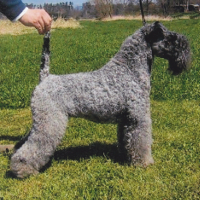
The typical Kerry Blue Terrier should be upstanding, well-knit and well proportionated, showing well developed muscular body with definite terrier style.

Behaviour / temperament

Terrier character throughout. The all-important factor-expression must be keen and alert.

Head

Cranial region

Head
Showing plenty of hair. Dogs should be stronger in head and more muscular than bitches.
Skull
Strong and well balanced. 
Stop
Slight.

Facial region

Nose
Black, nostrils large and wide.
Muzzle
The foreface should be of medium length.
Jaws and teeth
Teeth : Teeth large even and white, scissor bite (level bite acceptable).
Jaws : Jaws strong and muscular (punishing jaws).
Mouth : Gums and roof dark.
Eyes
Dark or dark hazel, medium in size and well placed, keen in expression.
Ears
Thin and not large, carried in front or close to the sides of the head, in a forward position, again to express the keen, sharp terrier expression.

Neck

Well proportioned, well set on shoulders and moderately long.

Body

Back
Medium length, level.
Loin
Moderate in length.
Chest
Deep and of moderate width. Ribs well sprung.

Tail

Thin, well placed and carried erect and gaily.

Limbs

Forequarters

Shoulders
Fine, sloping, well-knit.
Forearm
Straight in front, bone good.

Hindquarters

Generality
Hindlegs well set under dog.
Upper thigh
Muscular, well developed.
Hock
Strong.

Feet

Compact, pads strong and rounded, toe nails black.

Gait and movement

Good coordination, with legs parallel, forelegs reaching out and powerful drive in the hindquarters. When the dog is moving the topline should remain level and the head and tail should be carried high.

Coat

Hair
Soft, plentiful and wavy.
Colour
Blue of any shade with or without black points. Black is permissible only up to the age of 18 months, as is also a shade of tan.

Size and weight

Height at withers
Dogs 18 - 19,5 inches (45,5 to 49,5 cm), bitches 17,5 - 19 inches (44,5 to 48 cm).
Weight
Dogs 33 lbs to 40 lbs (15 to 18 kg), bitches proportionately less.

Faults

• Any departure from the foregoing points should be considered a fault and the seriousness with which the fault should be regarded should be in exact proportion to its degree and its effect upon the health and welfare of the dog and its ability to perform its traditional work.
• Faults listed should be in degree of seriousness.

General faults

 Flesh coloured gums.
 Yellow or light coloured eyes.
 Roach back or hollow back.
 Narrow chest.
 Protruding elbows.
 Teeth undershot or overshot.
 White or bone coloured toe nails.
 Dewclaws on hind legs, or marks of their removal.
 Close, cow-hocked or stilted hind action.
 Dogs whose heads or tails are held up by exhibitors or handlers should be penalised.
 Hard, wire or bristle coat.
 Any colour other than blue with the exception stated above.

Disqualifying faults

 Aggressive or overly shy.

NB :

• Any dog clearly showing physical or behavioural abnormalities shall be disqualified.
• The above mentioned faults when occurring to a highly marked degree or frequently are disqualifying.
• Male animals should have two apparently normal testicles fully descended into the scrotum.
• Only functionally and clinically healthy dogs, with breed typical conformation should be used for breeding.

Bibliography

https://www.fci.be/


Additional information from visitors

Originally known as the Irish Blue Terrier, this lively worker was developed by poachers and shepherds in the 1700's in the Kerry County of south-western Ireland. Contrary to popular belief, this is not a blue-coated strain of the Irish Red Terrier. The origins of the Kerry Blue are uncertain and there are many theories in existance, naming a variety of breeds as its ancestors, from the Irish Wolfhound, Bedlington Terrier, Bullterrier, Harlequin Terrier, Scottish Blue Paul, Spanish Water Dog, Poodle, Otterhound, Soft-Coated Wheaten Terrier, Bearded Collie, Portuguese Water Spaniel and local and imported sheepdogs and hounds to the famous stories of the Russian Terrier from a shipwreck in the Tralee Bay. Whatever its true ancestry may be, the mighty Kerry Blue Terrier was a succesful working dog, used for hunting badgers, otters, rabbits and foxes, as well as for water retrieving duties. This hardy breed was also a valued vermin killer and occasional fighting dog, but Kerry Blue's most surprising achievement was its stellar performance as a herder and livestock guardian.
The breed Standard was written in 1922 by Mrs. Hewitt, a respected Kerry Blue breeder. International recognition was granted the same year, introducing this feisty breed to dog lovers worldwide. The rugged and resilient Kerry Blue Terrier is a versatile worker, making an excellent property watchdog and even a capable Police dog. This is a very intelligent and alert breed, loyal and loving of its master, a good choice for a family companion. Stubborn, but trainable, the Kerry Blue enjoys lots of excercise and an active lifestyle, although it can do well in urban environments. Even though it isn't nearly as aggressive as it was in the past, the Kerry Blue Terrier is still quite confrontational with other dogs, requiring early socialization and responsible handling.
Squarely built, muscular and agile, this powerful breed is a very fast runner and an impressive swimmer. The most famous distinctive feature of the Kerry Blue Terrier is its silky curly coat, soft to the touch and greyish-blue in colour. The puppies are born black, but after approximately 9 months of age, their coat starts to appear reddish-brown in colour, before turning to the breed's trademark blue shades. The coat needs regular grooming, but most working Kerry Blue Terriers are left in their natural state. Average height is around 19 inches.

Detailed history

Dark, thick, such appears the dress of the Kerry Blue Terrier to whoever observes or regularly combs his fleece. But how to qualify, then, the darkness that covers the past of this dog ?

Anyone who is very interested in the history of dog breeds usually has a hard time disentangling the true, or at least the probable, fantasy about the Terriers' ancestry, but if it is She warns of elucidating the origins of "Irish Blue", she is indeed in front of an impenetrable mystery. To be convinced of this, it is sufficient, for example, to read what one author noted at the beginning of the century: "Although the authentic records proving the presence of Kerry Blue in Noah's Ark are lacking, there are still alive today to prove that this race existed a hundred years ago."

The historian will seriously pursue his research, however, trying to fill this gap on what may have happened between the time of the Flood and the nineteenth century; but it is not certain that it is clear from this Irish legend that, nearly three thousand years ago, a Celtic king married the daughter of a Pharaoh and brought back to his native Erin some dogs which are the originators of Irish Terriers and Irish Water Spaniel. And, probably, he will not give more credit to the story of the shipwreck which, long ago, occurred on the coast of County Kerry and whose only survivor was a blue dog.

But why would not Kerry Blue be a true native of Ireland? This country occupies the first place in the world, in front of France, for the number of dogs per household that are there. It would be extraordinary if, among this variegated multitude, he had not found all the ingredients whose dosage would lead to Kerry Blue, especially its color and the texture of its hair.

Thus, some involve the Irish Wolfhound (small specimens, it says). This very tall and long, rough-haired Greyhound, seems nevertheless far removed from the Kerry Blue, whose morphology is square and muscular and whose hair is silky. Bedlington Terrier is also known for both the hue and nature of its hair, and even the Bull Terrier, because of its muscular development and combative temperament. Admittedly, Bedlington and Bull Terrier were much closer to Kerry Blue in the past, but is it necessary to consider these foreign contributions to explain the appearance of the Irish Blue Terrier ?

Kerry Blue has many similarities with the other three (now recognized) breeds of Irish Terriers. The Irish Terrier, in its beginnings, was not exclusively wheat-colored, since it also knew gray and black and fire. It is true that it is a dog with hard hair, but Killiney Boy, one of the patriarchs of the race, did not present, one says, a hair typically "wire".

As for the Soft Coated Weaten Terrier, or Terrier soft hair color, it has a soft hair, provided and long, which argues in favor of his kinship with Kerry Blue, especially as, like him, it has in its hereditary heritage a factor that gradually dilutes the color: in Kerry, the black dress at birth turns blue in adulthood (sometimes it is necessary to wait until the age of eighteen months) and, in the Soft Coated, she goes from dark fawn to beige.

The rare Glen of Imaal Terrier, the least known of the Irish Terriers, also has characteristics that bring it closer to the Kerry Blue: its soft hair and provided (although much less long) and a shade that can, besides the wheat, be blue or blue and fire. We know the existence of Kerry Blues subjects, formerly (and still today), with fire marks.

We see that all these dogs have (or that some of their ancestors had) a soft hair and provided and / or colors ranging from wheat (that is to say a diluted fawn) to blue (a diluted black) or blue and fire. The question of whether one of these races is older than the others, or even if it can claim paternity, is unquestionably a false problem. In fact, they all come from the same population - certainly very ancient - but their selection was made at different times. The Irish Terrier was the first to be favored by dog enthusiasts, and no doubt he took advantage of the wake of the already famous Fox Terrier. That the Kerry Blue had to wait a few more decades is easily explained: as long as he kept his whole fleece, more or less badly combed, working dog, he could not interest lovers of beautiful dogs; In any case, the habit of grooming the Terriers, which would have made it possible to develop it, did not take place until shortly before the First World War, and it was not until the beginning of the 1920s that this practice occurred. generalize and become popular. However, coincidence, or rather result of a particularly clairvoyant action, it is precisely at this moment - in 1922 - that the Kerry Blue makes its entry on the stage, of course cynophilic !

Clearly, Kerry Blue was originally from the wild and rugged County of Kerry, in the south-west of Ireland, and it was indeed in Kerry, and more precisely at Tralee, where Mrs. Casey Hewitt, who introduced the breed to Britain. And yet, it is not sure that this is the original, or at least exclusive, terroir of Kerry Blue. By the way, were not the first specimens named Irish Blue Terriers ?

It may be noted that during one of the first exhibitions organized in Eire, in 1887 in Limerick, there were five Slate Blue Terriers. In 1902, there were fourteen - engaged in a class of work that was reserved for them - at the Killarney exhibition. In Cork, in 1913, there was a class of five subjects, all slate-blue and of relatively modest size. In 1916, there were twenty in a new edition of the Killarney exhibition. The progress of this dog (henceforth called Kerry Blue) was such that it justified the formation of a special Irish club in 1920.

It is here that the importance of Mrs. Casey Hewitt, who understood that the development of his favorite breed went through its introduction in Britain - which was not self-evident. In his country, Kerry Blue enthusiasts favored the qualities of their working dogs without unduly lingering on their appearance, which left something to be desired, it must be admitted: not only their fleece, left in the state, n It did not have much to do with the impeccably designed Terriers, but the homogeneity of the subjects in terms of color, size and shape was not perfect. In addition, these dogs selected to fight the dreaded badger and destroy rats and other pests showed a more than energetic character, so fights between dogs were not a rare phenomenon, even in the rings. It is therefore understandable that the English judges and amateurs showed at first some reluctance to admit these newcomers, certainly kneaded with qualities, but whose frequent let-go was hardly appropriate in their canine manifestations of great holding.

Mrs. Casey Hewitt succeeds in an undeniable feat! She had attached herself, it is true, to guide the selection in the sense of elegance and kindness. However, there was still some way to go, as evidenced by the arrival of Kerry Blues Cruft, as recounted in a well-documented study of N. Bazillon-Biémont, French specialist in the breed: "These merry, disheveled lurons were perched in and out of a cab full of overflowing, barking at whoever better. Mrs. Hewitt had to stay in a convent, but there was no question of housing the Kerries. Also, the Mother Superior, who loved dogs and owned a Bull Terrier, appealed to J. Seunders. He already had thirty Bulls and the hosting of Kerries posed him a famous problem! There were puppies and adults of all shapes and sizes. It could not be said that it was a fascinating collection: some were blue, others blue and tan."

The acceptance of Mrs. Kerry's ten Kerry Blue Hewitt at the Cruft show in February 1922 was really what gave the race a boost: the Kerry Blue Terrier Club of Great Britain was formed on this occasion, and he immediately recognized the need to give a neat grooming to Kerry Blue, who could thus stand the comparison with the other Terriers all having a chic appearance, and to obtain a more docile behavior.

The results were not long in coming: a few months after Cruft, the Kennel Club officially admitted Kerry Blue, and, on January 23rd, 1923, at the National Terrier Show (a very important exhibition where all breeds of Terriers compete), it is a Kerry Blue, Martell's Sapphire Beauty, who won the highest award, becoming the first champion of the breed. Mrs. Violet Handy, a British breeder of great reputation, then definitively developed the grooming specific to Kerries, and here are these merry Irish, as undisciplined as rustic, transformed into elegant perfectly civilized aristocrats !

Of course, the Americans were not insensitive to the potential qualities of Kerry Blue. From 1922, with only a slight delay on those who landed in England, the first specimens crossed the Atlantic; the American Kennel Club recognized the breed in 1924, and the American Club Kerry Blue was born in 1926.

American cattle breeding has made such progress that it tends today to surpass the British. Thus the champion Callaghan of Leander, who became "Best in show" Cruft in 1979 (the ultimate consecration for a breed in the Anglo-Saxon dog), is of American origin.

And in his country, what about Kerry Blue, meanwhile? The Irish specialists did not quite agree with the orientation of the breed. Being primarily concerned with preserving the eminent qualities of their dog's work, they came in 1926 to demand success before a work trial to authorize a subject to run for an Irish title. Thus, in the Teastas Mor, the dog had to face the badger, and in the Teastas Bag, it was for him to display a true hunter temperament against a rat and a rabbit.

In Ireland, the first amateurs did not want to hear about sophisticated grooming either, but the pre-eminence of British dog-eating was such that they could not impose their point of view. It should be noted that these differences were not so irreconcilable as they will not prevent dogs of purely Irish origin from obtaining championship titles in England. Thus, Kerry Blue's overly brilliant career as a subject for exhibitions has not erased her atavistic utilitarian features, and perhaps even helped to reveal them out of her native land !

Imported in France from the inter-war period, Kerry Blue did not become very popular there. It is certain that, in France, the true amateurs of Terriers are potentially much less numerous than in the Anglo-Saxon countries and that the general public admits with difficulty the necessity of a regular grooming as well as looked after for the dogs (to share for the Poodle, and again!). On this side of the Channel, there are few groomers able to treat Terriers according to the rules of art.

Comments

Latest page updates

  • Yorkshire Terrier

    Yorkshire Terrier FCI Standard No. 86 Origin Great Britain Group Group 3 Terriers Section Section 4 Toy Terriers Working Without working trial Date of acceptance on a definitive basis by the FCI Saturday 30 October 1954 Date of publication of the official valid standard Tuesday 08 September 2026 Date of the last update Tuesday 06 October 2026 En...
  • West Highland White Terrier

    West Highland White Terrier FCI Standard No. 85 Origin Great Britain Group Group 3 Terriers Section Section 2 Small-sized Terriers Working Without working trial Date of acceptance on a definitive basis by the FCI Friday 29 October 1954 Date of publication of the official valid standard Tuesday 08 September 2026 Date of the last update Tuesday 06...
  • Welsh Terrier

    Welsh Terrier FCI Standard No. 78 Origin Great Britain Group Group 3 Terriers Section Section 1 Large- and medium sized Terriers Working Without working trial Date of acceptance on a definitive basis by the FCI Saturday 23 October 1954 Date of publication of the official valid standard Tuesday 08 September 2026 Date of the last update Tuesday 06...
  • Welsh Springer Spaniel

    Welsh Springer Spaniel FCI Standard No. 126 Origin Great Britain Group Group 8 Retrievers-Flushing Dogs-Water Dogs Section Section 2 Flushing Dogs Working With working trial Date of acceptance on a definitive basis by the FCI Thursday 30 December 1954 Date of publication of the official valid standard Tuesday 08 September 2026 Date of the last...
  • Welsh Corgi Pembroke

    Welsh Corgi Pembroke FCI Standard No. 39 Origin Great Britain Group Group 1 Sheepdogs and Cattle Dogs (except Swiss Cattle Dogs) Section Section 2 Cattledogs (except Swiss Cattledogs) Working Without working trial Date of acceptance on a definitive basis by the FCI Wednesday 13 November 1963 Date of publication of the official valid standard Tuesday 08...
  • Welsh Corgi Cardigan

    Welsh Corgi Cardigan FCI Standard No. 38 Origin Great Britain Group Group 1 Sheepdogs and Cattle Dogs (except Swiss Cattle Dogs) Section Section 2 Cattledogs (except Swiss Cattledogs) Working Without working trial Date of acceptance on a definitive basis by the FCI Tuesday 12 November 1963 Date of publication of the official valid standard Tuesday 08...
  • Sussex Spaniel

    Sussex Spaniel FCI Standard No. 127 Origin Great Britain Group Group 8 Retrievers, Flushing dogs, Water dogs. Section Section 2 Flushing dogs Working With working trial Date of acceptance on a definitive basis by the FCI Friday 31 December 1954 Date of publication of the official valid standard Tuesday 08 September 2026 Date of the last update Tuesday 06...
  • Staffordshire Bull Terrier

    Staffordshire Bull Terrier FCI Standard No. 76 Origin Great Britain Group Group 3 Terriers Section Section 3 Bull type Terriers Working Without working trial Date of acceptance on a definitive basis by the FCI Thursday 21 October 1954 Date of publication of the official valid standard Tuesday 08 September 2026 Date of the last update Tuesday 06...
  • Skye Terrier

    Skye Terrier FCI Standard No. 75 Origin Great Britain Group Group 3 Terriers Section Section 2 Small-sized Terriers Working Without working trial Date of acceptance on a definitive basis by the FCI Wednesday 20 October 1954 Date of publication of the official valid standard Tuesday 08 September 2026 Date of the last update Tuesday 06 October 2026 En...
  • Shetland Sheepdog

    Shetland Sheepdog FCI Standard No. 88 Origin Great Britain Group Group 1 Sheepdogs and Cattle Dogs Section Section 1 Sheepdogs Working Without working trial Date of acceptance on a definitive basis by the FCI Tuesday 09 November 1954 Date of publication of the official valid standard Tuesday 08 September 2026 Date of the last update Tuesday 06...
  • Sealyham Terrier

    Sealyham Terrier FCI Standard No. 74 Origin Great Britain Group Group 3 Terriers Section Section 2 Small sized Terriers Working Without working trial Date of acceptance on a definitive basis by the FCI Tuesday 19 October 1954 Date of publication of the official valid standard Tuesday 08 September 2026 Date of the last update Tuesday 06 October...
  • Scottish Terrier

    Scottish Terrier FCI Standard No. 73 Origin Great Britain Group Group 3 Terriers Section Section 2 Small-sized Terriers Working Without working trial Date of acceptance on a definitive basis by the FCI Monday 18 October 1954 Date of publication of the official valid standard Tuesday 08 September 2026 Date of the last update Tuesday 06 October...
  • Old English Sheepdog (Bobtail)

      Old English Sheepdog (Bobtail) FCI Standard No. 16     Origin   Great Britain Group   Group 1 Sheepdogs and Cattle Dogs (except Swiss Cattle Dogs) Section   Section 1 Sheepdogs Working   Without working trial Date of acceptance on a definitive basis by the FCI   Monday 25 November 1963 Date of publication of the official valid standard   Tuesday 08 September...
  • Norwich Terrier

    Norwich Terrier FCI Standard No. 72 Origin Great Britain Group Group 3 Terriers Section Section 2 Small-sized Terriers Working Without working trial Date of acceptance on a definitive basis by the FCI Saturday 16 October 1954 Date of publication of the official valid standard Tuesday 08 September 2026 Date of the last update Tuesday 06 October...
  • Norfolk Terrier

    Norfolk Terrier FCI Standard No. 272 Origin Great Britain Group Group 3 Terriers Section Section 2 Small-sized Terriers Working Without working trial Date of acceptance on a definitive basis by the FCI Saturday 01 October 1966 Date of publication of the official valid standard Tuesday 08 September 2026 Date of the last update Tuesday 06 October...
  • Manchester Terrier

    Manchester Terrier FCI Standard No. 71 Origin Great Britain Group Group 3 Terriers Section Section 1 Large and medium sized Terriers Working Without working trial Date of acceptance on a definitive basis by the FCI Friday 15 October 1954 Date of publication of the official valid standard Tuesday 08 September 2026 Date of the last update Tuesday 06 October...
  • Lakeland Terrier

    Lakeland Terrier FCI Standard No. 70 Origin Great Britain Group Group 3 Terriers Section Section 1 Large and medium-sized Terriers Working Without working trial Date of acceptance on a definitive basis by the FCI Thursday 14 October 1954 Date of publication of the official valid standard Tuesday 08 September 2026 Date of the last update Tuesday 06 October...
  • Labrador Retriever

      Labrador Retriever FCI Standard No. 122     Origin   Canada Group   Group 8 Retrievers, Flushing dogs, Water dogs Section   Section 1 Retrievers Working   With working trial Date of acceptance on a definitive basis by the FCI   Friday 24 December 1954 Date of publication of the official valid standard   Tuesday 08 September 2026 Date of the last update   Tuesday 06...
  • King Charles Spaniel

    King Charles Spaniel FCI Standard No. 128 Origin Great Britain Group Group 9 Companion and Toy Dogs Section Section 7 English Toy Spaniels Working Without working trial Date of acceptance on a definitive basis by the FCI Monday 03 January 1955 Date of publication of the official valid standard Tuesday 08 September 2026 Date of the last update Tuesday 06...
  • Harrier

      Harrier FCI Standard No. 295     Origin   Great Britain Translation   Mrs. Peggy Davis, brought up to day by Dr. Paschoud Group   Group 6 Scenthounds and related breeds Section   Section 1.2 Medium-sized Hounds Working   With working trial Date of acceptance on a definitive basis by the FCI   Wednesday 27 November 1974 Date of publication of the official valid...
  • Greyhound

    Greyhound FCI Standard No. 158 Origin Great Britain Group Group 10 Sighthounds Section Section 3 Short-haired sighthounds Working Without working trial Date of acceptance on a definitive basis by the FCI Saturday 23 April 1955 Date of publication of the official valid standard Tuesday 08 September 2026 Date of the last update Tuesday 06 October...
  • Gordon Setter

    Gordon Setter FCI Standard No. 6 Origin Great Britain Group Group 7 Pointing Dogs Section Section 2.2 British and Irish Pointers and Setters; Setters Working With working trial Date of acceptance on a definitive basis by the FCI Tuesday 28 May 1963 Date of publication of the official valid standard Tuesday 08 September 2026 Date of the last...
  • Golden Retriever

    Golden Retriever FCI Standard No. 111 Origin Great Britain Group Group 8 Retrievers, Flushing Dogs, Water Dogs Section Section 1 Retrievers Working With working trial Date of acceptance on a definitive basis by the FCI Thursday 02 December 1954 Date of publication of the official valid standard Tuesday 28 July 2009 Date of the last update Wednesday...
  • Fox Terrier Wire

    Fox Terrier Wire FCI Standard No. 169 Origin Great Britain Group Group 3 Terriers Section Section 1 Large and medium-sized Terriers Working Working trial optional Date of acceptance on a definitive basis by the FCI Friday 13 May 1955 Date of publication of the official valid standard Tuesday 08 September 2026 Date of the last update Tuesday 06...
  • Fox Terrier Smooth

    Fox Terrier Smooth FCI Standard No. 12 Origin Great Britain Group Group Terriers Section Section 1 Large and medium sized Terriers Working Working trial optional Date of acceptance on a definitive basis by the FCI Wednesday 26 June 1963 Date of publication of the official valid standard Tuesday 08 September 2026 Date of the last update Tuesday 06...
  • Flat Coated Retriever

    Flat Coated Retriever FCI Standard No. 121 Origin Great Britain Group Group 8 Retrievers-Flushing Dogs-Water Dogs Section Section 1 Retrievers Working With working trial Date of acceptance on a definitive basis by the FCI Thursday 23 December 1954 Date of publication of the official valid standard Tuesday 08 September 2026 Date of the last update Tuesday...
  • Field Spaniel

    Field Spaniel FCI Standard No. 123 Origin Great-Britain Group Group 8 Retrievers, Flushing Dogs, Water Dogs Section Section 2 Flushing Dogs Working With working trial Date of acceptance on a definitive basis by the FCI Monday 27 December 1954 Date of publication of the official valid standard Tuesday 08 September 2026 Date of the last update Tuesday...
  • English Toy Terrier

    English Toy Terrier FCI Standard No. 13 Origin Great Britain Group Group 3 Terriers Section Section 4 Toy Terriers Working Without working trial Date of acceptance on a definitive basis by the FCI Tuesday 17 September 1963 Date of publication of the official valid standard Tuesday 08 September 2026 Date of the last update Tuesday 06 October 2026 En...
  • English Springer Spaniel

    English Springer Spaniel FCI Standard No. 125 Origin Great Britain Group Group 8 Retrievers-Flushing Dogs-Water Dogs Section Section 2 Flushing Dogs Working With working trial Date of acceptance on a definitive basis by the FCI Wednesday 29 December 1954 Date of publication of the official valid standard Tuesday 08 September 2026 Date of the last...
  • English Setter

    English Setter FCI Standard No. 2 Origin Great Britain Group Group 7 Pointing Dogs Section Section 2.2 British and Irish Pointers and Setters, Setter Working With working trial Date of acceptance on a definitive basis by the FCI Wednesday 06 March 1963 Date of publication of the official valid standard Tuesday 08 September 2026 Date of the last...
  • English Pointer

    English Pointer FCI Standard No. 1 Origin Great Britain Group Group 7 Pointing Dogs Section Section 2.1 British and Irish Pointers and Setters, Pointer Working With working trial Date of acceptance on a definitive basis by the FCI Tuesday 05 March 1963 Date of publication of the official valid standard Tuesday 08 September 2026 Date of the last...
  • English Foxhound

    English Foxhound FCI Standard No. 159 Origin Great Britain Group Group 6 Scenthounds and related breeds Section Section 1.1 Large-sized Scent hounds Working With working trial Date of acceptance on a definitive basis by the FCI Monday 25 April 1955 Date of publication of the official valid standard Thursday 26 March 2009 Date of the last update Wednesday...
  • English Cocker Spaniel

    English Cocker Spaniel FCI Standard No. 5 Origin Great Britain Group Group 8 Retrievers, Flushing Dogs, Water Dogs Section Section 2 Flushing dogs Working With working trial Date of acceptance on a definitive basis by the FCI Wednesday 10 April 1963 Date of publication of the official valid standard Tuesday 08 September 2026 Date of the last...
  • Tibetan Mastiff

    Tibetan Mastiff FCI Standard No. 230 Origin Tibet (China)Patronage FCI Group Group 2 Pinscher and Schnauzer- Molossoid breeds- Swiss Mountain and Cattle Dogs Section Section 2.2 Molossoid breeds, Mountain type Working Without working trial Date of acceptance on a definitive basis by the FCI Tuesday 22 August 1961 Date of publication of the...
  • Deerhound

    Deerhound FCI Standard No. 164 Origin Great Britain Group Group 10 Sighthounds Section Section 2 Rough-haired Sighthounds Working Without working trial Date of acceptance on a definitive basis by the FCI Friday 29 April 1955 Date of publication of the official valid standard Tuesday 08 September 2026 Date of the last update Tuesday 06 October...
  • Dandie Dinmont Terrier

    Dandie Dinmont Terrier FCI Standard No. 168 Origin Great Britain Group Group 3 Terriers Section Section 2 Small-sized Terriers Working Without working trial Date of acceptance on a definitive basis by the FCI Thursday 12 May 1955 Date of publication of the official valid standard Tuesday 08 September 2026 Date of the last update Tuesday 06...
  • Curly Coated Retriever

    Curly Coated Retriever FCI Standard No. 110 Origin Great Britain Group Group 8 Retrievers, Flushing Dogs, Water Dogs Section Section 1 Retrievers Working With working trial Date of acceptance on a definitive basis by the FCI Friday 10 December 1954 Date of publication of the official valid standard Tuesday 08 September 2026 Date of the last...
  • Collie Smooth

    Collie Smooth FCI Standard No. 296 Origin Great Britain Group Group 1 Sheepdogs and Cattle Dogs (except Swiss Cattle Dogs) Section Section 1 Sheepdogs Working Without working trial Date of acceptance on a definitive basis by the FCI Wednesday 18 December 1974 Date of publication of the official valid standard Tuesday 08 September 2026 Date of the...
  • Collie Rough

    Collie Rough FCI Standard No. 156 Origin Great Britain Group Group 1 Sheepdogs and Cattle Dogs (except Swiss Cattle Dogs) Section Section 1 Sheepdogs Working Without working trial Date of acceptance on a definitive basis by the FCI Wednesday 13 April 1955 Date of publication of the official valid standard Tuesday 08 September 2026 Date of the...
  • Clumber Spaniel

    Clumber Spaniel FCI Standard No. 109 Origin Great Britain Group Group 8 Retrievers, Flushing dogs, Water dogs Section Section 2 Flushing dogs Working With working trial Date of acceptance on a definitive basis by the FCI Thursday 09 December 1954 Date of publication of the official valid standard Tuesday 08 September 2026 Date of the last update Tuesday...
  • Chow Chow

    Chow Chow FCI Standard No. 205 Origin China, patronage : Great Britain Group Group 5 Spitz and primitive type Section Section 5 Asian Spitz and related breeds Working Without working trial Date of acceptance on a definitive basis by the FCI Tuesday 10 December 1957 Date of publication of the official valid standard Tuesday 08 September 2026 Date...
  • Chinese Crested Dog

    Chinese Crested Dog FCI Standard No. 288 Origin China, patronage Great Britain Group Group 9 Companion and Toy Dogs Section Section 4 Hairless breeds Working Without working trial Date of acceptance on a definitive basis by the FCI Monday 17 July 1972 Date of publication of the official valid standard Tuesday 08 September 2026 Date of the last...
  • Cairn Terrier

    Cairn Terrier FCI Standard No. 4 Origin Great Britain Group Group 3 Terriers Section Section 2 Small-sized Terriers Working Without working trial Date of acceptance on a definitive basis by the FCI Saturday 06 April 1963 Date of publication of the official valid standard Tuesday 08 September 2026 Date of the last update Tuesday 06 October 2026 En...
  • Bullmastiff

    Bullmastiff FCI Standard No. 157 Origin Great Britain Group Group 2 Pinscher and Schnauzer Molossoid breeds - Swiss Mountain and Cattle Dogs Section Section 2.1 Molossoid breeds, Mastiff Type Working Without working trial Date of acceptance on a definitive basis by the FCI Saturday 23 April 1955 Date of publication of the official valid standard Tuesday...
  • English Bulldog

    English Bulldog FCI Standard No. 149 Origin Great Britain Group Group 2 Pinscher and Schnauzer Molossoid breeds-Swiss Mountain and Cattle Dogs Section Section 2.1 Molossoid breeds, Mastiff Type Working Without working trial Date of acceptance on a definitive basis by the FCI Monday 14 March 1955 Date of publication of the official valid standard Tuesday...
  • Bull Terrier

    Bull Terrier FCI Standard No. 11 Origin Grande-Bretagne Group Group 3 Terriers Section Section 3 Bull type Terriers Working Working trial optional Date of acceptance on a definitive basis by the FCI Saturday 26 June 1993 Date of publication of the official valid standard Tuesday 08 September 2026 Date of the last update Tuesday 06 October 2026 En...
  • Border Terrier

    Border Terrier FCI Standard No. 10 Origin Great Britain Group Group 3 Terriers Section Section 1 Large and medium-sized terriers Working Without working trial Date of acceptance on a definitive basis by the FCI Wednesday 26 June 1963 Date of publication of the official valid standard Tuesday 08 September 2026 Date of the last update Tuesday 06...
  • Bedlington Terrier

    Bedlington Terrier FCI Standard No. 9 Origin Great Britain Group Group 3 Terriers Section Section 1 Large and medium sized Terriers Working Without working trial Date of acceptance on a definitive basis by the FCI Thursday 20 June 1963 Date of publication of the official valid standard Tuesday 08 September 2026 Date of the last update Tuesday 06...
  • Bearded Collie

    Bearded Collie FCI Standard No. 271 Origin Great-Britain Group Group 1 Sheepdogs and Cattle Dogs (except Swiss Cattle Dogs) Section Section 1 Sheepdogs Working Without working trial Date of acceptance on a definitive basis by the FCI Wednesday 30 August 1967 Date of publication of the official valid standard Tuesday 08 September 2026 Date of the...
  • Beagle

    Beagle FCI Standard No. 161 Origin Great Britain Translation Prof. R. Triquet Group Group 6 Scent hounds and related breeds Section Section 1.3 Small-sized hounds Date of acceptance on a definitive basis by the FCI Tuesday 26 April 1955 Date of publication of the official valid standard Tuesday 08 September 2026 Date of the last update Tuesday 06...
  • Basset Hound

    Basset Hound FCI Standard No. 163 Origin Great Britain Group Group 6 Scent hounds and related breeds Section Section 1.3 Small-sized hounds Working With working trial Date of acceptance on a definitive basis by the FCI Thursday 28 April 1955 Date of publication of the official valid standard Tuesday 08 September 2026 Date of the last update Tuesday...
  • Basenji

    Basenji FCI Standard No. 43 Origin Democratic Republic of Congo, under the patronage of Great Britain Group Group 5 Spitz and primitive types Section Section 6 Primitive type Working Without working trial Date of acceptance on a definitive basis by the FCI Thursday 26 March 1964 Date of publication of the official valid standard Tuesday 08...
  • Airedale Terrier

    Airedale Terrier FCI Standard No. 7 Origin Great Britain Group Group 3 Terriers Section Section 1 Large and medium sized Terriers Working Working trial optional Date of acceptance on a definitive basis by the FCI Tuesday 28 May 1963 Date of publication of the official valid standard Tuesday 08 September 2026 Date of the last update Tuesday 06...
  • Afghan Hound

    Afghan Hound FCI Standard No. 228 Origin AfghanistanPatronage Great Britain Group Group 10 Sighthounds Section Section 1 Long-haired or fringed sighthounds Working Without working trial Date of acceptance on a definitive basis by the FCI Tuesday 12 December 1961 Date of publication of the official valid standard Tuesday 08 September 2026 Date of the...
  • Romagna Water Dog

    Romagna Water Dog FCI Standard No. 298 Origin Italy Translation Antonio Morsiani, Renée Sporre-Willes and Prof. R. TriquetRevised by ENCI and Renée Sporre-WillesRevised by the FCI Head OfficeOfficial language (EN). Group Group 8 Retrievers –Flushing Dogs –Water Dogs Section Section 3 Water Dogs Working Working trial optional Date of acceptance on a...
  • Whippet

    Whippet FCI Standard No. 162 Origin Great Britain Group Group 10 Sighthounds Section Section 3 Short-haired Sighthounds Working Without working trial Date of acceptance on a definitive basis by the FCI Wednesday 27 April 1955 Date of publication of the official valid standard Tuesday 08 September 2026 Date of the last update Tuesday 06 October...
  • Tibetan Terrier

    Tibetan Terrier FCI Standard No. 209 Origin Tibet, patronage Great Britain Group Group 9 Companion and Toy Dogs Section Section 5 Tibetan breeds Working Without working trial Date of acceptance on a definitive basis by the FCI Wednesday 18 December 1957 Date of publication of the official valid standard Tuesday 08 September 2026 Date of the last...
  • Tibetan Spaniel

    Tibetan Spaniel FCI Standard No. 231 Origin Tibet (China)Patronage Great Britain Group Group 9 Companion and Toy Dogs Section Section 5 Tibetan breeds Working Without working trial Date of acceptance on a definitive basis by the FCI Tuesday 22 August 1961 Date of publication of the official valid standard Tuesday 08 September 2026 Date of the...
  • Shih Tzu

    Shih Tzu FCI Standard No. 208 Origin Tibet, patronage Great Britain Group Group 9 Companion and Toy Dogs Section Section 5 Tibetan breeds Working Without working trial Date of acceptance on a definitive basis by the FCI Monday 16 December 1957 Date of publication of the official valid standard Tuesday 08 September 2026 Date of the last update Tuesday 06...
  • Pug

    Pug FCI Standard No. 253 Origin China, patronage Great Britain Group Group 9 Companion and Toy Dogs Section Section 11 Small Molossian type dogs Working Without working trial Date of acceptance on a definitive basis by the FCI Friday 04 November 1966 Date of publication of the official valid standard Tuesday 08 September 2026 Date of the last...
  • Pharaoh Hound

    Pharaoh Hound FCI Standard No. 248 Origin Malta, patronage Great Britain Group Group 5 Spitz and primitive types Section Section 6 Primitive type Working Without working trial Date of acceptance on a definitive basis by the FCI Friday 09 August 1963 Date of publication of the official valid standard Tuesday 08 September 2026 Date of the last...
  • Pekingese

    Pekingese FCI Standard No. 207 Origin China, patronage Great Britain Group Group 9 Companion and Toy Dogs Section Section 8 Japan Chin and Pekingese Working Without working trial Date of acceptance on a definitive basis by the FCI Thursday 03 November 1966 Date of publication of the official valid standard Tuesday 08 September 2026 Date of the last...
  • Parson Russell Terrier

    Parson Russell Terrier FCI Standard No. 339 Origin Great Britain Group Group 3 Terriers Section Section 1 Large and medium sized Terriers Working Working trial optional Date of acceptance on a definitive basis by the FCI Monday 04 June 2001 Date of acceptance on a provisional basis by the FCI Monday 02 July 1990 Date of publication of the...
  • Otterhound

    Otterhound FCI Standard No. 294 Origin Great Britain Group Group 6 Scenthounds and related breeds Section Section 1.1 Large-sized hounds Working Without working trial Date of acceptance on a definitive basis by the FCI Thursday 12 September 1974 Date of publication of the official valid standard Tuesday 08 September 2026 Date of the last update Tuesday 06...
  • Miniature Bull Terrier

    Miniature Bull Terrier FCI Standard No. 359 Origin Grande-Bretagne Group Group 3 Terriers Section Section 3 Bull type Terriers Working Working trial optional Date of acceptance on a definitive basis by the FCI Tuesday 05 July 2011 Date of acceptance on a provisional basis by the FCI Tuesday 05 July 2011 Date of publication of the official valid...
  • Mastiff

    Mastiff FCI Standard No. 264 Origin Great Britain Group Group 2 Pinscher and Schnauzer – Molossoid breeds - Swiss Mountain and Cattle Dogs Section Section 2.1 Molossoid breeds, Mastiff Type Working Without working trial Date of acceptance on a definitive basis by the FCI Thursday 05 November 1964 Date of publication of the official valid standard Tuesday 08...
  • Lhassa Apso

    Lhassa Apso FCI Standard No. 227 Origin Tibet (China)Patronage Great Britain Group Group 9 Companion and Toy Dogs Section Section 5 Tibetan breeds Working Without working trial Date of acceptance on a definitive basis by the FCI Saturday 19 November 1960 Date of publication of the official valid standard Tuesday 08 September 2026 Date of the last...
  • Lancashire-Heeler

    Lancashire-Heeler FCI Standard No. 360 Origin England, patronage : FCI Group Group 1 Sheepdogs and Cattle Dogs (except Swiss Cattle Dogs) Section Section 1 Sheepdogs Working Without working trial Date of acceptance on a provisional basis by the FCI Sunday 01 May 2016 Date of publication of the official valid standard Tuesday 08 September 2026 Date...

© 2026 Groupe Milouchouchou ASBL. Tous droits réservés. En savoir plus

Protected by Copyright01
