 |
Entlebuch Cattle Dog |
|
FCI standard Nº 47 |
||
Origin |
Switzerland | |
Translation |
Mrs. C. Seidler | |
Group |
Group 2 Pinscher and Schnauzer type Molossoid breeds - Swiss Mountain and Cattle-Dogs | |
Section |
Section 3 Swiss Cattle Dogs | |
Working |
Without working trial | |
Acceptance on a definitive basis by the FCI |
Wednesday 28 July 1954 | |
Publication of the official valid standard |
Wednesday 28 November 2001 | |
Last update |
Friday 28 June 2002 | |
En français, cette race se dit |
 |
Bouvier de l'Entlebuch |
Diese Norm ist in deutscher Sprache sichtbar |
 |
Entlebucher Sennenhund |
En español, esta raza se dice |
 |
Perro Boyero de Entlebuch |
In het Nederlands, wordt dit ras gezegd |
 |
Entlebucher Sennenhond |
Usage |
| Driving-, watch-, guard-, and farm dog. Today also a versatile working and agreeable family dog. |
Brief historical summary |
| The “Entlebucher” is the smallest of the four Swiss Mountain and Cattle Dogs. He originates from Entlebuch, a valley in the region of the Cantons Lucerne and Bern. The first description under the name “Entlibucherhund” dates from the year 1889, but for a considerable time after that date, no difference was made between Appenzell and Entlebuch Cattle Dogs. In the year 1913 four examples of this small herding dog with congenital bobtail were exhibited at the dog show in Langenthal and presented to Prof.Dr.Albert Heim, the great patron of the Swiss Mountain and Cattle Dog breeds. On account of the judges reports, they were entered into the Swiss Canine Stud Book (SHSB) as the fourth Mountain and Cattle Dog breed. However, the first standard was only completed in 1927. After August 28th 1926, the date of the foundation of the Swiss Club of Entlebuch Cattle Dogs initiated by Dr. B. Kobler, this breed was promoted and continued as purebred. As the small number of entries into the SHSB (Swiss Stud Book) shows, the breed developed only slowly. The Entlebuch Cattle Dog received renewed impetus when, apart from his hereditary qualities as a lively, tireless driving dog, his outstanding suitability as a utility and companion dog was proved. Today, still on a modest scale, this attractive tricoloured dog has found his admirers and enjoys increased popularity as a family dog. |
General appearance |
| Only just medium-sized, compactly built dog of slightly elongated shape. Tricolour like all the Swiss Mountain and Cattle Dogs, very agile and deft; alert, clever and friendly facial expression. |
Important proportions |
| Ratio of height at withers to length of the body = 8 : 10. Ratio of length of muzzle to length of the skull = 9 : 10. |
Behaviour / temperament |
| Lively, high-spirited, self-assured and fearless. Good-natured and devoted towards people familiar to him, slightly suspicious of strangers. Cannot be bribed as a watch dog. Cheerful and capable of learning. |
Head |
||
Cranial region |
||
Head |
In harmonious proportion to the body, slightly wedge-shaped, clean. Head planes of muzzle and skull more or less parallel. | |
Skull |
Rather flat, relatively broad, broadest between set-on of ears; slightly tapering towards muzzle. Occipital bone barely visible. Frontal furrow barely pronounced. | |
Stop |
Barely pronounced. | |
Facial region |
||
Nose |
Black, protruding slightly over front edge of lips. | |
Muzzle |
Strong, well chiselled, clearly set off from forehead and cheeks, tapering evenly but not pointed. Slightly shorter than distance from stop to occipital protuberance. | |
Lips |
Barely pronounced, close-fitting to jaw, with black pigmentation. | |
Nasal bridge |
Bridge of nose straight. | |
Jaws and teeth |
Strong, regular and complete scissor bite. Even bite tolerated. Absence of one or two PM1 (premolar 1) tolerated. Absence of M3 (molar 3) not taken into consideration. | |
Cheeks |
Barely pronounced. | |
Eyes |
Rather small, roundish, dark brown to hazel. Expression lively, friendly, alert. Eyelids well fitting. Black pigmentation on rims. | |
Ears |
Not too big. Set on high and relatively wide. Flaps pendulous, triangular, well rounded at tip. Firm, well developed ear-cartilage. In repose lying flat and close to head; when alert, slightly raised at set-on and turned forward. | |
Neck |
| Of medium length, strong and clean, merging smoothly with the body. |
Body |
||
Body |
Strong, slightly elongated. | |
Back |
Straight, firm, broad, relatively long. | |
Loin |
Strong, supple, not too short. | |
Croup |
Sloping slightly, relatively long. | |
Chest |
Broad, deep, reaching to the elbows. Pronounced forechest. Ribs moderately rounded. Ribcage extended, roundish-oval in diameter. | |
Underline and belly |
Slight tuck up. | |
Tail |
| Natural tail set on in continuation of the gently sloping croup. Congenital bobtail. Natural long tail and bobtail equally acceptable. |
Limbs |
Forequarters |
||
Generality |
Strongly muscled but not too heavy. Forelegs placed neither too wide nor too close together; forelegs short, sturdy, straight, parallel and placed well under the body. | |
Shoulders |
Muscular, shoulder blade long, slanting and well attached to the body. | |
Upper arm |
Length equal or slightly shorter than shoulder blade. Angle to shoulder blade about 110-120 degrees. | |
Elbows |
Well attached to the body. | |
Forearm |
Relatively short, straight, well boned, clean. | |
Pastern |
Seen from the front in straight continuation of the forearm; seen from the side very slightly angulated. Relatively short. | |
Hindquarters |
||
Generality |
Well muscled. Seen from behind hind legs not too close together, straight and parallel. | |
Upper thigh |
Fairly long. Forming a rather wide angle with the lower thigh at the stifle joint. Thighs broad and strong. | |
Lower thigh |
Approximately equal length to upper thigh, clean. | |
Metatarsus |
Fairly short, sturdy, vertical and parallel in position. Dewclaws must be removed, except in those countries where the removal is prohibited by law. | |
Hock |
Strong, set relatively low, well angulated. | |
Feet |
| Roundish, with tight, well arched toes, pointing straight forward. Nails short and strong. Pads coarse and robust. |
Gait and movement |
| Ground covering, free, easy movement with strong drive from rear. Seen from front or rear, legs track in a straight line. |
Coat |
||
Hair |
Double coat (Stockhaar). Topcoat short, close fitting, harsh and shiny. Undercoat dense. Slightly wavy hair on withers and/or back tolerated, but not desirable. | |
Colour |
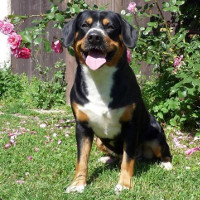
Typically tricolour. Basic colour black with “yellow- to reddish-brown” tan markings which should be as symmetric as possible. The tan markings are placed above the eyes, on cheeks, on muzzle and throat, on either side of chest and on all four legs. On the legs the tan markings are situated between the black and the white. Undercoat Dark grey to brownish. White markings • Distinct small with blaze which runs without interruption from top of the head over the bridge of nose and can wholly or partially cover the muzzle. • White from chin over throat without interruption to chest. • White on all four feet. • On a long tail white tip desirable. Undesirable but tolerated Small white patch on nape of neck (not more than half the size of a palm). |
|
Size and weight |
||
Height at withers |
Dogs 44-50 cm, tolerance up to 52 cm, bitches 42-48 cm, tolerance up to 50 cm. | |
Faults |
| • Any departure from the foregoing points should be considered a fault and the seriousness with which the fault should be regarded should be in exact proportion to its degree and its effect upon the health and welfare of the dog and its ability to perform its traditional work. • Faults listed should be in degree of seriousness. |
General faults |
 Lack of typical sex-specific appearance. Distinctly unbalanced. Bone too coarse or too fine. Insufficient musculature. Round skull. Stop too defined. Muzzle short, too long or snippy; nasal bridge not straight. Mouth very slightly undershot. Absence of teeth other than 2 PM1 (premolars 1). Eyes too light, too sunken or protruding. Eyelids slightly slack. Ears too deep-set, too small or too pointed, carried standing-off or folded. Back too short, swayback or roach back. Croup overbuilt or falling away. Chest too flat-ribbed or barrel-shaped, lacking in forechest. Kinky tail; tail carried over back. Forequarters not sufficiently angulated. Forelegs turned out or crooked. Pastern weak, or down on pastern. Hindquarters not sufficiently angulated, cow-hocked or bandy legs, close behind. Feet longish, spread toes. Movement short stride, stilted, close coming and going, weaving. Unsure behaviour, absence of liveliness, slight sharpness. Lack of typical sex-specific appearance. Distinctly unbalanced. Bone too coarse or too fine. Insufficient musculature. Round skull. Stop too defined. Muzzle short, too long or snippy; nasal bridge not straight. Mouth very slightly undershot. Absence of teeth other than 2 PM1 (premolars 1). Eyes too light, too sunken or protruding. Eyelids slightly slack. Ears too deep-set, too small or too pointed, carried standing-off or folded. Back too short, swayback or roach back. Croup overbuilt or falling away. Chest too flat-ribbed or barrel-shaped, lacking in forechest. Kinky tail; tail carried over back. Forequarters not sufficiently angulated. Forelegs turned out or crooked. Pastern weak, or down on pastern. Hindquarters not sufficiently angulated, cow-hocked or bandy legs, close behind. Feet longish, spread toes. Movement short stride, stilted, close coming and going, weaving. Unsure behaviour, absence of liveliness, slight sharpness.Faults in marking Interrupted blaze. White patch on nape of neck bigger than half of a palm. White distinctly reaching above pasterns (“boots”). White not on all 4 feet. White collar around the whole neck (serious fault). Divided white on chest (serious fault). Forelegs absence of tan between the white and the black (serious fault). Absence of any white on head = totally black head (very serious fault). |
Disqualifying faults |
| Overly shy or aggressive. Overshot, distinctly undershot or wry mouth. Entropion, ectropion. Yellow hawk eyes, wall eyes, blue eyes. Ring tail. Coat too long, soft (no double coat). Other than tricoloured coat. Basic colour other than black. Undersize, oversize regarding tolerances. |
NB : |
| • Any dog clearly showing physical or behavioural abnormalities shall be disqualified. • The above mentioned faults when occurring to a highly marked degree or frequently are disqualifying. • Male animals should have two apparently normal testicles fully descended into the scrotum. • Only functionally and clinically healthy dogs, with breed typical conformation should be used for breeding. |
Bibliography |
| https://www.fci.be/ |
Detailed history |
| The Bouvier of the Entlebuch, which is the least known and the smallest of the Swiss Cattle Dogs, is native; as indicated by his name ; Entlebuch, a region formed by the valleys of Little Emme and Entle, as well as the neighboring valley of the Great Emme, in the cantons of Lucerne and Bern. In the general opinion of the cynologists, this dog descends from the light type of Molosses introduced into Switzerland by the Romans, via the passes of Saint-Bernard and Saint-Gotthard, but, to tell the truth, we have no certainty as to its distant origins. One thing, however, is undeniable: the Entlebucher has long been treated with the most perfect indifference in Helvetia, where one saw in him only a vulgar "farm dog." The herd nevertheless presented a certain homogeneity, resulting on the one hand from the isolation of the Swiss valleys, on the other hand from the empirical selection practiced by the shepherds and the cowherds, a selection which was based on the physical and psychological qualities of the animal and not on aesthetic criteria. Nevertheless, the Bouvier Entlebuch would have disappeared today if two men had not looked at his fate at the beginning of the twentieth century. It is to Franz Schertenleib, of Berthoud in the Emmental, that the honor returns to have shot this little Bouvier of oblivion. In 1913, he was able to exhibit it at Langenthal, and on this occasion, Professor A. Heim made a detailed description of it, thus allowing a reconstruction, albeit very discreet, of the breeding. Even today, the Entlebuch is a poor relative in the Swiss Bouvier family. There are hardly more than 300 subjects in his country of origin. Also known in Germany, he is equally poorly represented. In France, where there are only three or four specimens, it is considered an object of curiosity. This is unfortunate, because it displays a happy naturalness and undeniable utilitarian qualities. This Bouvier, which has the peculiarity of being born with the truncated tail, is as gifted for the surveillance of the herds as for the guard of the farm. According to Fred Rufer, this utility dog is remarkably effective and uses a proven working technique: "When the shepherd arrives at the pasture, he walks around with the dog, which, throughout the day, will not allow any beast of the flock to go beyond the limits. Very cunning, enduring, resistant to changes of weather, he renders great services to the alp where he masters the bull as well as another. Perhaps even better, since its small size allows it to counter the hoofs of cattle. Very vigilant, always on the alert, reserved for strangers, he has an innate sense of care. Some subjects even practice tracking and search avalanche and rubble. Cheerful, lively, playful, open and affectionate with his family, the Entlebuch has all the character traits of an excellent family dog. Especially since his relations with children are idyllic and his relations with other domestic animals are placed under the auspices of tolerance. To conclude, however, it will be emphasized that this tireless worker needs space, air and activity to maintain his balance. In other words, he was not born to live in the city, and he should be remembered before becoming passionate about him. |



 English (United Kingdom)

Comments