
 |
Turc de Van |
|
TranslationFrancis Vandersteen |
||
OriginThe Turc de Van is a breed of cat originating from the Lake Van region in the Armenian highlands of southeastern Turkey. |
| This large cat is characterized by its semi-long-haired coat. |
A brief historical overview |
| The Turc de Van is a rare, natural breed, originally found in the Lake Van region of the Armenian Highlands in southeastern Turkey. Lake Van Cats have lived in their native region for thousands of years, as shown by several references to a “ring-tailed” cat throughout history. The classic white and red tabby pattern gives the tail this appearance and has been found depicted on ancient Hittite jewelry. Also, archaeologists have found “relics of an ancient battle during the Roman occupation of Armenia including armor and banners decorated with images of a large white cat with rings on its tail”. In 1955, two British women, Laura Lushington and Sonia Halliday, saw Turcs de Van for the first time and decided to bring some home. They immediately recognized a natural breed, and began breeding. A quote from Laura Lushington in the Complete Cat Encyclopedia, edited by Grace Pond and published in 1972: “One of the two breeds accepted in Turkey, the Turc de Van, is now known in Britain as the Turkish cat. Originating from the Lake Van region of southeastern Turkey, these cats have been domesticated for centuries (in fact, for as long as the famous Saluki dog); they are much loved and prized by Turks for their exceptional character and unique coloring. Apart from their great capacity for affection and alert intelligence, their incredible characteristic is a love of water, which is unusual for a feline. Not only are they interested in water and play with it, but they have also been known to enter ponds to swim - they soon became known as “swimming cats”. I was first given a pair of kittens in 1955 on a trip to Turkey, and then decided to bring some back to England, although I was traveling by car and camping at the time - the fact that they survived in good condition showed the great adaptability and intelligence of their species to changing conditions. Experience showed that they could be bred. They were not known in Britain at the time, and since they were so charming and intelligent, I decided to try to establish the species and have it officially recognized in Britain by the GCCF." The first Turcs de Van were imported to the USA in 1982 and accepted into Cat Fancier Association (CFA) shows in 1994. Since then, the CFA has registered around 100 Vans born each year in the U.S.A., making them one of the rarest cat breeds. However, the gene pool thrives because they still use Vans imported from Turkey. The imported cats have not been influenced by human breeding and are very hardy. |
General appearance |
| The Turc de Van is a large cat. Males can reach 9 kg, and females weigh around half that. To reach such a weight, they have to grow slowly, which can take between three and five years. |
Behavior / characteristics |
| Turcs de Van are described as very intelligent, quite energetic and follow their owner everywhere. They are said to be playful and enjoy exploring everything within their reach. Many Turcs de Van are said to be trained to fetch a particular object, and many owners describe them as “dogs in cat's clothing” because of their unusual personalities. Another interesting trait is their fascination with water. Vans are also known as swimming cats because, in their homeland, they are known to be able to dive into Lake Van. This area is known for its high summer temperatures. This trait may have benefited them during their evolution. Most Vans are indoor cats and don't have access to large bodies of water, but their attraction and curiosity for water is innate. However, these traits remain perfectly individual and are above all a function of the history of each cat, whatever its breed. |
Genetics |
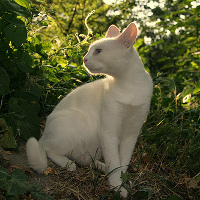
| There has long been debate as to whether the white Van is a Van or a Turkish Angora. Some breeders have been crossing them with Turkish Angoras for many years. Others have continued to breed them exclusively with their patterned Vans, with no obvious alteration to the Van breed. Research is underway in the USA to determine whether the Van is genetically the ancestor of the Turkish Angora. The question was put to genetic specialists as part of the study for TICA recognition of white Vans. A scientific answer should be forthcoming in 2007. However, after several years of study and show judgments, LOOF and TICA now recognize the white Van (formerly called Van Kedisi) as a simple color variant of the Van Cat: genetically, a white Van carries the color and markings inherited from its parents or ancestors under its white coat, and although its color is surprising or quite rare, it has exactly the same morphology and character as Vans whose body carries the “Van marking”. Their eyes can be blue, amber or mint. A popular superstition claims that white Van cats with mint eyes are able to grant wishes. As a general rule, only one white parent and one patterned parent should be bred: as with most cat breeds, the risk of deafness in the offspring increases when two white parents are bred, especially if the kitten is blue-eyed, as blue eyes are associated with possible inner-ear degeneration in cats. Genetic research carried out by the University of California at Davis has reported the presence at very low frequency of the recessive allele responsible for the Sacré de Birmanie white gait in the Turc de Van. A specific genetic test exists to detect the Burmese gantage gene. |
Head |
||
Cranial region |
||
Head |
From the front, the head is slightly longer than it is wide, forming a rounded triangle. Males have wider heads than females. | |
Facial region |
||
Forehead |
The forehead is rounded and the nose slightly arched. | |
Cheeks |
The cheekbones are prominent. | |
Eyes |
The eyes are large and walnut-shaped, set at a slight angle. They are blue, gold or minnow. Green is tolerated. | |
Ears |
Medium to large, set high on the head with a rounded tip and broad base. | |
Body |
||
Generality |
The body is long and strong, with powerful muscles. | |
Tail |
| Medium-length, plume-like and well furnished. |
Limbs |
| The legs are of medium length, with strong musculature. | ||
Forequarters |
||
Generality |
The forehand is particularly well developed and wider than the hindquarters, especially in males. | |
Hindquarters |
Feet |
| The feet are round, with tufts of hair between the toes. |
Coat |
||
Coat and texture |
The coat is medium-length, cashmere-soft and with as little undercoat as possible. As Lake Van is located in a region of extreme temperatures, the cats have developed a coat that becomes thick in winter with a wide ruff and a bottle-rinse tail, which falls off in hot summers and gives the impression of not being a semi-long-haired cat. Solid and van subjects are accepted. The standard allows one or more spots on the body, as long as there is no more than 20% color and the cat does not give the appearance of being bicolored. Although the classic Vans color is red tabby and white, the color on head and tail can be any of the following: red, cream, black, blue, tortoiseshell, tabby or not. Solid whites are preferred to Van whites by people in the Van region, and throughout Turkey in general, because they are rarer than the two-tone variant. It is the maximum expression of the piebald white gene that gives the cat this appearance. This gene appears in several different species, such as the horse and the royal python. It is also present in common domestic cats. A cat with these color patterns, but which is not authenticated or native to the Van region, is called a Vanalike. |
|



 English (United Kingdom)

Comments