|
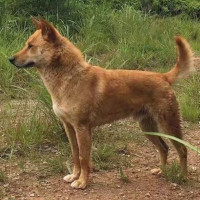
Tugou literally means "earth dog" in Chinese. It is a diverse group of dogs originating in China, still widespread today. The Chinese Shepherd Dog, the Chongqing Dog, the Liangshan Greyhound, the Taiwan Dog, and the Xiasi Dog are among the local breeds and varieties recognized as tugou. The term "tugou" does not refer to a single breed, but rather a collection of indigenous Chinese rural dogs, often called Chinese field dogs. These dogs are renowned for their hardiness, adaptability, loyalty, and working ability. They are characterized by their erect ears, almond-shaped eyes, and sickle tail. The tugou (also known as the Chinese Shepherd Dog) is considered a primitive spitz-type dog. Ancient local breeds with great genetic diversity, it is the ancestor of breeds such as the Shar Pei and the Chongqing Dog. Prized for its intelligence, fearlessness, and keen guarding instinct, it proves to be a family protector and a versatile hunter.
Tugou are thought to have descended from gray wolves and to have been domesticated by the Han Chinese after their migration. They are now widespread throughout China. Tugou exhibit significantly greater genetic diversity than other breeds, suggesting they may be a basal group related to the divergence between dogs and wolves. Tugou are the ancestors of ancient Spitz breeds such as the Shar-Pei and Chow Chow. They sometimes have black, blue, or spotted tongues, just like Chow Chows and Shar-Pei. Their size and coat can vary considerably, like many village dogs. Among the Tugou variants are the Wuhong and Wuhei dogs (meaning "five red and five black").
|




 English (United Kingdom)

Comments